

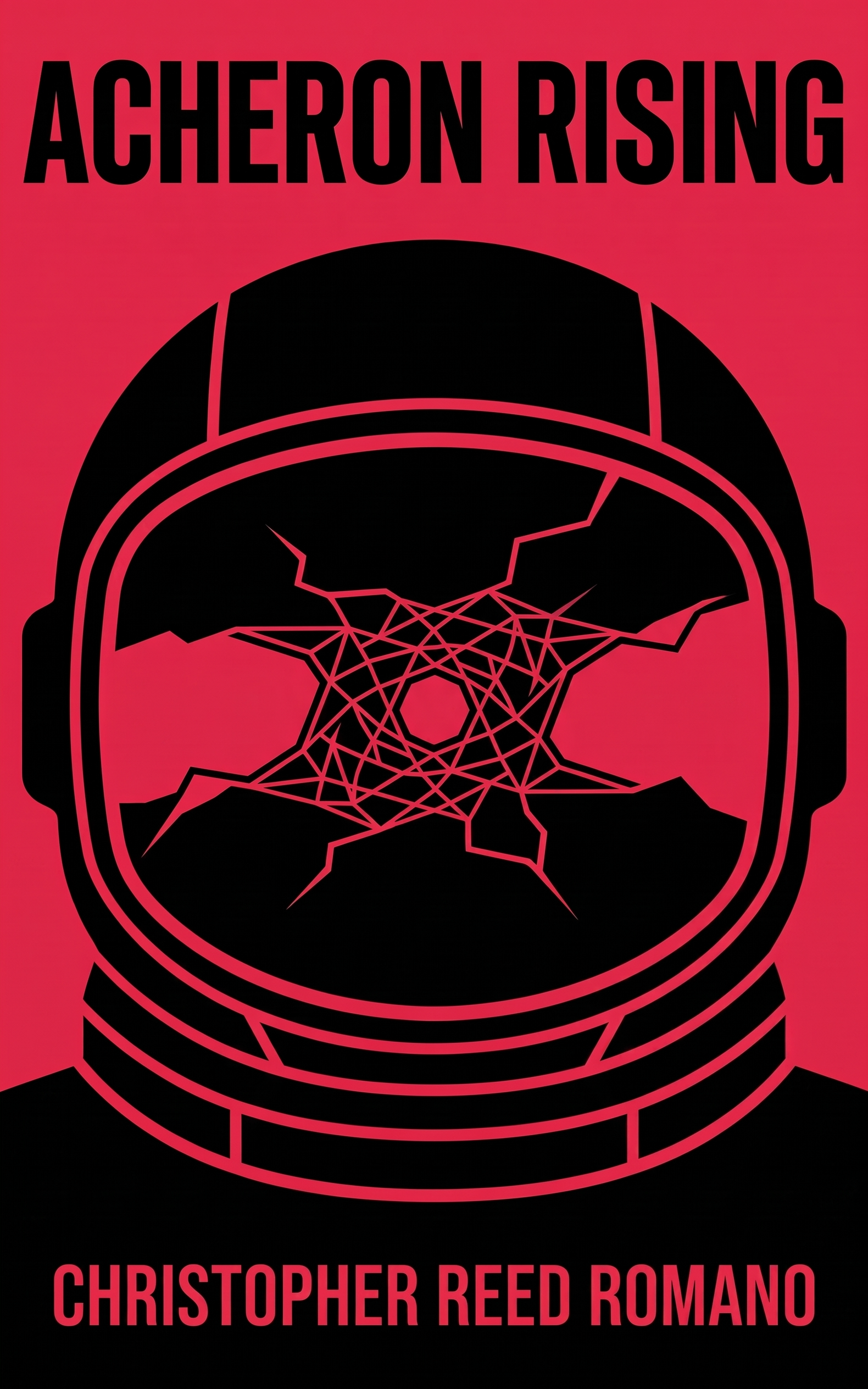
Acheron Rising
by DarkBoyManoGaming Romano
Deep in the Outer Rim, a secret black-site silent for decades ignites a system-wide nightmare. When sensor specialist Yael Montás escapes the destruction of Roche-Salvação, she brings more than trauma with her—she carries a terrifying, non-local neural link to the Acheron Strain. This invasive bio-cybernetic entity does not merely kill; it assimilates machinery, flesh, and code into something entirely alien. Rescued by the crew of a battered freight-hauler, Yael’s terrifying connection becomes humanity’s only defense as a Tri-Faction Cold War between Earth, Mars, and the Outer Rim explodes into open conflict. Across the solar system, shadow operatives and military commanders scramble to weaponize or destroy the anomaly, completely blind to its true purpose. As the infection anchors itself in the frozen infrastructure of the outer planets, Yael and a desperate crew must expose the truth before the entity completes its final, catastrophic transformation. In this sprawling military sci-fi thriller, Christopher Reed Romano delivers an unrelenting tale of political deception, cosmic horror, and the terrifying cost of human ambition.
- Science Fiction
- Horror
- Thriller
- Military Sci-Fi
- Space Opera
- Alien Contact
Chapter 1
The tank hummed at a frequency Maren Solberg had stopped consciously hearing three weeks ago, but her body still counted it, the way a heart counts a pulse it no longer bothers to announce. She sat with her chin propped on one knuckle, watching the specimen suspended in its bath of chilled electrolyte gel, and thought, not for the first time, that whoever had named this place Roche-Salvação had possessed either a cruel sense of humor or an unusually accurate one. Salvation Rock. A hollowed-out chondrite fragment three hundred kilometers past the last charted Syndicate claim marker, spun into a habitat by men who had wanted no one watching what they built inside it.
She had wanted the same thing, once she understood what had been pulled out of the ice.
The sample rotated slowly on its cradle, a fist-sized mass the color of an oil slick under sodium light, threaded through with filaments that caught the observation lamps and returned them in colors that didn't belong to any spectrum she'd been trained to name. It had come up out of a drill core taken from a companion body eleven months ago, a stray chunk of something that had drifted in from beyond the last reliable orbit anyone bothered to chart, and for the first four months it had done nothing at all. It had simply sat in its container like a lump of tar, inert, patient, giving her technicians nothing but baseline readings and long stretches of boredom.
Then, six weeks ago, it had started to grow.
Maren pulled the tablet closer and scrolled back through the last cycle's density curve, watching the line climb in a way that no longer fit any model her team had built. The mass had roughly tripled since the quarter began. It should not have been able to. There was no obvious nutrient uptake, no measurable metabolic signature that matched any biology she or anyone at Praxis-Halberd Biodynamics had ever cataloged, and yet cell density inside the tank kept rising, and the filament network kept branching, elegant and patient as frost spreading across a window.
"You're doing something," she said quietly, to the tank, to the thing suspended in it. "I just haven't found the mechanism yet."
She leaned closer to the acrylic, her breath leaving a brief circle of fog that shrank instantly in the dry climate control. Her fingers adjusted the optical magnification dial on her console by a fraction of a millimeter, tracking a sub-surface filament without blinking, her focus narrowed entirely to the cell wall. Her ex-husband had once told her, during the divorce proceedings and not kindly, that she loved her research the way other people loved dogs, which was to say uncomplicatedly and past the point of good sense. He hadn't been wrong. She had simply decided a long time ago that being right about the wrong things was still a form of being right.
The lab door slid open behind her with its characteristic shudder, the pneumatics on Roche-Salvação chronically starved of proper maintenance parts because everything requisitioned for this site had to move through three shell companies and a Syndicate shipping broker before it arrived, if it arrived at all. Priya Chandrasekaran came in with a tablet clutched to her chest and an expression that told Maren, before a single word was spoken, that something in the data had frightened her.
"Doctor Solberg." Priya was twenty-six, sharp, and had the particular anxiety of someone who had signed a very generous nondisclosure contract and was beginning to suspect the money hadn't been generous enough to cover what she'd actually be asked to witness. "You should look at the containment telemetry. The seal integrity readings on Bay Three just did something I can't explain."
"Show me."
Priya turned the tablet around. The graph there was nothing dramatic to an untrained eye, a small stutter in the pressure differential across the containment membrane, the kind of noise that on any other day Maren would have attributed to a sensor drift and logged for later recalibration. But she had spent six weeks watching this organism, and she had learned that it never did anything without a reason she simply hadn't identified yet.
"When did this start?"
"Nineteen minutes ago. It's already self-corrected twice. The system logged it as transient."
"The system is wrong." Maren was already standing, already moving toward the interior hatch that led from the observation lab into the specimen bay proper, her joints protesting the sudden urgency in the low, station-standard half-gravity that always made her feel like she was walking through syrup. "Pull up the acoustic sensors. If it's manipulating the membrane, there'll be a resonance signature, even if it's below what the environmental package flags."
"Manipulating." Priya said the word like it tasted bad in her mouth. "You think it's doing this on purpose?"
"I think purpose is a word we don't get to use yet," Maren said, though even as she said it she felt the lie in it, small and comfortable, the kind she'd been telling herself for weeks now every time the readings did something that had no business happening in a fragment of inert, alien tar. "I think we log everything and we don't touch a single control until we understand what we're looking at."
They were not going to have that luxury. She felt the sudden surge of adrenaline sharpen her senses, her gaze snapping back to the readouts as the numbers began to cascade out of parameters.
The specimen bay was a squat cylindrical chamber bored into the asteroid's rock mantle and lined with containment polymer, three redundant membranes between the tank and the rest of the station, each one rated for pressures and temperatures that had nothing to do with what actually threatened this place. Maren had signed off on that design herself, had told the Syndicate procurement liaison who oversaw the black budget that the specimen was biologically inert and posed no more risk than a jar of pond scum. She had believed it, mostly, right up until the moment she stepped through the hatch and saw that the tank's internal gel bath had gone the color of a bruise.
"Oh," she said, very softly, the sound an academic makes when a hypothesis she has been quietly nursing finally produces evidence. "There you are."
The mass inside the tank had unspooled. What had been a compact fist-sized lump six hours ago when she'd last checked it in person now spread across nearly a third of the tank's interior in a lattice of black filament, thinner than hair, branching and rebranching in patterns that made her think, absurdly, of mycelium photographed through an electron microscope, except that mycelium didn't pulse, and this did, a slow peristaltic ripple that traveled along each strand in sequence, like something breathing through a network instead of a lung.
"Doctor." Priya's voice had gone thin. "The membrane seal on the primary containment ring. It's reading zero-point-two millibars under spec."
"That's within tolerance."
"It's climbing."
Maren watched the readout over Priya's shoulder, the number ticking upward in increments too small to alarm anyone who hadn't spent the better part of two months learning to distrust every small number this thing produced. She thought about the drill core it had come out of, the notes from the extraction team describing a companion body that had shown no radiological signature, no organic chemistry that should have produced anything like this, and she thought, as she often did in moments like this, that the universe had apparently decided the rules everyone had agreed on didn't apply out here, past the edge of the charts, in the dark between the last claim marker and whatever came next.
Then the first membrane ruptured.
It didn't fail the way Maren had modeled containment failures failing in her head across a dozen contingency briefings she'd delivered to Syndicate overseers who cared more about liability exposure than actual danger. There was no explosive decompression, no violent tear. The polymer simply thinned in one localized patch near the tank's base, went translucent, and then went soft, the way ice goes soft in the moment before it becomes water, and the black filament network reached through the gap it had made for itself with a patience that Maren, even then, standing three meters away with her mouth slightly open, recognized as more frightening than violence would have been.
"Get the emergency team," she said, and her voice came out steadier than she felt, which surprised her enough that she noticed it happening. "Now, Priya. Go."
Priya went. Maren did not.
She told herself, in the three or four seconds she allowed herself to stand there instead of following her own instruction, that if she looked away now, humanity would lose its only record of the species' defining biological turning point.
All of that was true. But her reflection in the viewport stayed motionless, her pupils fixed on the white hairline fractures spreading across the secondary acrylic. She did not take a step back. She did not check the emergency seals on her collar. Her thumb rested against the tablet edge, steady, as the dark filaments inside pressed flat against the glass, searching for a seam.
The filament network found the base of the containment stand, a support structure of aluminum alloy and embedded sensor cabling, and it did not simply grow around the metal the way a vine grows around a trellis. It went into it. Maren watched threads finer than sewing needles slide between the crystalline grain boundaries of the alloy itself, watched the metal's surface bloom with a faint dark discoloration that spread outward from each point of contact like ink released in water, and somewhere in the analytical part of her mind that never quite stopped running even when the rest of her was frozen with something that wasn't quite fear yet, she understood that she was watching a biological system consume a technological one and use it, immediately, as raw material for its own expansion.
"That's not possible," she said aloud, to no one, because it plainly was.
The support stand's status LED, a small green diode that had blinked reassuringly for six weeks to indicate nominal structural load, flickered and then began pulsing in the same slow rhythm as the filament network's peristaltic ripple. Not failing. Synchronizing.
The klaxon started a half second later, station-wide, the low double-tone that Roche-Salvação's designers had chosen because it was cheap and effective and because nobody had ever expected to need it for anything worse than a pressure fault in the hydroponics ring. Red emergency lighting bled into the white observation glow, and somewhere down the corridor Maren heard boots, several pairs, moving fast, and a voice she recognized as belonging to Voss, station security, shouting something about lockdown protocol that the walls swallowed before she caught all of it.
She backed toward the hatch but didn't leave through it, not yet. She had her tablet raised, recording, her thumb finding the manual annotation key by pure muscle memory while the rest of her stared at the tank as the second containment membrane began to fail in the same soft, unhurried way the first one had.
"Doctor Solberg!" Voss came through the corridor hatch in a rush, sidearm drawn, a weapon that Maren understood immediately would do nothing useful against whatever was actually happening in this room, though she didn't say so. He was a broad man, ex-Syndicate militia, the kind of security contractor who had signed on to this posting expecting bored months guarding equipment against nothing more exotic than pirates or corporate espionage, and his face had the particular blankness of someone whose training had prepared him for every threat except the one currently in front of him. "We need to get you out. Sealed bulkhead's coming down on this section in ninety seconds, station protocol, it's automated, nobody can stop it now."
"Good," Maren said. "Sealing it in is exactly what we should be doing."
"Doctor."
"I'm coming." She was not moving, not yet, her eyes on the tank, on the way the black lattice had begun to climb the interior wall of the specimen bay itself, threading itself into the seams between polymer panels with the same unhurried, structural intimacy it had shown the aluminum stand.
Then the third membrane went, all at once this time, not soft failure but a wet tearing sound like a great deal of paper ripping in the same instant, and the gel bath that had suspended the specimen for six weeks sheeted out across the deck in a black-purple wave that moved faster than gravity alone should have carried it. It didn't spread the way a spilled liquid spreads. It reached, the leading edge of it fanning outward in exploratory tendrils the way a hand splays its fingers to feel for a wall in the dark, and one of those tendrils found the toe of Voss's boot before either of them had time to register what was happening.
He screamed. Maren would remember, later, at length, in the quiet hours she would have far too much time to fill with memory, that the scream had a strange quality to it, that it started as pain and became something else entirely inside of two or three seconds, a sound less like a man in agony and more like a man trying to speak two languages at once and failing at both.
The tendril didn't simply burn or corrode. It integrated. She watched, because she could not stop herself from watching, as the black filament crept up the seam of his boot and through the fabric of his trouser leg, and where it touched skin it did not tear the skin open the way she expected, the way every prior contact with biological tissue in her lab notes had documented. It slid beneath it. The skin at his ankle went the color of a week-old bruise, then darker, then took on a faint sheen, as if a very thin layer of oil had been worked into the flesh from underneath, and cabling, she would swear later that she saw cabling, threadlike structures the width of capillaries but with a matte gunmetal luster, rise up through the surface of his calf like something growing toward the light.
Voss went down. He did not go down cleanly. His leg buckled at an angle that had nothing to do with the joint's design, and even as he fell he kept trying to bring his sidearm up, kept trying to do his job, some part of his training refusing to accept what the rest of him already understood, and Maren stood in the hatchway with her tablet raised and recorded every second of it because some part of her, the part that had built a career on being the person willing to look when everyone else flinched, could not make herself turn away.
"Get back," Voss managed, his voice wrecked now, wet, wrong. "Doctor, get the fuck back—"
The bulkhead alarm chimed its final ten-second countdown. Maren finally moved, stepping backward through the hatch, and the last image she carried with her as the heavy door began its slow automated slide was of Voss on the deck, one arm still raised toward her, his fingers already gone the wrong color, already fused at the knuckle in a way that suggested bone remodeling itself in real time, and the black lattice climbing him the way frost climbs a windowpane, patient, total, indifferent to the fact that a man was dying inside it.
She did not scream. She simply logged her silence amid the alarm's blare and filed it away, relying on the same cold detachment that had kept her alive through every previous catastrophe.
The bulkhead sealed with a heavy pneumatic thud that she felt in her teeth. Through the small reinforced port set into the door, she watched the specimen bay's lighting flicker, gutter, and then take on a dim reddish cast that had nothing to do with the emergency system, a light that seemed to come from within the black lattice itself, threading now across the ceiling, the walls, the ruined tank, and the shape on the floor that had, ninety seconds earlier, been a man complaining about overdue equipment shipments.
Corridor lighting stuttered around her. Somewhere above, in the section that housed the station's primary environmental processors, she heard something that sounded like tearing metal, distant and enormous, and the klaxon's rhythm changed, the double-tone replaced by a rapid stutter that she recognized from the emergency manual as a full station lockdown, every internal bulkhead sealing in sequence, every airlock cycling to hard vacuum protocols whether or not anyone was on the wrong side of them.
She should have run. She knew she should have run, and some animal part of her legs had already started carrying her down the corridor toward the transit shaft that led to the habitat's spin-ring, toward the docking bay, toward anything that wasn't this, but she kept the tablet raised, kept recording, because the corridor cameras were about to lose power in the sections closest to the breach and she understood, with a clarity that cut through even the roaring in her ears, that whatever happened in the next ten minutes might be the only unfiltered data anyone would ever have on what this organism did when it was allowed to act without restraint.
The lights along the western spur went out in a traveling wave, section by section, not failing randomly but in sequence, the way a string of dominoes falls, and Maren understood before she saw the confirmation on her tablet that the lattice had already reached the power conduit that ran beneath the deck plating, had already found the station's own nervous system and begun rewriting it according to whatever logic governed its growth. Emergency lighting kicked in behind her, casting her shadow long and warped against the corridor wall, and from somewhere down the western spur she heard voices, several of them, panicked, overlapping, the particular chaos of people who had spent the last several weeks believing themselves safe inside triple-redundant containment now discovering all at once that the redundancy had been a story someone told them to help them sleep.
A woman's voice, one of the junior xenochemists, Okonkwo-Reyes, calling for someone to open a hatch that had already sealed. A man's voice under her, lower, less coherent, saying something Maren couldn't parse over the alarm. She thought, distantly, that she should go toward those voices, that there might be something she could do, some containment protocol not yet exhausted, some piece of expertise that only she possessed that might buy those people another hour of life.
She went the other way.
She told herself it was because the transit shaft was the only route that still showed green on her tablet's schematic, the only corridor not yet flagged by the station's dying network as compromised. But by now she had stopped bothering to pretend to herself. She was built to observe, to record, to survive long enough to understand—and if that meant leaving Okonkwo-Reyes and whoever was down there to whatever the lattice had planned, she had made that choice before her feet even finished deciding to run.
The transit shaft's status light blinked amber as she reached it, not yet compromised but close, and she keyed the manual override with hands that had finally, belatedly, started to shake. Behind her, deeper in the station, something enormous groaned, metal complaining under a stress it had never been engineered to bear, and she caught, in the reflection off the shaft's polished bulkhead, a flicker of movement that might have been Okonkwo-Reyes running, or might have been something that had already stopped being Okonkwo-Reyes, backlit by that same dim reddish glow the lattice carried with it wherever it spread.
She didn't look directly. She had learned, in the space of maybe four minutes, exactly how much direct observation she could afford, and she had reached the edge of it.
The shaft door cycled open. She stepped through into the narrow transit car, slapped the emergency call panel, and felt the whole compartment lurch into motion along its rail, carrying her up and outward toward the spin-ring where, if the schematic could be trusted for even another ninety seconds, the docking bay and its handful of small craft still sat untouched.
Through the car's single narrow viewport, she caught a last, brief look back down the length of the station's central spine, the long axis of Roche-Salvação stretching away into rock and shadow and dying emergency light. Even from this distance, even through the scratched polymer of the viewport, she could see it: threads of that dim red-black glow tracing along the station's ribs like veins mapped under thin skin, following the exact architecture of the power and data conduits the engineers had laid down decades ago for entirely different purposes, and the whole structure seemed, for one impossible moment, to breathe.
Somewhere far below, another bulkhead gave way with a sound like a held note breaking.
Maren pressed her palm flat against the viewport, less for balance than because some part of her needed to touch something solid, something that hadn't yet been rewritten, and she watched Roche-Salvação's dying architecture pulse once, slow and total, the way the tank had pulsed six hours ago when it had still been small enough to fit in her hand, and she thought, with a horror that arrived late and thin and strange, layered awkwardly over something that felt uncomfortably close to wonder: it isn't dying at all. It's only just been born.
Chapter 2
Sensor Bay Seven smelled like burnt insulation and cold coffee, and Yael Montás had logged nine hundred and forty consecutive shifts inside it without once thinking the room might kill her. That changed at 0347 station time, when the klaxon's double-tone stuttered into something else entirely, a rapid clattering pulse that her hindbrain understood …