

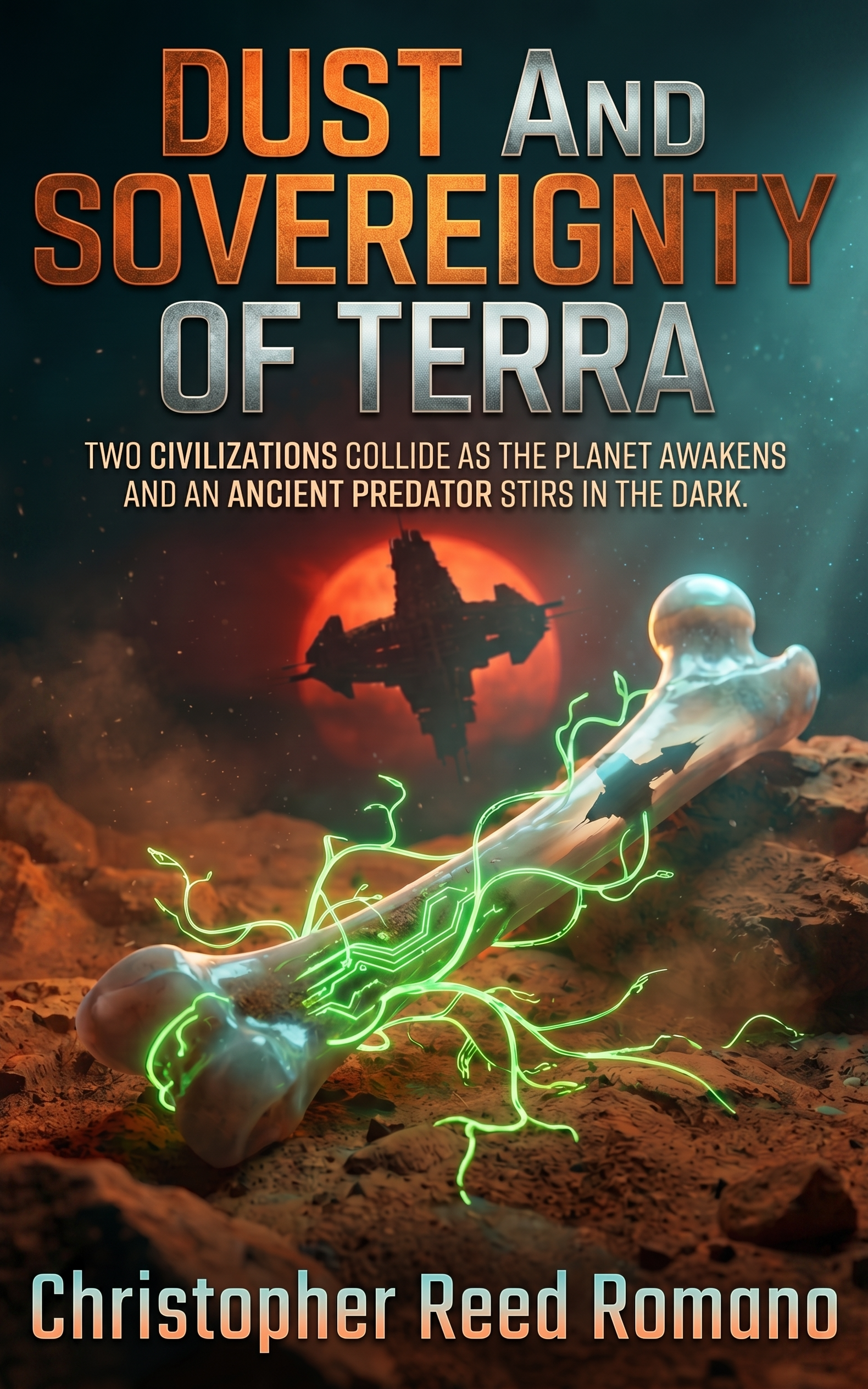
Dust And Sovereignty Of Terra
Two Civilizations Collide As The Planet Awakens And An Ancient Predator Stirs In The Dark.
The war for the surface is over, but the battle for the atmosphere has just begun. Earth is a fractured landscape of lethal storms and erratic rebirth. While the surface survivors cling to a fragile existence, the Sovereignty—an exiled fleet from the stars—hovers in orbit, hungry for a home they haven't seen in generations. Kaelo Hesperus stands at the center of the storm, his very biology fused with the planet’s awakening root network. He is the bridge between two worlds, but the bridge is cracking. When a cryptic signal broadcasts from a derelict deep-space outpost, it reveals the location of the Aion Core—the only technology capable of stabilizing the planet’s volatile climate. To save humanity, Kaelo must lead a desperate joint mission into the cold vacuum of the outer solar system. But they aren't alone. Rogue factions on the ground will stop at nothing to sabotage the alliance, and secrets buried in the Forbidden Archives suggest the original exodus was never a retreat. It was a flight from something far worse. As Kaelo’s humanity slips away, he realizes the mission isn't just a race for power—it's an accidental invitation to an ancient predator waiting in the black. In this epic tale of survival and sovereignty, the greatest threat isn't the vacuum of space, but the shadows we brought with us.
- Science Fiction
- Military Sci-Fi
- Space Opera
- Post-Apocalyptic
- Dystopian
The Aegis-7 Telemetry
Day 01 — Month Seven, Year One of the Accord of Shared Governance
07:30 Local Time — Sovereignty-Prime, Earth / Scout Vessel Vanguard-4, Main Asteroid Belt
Kaelo Hesperus stood at the eastern rampart of Sovereignty-Prime and watched the sky do something it had not done in his lifetime. The dawn light was climbing through layers of thinning haze, and for the first time since the terraforming arrays had come fully online, the color at the horizon held for more than a few minutes before the old brown murk swallowed it again. Pale gold. Then, briefly, something that was almost blue. He had learned not to trust it yet. The atmosphere still lied more often than it told the truth, and six months of peace had taught him that the sky's honesty was the last thing to come back.
Below him, the settlement was waking the way it always woke now, in the overlapping rhythms of two peoples who had not yet decided how much of each other's habits they were willing to keep. Surface crews moved along the terraced growing beds with hand tools and the slow patience of people who remembered famine. Fleet technicians in gray coveralls threaded cable through the retrofitted hull sections that had become Sovereignty-Prime's outer wall, salvaged from three decommissioned corvettes and welded into something that was not quite a fortress and not quite a farm. Garrick's engineers called it the Seam. Nobody had corrected them.
Kaelo's scar was quiet. It had been quiet for weeks now, a thin line of dormant crystal along his jaw and collarbone that no longer ached when the weather shifted, that no longer lit at the edges when he passed too close to a working relay. He had started, against his better judgment, to think of the quiet as something he might be allowed to keep.
Three hundred million kilometers away, in the cold dark between Mars and Jupiter, Pathfinder Soren Kest sat in the cramped forward cockpit of the long-range scout Vanguard-4 and watched a signal do something it had no business doing.
The Vanguard-4 was six weeks into a routine deep-field patrol, the kind of assignment Soren had flown a dozen times since the Coalition had restarted its atmospheric monitoring program, mapping debris drift and confirming that nothing larger than a fist was on a collision vector with the reclaimed orbital platforms. It was slow work. It was supposed to be slow work. He had a co-pilot named Ressa Dahl in the seat beside him, and between them they had developed a rotation of naming the more interesting rock formations after old fleet officers nobody liked, which was as close to entertainment as the Belt offered.
The instrument panel chimed at 07:19 ship-time with a signal classification alert that Soren had never seen the scout's systems generate before, not in four years of scouting.
"That's not a debris ping," Ressa said, leaning across to look at his display. "That's a comm header."
"It's not a comm header either." Soren pulled the raw waveform up and watched it scroll, a tight braided pattern of pulses that didn't match anything in the scout's threat library or its civilian traffic archive. "Tachyon carrier. Encrypted. Coming from bearing zero-four-one mark eleven, and that bearing puts it—" he checked the nav overlay twice before he trusted it, "—inside the Aegis-7 debris field."
"The dead solar hub."
"The dead solar hub," Soren agreed. Aegis-7 had been listed in the Coalition's asteroid belt survey as a pre-cataclysm terraforming relay, non-functional, catalogued and forgotten in the same breath eighteen months ago when the survey drones had first mapped its silhouette against the belt's rubble. Nothing about it had moved, radiated, or transmitted in all that time. It was supposed to be as dead as the rock it was tangled in.
He angled the Vanguard-4's high-gain array toward the bearing and started a passive intercept, the safest kind, the kind that wouldn't announce the scout's position to whatever was doing the transmitting. The signal strengthened as the array locked, and the waveform on his screen sharpened into something with structure, something with intention behind its shape.
"Running it through the pre-cataclysm linguistic library," he said, mostly to keep Ressa updated, mostly to keep himself steady. His hands had gone very still on the console. "Give me a minute."
The minute took closer to four, because the scout's onboard processor kept losing the decryption thread every time a solar radiation burst rolled through the Belt, and out here, unshielded by any planetary magnetosphere, the bursts came every few minutes, indifferent and enormous. Each time the corruption hit, Soren had to restart the pass from the last clean checkpoint, watching the confidence percentage climb and then collapse and then climb again, the way a man watches a wound that won't quite decide whether it's closing.
When the pass finally held past ninety percent, he sat back and read the result twice before he said anything out loud.
"Ressa. Look at this."
She looked. "That's Engineer terraforming syntax," she said. "That's the same frequency structure as the seedbank archives. The ones Director Thorne-Voss's people found under the old Spire."
"It's not just that structure. It's an exact match." Soren dragged the waveform into a side-by-side comparison, the archived terraforming distress frequency on one track, the live Aegis-7 signal on the other. They lined up close enough that the overlay function drew them as a single line, a whisper from the deep past reaching across three hundred million kilometers of vacuum to say, still, after everything, that it was alive.
But there was a second layer under the first, and it was the second layer that made the hair rise on the back of Soren's neck. The terraforming frequency was riding inside a carrier wave that had nothing gentle about it, a hard, fast, repeating structure that pushed and pulled at the older signal the way a parasite pushes and pulls at a host it hasn't finished digesting. When Soren isolated the carrier and ran it against the fragment libraries the fleet still carried from before the exile, the closest match the system could offer came back flagged in red, a classification he had only ever seen in decommissioned tactical manuals.
Automated resource requisition protocol. Biological sequencing template demand.
"That's a harvesting request," Ressa said quietly. "Something out there is asking for genetic material. Human genetic material, if the sequencing tags mean what I think they mean."
"Or it's asking for confirmation that human genetic material still exists to take." Soren drew a slow, measured breath through his nose, squaring his shoulders against the harness to anchor himself against the console. Inside, something colder than the cockpit's environmental controls had settled into his chest and was not moving. "Either way, that's not a dead relay talking. That's something using a dead relay's voice."
He didn't wait for Ressa's opinion on what to do next, because there was only one thing to do next. He opened the long-range tightbeam and began packaging the raw telemetry, the waveform captures, the decryption logs, the failed passes alongside the successful one so that whoever reviewed this on the other end would see exactly how the signal had fought to stay hidden. He tagged the packet priority-one, fleet-and-surface joint distribution, and addressed it to Sovereignty-Prime command and, on a line he added without discussing it with anyone, to Kaelo Hesperus directly.
"You think he needs to see this personally?" Ressa asked.
"I think his scar's going to see it before he does," Soren said, and transmitted the packet before he could second-guess the addressing.
The signal left the Vanguard-4 at the speed every signal left every ship, which was to say, at the speed of light, which felt instantaneous everywhere except across the distances that separated planets from their asteroid belts. Between the Vanguard-4's transmitter and the receiving array at Sovereignty-Prime lay eighteen minutes and twenty-four seconds of empty space, a gap of time in which the telemetry simply existed between two points, unwitnessed, unconfirmed, a message with no one yet to receive it.
Kaelo was still on the eastern rampart when the alert reached the command deck below him, and he felt it before anyone came to find him.
The scar along his jaw woke the way it always woke, not gradually but all at once, a hard pulse of warmth that ran from the hinge of his jaw down across his collarbone in a line of pale amber light visible even in the strengthening dawn. He put his hand to it out of old habit, and felt the light answer his palm the way it always did, rising brighter under contact.
But this was not the resonance he knew from touching a root cluster or standing near a working relay. This carried a rhythm underneath it, a beat inside the beat, structured and foreign, and it took him three full seconds standing alone on the rampart to understand what his own body was telling him. Something out beyond the reach of the restored sky had reached back down through the planet's own network and touched the same signature the network had always answered to. His signature. The one it had carried in its memory for two thousand years, waiting for a hand that fit the lock.
"Commander." One of the surface-fleet liaison officers, a young man named Petrov who had transferred from the old signal corps and still hadn't learned to knock properly, came through the rampart door at a near run. "Priority telemetry just cleared decryption, sir. Long-range. It's addressed to you personally."
"Source," Kaelo said. His voice was still his own then, still whole, still capable of carrying more than a syllable at a time, and he used all of it sparingly out of a habit that predated the scar by years.
"Scout Vanguard-4. Main Asteroid Belt. Pathfinder Kest's ship." Petrov held out a data-slate, his hand not quite steady. "Sir, you should look at the waveform before you read the summary. I don't fully understand what I'm looking at, but Syllis is going to want to."
Kaelo took the slate and looked at the waveform, and the scar under his jaw brightened another degree in direct, physical answer to the pattern scrolling across the screen. It was not coincidence. He had spent enough of his life being suspicious of coincidence to recognize, in his own body, the difference between an old ache and a live signal. The crystalline tissue in his jaw and collarbone was resonating with the exact frequency structure displayed on the slate, syllable for syllable, the way a tuning fork answers another tuning fork struck across a room. Whatever was transmitting from Aegis-7 was not simply broadcasting into open space. It was calling on something that ran through Earth's own mantle, through the root network Lyra had bound herself into, through him, and the calling was specific enough that his body had recognized the shape of the question before his mind had finished reading it.
He read the analysis summary Soren had appended, the terraforming frequency match, the overlaid carrier wave, the classification flagged in red. He read it twice, the second time slower, letting the words settle into the same place the number four had settled six months ago and never left.
Biological sequencing template demand.
"Get me Director Thorne-Voss," Kaelo said. "And get Syllis to the command deck. Full waveform, not the summary. They'll want the raw captures."
"Yes, sir." Petrov hesitated at the door. "Sir, if I can ask. Your—" he gestured vaguely at his own jaw, uncertain of the word. "It's glowing. Is that meant to happen with a comm signal?"
"No," Kaelo said, and left it there, because it was the truest thing he had to offer and he did not yet have the rest of the sentence.
He walked the length of the rampart toward the command deck stairs with the slate still in his hand, and the sky he had been watching only minutes before, that pale, tentative gold trying to become blue, seemed suddenly like a thing balanced on a very narrow edge. The telemetry had crossed three hundred million kilometers of dark while the scout continued drifting through Belt rubble, its crew unaware of whether their warning had landed or what waited on the far side of the silence. Kaelo understood, standing on the stairs with the scar's warmth spreading slow and certain down into his chest, that the signal lag was the least of the distances involved. Whatever had learned to speak in the dead relay's voice had been patient for a very long time, patient enough to wait through the entire war that had already been fought and won and paid for, patient enough to wait through six months of a peace that people were only just beginning to believe in.
It had chosen this morning to stop waiting.
Below him, on the command deck, the fleet's long-range array was already re-slewing to lock onto the Aegis-7 bearing directly, cutting out the relay delay where it could, hunting for a second confirming pulse. Kaelo reached the bottom of the stairs, pressed his palm flat against the cool metal doorframe to steady himself against the resonance still running under his skin, and stepped through into the low blue light of the deck, where every screen in the room had already turned to face the same dark patch of sky.
The Void Expedition Mobilizes
Day 02 — Month Seven, Year One of the Accord of Shared Governance, 13:15 Local Time — Sovereign Senate Chamber, Sovereignty-Prime, Earth The chamber had been an aircraft assembly bay once, before the war, and no one had bothered to make it look like anything else. The old crane rails still ran along the ceiling, unused now except to hang the banner…