

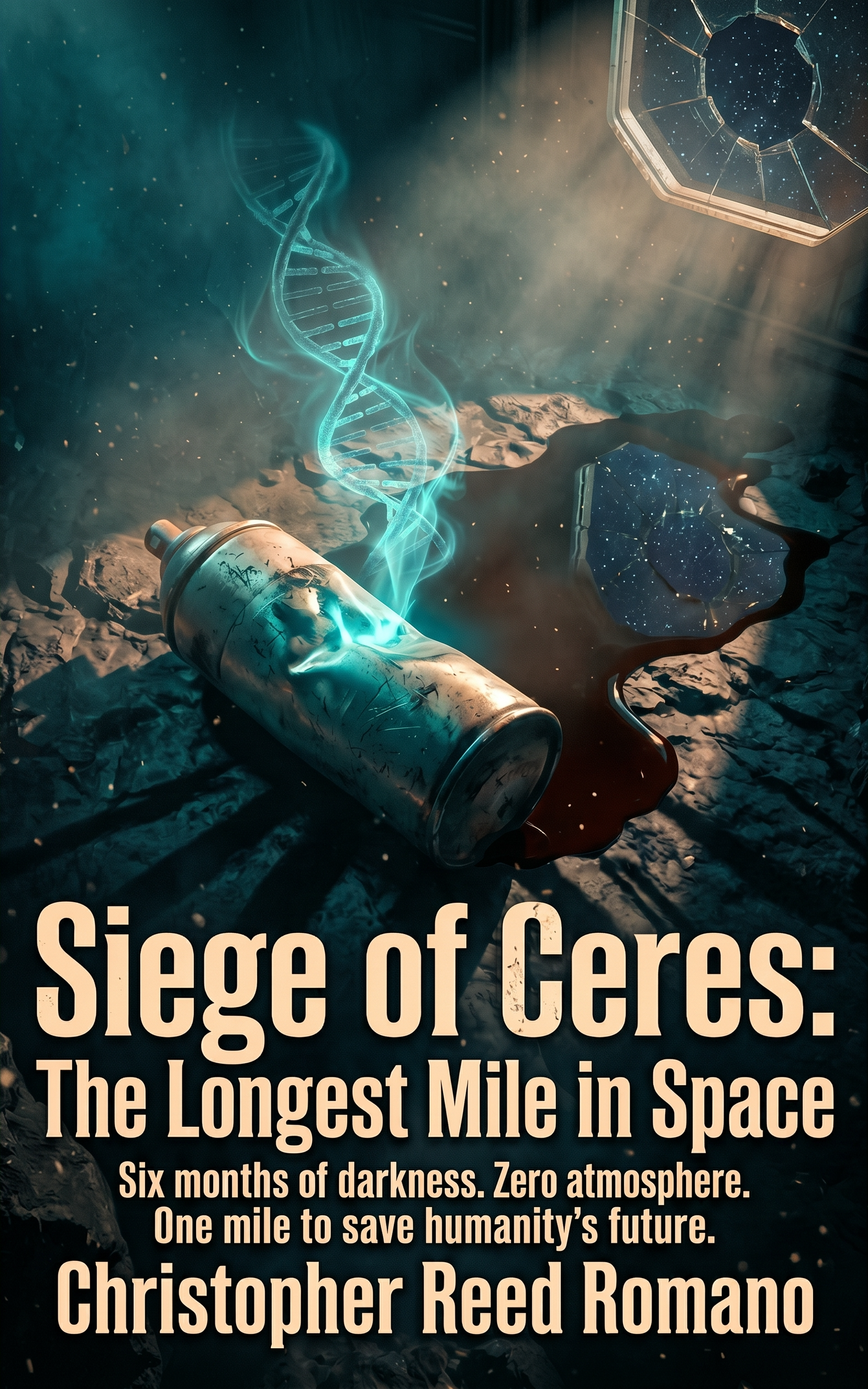
Siege of Ceres: The Longest Mile in Space
Six months of darkness. Zero atmosphere. One mile to save humanity's future.
by DarkBoyManoGaming Romano
Survival has a new depth. Deep within the asteroid Ceres, the air is thin, the heat is dying, and the war is just beginning. When the Terran Hegemony launches a brutal kinetic strike, the miners of Ceres are buried alive—trapped in a labyrinth of freezing maintenance tunnels with an elite boarding party closing in. Staff Sergeant Elias 'Kutter' Kovic never asked to be a hero. He’s a survivor, a man who knows the claustrophobic reality of fighting in the 'Longest Mile'—the final stretch of central shafts where a single stray bullet can vent a sector's worth of oxygen. Alongside a ragtag squad of 'tunnel rats,' Kovic must hold the line against a cold-blooded commander who views human lives as mere debris in the way of rare isotopes. As the siege stretches into months, the infrastructure of the colony begins to buckle. With starvation looming and the atmosphere bleeding out, the defenders of the Belt must choose between a quick death and a desperate, dirty fight for every inch of rock. In the crushing silence of space, the loudest sound is the heartbeat of the resistance. Christopher Reed Romano delivers a visceral, high-stakes military thriller that explores the true cost of defiance in the dark.
- Science Fiction
- Military Sci-Fi
The First Hammer
The patrol had been quiet for eleven minutes, which meant something was about to go wrong.
Kovic moved through Sector 4's maintenance corridor at a low crouch, one hand trailing along the cold steel of the conduit housing, the other resting on the grip of his sidearm. The ceiling pressed down to about five and a half feet here, forcing even his lean frame into a permanent hunch. Emergency lighting ran in amber strips along the floor seams, barely enough to read by, which was fine. He wasn't here to read. He was here to count: oxygen pressure, hatch integrity, the subtle vibration of the rock beneath his magnetic boots. He counted them the way other men counted breaths.
The asteroid had its own pulse. Forty-seven days into his rotation, he knew it well enough to feel when the rhythm was wrong.
He paused at junction 4-17 and pressed his palm flat against the outer hull plate. The steel was cold, as always, but the faint harmonic thrum of the ore processors two levels down was absent. They'd gone quiet three minutes ago. He'd noted it without comment. Now he noted it again.
Ceres didn't go quiet. The ore processors ran on a twenty-hour cycle, and shutting them down cost the mining consortium roughly four thousand credits per hour in lost throughput. Nobody shut them down voluntarily. Not for a routine patrol. Not for a shift change. Not for anything short of a catastrophic—
The first harpoon hit like a god's fist closing around the asteroid.
The deck lurched. Not the rolling shudder of a seismic event, not the gradual groan of a settling drift tunnel. This was a single, violent convulsion, the kind of impact that told your hindbrain it had made a terrible error in choosing to exist. Kovic's magnetic boots locked and held, but the shockwave still threw him shoulder-first into the conduit housing. A deep, resonant boom rolled through the steel around him, followed immediately by the high-pitched scream of a pressure alarm three sectors over.
Then the lights went red.
He was moving before the second impact hit, because he already knew what this was. He'd been briefed on the possibility during the initial blockade assessment six weeks ago. Kinetic harpoons. Terran Hegemony delivery vehicles, mass-accelerated from orbital distance, designed to punch through asteroid crust and anchor boarding pods to the interior framework. They didn't need to breach the hull cleanly. They just needed to crack it enough to give the pods a purchase point.
The second impact was harder than the first. The corridor flexed. An actual flex, the steel plates groaning apart at a seam joint near junction 4-19, a hairline gap that immediately began venting a thin white mist of condensing atmosphere. Kovic's suit alarm chirped once, a polite notification that the ambient pressure had dropped point-three PSI.
"Seal," he said, not to anyone in particular. Just a word to focus himself. He pulled a patch strip from his chest rig and slapped it across the joint. The adhesive grabbed. The mist died. He kept moving.
The internal comms crackled once, twice, and then produced nothing but static. Not the rolling interference of a damaged relay. The flat, total silence of a destroyed array. Someone had hit the comms infrastructure first, before the harpoons, which meant the kinetic strikes weren't the opening move. They were the second move. The first move had already happened, quiet and surgical, while he was walking his patrol and counting vibrations.
He reached junction 4-22 and found Specialist Javi Mendoza on the floor.
Mendoza was sitting with his back against the power relay housing, knees pulled to his chest, his diagnostic pad still strapped to his forearm and displaying a cascade of error codes in blinking orange. His eyes were fixed on the middle distance. His hands were pressed flat against his thighs, and Kovic could see the tendons standing out across the backs of his knuckles.
"Mendoza."
Nothing.
"Skeeter." Kovic crouched in front of him, getting his face in the kid's line of sight. "Look at me."
The eyes refocused. Slowly, like a camera adjusting from infinity to close range. Mendoza blinked twice, rapid and hard, and his mouth worked for a moment before sound came out. "The relay," he said. "I was running diagnostics on the secondary relay and the whole board just—everything spiked and then the lights—"
"Skeeter." Kovic's voice stayed level, quiet, the tone he used when he needed someone to receive information rather than generate it. "Breathe. In through the nose. Slow."
Mendoza inhaled. A jagged, slightly desperate breath, but a breath.
"Good. Now listen to me. Those were kinetic harpoons. The Hegemony is breaching. Comms are dark. We need to move to the secondary armory in Sector 4-C before the airlocks on the transition corridors are bypassed. Can you stand?"
A third impact hit while he was asking. This one was further away, somewhere in the upper crust by the sound and feel of it, but the vibration traveled down through the rock and came back up through their boots like a struck bell. A strip of emergency lighting above them flickered and died. Mendoza flinched hard, both hands coming up reflexively to cover his head.
"Hey." Kovic put a hand on the kid's shoulder, firm and steady. "That was upper crust, maybe Sector 2. We're not there. Focus on where you are. Can you stand?"
Mendoza looked down at his legs as if confirming their existence. Then he put his hands on the floor and pushed himself upright. His first step was unsteady, but his second was better. "Yeah," he said. "Yeah, I can stand."
"Good. Stay behind my left shoulder. Don't touch your pad unless I ask you to. If something ahead goes wrong, you go flat and you stay flat until I tell you otherwise. Understood?"
"Understood." A pause. "Kutter. The relay board. All the readings went wrong before the impacts. Like, wrong in a specific way. Sensor feeds dropping in a sequence. Someone was killing them in order."
Kovic had already reached the same conclusion. He filed it away. "Tell me when we're moving. Let's go."
The maintenance corridor that ran from junction 4-22 to the Sector 4-C armory was approximately three hundred meters of low ceiling, narrow width, and zero direct sightlines. Kovic knew every meter of it. He had walked it so many times in the past month that he could have navigated it blindfolded, which was fortunate, because the emergency lighting was failing in patches, leaving stretches of genuine darkness between amber pools. His boots clicked softly on the deck plating with each magnetic step. Behind him, he could hear Mendoza's slightly faster rhythm, the kid still burning adrenaline at a rate that wasn't sustainable.
"Slow your steps down," Kovic said, not turning. "You're clacking. Sound travels in here."
Mendoza slowed. Better.
They were sixty meters from the armory access hatch when the screaming started in the main thoroughfare above them.
The maintenance corridor ran parallel to and below Thoroughfare 4-Alpha, the main pressurized walkway that connected the residential nodes to the ore processing levels. Kovic could hear the sounds filtering down through the grating in the ceiling: the crack of weapons discharge, something heavier and more deliberate than small arms, a series of sharp, rhythmic detonations that he identified as door-buster charges. Then the screaming, which rose and cut off in a way that told him it had not ended naturally.
Mendoza stopped walking. "That's the main corridor. That's where the processing shift would be—"
"Keep moving." Kovic's voice was flat. Not unkind, just flat. The kind of flat that didn't leave room for a decision to be made.
"There are people up there."
"There are people down here too. Move."
He could feel Mendoza working through it, the arithmetic of conscience versus survival, and he let him work through it because there wasn't time to walk him across the bridge. The kid would have to cross it on his own feet or he'd be a liability for the rest of whatever came next. After two seconds, Mendoza started walking again. Kovic noted it without comment and kept his eyes on the corridor ahead.
The first drone came through the grating twelve meters later.
It was small, roughly the size and shape of a flattened fist, moving in the fast, jittering pattern of a programmed sweep rather than the variable motion of a human operator. Kovic recognized the model immediately. Hegemony TK-9 transition-zone clearer, equipped with a micro-flechette dispersal system and a thermal sensor that would spot their body heat if they stepped out of the conduit's shadow.
He went flat against the left wall and pulled Mendoza in behind him, pressing the kid into the narrow gap between a coolant housing and a junction box. He drew his sidearm and held it low, thumb on the safety, and watched the drone.
It moved down the corridor in a tight, looping pattern, its sensor array sweeping in short arcs. The thermal suppression from the conduit housing was doing its job. The drone passed within four meters of them, close enough that Kovic could hear the faint whisper of its rotors, and continued toward the junction behind them.
He waited until it was eight meters past, then pulled Mendoza out of the gap and moved fast toward the armory hatch.
"That's a TK-9," Mendoza breathed, just above a whisper. "That's not a civilian security model. That's military-grade. They brought military-grade clearance drones into the maintenance corridors."
"Yes," Kovic said.
"They planned this. The corridor access, the sensor sequence I saw on the relay board. They knew the layout."
"Yes."
"How do they know the layout?"
Kovic didn't answer that, because the answer would take more time than they had and would not improve their current situation. He reached the armory hatch and pressed his access card against the reader. The reader blinked red. Power disruption to this section. He pulled out a manual override key from his chest rig, inserted it into the mechanical bypass slot, and turned it twice.
The hatch groaned and released.
Beyond it, the short access passage to the armory was dark and intact. Kovic moved through it quickly, Mendoza close behind, and pulled the hatch shut. The locking mechanism engaged with a solid, satisfying click of steel tumblers.
He allowed himself one full breath in the dark.
Then he activated his helmet's low-light mode and assessed the armory door ahead.
It was intact. The secondary armory for Sector 4 was a standard Colonial Defense Force equipment cache: two meters by four, bolted to the inner rock face, with a hardened steel door rated for pressure differential up to fifteen PSI. The combination lock was mechanical, no electronic component, which meant the power disruption hadn't touched it. Kovic worked through the combination from memory and pulled the door open.
Inside the armory, two of the four equipment racks had been knocked from their mounts by the impact tremors. A crate of ammunition had split open and scattered its contents across the floor. One of the wall-mounted emergency oxygen canisters had been jarred loose and was rolling slowly in the low gravity, bumping softly against the rack supports. But the weapons were there: four low-recoil carbines designed for vacuum environments, a brace of magnetic grenades, two sets of emergency pressure suits, and a rack of compact sidearms.
Kovic grabbed a carbine, checked its charge, verified the ammunition, and slung it across his chest. He handed a second carbine to Mendoza, who took it with both hands and looked at it the way people look at things they've been trained to use but have never needed until now.
"Safety's on the left side," Kovic said. "Single trigger pull, single round. These are low-velocity, designed for enclosed spaces. Don't fire on full auto in here unless you want to ricochet yourself to death. Understood?"
"Understood." Mendoza's hands steadied on the grip. That was good. The weight of the weapon was doing some of the work that Kovic's words couldn't.
He was reaching for the oxygen canisters when he heard the voice.
It was coming from the far corner of the access passage, behind a collapsed section of shelving that had buckled when the racks went down. Low, ragged, the specific quality of someone trying to speak through significant pain.
"Hey. Hey, someone—"
Kovic moved the shelving aside with two quick shoves. Behind it, a young recruit was folded against the wall, one hand pressed to his side where a shard of steel from the collapsed rack had punched through his suit. The breach seal had deployed, the emergency foam around the wound site was doing its job keeping the atmosphere in, but the kid was pale in the low-light display of Kovic's helmet and his breathing had the shallow, rapid quality of someone bleeding into a space where the blood had nowhere to go.
He looked maybe nineteen. He was wearing the insignia of the supply corps, not the combat branch, which meant he'd been here running an inventory check or a delivery when the world ended.
"Sergeant," the kid said. His voice was remarkably steady for someone with a piece of steel in his torso. "I can't—my legs aren't—I tried to stand and I can't."
Kovic ran his eyes over the wound, over the legs, over the kid's face. The seal foam was holding. The legs were mobile, he could see the kid's right foot moving slightly in an involuntary tremor, so there was no spinal involvement. But the blood loss was real and the foam was not a fix, it was a clock.
He crouched down to eye level. "What's your name?"
"Hess. Corporal Hess, supply—"
"Hess. I'm going to tell you the truth, and I need you to hear it." Kovic kept his voice low and even. "You've got a hull fragment in your side and you're losing blood. The seal foam is keeping you pressurized but it isn't stopping the internal bleed. I can carry you or I can leave you here. If I carry you, we move slower, and there are TK-9 drones in this corridor with thermal detection capability. Slower means they find us. If I leave you here, the armory hatch is sealed, you have two oxygen canisters, and I will send a medical team back for you when I have one to send."
The kid stared at him. Nineteen years old, maybe twenty, with a piece of the asteroid in his ribcage and a decision being made for him by a man he'd met thirty seconds ago.
"You're leaving me," Hess said. Not an accusation. Just a statement of fact, the way someone says it when they've already done the math.
"I'm sending help back. That's not the same thing." Kovic held the kid's gaze for one more second, then straightened. He pulled both oxygen canisters from the rack and set them within reach of Hess's right hand. He moved the broken shelving back into place in front of him, not to hide him but to give him something solid at his back.
"Kutter," Mendoza said, very quietly, from the doorway.
"I know," Kovic said.
He sealed the armory door behind them. The combination lock engaged. Hess would be there when he came back, or he wouldn't be. That was the arithmetic of the current situation, and dwelling on it consumed oxygen at a rate he couldn't afford.
The access passage back to the main maintenance corridor was clear. The TK-9 had moved on. Kovic checked his suit's pressure gauge, confirmed his carbine was ready, and looked back at Mendoza.
The kid's face was set in a way it hadn't been twenty minutes ago, his eyes stripped of the noisy hope that things would return to normal if he just waited long enough. Mendoza had stopped waiting.
"Secondary armory gave us what we need," Kovic said. "We move toward the Sector 4 command node. The officer on watch should be Lieutenant Parrish. We need to link up with whatever's left of the fireteam and get a picture of the situation before we decide where to push next."
Mendoza nodded. Then: "Kutter. The maintenance duct that runs east from junction 4-31. I was in it last week running sensor cable. It bypasses the whole stretch of Thoroughfare 4-Alpha between here and the command node. The main corridor is going to be a kill zone."
Kovic looked at him. "Width?"
"About sixty centimeters at the narrowest. Tighter than this but shorter run. Maybe eighty meters total."
"Environmental?"
"Cold. The insulation on that stretch is thin. But pressurized, I checked the seals myself last week."
"That's the route," Kovic said. He pointed down the corridor. "Lead."
Mendoza blinked. "You want me to lead?"
"You know where it is. I don't. Lead."
A moment of recalibration behind the kid's eyes. Then he turned and started down the corridor, and his pace was steady.
They reached junction 4-31 without contact. The duct access panel was exactly where Mendoza said it would be, a forty-centimeter square of brushed steel in the corridor's east wall, secured by four standard hex bolts. Mendoza had the panel off in under two minutes using the multi-tool from his forearm kit. The darkness beyond was absolute.
Kovic went in first this time, carbine tucked against his chest, low-light mode giving him a gray-green tunnel of cold conduit steel. The duct smelled like recycled air and industrial sealant and the specific metallic odor of rock dust that had been circulating through the ventilation system for decades. He moved on his elbows and knees, keeping his movements small and quiet, and behind him he could hear Mendoza moving with more competence than he'd managed ten minutes ago.
They were forty meters into the duct when the sound reached them.
It was rhythmic and patient and unmistakable: the deep, grinding percussion of a breaching drill working through deck plating. Not above them this time. Below. The sound came up through the duct floor and vibrated in Kovic's elbows and kneecaps, a slow, deliberate chewing through steel and rock that told him with complete certainty that the Hegemony boarding pods were not just at the outer hull. They were already inside the secondary perimeter. They were already working their way up through the substrata, threading through the maintenance levels, using the same kind of intimate knowledge of the asteroid's layout that Mendoza had noticed in the sensor sequence.
They knew the layout. Kovic had not answered that question out loud, but the answer was settling into place now with the unhurried weight of something that had always been true.
He stopped moving and held up a fist. Behind him, Mendoza went still.
The breaching sound was roughly twelve meters below and slightly forward. Based on his mental map of Sector 4's substructure, that put the drill somewhere in the lower maintenance substrata, possibly in the hydraulic service conduit that ran beneath the command node's foundation plate. If they were drilling up from there, they weren't just breaching for access. They were targeting the command node specifically. They were going for the head of the local defense structure before the body even knew it was dying.
Kovic pressed his lips together and held very still, letting the sound tell him more. The rhythm was consistent, no pauses, which meant the drill was automated and unattended. The Hegemony had set it running and moved on to other work. That was either very confident or very efficient, and in his experience the Hegemony tended toward the latter.
He started moving again. Faster now, because the calculus had changed. The command node wasn't a destination anymore; it was a problem with a countdown attached to it.
They came out of the duct into a service alcove twelve meters from the command node's secondary entrance. The alcove was dark and intact. Kovic replaced the duct panel behind them, a reflex of tidiness that served a tactical purpose: leave no obvious entry point for anything following them through the ventilation system.
The secondary entrance to the command node was a reinforced hatch with an electronic lock. The power disruption had it displaying a fault code. Kovic tried the manual override. It turned, but the hatch didn't open. He tried again, harder.
"Let me," Mendoza said. He pulled his diagnostic pad from his forearm rig and pressed it against the lock panel. His fingers moved across it rapidly, a language of quick inputs that Kovic didn't speak but had learned to trust. Twelve seconds. The lock disengaged with a click and the hatch swung outward.
"Good," Kovic said.
Inside the command node, the situation was worse than he'd calculated.
Lieutenant Parrish was dead. He was seated at the primary operations console with his hands still on the keyboard and a flechette wound through the back of his neck, which told Kovic the room had been cleared from the inside at some point before they arrived. The console itself was dark, the displays smashed, the comm equipment reduced to scattered components that someone had been very thorough about destroying.
Two other bodies were on the floor: a comms technician and a defensive systems operator, both with the same tight, economical wound patterns of close-range flechette fire. Someone had come through here with professional efficiency and left nothing operational behind them.
Mendoza made a sound in the back of his throat that wasn't quite a word.
"Don't look at their faces," Kovic said, already moving through the room toward the back equipment rack. "Look at the equipment. Tell me what's salvageable."
A beat of silence. Then Mendoza was beside him, his diagnostic pad out, his training reasserting itself over the horror of the room with the specific relief of someone who has something concrete to do with their hands. "Primary comms are destroyed. Secondary relay might still have a carrier signal if the external antenna wasn't hit. I can check from here but I'll need a direct cable connection to the backup port." He crouched behind the rack and Kovic heard him pulling components. "The tactical display is gone. Power feeds are cut locally but the emergency battery should still be—yeah. Yeah, there's about forty minutes of battery if I isolate the non-essential draws."
"Do it."
"Kutter." Mendoza's voice changed, dropped a register. "The tactical display before it went down. I saw the sector map for maybe three seconds. The breaching pods. They weren't just on the outer hull." He paused. "They were inside the secondary perimeter. Multiple contact points across Sector 4. We're the only unit I saw flagged active in this entire sector."
The words settled in the room and didn't move.
Kovic had already suspected it. Hearing it stated in Mendoza's flat, controlled voice made it concrete in a different way, the way things become concrete when someone else says them and you can no longer run the alternative calculations.
The squad was gone. Parrish was gone. Every other contact point in Sector 4 was dark or neutralized. The Hegemony had not launched a raid or a probing attack. They had launched a decapitation strike against an entire sector's worth of defenders, and they had done it with the kind of precision that required foreknowledge, detailed foreknowledge, of the layout, the personnel distribution, and the communication architecture.
Two people. Him and Mendoza, in a dead command node with forty minutes of battery and a breaching drill grinding through the foundation twelve meters below their feet.
Kovic pulled a spare magazine from his chest rig, checked it, and seated it in the carbine.
"Get what you can from the backup port," he said. "We have maybe twenty minutes before that drill breaks through the foundation. We need to know what we're moving toward before we move." He looked at the wrecked displays, at Parrish's slumped form, at the dark corridors through the node's forward windows. "And we need to move before the breaching team comes up to see what their drill found."
Mendoza was already connecting the cable, his hands moving with a precision that no longer had anything to do with confidence and everything to do with the fact that stopping was not an option either of them was prepared to take.
Kovic moved to the forward window and looked out into Thoroughfare 4-Alpha.
The main corridor was dark except for the drifting orange glow of three separate fires burning in the distance, chemical fires by their color, the kind that came from shattered equipment rather than structural material. In the flickering light he could make out shapes on the floor that he did not look at for long. Near the far end of his sightline, at the junction where Thoroughfare 4-Alpha met the central hub corridor, he could see movement. Figures in the heavy, articulated pressure suits of Hegemony shock troops, moving with the unhurried deliberateness of people who had already won the first phase of their operation and were now consolidating their gains. Four of them, maybe five.
One of them stopped at the junction wall and raised what looked like a hand tool. Kovic watched as the trooper pressed the tool against the rock face and held it there for several seconds, then stepped back and marked the spot with a glowing chemical marker.
He watched a second trooper do the same thing twelve meters further down the wall.
They were sampling. Taking material from the rock face itself, from the raw asteroid substrate exposed between the wall panels, systematically marking and cataloging as they moved through what should have been a kill-and-clear operation.
Kovic filed that away. It didn't change his immediate tactical problem, but it changed the shape of the larger one. This wasn't just a pacification operation. They were here for the rock itself.
Below his feet, the breaching drill ground on, patient and mechanical, chewing toward the foundation of the one room in Sector 4 that still had a live human being in it.
"Kutter," Mendoza said. "I've got something on the backup carrier. It's fragmented, but there's a signal from Sector 7 command. They're still broadcasting. The message is on a loop." A pause while he read. "It's an all-hands to secondary armories and emergency rally points. It's telling us the Hegemony breaching pods have already penetrated the secondary perimeter in multiple sectors. It says—" Another pause. "It says the main elevator hub has been seized."
The main elevator hub. The central vertical infrastructure that connected the residential levels, the command structure, the ore processing tiers, and the surface airlocks into a single functioning system. If the Hegemony held the elevator hub, they held the spine of the asteroid. Everything else was just the body, separated from its own nervous system and slowly dying.
"How old is the broadcast?" Kovic asked.
"Timestamp says thirty-four minutes ago."
He turned from the window. "Then it's already worse than that. Pack what you can carry from the battery array. Anything portable with a charge. We're done here."
The breaching drill's rhythm had shifted below them, the grinding note rising slightly in pitch. It was through the substrata now, working on the foundation plate itself. Maybe eight minutes. Maybe less.
Mendoza was on his feet, pulling power cells from the battery array with practiced efficiency. His face was pale and his jaw was set and he was not looking at Parrish or the others on the floor, and Kovic recognized that choice as the same one he'd made himself a long time ago in a corridor not very different from this one. You look at what you can fix. You don't look at what you can't.
"Route?" Mendoza asked.
"North maintenance duct. Away from the elevator hub, away from the breaching contact points, toward the deep-crust access shafts." Kovic moved to the hatch. "We find what's left of our people. We find someone with actual comms capability and a picture of the full situation. And we don't use the main corridors." He opened the hatch and checked the alcove beyond. Clear. "The main corridors are already kill zones."
Mendoza came up beside him, power cells stowed, carbine at low ready. His breathing was controlled now, deliberate, in through the nose the way Kovic had told him. He was still scared; Kovic could see it in the set of his shoulders and the slight widening around his eyes. But scared and functional were not mutually exclusive states. In Kovic's experience, they were most often the same state.
"Hess," Mendoza said.
"I know."
"We're going further away from him."
"I know that too." Kovic looked at him directly. "When I have a medical asset and a secure route, I will send someone back. That is not a thing I say to make you feel better. That is the plan." He held the kid's gaze for one second. "Now move."
They came out of the command node and into the alcove and Kovic sealed the hatch behind them out of the same reflex that had him replace the duct panel. Leave nothing open that should be closed. In the maintenance corridor beyond, the amber emergency lighting was failing in more places now, the dark stretches longer than the lit ones, and the air had taken on the faint metallic bite of a scrubber running past its service threshold.
Kovic moved north at a fast, low crouch, Mendoza tight behind him.
And beneath them, thirty seconds later, they heard the foundation plate of the command node give way with a sound like a struck bell, hollow and final, as the Hegemony's breaching drill broke through into the room they had just left.
Kovic didn't slow down. He counted the distance to the next junction, tracked the fading amber light, and kept moving through the dark heart of the asteroid with the only other living person in Sector 4, while somewhere in the substrata below, a drilling machine turned in a room full of the dead and found nothing left to report to whoever came up the shaft to follow it.
The sound of it followed them for a long time through the rock.
Atmospheric Pressure
The north maintenance duct ended in a collapse forty meters from where Mendoza said it wouldn't. Kovic stopped, held up a fist, and studied the obstruction. A section of conduit housing had buckled inward, probably from one of the mid-range harpoon impacts, and the resulting crush had compacted a meter and a half of steel and insulation into somet…