

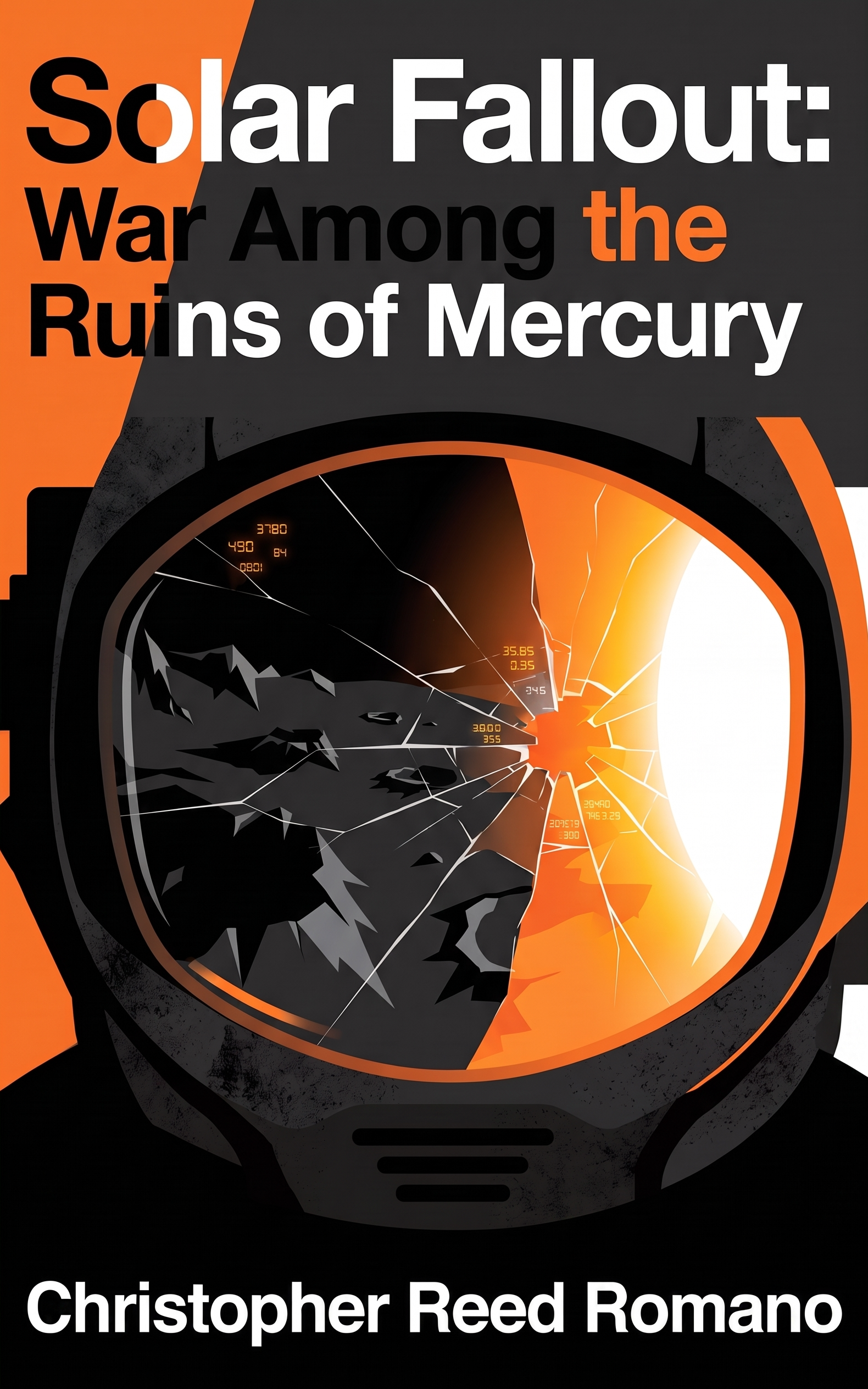
Solar Fallout: War Among the Ruins of Mercury
Mercury is a planet of lethal extremes, but the real danger isn't the heat—it's the war. Captain Eric Vane and the 'Sun-Walkers' of the 12th Aegis Armored Infantry were prepared for the 800-degree surface of the Caloris Basin. They weren't prepared for a quantum-cascade betrayal that would plunge the entire planet into darkness. When a Eurasian sabotage mission triggers a planetary EMP, the USNA FleetCom is left blind, and Platoon 4 is left for dead. After their lander crashes across the terminator line, Vane must lead his surviving squad through a 90-Kelvin nightmare. Between them and safety lies a landscape of razor-sharp volcanic glass, lethal static storms, and high-tech shadow drones hunting in the dark. But the discovery of a covert kinetic mass-driver—a weapon capable of wiping out Earth’s fleet—changes everything. With power reserves failing and the incinerating sunrise rapidly approaching, Vane must execute a desperate guerrilla strike against a fortified basalt bunker. It’s a race against physics and a ruthless enemy in a battle where the first light of day brings certain death. In the ruins of Mercury, the price of failure is the fall of Earth.
- Science Fiction
- Adventure
- Military Sci-Fi
- Space Exploration
- Action Adventure
- Survival
The Furnace at Caloris Basin
The regolith under my boots read six hundred and eighty-one Kelvin at first light, and by the time the Sun cleared the eastern rim of the Caloris Basin it would climb past seven hundred, hot enough to sweat solder off a hull plate if you left it exposed for more than ninety seconds. I watched the number tick upward on my forearm display, a patient green digit counting toward the kind of heat that used to exist only in the abstract, in a lecture hall, in the neat equations I once wrote on a whiteboard for undergraduates who thought blackbody radiation was something they'd never need outside of a final exam. Now it was the air I didn't breathe, the ground I walked on, the reason every joint in my Mark-VIII suit hummed with active cooling instead of simple insulation.
Mercury does not forgive assumptions. That was the first thing I taught every new transfer to the 12th Aegis, before I taught them how to fire a rifle in vacuum or how to read a terrain scan for buried lava tubes. The planet has almost no atmosphere to speak of, a thin exosphere of sodium and helium too sparse to hold a candle flame, let alone temper the raw output of a star that sits three times closer than it does to Earth. There is no wind here to carry heat away from your skin. There is no humidity to sting your throat. There is only radiation, direct and merciless, striking the surface at eleven times the intensity we grew up calling summer, and there is conduction, the basalt and regolith holding that heat like a stone in a forge long after the shadow of a ridge should have offered relief. My suit's job was to fight both, every second, with pumps and fins and a liquid metal loop that never really stopped moving.
"Command, this is Sun-Walker One. Patrol checkpoint Bravo-Nine, all systems nominal." My voice came out flat over the comm, filtered through the thermal baffles built into my helmet mic to keep the electronics from cooking themselves on my own exhaled breath. Even words had to be managed out here. Even breathing had a budget.
"Copy, Sun-Walker One." The reply came back thin, threaded with the faint static that always crept into transmissions once the Sun climbed high enough to saturate the ionized dust kicked up along the terminator winds. That was CWO Simon Archer's voice, steady as a metronome, sitting inside the cool dark of the Sol-Grid Prime control room forty kilometers behind us, watching numbers scroll across a bank of monitors that I imagined were a great deal more comfortable than the basalt ridge I was currently standing on. "Telemetry's clean. Power grid's drawing at ninety-four percent capacity. Keep your eyes on Ridge Seven, Captain. Ground survey flagged a possible subsidence event near the old mining shaft."
"Copy that. We'll take the long route around."
I turned and looked back down the length of my platoon, twelve suits strung out along the ridge in a loose overwatch formation, each one throwing its own long, hard shadow across the black rock. The shadows here were strange things, sharp-edged as knife cuts, because there was nothing in the exosphere to scatter the light and soften them. Where the Sun touched, the world burned white. Where it didn't, the world dropped instantly into cold enough to kill you in minutes if your suit's heating elements failed instead of its cooling. We called it the knife-edge planet, and every patrol route we walked had to respect that line the way a sailor respects a reef.
"You want to explain to me again," Gunnery Sergeant Mikhail Rostov said, his voice carrying that particular gravel he only used when he was needling me, "why Command thinks Ridge Seven needs a live patrol instead of a drone flyover?"
"Because the last three drones we sent over Ridge Seven came back with corrupted imaging," I said. "Something about the magnetic anomaly in that basalt shelf plays hell with unshielded optics."
"So we send twelve men and women to walk it instead."
"Twelve men and women in suits rated for the surface of a star's front porch, yes."
Rostov grunted, which from him was as close to agreement as you were likely to get. He reached up to tighten a torque seal on his suit’s forearm array, his thick, scarred fingers moving with automatic precision despite the bulky seals, looking as though the exoskeleton was an afterthought stapled onto a frame that had already been doing the heavy lifting for twenty years. A veteran of surface assault doctrine going back to the early Cartel skirmishes near the Tharsis relay stations, he didn't ask questions about strategy. He asked questions about logistics, about angles of approach, about which of his people might die executing an order and whether that order was worth the cost. I respected that more than I respected most of the philosophy I'd left behind in Geneva.
Behind him, the rest of Platoon 4 moved in the deliberate, economical strides that Mercury training beat into you within the first month. You didn't run here unless you had to. Running spiked your core temperature, spiked your suit's cooling demand, burned through your coolant reserve at a rate that could leave you dry an hour before extraction. You walked like you had all the time in the world, even when you didn't, because the alternative was worse. I'd seen a recruit once, fresh off the transport from Luna Station, sprint forty meters across open regolith to catch up with a supply convoy. His suit red-lined within ninety seconds. It took Lind eleven minutes to stabilize his core temp once we got him into the crawler, and even then his hands shook for a week.
"Ridge Seven's a klick out," I called back to the line. "Column discipline, ten-meter spacing. Watch your footing on the glass fields, they're worse than they look."
The glass fields were one of Mercury's more elegant cruelties. Ancient volcanic activity, back when the planet still had enough internal heat to push magma to the surface, had left sheets of obsidian-like material scattered across parts of the Caloris Basin, formed when silicate melts cooled fast enough to skip crystallization entirely. Under normal circumstances it would have been a geologist's dream, an untouched record of Hermean vulcanism laid out under an open sky. Under combat conditions it was a floor made of broken bottles, capable of shredding suit fabric if you caught an edge wrong, and it held heat with a stubbornness that made the surrounding regolith look forgiving by comparison. I'd run the numbers myself, back during initial deployment briefings: the glass fields could sit fifteen, twenty degrees hotter than the dust around them, radiating that heat back up into a suit's lower plating long after the direct sunlight should have made the difference negligible.
Tech-Sergeant Freya Lind fell into step beside me as we started the long traverse around the ridge, her diagnostic pad already glowing faint blue against her forearm, throwing numbers I didn't need to squint to read after four years of working beside her.
"Your suit's running warm, Captain," she said, without looking up.
"Everyone's suit is running warm. It's seven hundred Kelvin out here, Sergeant."
"Yours specifically. Left shoulder radiator fin's down eight percent efficiency from spec. I flagged it during the morning diagnostic and you signed off anyway."
"It's within tolerance."
"It's within tolerance for another six hours, and then it's a problem, and problems out here don't wait for convenient timing." She glanced at me, her expression unreadable behind the gold-tinted visor that cut the worst of the glare. "I'll swap the fin when we're back at the crawler."
"Noted, Sergeant." I let a small measure of dryness into my voice. "Anything else wrong with me you'd like to catalog while we're at it?"
"Give me until end of shift. I'm sure I'll find something."
It was as close to banter as field discipline allowed, and I let myself enjoy it, because out here small mercies mattered. Lind had transferred into the 12th eighteen months ago from a orbital maintenance crew, and she'd taken to surface work with an ease that surprised everyone except her. She understood suits the way I understood orbital mechanics, as systems that obeyed rules if you respected them and killed you the moment you didn't. I trusted her judgment on hardware more than I trusted my own eyes, which was precisely why I'd hired the mouth that came attached to it.
We crested the low shoulder of Ridge Seven forty minutes later, and the basin opened up beneath us in a way that still, after eleven months of deployment, managed to steal something out of my chest every time I saw it. Caloris Basin is one of the largest impact structures in the solar system, older than complex life on Earth, a wound punched into the crust by an asteroid strike so violent it sent shockwaves clean through the planet's mantle and out the other side, wrinkling the terrain on the antipodal point into a chaos of jumbled hills we called Weird Terrain in the old survey maps, because nobody in the twentieth century had a better word for it. From the ridge, the basin floor stretched out gray-gold under the punishing light, seamed with fault scarps that had been folding and buckling since before there were oceans on Earth to name.
And rising out of that ancient wound, gleaming like a second sun where its collector arrays caught the light, sat Sol-Grid Prime.
It was, without exaggeration, the largest solar energy collection facility in human space. Forty square kilometers of photovoltaic and thermal collector arrays, feeding microwave transmission towers that beamed gigawatts of power off-world to relay stations in Mercury orbit, which in turn fed the fleet assets holding position along the Sun-side approach and, eventually, Earth itself. It had been built here specifically because nowhere else in the system offered this kind of raw solar flux, and nowhere else demanded this kind of engineering to survive collecting it. I'd read the initial feasibility studies during officer training, back when Sol-Grid Prime was still a line item in a budget committee's projections instead of the reason my platoon existed. The math was elegant, in the way that only orbital-scale engineering can be elegant: harvest the Sun's output where it's strongest, transmit it where it's needed, and station enough armor on the ground to keep anyone else from doing the same thing to you first.
"Command, Sun-Walker One," I said, keying the comm as we started down the ridge's far slope toward the survey point Archer had flagged. "We have visual on Ridge Seven subsidence zone. Proceeding to assess."
"Copy, Sun-Walker One." Archer's voice again, unhurried. "Sensor logs show a two-centimeter drop in surface elevation over the last six hours, localized to a forty-meter radius. Could be settling in one of the old mining shafts beneath the ridge. Command wants confirmation before we route the next supply convoy through there."
"Understood. Give us twenty minutes."
The mining shafts were older than Sol-Grid Prime itself, dug in the early decades of Hermean exploitation when private consortiums had come looking for rare earth deposits and platinum-group metals before anyone had worked out a sustainable way to keep human beings alive on the surface for more than a few hours at a stretch. Most of those old operations had been abandoned within a generation, their equipment left to bake in place, their tunnels sealed and forgotten under decades of dust. The survey maps we'd been issued marked them as hazards, not resources, structural liabilities riddling the crust beneath half the basin like wormholes in old fruit. I'd walked past enough of those sealed shaft entrances to stop being curious about what lay beneath them. Today wasn't going to change that, I assumed, though I'd learn soon enough how wrong that particular assumption was going to turn out to be.
Private Kowalski was on point when we reached the subsidence zone, his rifle held low and steady, sweeping the ground ahead in the practiced arc that came from months of drilling the same movements until they stopped being conscious choices. He was young, younger than most of the platoon, transferred in from a training battalion on Luna only four months back, and he still had that particular alertness recruits carried before Mercury taught them which threats were worth the adrenaline and which ones were just the planet doing what the planet did.
"Depression's right here, sir," he called back, crouching at the edge of a shallow bowl in the regolith, maybe two meters across, its surface cracked in a spiderweb pattern that suggested something shifting underneath rather than anything violent happening on top. "Looks stable. No active venting, no thermal bloom."
I crouched beside him, running my own scanner over the depression, watching the readout confirm what my eyes already suspected. A slow settling, consistent with a support timber finally giving way somewhere in the tunnel system below, decades of thermal cycling between the murderous day and the brutal night having worked exactly the kind of slow damage that patient physics always manages, eventually, given enough time. Mercury's day-night cycle is long, one hundred seventy-six Earth days from noon to noon, thanks to the peculiar three-to-two resonance between its rotation and its orbit, and that meant every structure on the surface endured swings from 700 Kelvin blaze to 90 Kelvin dark across a cycle that would have made an engineer on Earth weep. Metal fatigued. Rock fractured. Old timbers, driven into shafts a hundred years before anyone thought to reinforce them against a swing of six hundred Kelvin, eventually just failed.
"Structural, not seismic," I said, straightening. "Log it as a subsidence hazard, route the convoy two hundred meters east of here. Command can send a survey drone down the shaft itself if they want confirmation, but I'm not putting boots into a hundred-year-old tunnel on a whim."
"Copy that, Captain." Archer's voice again, and I could hear the faint click of him logging the assessment into the tactical record, the kind of unglamorous bureaucratic housekeeping that made up ninety percent of what actually kept a platoon alive out here. Nobody wrote songs about accurate hazard logs. Nobody should have to. The songs, if there ever were any, would be about the platoons who didn't bother logging them.
We held position at the subsidence zone for another ten minutes while Kowalski and Private DeSantis ran a more thorough ground scan, mapping the extent of the depression for the engineering corps to review later, and I used the lull to do what I always did during the dead time on patrol: I watched the Sun.
You could not look at it directly, of course. Even through the heavy filtering of a Mark-VIII visor, direct solar viewing on Mercury's dayside would cook your retinas inside of a second. But you could watch its effects, the way the light struck the basin floor and made the regolith shimmer at its edges with a heat-haze so thick it looked almost liquid, the way shadows behind ridge formations sat black and absolute, containing temperatures that could differ from the sunlit ground beside them by four hundred degrees or more within the space of a single stride. I had spent my career before this one studying stars from a comfortable distance, publishing papers on stellar spectra and radiative transfer for an audience of maybe two hundred people worldwide who cared about the fine details. Now I lived inside the equations. Now the star wasn't data on a screen. It was the reason my suit weighed forty kilograms of cooling apparatus, the reason every soldier under my command trained for eighteen months before ever setting foot on this surface, the reason Sol-Grid Prime existed at all, squatting in the basin below us like a vast mechanical flower turned forever toward its only sun.
"You're doing the thing again," Rostov said, coming up beside me while the scan team finished their work.
"What thing."
"The professor thing. Staring at the horizon like it owes you an answer."
"It does owe me an answer. I just haven't figured out the right question yet."
He huffed something that might have been a laugh, might have been static distortion, hard to tell inside a helmet speaker. "You know what I think about, staring at that horizon?"
"Enlighten me, Gunny."
"I think about how many ways this planet can kill me before lunch. It's a shorter list than you'd think, actually. Heat. Cold. Glass. Falling into a hole nobody logged. Cartel patrol catching us with our pants down on the wrong side of a ridge. Five ways, give or take. Mercury's an efficient bastard. Doesn't waste effort on creativity."
"There's a certain elegance to that."
"There's a certain something. I wouldn't call it elegance. I'd call it Tuesday."
I let that sit, because there wasn't much to add to it. Rostov had a gift for compressing the entire philosophy of Hermean deployment into a handful of gravel-voiced sentences, and I'd learned not to compete with that particular talent. Better to let him have it. Every platoon needs someone who can say the true, ugly thing out loud without flinching, so the rest of the unit doesn't have to carry the weight of pretending it isn't true.
The scan team finished their sweep and we started back toward the crawler, a six-wheeled transport vehicle parked in the lee of Ridge Seven's northern shoulder, its hull plating scorched matte gray from months of accumulated thermal cycling, its radiator array deployed and glowing faintly with waste heat even in standby mode. Crawlers were slow, patient things, built to survive the surface the same way our suits were, through redundancy and careful thermal management rather than speed or agility. On Mercury, speed got you killed. Patience kept you alive. It was a lesson that ran contrary to almost everything I'd absorbed in a decade of academic life, where the fast answer, the clever answer, the elegant proof, always won the argument. Out here the slow answer usually won, because the slow answer accounted for the fact that the ground itself was actively trying to cook you.
Lind was waiting at the crawler's rear hatch when we arrived, already running her diagnostic pad over the first suits through the airlock cycle. "Radiator fin swap first, Captain," she said, before I'd even finished cycling through. "Then you can go back to staring at horizons."
"Understood, Sergeant."
The interior of the crawler was, by comparison to the surface, almost obscenely comfortable. Not cool, exactly, nothing on Mercury's dayside got what a temperate climate would call cool, but shielded, buffered, a controlled seventy-two degrees Fahrenheit maintained by a cooling system that drew more power in an hour than my childhood home had used in a month. I unsealed my helmet the moment the internal pressure equalized, and the air that hit my face was recycled and faintly metallic, tasting of the carbon scrubbers and the ozone tang of electronics running warm, but it was air I didn't have to manage through a suit's filtration lattice, and that alone made it feel like luxury.
"Command, Sun-Walker One," I said, settling into the crawler's command station, a cramped console wedged between two rows of jump seats where off-duty platoon members caught what rest they could between patrol rotations. "Ridge Seven assessment complete. Recommend convoy reroute two hundred meters east. No further anomalies detected."
"Copy, Sun-Walker One." Archer's voice came through clearer now, the crawler's antenna array cutting through the dust interference that plagued suit-to-suit comms on the exposed surface. "Logging assessment. Command wants your platoon back at Sol-Grid Prime by fourteen-hundred for the equipment rotation. Fresh coolant cartridges just came down from the last supply drop."
"Copy that. We'll be there."
I pulled up the tactical display on the console, a topographic render of the Caloris Basin overlaid with Sol-Grid Prime's collector grid, the microwave transmission towers marked in a lattice of amber icons, the relay stations in orbit above marked in blue, and further out, at the edge of the display's useful range, the pale threading lines that represented the ongoing negotiation of orbital slots and patrol corridors between USNA FleetCom assets and the Eurasian Solar Cartel's own presence in the system. It was a Cold War fought in decimal points and telemetry logs, in who controlled which slice of collector real estate and whose patrol routes crossed whose without triggering an incident report. I had spent eleven months walking that line, and in all that time the worst thing that had happened was a shouting match over encrypted channel bandwidth between our comms officer and his Cartel counterpart, resolved within a day through channels far above my pay grade.
It was easy, looking at the display, to believe that the war would stay that way. Cold. Contained. A matter of decimal points and grid allocations rather than blood. I want to be honest about that, looking back, because it would be convenient to claim I saw something coming, some flicker of premonition in the data that told me the balance was about to break. I didn't. The display showed exactly what it had shown every day for eleven months: a fragile, functional peace, maintained by mutual exhaustion and the shared understanding that neither side wanted to be the one who fired first on a planet where firing first might mean losing your own collector grid to retaliation within the hour.
"Captain." Lind's voice, from the crawler's aft compartment, where she'd set up a temporary bench to work on the suit fin she'd flagged earlier. "Got a minute?"
I unfolded myself from the console and made my way back, past Rostov running a weapons check on his rifle with the methodical patience of a man who'd done it ten thousand times and would do it ten thousand more, past Kowalski and DeSantis comparing notes on the subsidence readings with the easy chatter of soldiers who'd just come off a patrol without incident and were allowing themselves to feel good about it.
Lind had my shoulder fin laid open on the bench, the radiator vanes exposed, a fine layer of dust ground into the joint seams that shouldn't have been there given how recently the suit had been through a full maintenance cycle.
"See this?" She pointed with a stylus at the buildup. "That's not surface dust. Surface dust is coarser, higher iron content, shows up different on the spectrometer. This is finer. Almost looks like it migrated in from inside the suit's own cooling loop."
"Contamination in the coolant line?"
"Maybe. I want to run a full flush before we head back out for the next rotation. It's probably nothing, some seal wearing thinner than spec, kicking particulate into the loop. But I'd rather chase it down now than find out the hard way at two in the afternoon local, with your core temp climbing and half your fin capacity offline."
"Do it," I said. "Whatever time it takes."
"That's the answer I like to hear." She was already reaching for her tool kit, the particular focus settling over her that I'd come to associate with problems she found genuinely interesting rather than merely routine. "Command still wants us back by fourteen-hundred?"
"Command wants a lot of things. We'll be back when the suit's fixed."
It was a small thing, a scrap of anomalous dust in a coolant loop, the kind of detail that on any other deployment, on any other planet, would have meant nothing more than a maintenance note filed and forgotten. I want to be clear that in that moment, sitting in the crawler with the ferocious daylight of the Caloris Basin pressing against the hull outside, I gave it exactly the weight it seemed to deserve, and no more. A curiosity. A footnote. Not a warning, because there was no reason yet to read it as one.
We spent the better part of an hour in that crawler while Lind worked, and I used the time the way I usually did, running through the platoon's readiness numbers, checking coolant reserves against the projected patrol schedule for the next several days, reviewing the maintenance logs Archer had forwarded from Sol-Grid Prime's own systems. The facility ran on a schedule as rigid and unforgiving as the planet itself: collector arrays tracking the Sun across the sky with millimeter precision, transmission towers beaming power skyward in tight, phased bursts timed to catch the relay satellites at the optimal window, cooling systems working around the clock to keep the whole apparatus from melting itself into the basin floor it stood on. Every piece of that machine had to function within tolerances measured in fractions of a percent, because the margin between successful operation and catastrophic failure on this planet was thinner than anywhere else humanity had ever built anything.
I thought, not for the first time, about the strange inheritance I'd walked into. Eighteen months ago I had been Nathan Vance, an assistant professor with tenure prospects and a research grant renewal pending, teaching radiative transfer to undergraduates who mostly wanted the credit and mostly didn't care about the equations. Somewhere between one semester and the next, that life had folded itself away, and Captain Eric Vane had walked out the other side of it, carrying most of the same knowledge but almost none of the same certainty. The equations hadn't changed. Blackbody radiation still worked the way it always had, the Stefan-Boltzmann law still governed how much energy a surface radiated as a function of its temperature to the fourth power, the physics of Mercury's dayside heat still followed rules I could have derived on a whiteboard given enough chalk and time. What had changed was the stakes. In Geneva, getting the equation wrong meant a paper got rejected. Here, getting it wrong meant somebody's suit failed at the worst possible moment, and I stopped being the person who explained the universe and started being the person responsible for keeping human bodies alive inside it.
I didn't resent the change, exactly. There were nights, back on Luna during training, when I lay awake wondering whether I'd made some catastrophic error walking away from the quiet, contained danger of academic politics into the loud, immediate danger of surface command. But most days, out here, watching the light hit the basin floor and turn the horizon into something almost holy in its violence, I found I didn't miss the whiteboard nearly as much as I'd expected to. There was a clarity to this work that the lecture hall never offered. The equations here had teeth. You respected them, or the planet reminded you why you should have.
"Fin's flushed and reseated," Lind announced, closing the panel on my suit's shoulder with a satisfied click. "Contamination's gone. I want to pull a sample and run it through the full spectrometer back at base, just to rule out anything systemic, but for now you're clear."
"Good work, Sergeant."
"Don't thank me yet. If it turns out half the platoon's suits have the same contamination signature, we're going to be running flush cycles for a week straight."
"I'll take that over the alternative."
She smiled, a small, tired thing, and moved on to check the next suit in line, already calling out to DeSantis to strip down for inspection. I sealed my own helmet back into place, feeling the familiar pressure settle across my skull, the suit's internal systems cycling back to full readiness with a series of soft chimes and status confirmations scrolling down the inside of my visor.
By the time we mounted back up and started the return traverse toward Sol-Grid Prime, the Sun had climbed high enough that the basin floor shimmered with heat distortion in every direction, the horizon itself seeming to bend and waver like something seen through old glass. The facility's collector arrays tracked patiently overhead, vast mirrored petals turning in their slow arcs, catching every available photon and funneling it down into the transmission towers that would, within the hour, beam another burst of concentrated power up toward the relay satellites waiting in high orbit. It was, I thought, watching it, one of the more remarkable engineering achievements our species had managed, a testament to nothing except stubbornness and the refusal to let a hostile environment stay hostile forever.
"Sun-Walker One, this is Command." Archer's voice again, carrying a note I hadn't heard from him before, a fraction of hesitation that didn't belong in his usual clipped delivery. "We're showing some micro-fluctuations in the power distribution grid. Nothing outside tolerance yet, but it's the third anomaly this week. Wanted you aware before you came in for the rotation."
"Define micro-fluctuation," I said, feeling something at the back of my neck that I couldn't yet name, a professional instinct sharpening without a clear target.
"Sub-millisecond timing drift in the phased array bursts. Could be thermal expansion in the waveguides, could be a calibration issue in the tracking servos. Engineering's on it. I just wanted you to have eyes on before you're back inside the facility."
"Understood. Keep me updated."
"Copy that, Sun-Walker One. Command out."
I let the channel close and sat with it for a moment, the crawler rocking gently over the uneven ground as it carried us the last kilometers back toward the vast gleaming sprawl of Sol-Grid Prime. Micro-fluctuations. Sub-millisecond timing drift. On paper, in any engineering log anywhere in human space, that was the kind of anomaly that got a maintenance ticket and a follow-up inspection, nothing more. Machines drifted. Calibrations slipped. It happened on every facility humanity had ever built, on Earth, on Luna, on every station strung out across the solar system's hostile corners.
But I thought about the fine dust in my suit's coolant loop, the kind that shouldn't have migrated in from the outside, and I thought about three anomalies in a week where Archer's careful, methodical logs had shown none in the eleven months before it, and I felt that instinct at the back of my neck sharpen into something closer to attention.
It was nothing yet. I want to be honest about that. It was three data points and a coincidence of timing, the kind of pattern the human mind is built to find whether or not it's actually there. I had spent enough years doing real science to know the danger of seeing signal in noise, of building a narrative out of scattered points that would, given enough data, resolve into nothing more than the ordinary scatter of a complex system operating at the edge of its tolerances.
Still. I filed it away, the way I filed away every anomaly out here, in the part of my mind that didn't stop working just because the patrol had ended without incident. Mercury did not forgive assumptions, and it seemed to me, as the crawler rolled the last stretch toward Sol-Grid Prime's outer perimeter and the collector arrays rose up ahead of us like the ribs of some vast metal creature basking in the punishing light, that assumptions were exactly what a facility running on sub-millisecond timing margins could least afford right now.
"Command, Sun-Walker One," I said, keying the comm one more time as the perimeter gates cycled open ahead of us. "Requesting full diagnostic on the power distribution grid before end of shift. I want eyes on those fluctuations before we call it routine."
There was a pause on the line, long enough that I could picture Archer glancing over his shoulder at whoever else was in the control room with him, weighing the request against a schedule already crowded with the ordinary demands of running the largest solar facility in human space.
"Copy that, Captain," he said finally. "I'll pull the engineering team in. We'll have something for you by end of shift."
"Appreciated. Sun-Walker One out."
I closed the channel and looked out through the crawler's forward viewport at the facility rising ahead of us, its collector petals turning in their slow, patient arcs, drinking in the light of a star that had, for eleven months, asked nothing of us except respect and careful engineering. The heat outside had climbed past seven hundred and ten Kelvin now, according to the display, hot enough to have melted the crawler's tires if they'd been made of anything less exotic than the ceramic composite that let us drive across this furnace at all. Somewhere behind that gate, inside the cool, shielded corridors of Sol-Grid Prime, an engineering team was about to start pulling apart sub-millisecond timing logs looking for the source of a drift that was, by every reasonable measure, still well within acceptable tolerance.
I told myself it was nothing. I had spent a career training myself to distrust easy narratives, to let the data speak before the story did. But as the crawler passed through the perimeter gate and the harsh outside light gave way to the facility's shadowed interior bay, I found I couldn't quite shake the feeling that the equations, this time, were trying to tell me something I hadn't finished reading yet.
The Sol-Beams of Directorate Prime
The perimeter gate closed behind the crawler with a shudder that traveled up through the floor plating, a sound like a held breath finally let go, and the punishing light of the Caloris Basin gave way to the flat, shadowless glow of the facility's interior bay lighting. I felt my shoulders drop half an inch inside the suit, the reflex of a body tha…