

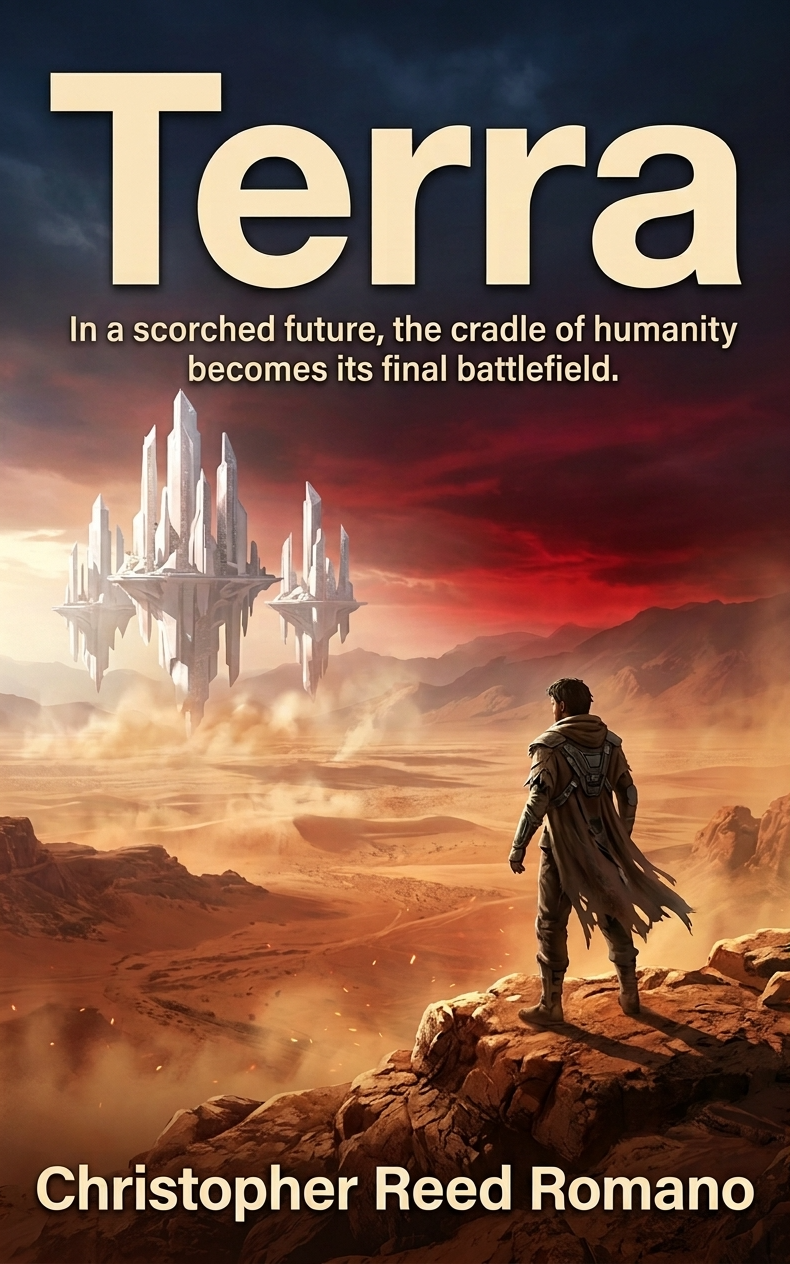
Terra
In a scorched future, the cradle of humanity becomes its final battlefield.
by DarkBoyManoGaming Romano
One hundred thousand years from now, Earth is no longer the world we know. It is a scorched wasteland ruled by the High Hegemony from floating Spires, while the forgotten masses wither in the dust of the surface below. Kaelo Hesperus is a scavenger hiding in the shadows of the Equatorial Belt, carrying the weight of a fallen noble name and the dangerous secrets of the Old Sciences. When the High Hegemon, Aristhène Vora, prepares to unleash an ancient climate weapon to purge the unworthy, Kaelo can no longer remain a ghost in the ruins. Joined by a battle-hardened technician and a mystic spy, Kaelo must lead a desperate rebellion of outcasts against the celestial power of the Spires. But the key to the planet’s orbital weapons isn't a code—it is buried in Kaelo’s own blood. As the sky turns a lethal crimson, he faces a soul-shattering choice: embrace the mantle of a tyrant to secure survival or stand by as the cradle of humanity is reduced to ash. From the visionary mind of Christopher Romano comes a sweeping epic of power, sacrifice, and the enduring spirit of a world that refuses to die.
- Science Fiction
- Military Sci-Fi
- Dystopian
- Post-Apocalyptic
Dust and Copper Eyes
Month 1, Day 01 — 0640 Hours — Equatorial Dust-Seas, Sector Seven
The wind came first as a whisper against the visor, then as a fist. Kaelo Hesperus leaned into it, weighted boots dragging twin furrows through sand the color of dried blood, and counted his breaths the way Deneth had taught him: four in, hold for two, six out. The rebreather clicked with every cycle, a small mechanical heartbeat strapped to his face, and somewhere behind the cracked left lens a hairline fracture whistled thin and sharp, letting in grit that tasted like rust and old bone.
He did not stop walking. Stopping in a dust-sea at first light meant standing still long enough for the storm behind him to catch up, and this one was already a wall on the horizon, a bruise-colored curtain climbing into a sky that had not been blue in longer than anyone alive could remember. Above it, if he tilted his head just right, he could see the pale gleam of Spire-Six riding the thermals like a knife stuck in the throat of the world.
Station Seven waited another six hundred meters ahead, or what was left of it. From this distance it looked like the ribs of some enormous dead animal, half swallowed by a dune that had been growing across it for longer than Kaelo had been alive. He had scavenged the outer collapse three times already this season, each time pulling less from the wreckage, each time the dust a little deeper, the filters a little more clogged with the caustic silica that ate through polymer seals if you let it sit too long.
His filter gauge, a cracked amber dial stitched into his left cuff, sat at thirty-one percent. He had left the bunker with it at sixty. The storm hadn't even reached him yet.
"Come on," he muttered into the mask, voice flattened by the rebreather's diaphragm. "Just a little farther."
The dune shifted under him, the way it always did in the hour before a storm, grains sliding downslope in long ripples that made the ground feel alive. Kaelo had grown up on sand that moved like water and he had learned early which shifts meant nothing and which meant a sinkhole was about to open beneath his feet and swallow him down into some forgotten sublevel of a station drowned a hundred years before his birth. This shift meant nothing. He kept walking.
By the time he reached the exposed strut work of Station Seven, the wind had teeth. Dust needled the exposed skin at his wrists, and his eyes, already dry from the recycled air, burned behind the scratched lens. He ducked through a gap in the collapsed superstructure where a support pylon had buckled into an arch, and the wind dropped instantly, muffled by tons of rusted alloy and packed sand. The quiet inside was its own kind of pressure.
He had marked the location three days ago on his last pass, a service alcove half-buried near what had once been a data relay spine, its casing split open like a fruit gone to rot. He worked his way down through the wreckage on hands and knees, boots scraping against twisted decking, until he found the crack again, wider now, widened by wind and time and his own careful hands.
The crystal sat where he'd left it wedged in memory, though he still had to dig for it, forearm-deep in grit that smelled of ozone and something faintly organic, like the inside of an old wound. His fingers closed around a shape no bigger than his palm, faceted, cool despite the heat radiating off the dune above. He drew it out into the gray half-light and turned it over.
A data crystal, cracked along one edge in a spiderweb of fine lines, its core still pulsing with a weak violet light that flickered when he moved it. Old-world tech. Older than the Spires themselves, if Deneth was right about the depth of this station's foundations, and Deneth was rarely wrong about depths.
Kaelo wrapped it in a strip of oiled cloth and tucked it into the sealed pouch at his hip, then checked his gauge again. Twenty-six percent. The whistle in his left lens had gotten worse, a thin reedy note that made his skull ache, and the world had started to swim faintly at the edges, colors bleeding a little too bright, a little too slow. Thin air did that. Not enough of it, and what little there was thick with grit that scoured the lungs raw.
He didn't wait to admire the find. He turned and started back the way he'd come, faster now, because the storm wall on the horizon had grown a shade darker, and Deneth's cough had not sounded good three days ago, and it would sound worse now.
The wind screamed at his back the whole way home.
Month 1, Day 01 — 0910 Hours — Deneth Cael's Bunker, Station Seven Undercroft
The hatch into the bunker was a slab of scavenged blast door, three layers of alloy welded crooked by hands that had cared more about function than symmetry. Kaelo hit the release sequence with the heel of his hand, a code of taps against a rusted panel that no working scanner would ever recognize, and the door groaned inward on hinges that needed oil he did not have.
The air inside hit him like a wall of warm soup, thick with the smell of scorched wiring and mineral dust and the particular sourness of a body that had been sick a long time. He pulled the rebreather off the moment the door sealed behind him, gasping, and the bunker's recycled air, stale as it was, felt like a gift after the dune-top thinness.
"Deneth."
The old man lay propped against a nest of salvaged cushions in the far corner, beneath the dead gray eye of a wall-mounted screen that hadn't shown color in a decade. A single glow-lamp threw long shadows across banks of cannibalized machinery, cables running like veins along the ceiling to a jury-rigged oxygen concentrator that wheezed almost as badly as its patient. Deneth Cael's eyes opened at the sound of his name, pale and rheumy, sunk deep in a face gone the color of old paper. His chest rose and fell in shallow, ragged pulls, each one accompanied by a wet click somewhere in his throat that Kaelo had started hearing in his dreams.
"You found something." Deneth's voice was a dry rasp, more air than word. "I can see it on you. You always walk faster when you've found something."
"A crystal. Cracked, but the core's still lit." Kaelo crossed the room and knelt beside him, pulling the wrapped bundle from his hip pouch. "Pulled it from the relay spine. Deep vault, past the collapse."
Deneth's hand, all knuckle and tendon now, closed around his wrist with more strength than Kaelo expected. "Let me see it."
Kaelo unwrapped the cloth and set the crystal in his mentor's palm. The old man held it up toward the glow-lamp, turning it with trembling fingers, and something moved behind his eyes that Kaelo hadn't seen in weeks. Not hope, exactly. Recognition.
"This is a command shard," Deneth said. "Not a data log. A key fragment." He coughed, a deep tearing sound that doubled him forward, and Kaelo caught his shoulder before he could fold all the way into himself. Deneth waved him off after a moment, breath rattling. "Help me to the terminal. Now, boy, while there's still light in it."
The terminal sat against the back wall, a squat pre-cataclysm console that Deneth had spent twenty years coaxing back to life, its casing scarred and patched with mismatched alloy, its single working port waiting like an open mouth. Kaelo half carried the old man across the room, feeling how little weight remained in him, how the bones sat close beneath skin gone thin as parchment.
Deneth's hands shook as he guided the crystal into the port, but they did not miss. Decades of practice lived in those fingers even as the rest of him failed.
The terminal woke with a low hum, and then the room filled with light.
It came from nowhere and everywhere, a projection blooming out of the console's dead housing into the air above them, gold and translucent, rotating slowly like something alive. Kaelo had seen Deneth pull up fragments before, broken maps, corrupted logs, half a face speaking in a language no one alive still used. He had never seen anything like this.
Nine towers hung suspended in the projected dark, tethered by threads of light to a curved horizon Kaelo recognized, with a cold drop in his stomach, as the surface of the world he lived on. Each tower bristled with rings, dozens of them stacked along their lengths like growth rings in a tree, and at the base of each ring a small arrow pulsed outward, away from the tower, away from the sky, down toward the ground. "Spire-Prime," Deneth whispered, and one of the towers brightened at the center of the formation, larger than the rest, its rings thicker, more numerous. "And the eight that orbit her. Do you understand what you are looking at?"
Kaelo stared at the pulsing arrows, all of them pointed the same direction, all of them pointed down. "The atmospheric rings. The filtration systems."
"That is what they call them." Deneth's laugh turned into a cough halfway through, and he pressed a rag to his mouth that came away spotted dark. "That is what they have always called them. I believed it myself, once, when I was young enough to trust an old text without checking its seams."
"And now?"
Deneth reached out, unsteady, and touched the projection near one of the pulsing arrows. The image responded to his fingers, zooming, peeling back a layer of gold light to reveal a cross-section of machinery underneath, turbines and valves and long throats of piping that ran not inward, toward the Spire's core, but outward, venting into open air.
"They do not filter the air, Kaelo." His voice had gone very quiet, very steady, the way it always did when he was most certain of something terrible. "They vent it. They pull the good air up from the surface, scrub what little remains of value for themselves, and release the rest back down thinned, poisoned, choked with the particulate you breathe every single day of your life."
The words landed slow, the way a stone drops into water and takes a moment to reach the bottom. Kaelo felt his own pulse in his ears, quick and hot.
"They are not protecting us from the ash," Deneth whispered, his hand trembling as it fell back to his lap. "They are the reason there is ash."
Kaelo looked back up at the rotating schematic, tracing the downward arrows venting into the lower atmosphere. The realization hit him like a physical blow. "The choking seasons," he said, his voice tight. "The grit storms that settle over the low sectors every harvest. It's not just the planet dying. If they're stripping the oxygen for the upper tiers and venting the concentrated particulate down here..."
"Then every cough, every ruined lung in the dust-seas, is engineered," Deneth said, nodding weakly. "A system built and maintained to keep the surface starved and struggling, ensuring no one below ever has the breath to fight back."
Kaelo said nothing for a long moment. Outside, muffled through meters of rock and rusted alloy, the storm had finally arrived, a low continuous roar like something enormous grinding its teeth against the world.
"Why," he said finally, "would anyone build something like that on purpose?"
"Because scarcity is easier to rule than plenty." Deneth's eyes had drifted to the projection again, to the nine towers and their slow bleeding light. "A hungry man will trade anything for bread. A suffocating man will trade everything, including his own children, for one clean breath. Aristhène Vora did not invent this system. She inherited it. But she has perfected it beyond anything the first architects imagined, and she is not finished."
He coughed again, longer this time, and Kaelo saw with a cold lurch that the rag came away wetter, darker, that Deneth's lips had taken on a bluish cast at their edges that had not been there an hour ago.
"Deneth—"
"There is more." The old man's hand found Kaelo's wrist again, gripping now with an urgency that had nothing to do with strength. "Listen to me. I do not have the breath to say this twice."
Kaelo leaned in close, close enough to smell the copper under the sourness of his mentor's failing lungs.
"The vents are only half the system. Beneath them, at the root of the network, there are seven nodes, old-world machines built before the Spires ever existed, built to heal this planet rather than strangle it. Terraforming nodes. Dormant, buried, waiting for an authorization the Hegemony can no longer provide, because the Hegemony was never meant to hold that authority in the first place."
"Waiting for what authorization."
Deneth's gaze moved, slow and deliberate, from Kaelo's eyes down to his jaw, to the crystalline scar that ran in a pale, faceted seam from the corner of his mouth down along the line of his throat to his collarbone. A scar Kaelo had carried since before memory, one Deneth had always called an accident, a birth defect, nothing worth dwelling on. "A dual-key," Deneth said. "Biological and genetic both. Grown into the bloodline of the old house that built the first nodes, so that no throne, no council, no tyrant could ever seize control of them by force. Only blood could open that door. Only blood, and a very specific kind of scar." Kaelo's hand rose without his willing it, fingers brushing the ridge of crystal along his own jaw, cool and smooth under his fingertips the way it had always been, familiar as his own name and suddenly, impossibly, strange. "You are telling me this is not a scar." "I am telling you it never was." Deneth's breath came in shorter pulls now, each one a visible effort, his chest hitching with a sound like paper tearing deep inside him. "I suspected, when your mother brought you to me all those years ago, half-starved and half-drowned in dust, that House Hesperus had not simply fallen. I suspected it had been hunted, and that you were the reason. I did not know for certain until I found the old registries, buried three sublevels beneath this one, and matched the resonance pattern to yours." "Why didn't you tell me."
"Because a boy who believes himself ordinary survives longer than a boy who believes himself a key." Deneth's eyes had gone glassy, wet with more than just illness. "I wanted you to have a childhood, however short, however cruel this world made it. I am sorry that I have run out of time to give you anything gentler than the truth."
The projection above them flickered, the crystal's core dimming as its charge began to fail, and Deneth's grip on Kaelo's wrist tightened one final time.
"There is a coordinate," he rasped. "Buried in the deepest stratum of this station, past the collapse you have not yet dared to clear. A relay marker, the first node's location. Sector Two, beneath the salt flats, coordinates seven-one-nine by twelve-four. It will not activate for anyone else. It will only answer you."
"Deneth, breathe. Slow down, hold for two—"
"I do not have two to hold for, boy." A ghost of the old dry humor moved through his ruined voice, and for one moment he looked almost like himself, the man who had taught Kaelo his letters by candlelight and mathematics by counting grains of sand. "Listen. The scar responds to a bio-link handshake, direct contact with an active terminal. It will cost you. I do not know how much, only that the old texts warned of blood, of strain the body was never meant to carry alone. Do not attempt it without knowing what waits on the other side of the door."
His hand slipped from Kaelo's wrist, falling limp into his own lap, and the wet click in his throat had become something else now, a long shallow rattle that filled the small room louder than the storm outside.
"Deneth." Kaelo caught him by the shoulders, feeling how little substance remained beneath the thin robe, how the old man's head had begun to loll despite every effort to hold it steady. "Stay with me. Stay with me, I'll get the concentrator, I'll—"
"Tell them," Deneth whispered, so quiet now that Kaelo had to lean his ear almost to his mentor's lips to catch the words at all. "Tell the surface the sky was always theirs. That someone remembered. That someone always remembered."
His chest rose once more, a long slow effort that seemed to take everything he had left, and did not fall again.
The projection above them guttered out entirely, plunging the bunker into the dim orange light of the single glow-lamp, and in the sudden quiet Kaelo could hear nothing but the storm outside, the concentrator's useless wheeze, and the terrible new silence where his mentor's breathing had been. He knelt there a long time, one hand still braced against Deneth's shoulder, the other pressed without thinking to the crystalline scar along his own jaw, cool as ever beneath his fingers, and utterly changed.
Scrap and Brass
Month 1, Day 02 — 0430 Hours — Sector Four Transit Culvert, Subterranean Beneath the Slag Flats The pipe was barely wide enough for a man's shoulders, and Kaelo had learned three years ago that the trick to moving through one without losing skin was to breathe out all the way before you started, empty your chest like a bellows, and pull yourself f…