

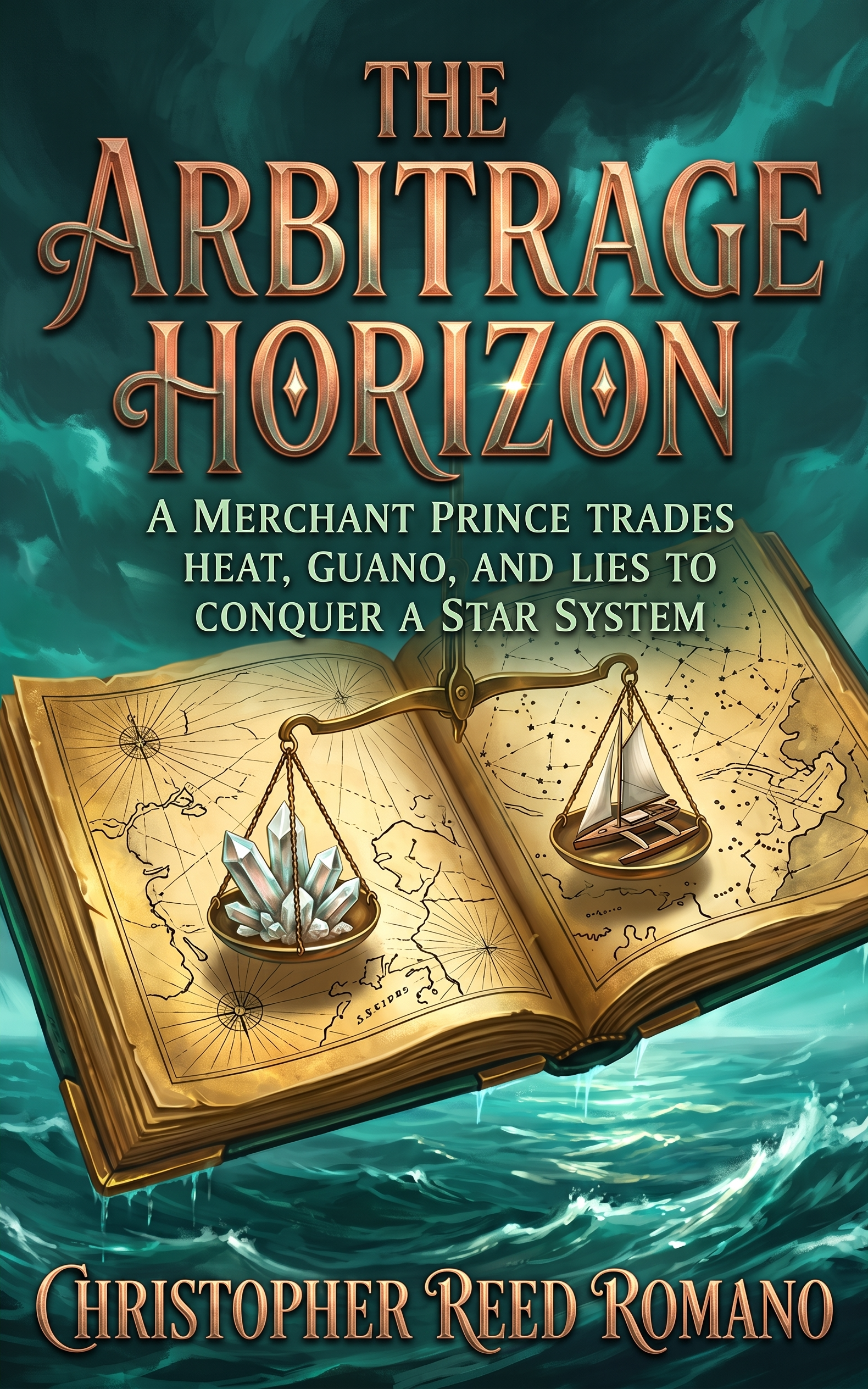
The Arbitrage Horizon
A merchant prince trades heat, guano, and lies to conquer a star system
by DarkBoyManoGaming Romano
He doesn't fight wars. He buys them. Director-General Wouter van der Zee is no soldier — he's a merchant prince of the Terran Democratic Alliance of Trade who weaponizes ledgers the way admirals weaponize fleets. Feigning gouty senility while calculating every margin, he is the most dangerous man on any exchange. Stranded on the methane ice of Swarte-Klip under a crippling Hanseatic salvage lien, with his cutter's relays fused and his crew frozen in place, Wouter has nothing to trade but heat and copper wire. From that, he will forge quartz, bankrupt a guild, and seize four frigates. But his greatest trade is yet to come. When his shuttle crashes on the ocean world Pelagios-3 with only thirty days of food and biology that makes every native bite lethal, he must broker peace between the timber-rich Archon Hegemony and the winged, guano-rich Pelagian Flotillas. To survive, they will launch a joint-stock company, build the 150-foot trimaran Sovereign Ledger, and sail 4,200 nautical miles through the Great Storm Gyre. At the end of that voyage lies proof of a jump-gate fuel monopoly that bleeds the stars dry. And Wouter intends to liquidate it.
- Science Fiction
- Adventure
- Space Opera
- Alien Contact
- Colony Worlds
- Survival
The Balance Sheet at Swarte-Klip
Director-General Wouter van der Zee had once calculated, in the drowsy years before his hair went the color of ash, that a man's worth could be measured precisely in the ratio of his liabilities to his patience. Sitting now on the narrow acceleration bench of the cutter Goede Hoop, with his gouty left foot propped on an upturned ration crate and his velvet coat gone stiff with dried methane spray, he found that ratio had inverted itself rather badly against him.
Seven hundred thousand Guilder-credits. The number sat on the cracked screen of his ledger-padd like a tumor, blinking amber against the dim cabin lighting, and no amount of squinting or recalculating the depreciation schedule made it smaller. The organometallic catalyst shipment, forty tons of the stuff, contracted at premium rates to three separate purchasers along the Centauri corridor, now sat exactly where it had sat for the last eleven hours: locked in the Goede Hoop's aft hold, going nowhere, because the ship itself was going nowhere, because an electromagnetic pulse loosed by a Hanseatic corvette had reached across four hundred kilometers of vacuum and turned every silicon-carbide relay in the primary bus into something resembling a puddle of poorly annealed glass.
"My gout," Van der Zee announced to the cabin at large, in the tone of a man delivering a papal bull, "has never before endured one point four gravities on a surface this cold. I want that noted in the ship's log, Captain Kross, as a contributing factor to any future insurance claim against the Hanseatic Guild."
Captain Valerie Kross did not look up from the diagnostic panel bolted beside the aft bulkhead. The panel's glow washed the fine scar along her jaw in pale blue, and her fingers moved across the input plate with the unhurried precision of a woman who had long ago stopped being impressed by other people's suffering, real or performed. "The gravity's not going anywhere, Director-General. Neither is the relay bank."
"A tragedy compounding a tragedy," he said, and groaned as he shifted his weight, feeling the extra pull of Swarte-Klip's one point four g settle into his knee joints like a slow, cold vibration working its way up through cartilage that had not been young in twenty years. The whole cabin trembled faintly with it, that low, gravity-borne hum that never quite went away, a reminder that this world took its toll not in heat or storm but in simple, patient weight. Outside the hull, some forty meters distant across the mudflats, a gust of Swarte-Klip's thick, cold wind sent a slosh of liquid methane slush against the Goede Hoop's titanium plating, and Van der Zee heard it clearly through the hull: a wet, hollow clack, like a bucket of gray slurry thrown against a boiler tank. The sound repeated itself every few minutes, arrhythmic, patient, indifferent. The planet did not know or care that a merchant prince's fortune was evaporating inside the hull it was slowly encasing in frozen sludge.
"Give me the numbers again," he said. "All of them. I want to hear how bad it truly is before I permit myself to feel properly sorry for myself."
Kross straightened from the panel, wiping a thin sheen of condensation from her brow, though the cabin's internal climate control held steady at a merciless two hundred ninety Kelvin against the seventy-nine Kelvin hell outside. The air still carried a bitter trace of ozone, the ghost of shorted busbars, an acrid tang that clung to the back of the throat no matter how hard the scrubbers worked. "The EMP burst hit us broadside eleven hours ago, right after the Konigsberg dropped out of its parking orbit and announced the salvage lien. It fused every silicon-carbide relay in the primary bus and half of the secondary redundancies. We need twelve kilograms of replacement wafer stock to restore full reaction-control and life-support cycling. We have two."
"Two," Van der Zee repeated, savoring the word the way a man savors a particularly bitter medicine, letting it sit on his tongue before swallowing. "Two kilograms, against a requirement of twelve. Tell me, Captain, in your professional opinion as a woman who has flown enough intelligence sorties to know the taste of catastrophe when it is served to her, what happens to a merchant vessel that cannot restore ten kilograms of relay stock on a world with no orbital shipyard, no friendly port, and a hostile corvette parked in a lien-enforcement posture directly overhead?"
"It sits here," Kross said. "Until it doesn't."
"Precisely," Van der Zee said, and allowed himself a long, theatrical sigh that hurt his ribs rather more than he had intended, because at one point four gravities even a theatrical sigh cost something. "The Hanseatic Guild does not need to fire a single kinetic round at us, Captain. They need only sit up there, burning their reaction mass at their leisure, watching our life-support cycle down toward failure, while their lawyers back on Middelburg file the appropriate liens against our hull, our cargo, and quite possibly my personal collection of pipes. It is a war fought entirely with patience and paperwork. The most civilized kind of war there is."
It was at this point that Lord James Sterling-Chambers, who had been standing rigid near the aft ladder well with one hand resting on the grip of his sidearm as though the mere proximity of a holstered weapon might solve their present difficulties, cleared his throat in the manner of a young man about to say something he suspected would not be well received.
"Director-General," Jamie said, "if I may. The Konigsberg's captain has, by his own actions, committed an act of aggression against a Charter-holding vessel. The EMP strike was indiscriminate and unprovoked. Under Section Nine of the League Charter, a Factor of BEMC standing has the right to demand personal satisfaction from the commanding officer responsible. I propose we transmit a formal challenge. A duel, fought under Charter-recognized terms, would resolve this matter far more quickly than sitting here counting kilograms of ruined relay stock."
Van der Zee turned his head slowly, the way a large and weary animal turns to regard something that has just bitten it without meaning any particular harm.
"A duel," he said.
"Yes, Director-General."
"You wish to expend our remaining store of ammunition, our remaining reserve of goodwill with the League Charter Commission, and quite possibly my remaining store of life, on a gesture."
"It is not a gesture, sir. It is a matter of honor."
"Lord Sterling-Chambers." Van der Zee set down the ledger-padd on his knee with the careful deliberation of a man setting down a loaded weapon, and leaned forward, feeling every one of his one point four gravities' worth of extra weight settle unpleasantly into his lower back as he did so. "Let me explain to you, in terms simple enough for a young man raised on stories of chivalry and the clash of honorable steel, precisely why a duel is the single stupidest transaction available to us at this juncture. A duel costs us ammunition we cannot replace on this rock. It costs us the attention and goodwill of the Charter Commission, who take a dim view of Factors settling commercial disputes with gunfire rather than litigation. And most importantly, my boy, it costs us nothing whatsoever against the Hanseatic Guild, because High Director Von Berg does not need to accept your challenge. He can simply decline it, cite the salvage lien as a lawful commercial action rather than an act of war, and continue sitting in orbit, burning his reaction mass at his own leisure, while we starve to death with considerably more dignity than we would have enjoyed being shot."
"Then what would you have us do, sir?" Jamie's voice carried the particular strain of a man who has been trained since childhood to believe that difficulties are solved by courage, and who has just been told, not for the first time, that his mentor considers courage a luxury good with an unfavorable exchange rate.
"I would have us," Van der Zee said, picking the ledger-padd back up and squinting once more at the amber figures glowing there, "starve them first."
Jamie blinked. "Starve them, sir?"
"The Konigsberg is a corvette, Lord Sterling-Chambers, not a fortress. She carries a finite quantity of reaction mass, a finite quantity of coolant, and a finite quantity of patience among her crew, who I promise you did not sign aboard a Hanseatic Guild vessel expecting to spend a month parked over a frozen methane swamp enforcing a lien against a single wounded cutter. Every hour that corvette sits in low orbit, burning station-keeping fuel to maintain her position against Swarte-Klip's rather uncooperative gravity well, she bleeds reaction mass she cannot replace until she returns to a friendly depot. We, meanwhile, sit here consuming nothing but time, which costs us nothing at all, because time, Lord Sterling-Chambers, is the one commodity in this universe that a man in my physical condition has learned to spend without regret." He tapped the ledger-padd twice, as if for emphasis, though the gesture was mostly for his own benefit. "It is written, in the Apocrypha of Saint Jude the Unprofitable, that the patient merchant inherits the debtor's ledger, while the impatient merchant inherits a coffin and a very small memorial service. We shall be patient."
Kross, who had returned her attention to the diagnostic panel, allowed the corner of her mouth to twitch in something that was not quite a smile. "Relay fabrication requires twelve kilograms of pure silicon-carbide wafer stock, Director-General. We have two kilograms in the spares locker and no way to synthesize the rest from anything in our current cargo manifest. The catalyst shipment is organometallic, not silicate. It's useless for this."
"I am aware, Captain, thank you," Van der Zee said, with the faint irritation of a man being reminded of a fact he had already spent the last eleven hours turning over in his mind like a worry stone. "Which is why I intend to go outside and look at the mud."
"The mud, sir?"
"The mud, Lord Sterling-Chambers. You will find, if you survive long enough in this trade to develop the necessary patience, that the answer to nearly every commercial crisis in the galaxy is contained somewhere in the local geology, provided one is willing to go and look at it rather than propose shooting someone." He heaved himself upright from the acceleration bench, a process that took the better part of ten seconds and produced a series of small popping sounds from his lower spine that made even Kross wince faintly. "Suit up. Both of you. We are going for a walk."
The airlock cycled with its usual reluctant groan, the outer door grinding open against a crust of frozen methane slush that had accumulated along its seal during the eleven hours since the crash, and Van der Zee stepped out onto the surface of Swarte-Klip for the first time since the emergency landing, his suit's exterior thermal plating already crackling faintly as the seventy-nine Kelvin cold bit at its outer layer.
Above him, filtered through a haze of yellow sulfur dioxide that hung permanently in the thick atmosphere, the light of Janszoon-9 fell in a strange, muddy red, the F8V primary's normally white-hot glare reduced by the haze to something the color of a dying ember. It was not darkness, exactly. It was worse than darkness, in a commercial sense, because it was light with no warmth in it, illumination that revealed the bleak, ice-crusted plain around the crash site without offering any comfort in exchange. The mudflats stretched away toward a low ridge of black basalt perhaps eight hundred meters distant, their surface a slick, half-frozen slurry of liquid methane and dissolved minerals that gleamed dully under the red sun, and every step Van der Zee took across that surface required him to lean his entire, considerable bulk into the effort against one point four gravities that seemed determined to fold his knees the wrong way.
"This," he wheezed into his suit comm, "is precisely the sort of exercise regimen my physician warned me against. I want that noted as well, Captain, for the same eventual insurance claim."
"Noted," Kross said, her voice flat and unbothered as she fell into step beside him, her rifle slung but not drawn, her eyes tracking the ridge ahead with the professional wariness of a woman who had long ago learned that new worlds rarely announced their dangers politely. Jamie walked a pace behind them both, his hand once again resting near his sidearm, his young face set in the particular expression of a man determined to prove himself useful in a situation his training had not adequately prepared him for.
They climbed the low ridge together, the basalt underfoot crusted with a fine, frost-white rime of frozen sulfur that crunched beneath their boots with every step, a dry, granular sound quite unlike the wet clack of the methane slush below. Van der Zee paused twice on the ascent, ostensibly to catch his breath, though in truth he was using the pauses to study the mudflats spread out below them, his mind already assembling the geology into a mental balance sheet of possible assets and liabilities.
It was Kross who saw them first.
"Contact," she said quietly, dropping into a half-crouch behind a shoulder of black rock, one hand rising in a silent gesture that brought both men down beside her. "Five hundred meters, bearing zero-four-five. Six individuals. Not human."
Van der Zee brought up his suit's optical magnification, and the scene resolved itself with sudden, startling clarity: six figures moving with a slow, deliberate gait across the frozen mud, their bodies encased in what looked, at first glance, like segmented chitin armor, though a closer look told him it was not armor at all but exoskeleton, plates of some silicon-sulfur composite that caught the muddy red sunlight and threw it back in hard, razor-edged flashes, as though someone had scattered a handful of broken glass across the mudflat. Each figure stood perhaps a meter and a half at the shoulder, low-slung and multi-limbed, moving with the peculiar economy of creatures built for a heavier gravity than even Swarte-Klip's own considerable pull. Two of them carried long, slender shafts tipped with something that glinted dully rather than sharply, a metal that had clearly oxidized rather than been polished.
"Weapons," Jamie said immediately, his voice tight. "Director-General, those are spears. Six armed hostiles, five hundred meters and closing. I recommend we return to the ship immediately and bring the point-defense turrets to bear before they close the distance."
"Bring the turrets to bear," Van der Zee repeated, still watching the six figures through his magnified optics, "against six individuals carrying spearheads made of what I am fairly confident, from the color of the oxidation, is unrefined native copper."
"They could be a scouting party for a larger force, sir. We have no intelligence on this species whatsoever."
"We have some intelligence, Lord Sterling-Chambers, gathered in the last four seconds by the simple application of observation, which I recommend you attempt more often before reaching for a weapon." Van der Zee shifted his weight against the ridge, feeling the cold seep up through his suit's insulation despite its rated tolerances, a slow, patient chill that seemed to mock the thermal plating's manufacturer specifications. "Consider the metallurgy, if you would be so kind. Native copper, unalloyed, oxidized to that particular shade of green-black patina, worked into spearheads by hand rather than cast in a foundry. This tells me these creatures possess no refining infrastructure whatsoever. They have found copper ore somewhere on this miserable rock and beaten it into a useful shape using tools no more sophisticated than stone hammers, in an environment that sits at seventy-nine Kelvin under four and a half bars of sulfur dioxide and nitrogen. That is not the behavior of a raiding party, Lord Sterling-Chambers. That is the behavior of a mining operation."
Kross, still watching through her own scope, made a small sound of confirmation. "Dorsal sensors flaring red on all six. Thermal-sensitive organs, looks like. They're reading our heat signatures, not our weapons."
"Naturally," Van der Zee said. "A silicon-sulfur biology at this temperature range would depend entirely on thermal gradients for metabolic function, much as our own biology depends on chemical energy stored in sugar. To them, Captain, we are not a threat. We are a heat source. A very large, very inefficient, very leaky heat source, radiating waste thermal energy from our hull vents at this very moment, which I would wager is the only reason they have come within five hundred meters of us at all." He allowed himself a small, satisfied grunt, the particular sound of a man watching a difficult sum resolve itself neatly on the page. "Do you know what a zero-wage copper metallurgist with an unmet thermodynamic need represents, Lord Sterling-Chambers?"
Jamie hesitated, clearly searching for the trap in the question and finding none obvious enough to name. "A threat, sir?"
"A labor pool," Van der Zee said. "And quite possibly the answer to our relay problem, though I will need considerably more information before I commit to that particular arbitrage. Stand down from the turrets. We are not going to fight these creatures, and we most certainly are not going to waste battery reserves powering point-defense systems against six individuals armed with spearheads that would not penetrate our hull plating if they threw them with the combined strength of their entire species."
"With respect, Director-General, we don't know their capabilities. We don't know if there are more of them beyond the ridge, we don't know if that copper is meant for tools or for war, and we don't know—"
"We do not know a great many things, Lord Sterling-Chambers, which is precisely why I intend to find out before committing any further resources to violence." Van der Zee straightened, wincing at the fresh complaint from his knees, and studied the six figures a moment longer as they paused at the edge of the mudflat, their dorsal sensors flaring that same dull red, clearly registering the heat bleeding off the distant cutter's hull. One of them, larger than the rest, stood slightly forward of the group, its mandibles working in a slow, rhythmic clatter that carried faintly even across five hundred meters of thin, cold air, a metallic click-click-click that reminded Van der Zee, absurdly, of an old counting machine tallying figures in some forgotten counting house back on Terra. "That one," he said, pointing, "is in charge. Watch how the others orient toward it before moving. A chieftain, or the closest local equivalent. Interesting."
"Interesting how, sir?"
"Because a chieftain implies a social structure sufficiently developed to organize labor, Lord Sterling-Chambers, which implies a social structure sufficiently developed to recognize the concept of trade." Van der Zee turned from the ridge and began the slow, laborious process of descending back toward the ship, each step a small negotiation between his aching knees and the planet's relentless pull. "We are not going to approach them today. We are not going to wave and smile and offer them trinkets, because that is the behavior of an amateur, and amateurs die of exposure on worlds like this one while professionals go home with a profit. We are going to prepare an offering, calibrated precisely to what a thermodynamically deprived silicon-sulfur species would value most, and we are going to let them come to us."
Jamie fell in step behind them, his expression still troubled, the crease between his brows the particular mark of a young man who has just watched a threat assessment he was quite confident in get quietly and thoroughly dismantled. "And if they don't come, sir? If we've misjudged their intentions and they attack the ship while we're preparing this offering of yours?"
"Then, Lord Sterling-Chambers, we will have learned something valuable about the risks of alien first contact at the modest cost of a few kilograms of copper wire, rather than at the cost of our entire remaining ammunition reserve and any hope of Charter goodwill." Van der Zee reached the base of the ridge and paused, catching his breath in short, wheezing gasps that fogged the inside of his helmet visor, before adding, in a somewhat gentler tone, "Patience, my boy, is not cowardice. It is simply capital, invested rather than spent. Come. We have work to do in the cargo bay, and considerably less time to do it in than I would prefer."
The cargo bay of the Goede Hoop smelled, as it always did during any period of active work, of machine oil and cold metal, though beneath that familiar smell there now lingered a fainter, more troubling note: the ozone tang from the shorted busbars, drifting down from the damaged relay compartment two decks above, seeping through the ship's ventilation despite the scrubbers' best efforts. Van der Zee stood at the head of a long steel workbench bolted to the deckplates, his gilded cane hooked over one arm, and surveyed the modest inventory that Kross had laid out before him with the particular satisfaction of a man reviewing troops before a battle he was reasonably confident of winning.
Before him sat six spools of pure electrolytic copper wire, salvaged from the ship's redundant wiring stores, each strand gleaming with a faint oily sheen where the manufacturing lubricant had never fully been wiped away, the copper's surface catching the bay's overhead lighting in warm, ruddy gleams entirely unlike the dull, oxidized green of the Skarr's spearheads. Beside the wire spools sat a stack of empty battery casings, their lithium cores long since drained and repurposed elsewhere in the ship's systems, and at the center of the arrangement, connected by a snarl of insulated cabling to the bay's auxiliary power junction, sat a single squat cylinder of dull gray alloy: the argon thermal core, rated at a steady five hundred watts of continuous output, its housing already humming faintly with the promise of the heat it would soon produce.
"Five hundred watts," Van der Zee murmured, running one thick finger along the core's casing, feeling the faint warmth already building beneath the metal. "A trifling sum, in the grand scheme of a starship's power budget. But to a creature whose entire metabolism depends on scavenging thermal gradients from a world that sits at seventy-nine Kelvin, five hundred watts delivered in a continuous, reliable stream is not a trifle, Lord Sterling-Chambers. It is a fortune."
Jamie, standing across the workbench with a manifest padd in hand, frowned at the arrangement. "You intend to simply give them the core, sir? Along with the copper wire? That's a not-insignificant fraction of our remaining spare power infrastructure, freely surrendered to a species we've had no direct contact with."
"I intend to give them nothing, Lord Sterling-Chambers. I intend to trade with them, which is an entirely different transaction, governed by an entirely different moral framework." Van der Zee eased himself down onto a crate, the crate's contents shifting beneath him with a dull thud that echoed faintly off the bay's curved bulkheads, and reached for his meerschaum pipe, patting his coat pockets in the vague, distracted manner of a man who knew perfectly well the pipe was unlit and unlightable in a sealed cargo bay but found the ritual of reaching for it soothing regardless. "Consider the underlying arithmetic. We possess two commodities of enormous value to a heat-starved, low-metallurgy species: a steady thermal output, and pure, ductile electrolytic copper, vastly superior to the brittle, oxidized native copper they currently work with. In exchange, we require a single commodity that this world apparently possesses in abundance and that we cannot synthesize aboard this vessel: raw quartz-silicate crystal, from which, with sufficient heat and a great deal of patience, our own Dr. de Jong can fabricate the silicon-carbide relay wafers our reaction-control systems so desperately require."
"You believe this world has exploitable quartz deposits, sir? We've seen nothing in our surface scans to suggest—"
"Our surface scans, Lord Sterling-Chambers, were conducted from orbit before the crash, at a resolution suitable for identifying landing hazards, not mineral deposits. But the Skarr carry copper spearheads worked by hand. Copper does not simply lie about on the surface of a planet in convenient nugget form, waiting to be picked up; it must be extracted, typically from ore bodies frequently associated with silicate mineralization, particularly on a world with this particular volcanic and tectonic history." He gestured vaguely at the bay's outer hull, beyond which the mudflats and the distant basalt ridge lay under their eternal red haze. "A species with sufficient technical sophistication to smelt and forge copper, however crudely, in an environment this hostile, almost certainly possesses knowledge of where to find silicate ore as well. I am wagering our remaining relay budget on that inference. It is not a certain wager. It is, however, the only wager currently available to us that does not involve either sitting here quietly starving to death, or Lord Sterling-Chambers here proposing a duel with a Hanseatic corvette that outguns us roughly forty to one."
It was at this moment that Kross's voice came crisp and flat over the bay's comm speaker, cutting through Van der Zee's exposition with the particular briskness of a woman who had spent the last several minutes watching a sensor display and did not intend to wait politely for a natural pause in the conversation to report what she had found.
"Director-General. Konigsberg just deployed something. Small, ballistic trajectory, no active drive signature. I'm reading four separate objects, deorbiting from the corvette's position, spread across a roughly two-kilometer footprint around our position."
Van der Zee's expression did not change, though something behind his eyes sharpened considerably. "Probes, I would imagine, Captain. Passive atmospheric sensors, dropped rather than fired, designed to sit on the surface and report back thermal and electromagnetic data without expending any active power of their own."
"That's my read too," Kross said. "They're not weapons. They're watching us. Probably trying to confirm whether we've restored any reaction-control capability yet, and gathering a thermal baseline of the crash site so they know exactly when something changes."
"How thoughtful of them," Van der Zee said, and there was, beneath the dry irony of his tone, a note of genuine satisfaction that made Jamie glance at him with fresh suspicion. "Tell me, Captain, from your professional estimate: how much reaction mass did the Konigsberg expend achieving and maintaining her current orbital posture over the past eleven hours, accounting for the deorbit burns required to place those probes with any precision?"
Kross was quiet a moment, the faint click of her fingers against a data terminal audible even over the comm. "Rough estimate, given standard corvette-class RCS efficiency and the delta-v required for a controlled deorbit insertion from a hundred-and-fifty-kilometer parking orbit... call it three hundred kilograms of reaction mass for the probe drops alone. Plus whatever they're burning on station-keeping to maintain position against Swarte-Klip's gravity well and rotation. I'd estimate they're burning somewhere in the neighborhood of three point two tons of reaction mass per hour just holding their lien-enforcement posture."
"Three point two tons per hour," Van der Zee repeated, and this time he did allow himself the small, private smile he had been suppressing since the ridge, a smile that Jamie, watching closely, found rather more unsettling than any amount of gout-related complaining. "And how long, Captain, in your estimation, can a Hanseatic corvette maintain that burn rate before her captain must choose between abandoning his salvage lien and returning to a friendly depot for refueling, or remaining here until his own reaction-mass reserves are exhausted and his own vessel becomes a derelict rather more permanently stranded than our own?"
"Depends on her fuel load at insertion," Kross said. "But if she came in hot to intercept us in the first place, and she's been burning at that rate for eleven hours already, I'd say she has somewhere between four and six days before her captain has to make that decision. Assuming he doesn't want to cut it dangerously close to a one-way trip."
"Four to six days," Van der Zee said, turning the number over with evident pleasure. "Which is rather more time than we require, if our friend Dr. de Jong can work her particular alchemy on a sufficient quantity of quartz-silicate feedstock, but rather less time than the Hanseatic Guild's shareholders would prefer their captain to spend burning fuel enforcing a lien against a vessel that, from their orbital vantage point, appears to be doing absolutely nothing at all." He gestured toward the argon thermal core, still humming faintly on the workbench, its housing now noticeably warm even through his suit gloves. "Which brings us back to our little bait, Lord Sterling-Chambers. Every watt of heat this core radiates onto the mudflat outside serves two purposes simultaneously, and I confess I find a certain elegance in the arrangement that I hope you will come to appreciate, in time, as the mark of a well-constructed trade rather than the mark of an old man's confused priorities."
Jamie set down the manifest padd, his brow still creased, though the crease had shifted somewhat from suspicion toward genuine curiosity, the particular expression of a student beginning, against his own inclination, to see the shape of a lesson he had not asked for. "Two purposes, sir?"
"The first purpose, obviously, is to draw the Skarr into contact, offering them a thermal resource superior to anything their own biology or technology can currently produce, in the hope that they will trade us quartz-silicate ore in exchange." Van der Zee held up one thick finger, then a second. "The second purpose, rather less obvious, is that every additional hour the Konigsberg's captain observes unusual thermal activity at our crash site, without any accompanying restoration of our reaction-control systems or any attempt at escape, is an hour in which he must continue justifying his own fuel expenditure to a set of shareholders back on Middelburg who will, I promise you, take a very dim view indeed of a corvette captain who burns through his entire reaction-mass reserve enforcing a lien against a crippled cutter that never even attempts to flee. He cannot know what we are doing down here. He can only watch his own fuel gauge, and wonder, and burn, and wonder some more."
"You're using the thermal signature itself as bait," Jamie said slowly, working through it. "Not just to lure the Skarr, but to make the Hanseatic captain believe we're attempting some kind of repair or escape, forcing him to maintain a closer, more fuel-intensive watch than he otherwise might."
"Very good, Lord Sterling-Chambers. There is hope for you yet." Van der Zee reached for the nearest copper spool, turning it slowly in his gloved hands, watching the oily sheen along the wire catch the bay's overhead lights in warm, ruddy glints. "A single resource, deployed once, generating two entirely separate lines of profit. That, my boy, is the essential grammar of arbitrage. One does not simply solve a problem. One arranges circumstances such that the very act of solving one problem creates leverage against an entirely different party, who never sees the trap until it has already closed around him."
Kross's voice returned over the comm, brisk and businesslike as ever. "Probes have settled, Director-General. All four reading passive thermal and electromagnetic data, no active transmission detected yet, though I expect they're storing telemetry for burst transmission back to the corvette on a scheduled interval. I can jam the burst frequency if you want them blind."
"No, Captain. Let them see everything." Van der Zee set the copper spool back down on the workbench with a soft clink, and reached instead for one of the empty battery casings, turning it over to examine the mounting bracket where the argon core's feed lines would eventually attach. "Let them watch us haul cargo across the mudflat like a bunch of confused, panicking merchants trying every desperate trick available to restore power to a dead ship. Let them see heat, and copper wire, and battery casings, and draw whatever conclusions their tactical analysts back on the corvette wish to draw. The truth, Captain, is always the last thing a hostile observer expects, because the truth in this case is so much stranger and so much more embarrassing to their own position than any of the conclusions they are likely to reach on their own."
"And what is the truth, sir?" Jamie asked, though there was less challenge in the question now and more genuine appetite for the answer, the particular hunger of a young man beginning, despite himself, to enjoy the shape of a well-laid trap.
"The truth, Lord Sterling-Chambers, is that we are not attempting to repair the ship at all, not directly, not yet. We are attempting to open a trade negotiation with an indigenous species that the Hanseatic Guild's own charter, and indeed the League Charter itself, explicitly forbids them from interfering with, on pain of a rather severe set of penalties regarding first-contact protocols and non-interference clauses that I happen to know rather well, having spent an unpleasant winter some years ago drafting several of them myself." He allowed himself another small, satisfied grunt as he set the battery casing down beside the copper spools. "High Director Von Berg's corvette can sit up there burning three point two tons of reaction mass an hour watching us do absolutely nothing that his own legal counsel would recognize as either repair or escape, right up until the moment we walk back aboard this ship with forty kilograms of quartz-silicate crystal and the means to fabricate our own relay wafers from scratch. By which time, Captain Kross, I rather suspect his fuel reserves and his patience will both have run considerably thinner than ours."
Kross allowed a rare note of dry amusement to enter her voice over the comm. "You're planning to out-wait a Hanseatic corvette with a can of argon and some copper wire."
"I am planning, Captain, to out-wait a Hanseatic corvette with arithmetic, which has always been considerably more reliable than courage, and rather less expensive than ammunition." Van der Zee pushed himself upright from the crate, wincing once more at the fresh protest from his knees, and gestured for Jamie to begin loading the copper spools and the battery casings onto the small cargo sledge that would carry the trade goods out through the airlock and across the mudflat toward whatever staging point they eventually chose. "We will set the core and the wire spools at a distance from the ship sufficient to demonstrate good faith without inviting the Skarr into direct proximity with our hull. We will withdraw. And we will wait, Lord Sterling-Chambers, with considerably more patience than I suspect either you or High Director Von Berg currently possess, for the Skarr chieftain to make the next move in a negotiation neither he nor his opposite number in orbit yet realizes has already begun."
Jamie began loading the wire spools onto the sledge with careful, deliberate motions, and Van der Zee noted, with a private satisfaction he did not bother to voice, the particular economy that had crept into the young man's movements, the beginnings of a professional's efficiency replacing the earlier stiff formality of a soldier eager for a fight that would not, in fact, be coming. "You're wagering the whole of our remaining relay repair timeline on the assumption that a species we have observed for perhaps four minutes will recognize the value of our trade goods and respond in kind, rather than simply ignoring the offering, or worse, treating it as an act of aggression."
"I am wagering, Lord Sterling-Chambers, on thermodynamics, which does not lie, does not negotiate in bad faith, and does not care in the slightest for the diplomatic niceties that so occupy the minds of young officers raised in the Sol-Inner court traditions." Van der Zee reached for his pipe once more, out of habit rather than any genuine hope of lighting it, and tucked it instead into his coat pocket with a small, resigned sigh. "A creature whose metabolism depends on scavenging heat from a world locked at seventy-nine Kelvin does not require diplomacy to recognize the value of a steady five-hundred-watt thermal source. It requires only the opportunity to observe it, and the absence of any immediate threat while doing so. We will provide both, and then we will wait, and in the waiting, Lord Sterling-Chambers, we will discover a great deal more about our new trading partners than any amount of scanning or speculation could tell us."
The argon core's low hum filled the cargo bay's sudden quiet as Jamie finished loading the last of the copper spools, the oily sheen along each coil catching the overhead lights in soft, warm gleams, while somewhere above the hull, unseen but keenly felt, the Hanseatic corvette Konigsberg continued its slow, expensive vigil, burning its reaction mass one careful ton at a time against a debt neither its captain nor its shareholders yet understood they had already begun to accumulate.
Val Kross's report crackled once more through the bay's speaker, precise and unadorned as ever. "Probe telemetry burst detected, Director-General. Scheduled transmission window, six minutes duration, now relaying to the Konigsberg. They're getting their thermal baseline."
"Let them have it," Van der Zee said, and permitted himself, at last, a genuine smile, the kind he rarely showed even to his own crew, the smile of a man who has just watched the first domino tip precisely as calculated. "Every kilowatt they measure from this cargo bay is a kilowatt they will spend the rest of the week trying to explain to their insurers. Load the sledge, Lord Sterling-Chambers. We have a chieftain to meet, and a corvette to bleed dry, and I find, gout notwithstanding, that I have rarely enjoyed an afternoon's work quite so much."
Outside, beyond the airlock's thick, frosted viewport, the mudflats of Swarte-Klip stretched away under their eternal ember-red light, silent, patient, and utterly indifferent to the fortunes being wagered upon their frozen, mineral-rich surface, while somewhere near the black basalt ridge, six chitin-armored figures stood in the failing warmth of an alien sun, their dorsal sensors flaring red, waiting to see what the strange, heat-leaking visitors from the sky would offer them next.
The Exchange Rate
The trade sledge rode low on four broad skids of temper-forged alloy, its rails groaning softly with every meter it crossed, and Director-General Wouter van der Zee discovered within the first hundred paces that dragging seven hundred kilograms of copper wire, battery casings, and a live argon thermal core across a slurry of liquid methane at one p…