

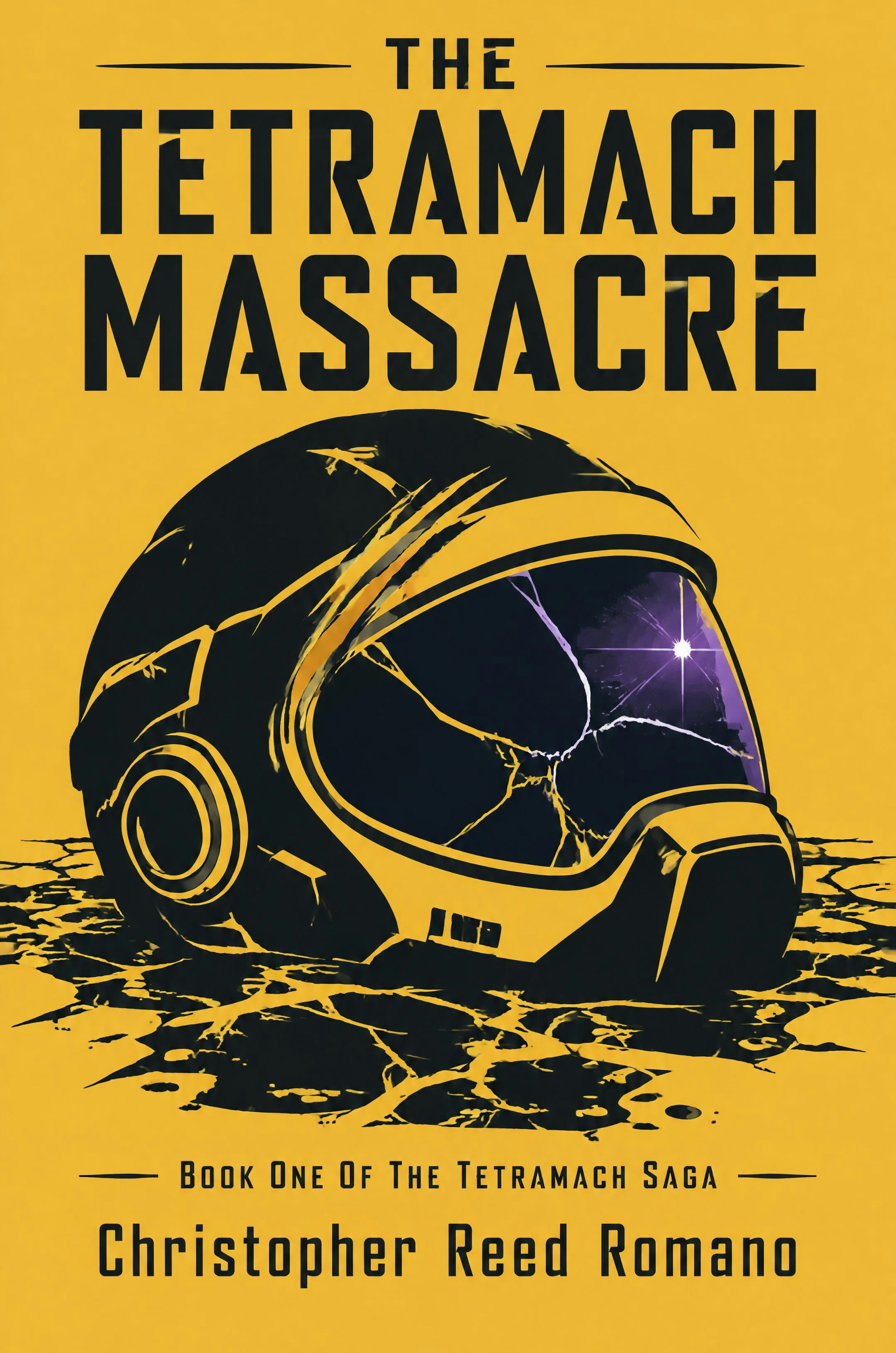
THE TETRAMACH MASSACRE
Book One Of The Tetramach Saga
by DarkBoyManoGaming Romano
On mineral-rich Tetramach, an expeditionary brigade is crushed between indigenous saurian warriors and a fanatical cybernetic crusade. Scout Sergeant James Mackridge volunteers for the rear guard so the fleet can flee. Then the crusade commander crashes an assault carrier into a native spire city, lighting fission fire that vitrifies the world into radioactive glass. Mackridge lives. On the waste he becomes the Night King. High Captain T'warhach T'wargha of the Cruc'kig swears vengeance, then an unspoken covenant, and together they slip into the Iron Cathedral to end atmospheric harvesters and a lord militant who never meant to win a planet. The massacre was not conquest. It was an invitation. A super-Earth machine mind, the Cold Watcher, is coming. Five years later warp-flashes stain the violet sky. Mackridge stands on glass again, ready to defend the deep hives. Military science fiction of asymmetric war, alien honor, and the cost of being left behind.
- Science Fiction
- Adventure
- Military Sci-Fi
- Space Opera
- Action Adventure
The Scent of Rotting Leaves
Seventy meters up, the brasalat tree moved with the wind in long, slow pulses that Mackridge had learned to anticipate like his own pulse. He hung in the crook where a secondary trunk split from the main bole, a nylon restraint line cinched through two D-rings on his chest plate, both boots braced flat against bark the color of old bruises. The tree's resin ran in thick amber beads from a dozen cracks along the branch above him, and every few minutes a bead broke free and fell, catching faint green light from bioluminescent fungus colonies forty meters below before it vanished into the leaf litter.
He had been coated in that resin for six hours.
It started as tactical improvisation three weeks back, when his suit's standard thermal dampening paste ran out and left him with nothing but the Mark IV's passive heat sink and his own judgment. The brasalat trees wept resin that, when cut raw from the bark and worked between gloved palms until it went tacky, could be smeared across a scout's chest plate and shoulder cowl in a layer thick enough to disrupt his own infrared signature. The chemistry was crude. It worked because the trees themselves ran hot, their vascular systems pumping sap heated by bacterial fermentation inside root nodules the size of fuel drums, and that ambient heat bath blinded anything hunting for a human-shaped thermal bloom in the canopy. Mackridge smelled like a dying tree. He had decided he could live with that.
The suit's heat sink gauge, a dim amber readout stitched into the lower left corner of his visor, held steady at nineteen percent saturation. He had throttled his servo assist down to minimum, enough to keep the knee actuators from locking under his own body weight, nothing more. No walking, no climbing, no venting. Just stillness, and the patience that stillness demanded.
Below him the canopy fell away in three distinct layers, each one darker and more entangled than the last, until the ground itself disappeared beneath a ceiling of broad fan-leaves that trapped the day's heat and released it slowly through the night like a baking kiln cooling down. The air down there did not move. Up where Mackridge hung, it moved constantly, pushed by thermals rising off the valley floor, and he had learned to read those currents the way sailors once read waves, feeling for the subtle temperature gradients that meant a patrol had passed through brush two hundred meters off, or that a predator bird had settled somewhere out of sight to digest a kill.
The Cruc'kig war camp occupied a natural clearing four hundred meters southeast of his position, carved out of the jungle by what looked like controlled burns decades old, the char long since swallowed by secondary growth that the saurians had cut back and kept cut back with the patient discipline of a species that did not waste effort. Mackridge had spent two nights mapping it through his visor's low-light overlay, logging structure counts and traffic patterns into a notebook he kept folded inside a watertight pouch at his hip, old habits from a scout school that no longer existed in any meaningful sense, taught by instructors who were almost certainly dead on worlds Mackridge would never see again.
The shelters were built from quadruped bone, enormous curved ribs lashed together with sinew cord and draped in cured hide that had gone the color of wet slate. Mackridge guessed the bones came from something like a bison or a rhinoceros, some grazing animal large enough that a rib alone could span three meters, and the Cruc'kig had learned to bend and season that bone into load-bearing arches the way human engineers once bent steel. He counted eleven shelters from his current vantage, though he knew the camp extended farther than his sightline permitted, hidden behind a shoulder of raised ground thick with climbing vine.
Strung between the shelters on cord lines, swaying gently in the warm air, hung predator teeth the length of a man's forearm, serrated along one edge and polished to a dull shine along the other. Mackridge had studied them through his visor's magnification the first night he found the camp, close enough to make out the faint crust of residue packed into hollow channels bored through each tooth's root. Neurotoxin, almost certainly extracted from the venom glands of whatever apex predator had once owned those teeth, dried and concentrated and stored inside the bone itself like a crude ampoule. He had no idea whether the teeth were weapons, warnings, or something closer to religious iconography, trophies hung to ward off whatever the Cruc'kig feared in these woods. He suspected all three. A species that built war camps out of the bones of what it killed did not waste symbolism any more than it wasted effort.
A soft chattering whistle rose from somewhere high in the canopy to his left, three notes repeated and then silence, the call of one of the small gliding lizards that infested the upper branches and fed on insects drawn to the brasalat resin. Mackridge did not turn his head. He had catalogued that call on his second night in the tree and confirmed it was no threat, just another voice in the suffocating chorus of a jungle that never, not once, fell completely silent.
His HUD blinked a soft amber warning in the lower right quadrant. Movement, four hundred meters, bearing one-nine-five. He eased his head three degrees to the right, careful not to disturb the branch beneath him, and brought his passive optics to bear on the camp's northern edge.
They came out of the tree line in column, fourteen of them by his count, moving with the loose, economical gait of soldiers who had marched this route a hundred times before and expected nothing from it. Dark blue chitin, nearly black in the understory shade, segmented across their torsos and down the long muscular tails that swept low behind them, brushing fern fronds aside without disturbing them enough to betray the patrol's passage to anything less patient than Mackridge. Each warrior carried a breech-loading rifle slung across a shoulder harness, the weapons long and heavy, built for saurian hands with four fingers and a reversed thumb, stocks carved from some dense black wood that looked hand-fitted rather than machined. Mackridge had seen those rifles fire exactly once, three weeks back, from a distance of six hundred meters, and the round that came out of the breech had taken the top off a Hermes trooper's skull with the flat, contemptuous ease of a hydraulic press crushing a tin can.
He did the math anyway. It was reflex, not intention. The officer walked third from the front, distinguishable by a strip of pale hide knotted around the base of the tail and a secondary weapon, something shorter and more ornate, slung across the chest rather than the back. Four hundred meters, slight downward angle, no wind he could detect through the canopy gaps. The Kaufman-Arisaka's suppressed subsonic load would reach that range with enough energy to put a round through chitin plate if the shot broke clean, and from this elevation, with the patrol strung out in a column that offered no cover against a strike from directly above, Mackridge calculated he could put down the officer and at least four more before the rest scattered into the brush.
And then he would have thirteen angry Cruc'kig soldiers with breech rifles converging on a single human clinging to a tree seventy meters above a war camp with no second position, no support, and a suit running on a heat sink he could not vent without lighting himself up like a flare for anything watching the thermal spectrum within five kilometers.
He lowered the Forty-Four’s muzzle two degrees, taking the officer out of the sight picture, and eased his finger off the trigger guard entirely. Not today.
The column passed beneath him without slowing, their tails cutting soft parallel grooves through the leaf litter, and Mackridge tracked their bearing through a gap in the canopy until the trees swallowed them whole. Northeast. Toward the plains, toward the edge of the vitrified flats where the jungle gave up its fight against the ash and the glass began. He filed the bearing away alongside the rest of what he'd gathered, the shelter count, the resin reserves, the patrol interval, all of it useless intelligence unless he found someone left alive to report it to, and for three weeks running that someone had mostly been himself.
The resin on his chest plate had gone tacky again in the heat, and Mackridge worked his jaw slowly, feeling the dry crack of his own lips beneath the breather seal. His water reserve sat at just under a liter, rationed out in careful sips through a tube that ran up inside his collar, and he had learned not to think about thirst until the suit's internal gauge dropped below a quarter. Thinking about it early only made the thirst worse.
He gave the patrol another ten minutes before he moved, counting seconds in his head the way he'd counted them since before Tetramach, since a classroom on a transport ship where an instructor with a Midwestern accent had drilled timing discipline into recruits half-asleep from gravity sickness. When the ten minutes passed and his passive audio picked up nothing but insect drone and the distant creak of settling branches, Mackridge began his descent.
The rope ladder he'd rigged into the brasalat's secondary branches three weeks back had rotted through in two places, chewed by something with small sharp teeth that left droppings like black rice along the rungs, and he bypassed the worst of it by dropping from branch to branch with his restraint line paying out behind him on a friction brake, boots finding purchase on limbs slick with condensation and resin both. The suit's servos whined faintly under the strain, pitched low enough that he doubted it carried beyond ten meters, and the heat sink gauge ticked up two points before he reached the lowest branch, forty meters above the ground, where the canopy thickened into an impenetrable ceiling that blocked out what little daylight survived this deep in the forest.
From there he climbed down the trunk itself, using the deep vertical fissures in the bark as footholds, moving with the deliberate unhurried care of a man who understood that a broken ankle this far from anything resembling support was a death sentence measured in days rather than hours.
His boots touched the forest floor with a soft compression of wet leaf mold, and Mackridge held perfectly still for a slow count of thirty, letting his audio pickups and the suit's passive sensor suite sweep the immediate area before he committed to movement. Nothing answered back but the endless insect static and, somewhere off to the north, the low rolling rumble of something large moving through brush far enough away that it posed no immediate concern.
He found the dry creek bed two hundred meters southwest, exactly where his mental map said it would be, a shallow channel cut through red clay that had not seen water in what looked like months, its bed cracked into plates the size of dinner trays. The creek ran roughly northwest to southeast, offering a natural corridor beneath the canopy where the undergrowth thinned enough to permit silent movement without the suit's servos snagging on vine or root, and Mackridge dropped into a low crouch and began working his way along it, boots finding the cracked clay plates and testing each one's give before committing his weight.
The walls of the creek bed rose a meter and a half on either side, lined with exposed root systems that had once drawn water from the channel and now hung bare and skeletal, pale roots dangling like something flayed. Mackridge moved with his Forty-Four held low and angled across his body, muzzle tracking his eye line by habit rather than conscious thought, a discipline so deeply worn into him that he no longer registered it as effort.
Sweat ran down the channel of his spine inside the suit's internal padding, pooling at the small of his back where the padding had worn thin months ago and never been replaced because there was nothing left to replace it with. The suit smelled, as it always did after hours of sustained wear, of old sweat and recycled breath and the faint bitter tang of the chemical scrubber cartridges that kept his air breathable, a combination so familiar he'd long since stopped noticing it except in moments like this, when his mind had nothing else to occupy itself with and drifted toward the body's complaints.
The creek bed bent sharply south after four hundred meters, cutting through a shoulder of raised ground thick with the climbing vines the Cruc'kig favored for binding their bone shelters, and Mackridge paused at the bend to check his bearing against the faint directional glow of his wrist compass, its needle floating in a bath of luminescent gel that had dimmed over the years to a weak amber smear.
Northwest. Toward the valley he'd marked on an earlier patrol, a fold in the terrain deep enough and narrow enough that almost no ambient light reached its floor even at midday, a place he'd used twice before as a waypoint when the jungle's canopy grew too dense to track the sun's position and he needed somewhere dark enough to let his optics recalibrate without risking a visible glow. He angled his course toward it now, less out of urgent need than habit, the accumulated instinct of a man who had learned that survival in this jungle meant never taking the same path twice, never resting in the open, and always, always having a dark place to retreat into when the suit's heat sink crept past the point where stillness alone could manage it.
The gauge read twenty-six percent when he reached the valley's lip, an unassuming fold where the ground simply dropped away into shadow, the canopy overhead knitting so tightly together that even the fungal bioluminescence that lit most of the forest floor failed to penetrate. Mackridge stood at the edge for a long moment, listening, before he started down the slope on a diagonal, boots finding the loose scree beneath a mat of dead leaves with the careful, silent placement of a man who had broken too many things in his life to risk breaking an ankle over carelessness now.
He did not expect to find anything waiting for him in the dark. That was, in its own way, the entire point of the valley. Nothing came here because nothing could see to come here, and Mackridge had built three years of survival on exploiting exactly that kind of blind spot in a jungle that otherwise saw everything.
His visor's thermal overlay flickered as the ambient temperature around him dropped, the valley floor pooling cooler air the way low ground always did, and for a moment the whole display washed in a uniform, comfortable blue that told him nothing lived close enough to register.
Then the overlay resolved a single shape, seven feet of dense muscle mass radiating body heat in a profile unmistakably saurian, standing utterly motionless at the valley's far wall, less than thirty meters from where Mackridge had just planted his boot.
He froze mid-stride, weight still balanced over his trailing leg, and every system in his body dropped into flat, airless stillness.
The shape did not move. Mackridge's visor fed him a passive scan, resolving detail out of the thermal bloom the way a developing photograph resolves out of chemical bath, and the detail that emerged turned his mouth dry in a way three hours of jungle heat and resin fumes had not managed.
Four eyes. Even in thermal, even at this range, he could make out the paired bioluminescent organs mounted above a narrow saurian skull, each eye a small separate heat source distinct from the rest of the head's signature, and all four of them were angled directly at him.
Mackridge's hand found the Forty-Four's pistol grip without conscious instruction, his thumb resting against the safety tab, and for three seconds his entire mind narrowed down to the mechanical question of whether he could bring the weapon to bear and break the first shot before whatever stood across that valley closed thirty meters of open ground.
He did not raise the rifle.
It was not courage; it was arithmetic. If the shape across the valley had wanted him dead, it would already have moved, because nothing stayed that still, that patient, unless stillness itself was the weapon. a creature that had not charged in those three seconds was waiting to see what he did next, and Mackridge had learned, somewhere in the long attrition of the last three years, that the fastest way to die in this jungle was to answer patience with panic.
He lowered the rifle's muzzle, slow and deliberate, until it pointed at the loose scree between his own boots rather than across the valley floor, and he held it there.
The shape's four eyes tracked the motion. Mackridge saw it in the thermal bloom, a faint shift in the angle of the heat signature's upper mass, and he understood with a certainty that chilled him worse than the cold valley air that whatever stood across from him had seen him lower the weapon and had registered exactly what that gesture meant.
Neither of them moved.
Mackridge's visor clock, a thin green digit ticking away in the corner of his display, marked the minutes in a steady, indifferent crawl. One minute. His own pulse hammered loud enough in his ears that he wondered, absurdly, whether the audio pickups built into his helmet might somehow transmit it outward, betray him with the simple fact of a frightened heart beating too fast in a chest that was supposed to know better.
Two minutes. The cold valley air seeped through the suit's seals at his wrists and throat, raising gooseflesh along skin that had not felt genuine cold in longer than he cared to calculate, and still the shape across from him did not move, did not shift its weight, did not so much as flick the long tail that trailed off into shadow behind it.
Three minutes. Mackridge let his breathing slow, deliberately, the way he'd been trained to do under fire a lifetime ago, four counts in, four counts held, four counts out against the inside of his breather seal, and with each cycle the hammering in his chest eased by degrees until he could hear, beneath it, the valley's own quiet, the distant drip of condensation somewhere off to his left, the faint electrical hum of his own suit's idling servos.
Four minutes. The shape moved.
It did not charge. It did not raise a weapon, though Mackridge's thermal overlay now resolved enough secondary detail to confirm the long, curved blade strapped diagonally across its back, a weapon easily as tall as Mackridge himself, its pommel wrapped in something that radiated almost no heat at all, old leather or cured hide gone cold and dead with age. The shape simply turned, unhurried, the motion economical and complete, and stepped backward into the deeper darkness at the valley's edge, where a wall of broad fronds hung thick enough to swallow a body twice its size.
Mackridge watched the heat signature dim as it withdrew behind the first layer of foliage, then the second, the thermal bloom fracturing into smaller and smaller fragments of warmth visible through gaps in the leaves until, within another ten seconds, it vanished entirely, swallowed by whatever deeper shadow lay beyond the fronds.
When he finally eased himself down into a crouch at the valley's lip, back against the cool clay of the slope, Mackridge became aware that his hands, still gripping the Forty-Four's stock, had begun to tremble, a fine, involuntary shiver that ran from his fingers up through his wrists and into the muscles of his forearms. He let the rifle rest across his knees and flexed his fingers twice, slow, until the tremors settled, and only then did he allow himself to consider, in the flat and careful manner that had kept him alive through things that should have killed him twice over, exactly what had just happened to him in the dark.
Something had seen through the brasalat resin.
That was the fact that mattered. The Mark IV's camouflage suite, even running at reduced servo load with his own resin coating layered over the top, had been engineered by people on a world Mackridge would probably never see again specifically to defeat passive thermal detection at close range. He had tested it himself, more times than he cared to count, against the hunter-packs deployed across the outer perimeter, and it had held. It had held against cybernetic optics tuned to a dozen different spectra, against sensor drones that could pick out a rat's heartbeat from two hundred meters.
It had not held against four amber eyes in a dark valley.
Mackridge turned that fact over slowly, the way he turned over a jammed cartridge before deciding whether to clear it or discard the whole weapon, and he found no comfortable place to set it down. Either the suit's camouflage had failed in some mechanism he did not yet understand, degraded by three years of field use and improvised repairs that had never once been inspected by anyone with proper tools, or the thing across the valley had senses that did not care about infrared signatures at all, that read the world through some channel entirely its own, scent or vibration or something stranger that no engineer back on any human world had ever accounted for when they built his armor.
Both possibilities led to the same conclusion. He was not as hidden as he had told himself he was, and he had been telling himself that particular lie for longer than was safe.
He wondered, not for the first time, what else moved through this canopy with senses tuned to catch things that a suit of powered armor could not hide from.
Mackridge drank from his water tube, two careful swallows, no more, and let the valley's cold settle into him until his pulse returned fully to its normal resting rhythm. Then he checked his heat sink gauge, confirmed it had dropped to twenty-two percent in the cool pocket of air pooling at the valley floor, and began, with the same unhurried discipline that had carried him this far, to plan his route back out.
The jungle above the valley rim had gone fully dark by the time Mackridge climbed back out, the canopy's last filtered daylight finally extinguished somewhere in the hour he'd spent motionless at the valley's edge, and he moved now by the pale green wash of his visor's low-light overlay, every shape rendered in flat contrast against a background the color of decayed moss.
He did not return to the brasalat tree. Three weeks in one position was already longer than his own doctrine allowed, a rule he'd broken because the tree's resin reserves made it too valuable a hide to abandon on schedule, and the encounter in the valley had just handed him every reason he needed to break camp entirely. Whatever had watched him from across that dark ground knew, at minimum, that something with a human silhouette and a suit full of heat-generating servos moved through this stretch of jungle. Mackridge had no intention of making himself easy to find twice.
He worked his way east along a game trail he'd scouted two weeks prior, boots finding the packed earth with the economy of a man who had walked this exact ground before and remembered every root, every loose stone, every place where the canopy thinned enough to risk a glance skyward and check his bearing against the faint smear of starlight that made it through. The trail climbed gradually, following the natural grade of a ridge that would, eventually, if he stayed on it another six kilometers, bring him within sight of the glass flats, that endless vitrified wasteland where the jungle simply stopped and the badlands began.
He had not decided yet whether he was heading there. The decision would make itself, as it usually did, somewhere in the gap between what his supplies allowed and what his instincts told him about the ground ahead.
An hour into the march, with the heat sink gauge climbing back toward 30 percent from the exertion of sustained movement, Mackridge stopped at a fallen log thick enough to sit astride and allowed himself five minutes of stillness, the suit's servos idling down to their lowest draw while he listened to the jungle settle around him.
It was in that stillness that the memory surfaced, unbidden, the way memories always did when his guard dropped low enough to let them through. Not of the valley. Of before Tetramach, before any of this, a cramped classroom aboard a transport ship with recycled air that tasted faintly of machine oil, and an instructor, a woman with a flat Midwestern accent and a voice that never once rose above a conversational register, standing in front of a tactical display and saying the same thing she said at the start of every lesson: the enemy you can see is rarely the one that kills you.
Mackridge had been twenty-two years old then, young and untested, and he had taken the lesson as abstract doctrine, something to be memorized and regurgitated on an exam and then set aside in favor of the more immediate business of learning to strip and reassemble a weapon in under ninety seconds with his eyes closed.
He understood it now in a way that had nothing abstract left in it at all. Something in that valley had looked at him with eyes that did not need infrared to find a target, and it had chosen, for reasons Mackridge could not begin to guess at, not to kill him when killing him would have cost it almost nothing.
He sat with that thought until his five minutes ran out, then rose, checked his bearing, and kept moving.
The ground changed character as he climbed, the thick leaf mold of the valley floor giving way to a harder, rockier soil threaded with root systems that had adapted to shallower purchase, and Mackridge found himself picking a more careful path, testing each foothold before committing his weight, aware that a twisted ankle out here, alone, with no support and a thermal signature that had apparently already been compromised once tonight, would be the kind of mistake that ended careers measured in corpses rather than courts-martial.
He crossed a second dry creek bed an hour later, shallower than the first and running in a different direction entirely, and paused at its edge to check his compass against the faint directional glow still bleeding through gaps in the canopy far above. The needle had drifted slightly from true, a known defect he'd catalogued months ago and compensated for with a mental correction factor, three degrees east of whatever the gel actually indicated, and he adjusted his course accordingly before pressing on.
It was somewhere past the second creek bed, with the heat sink gauge sitting at thirty-four percent and the first faint ache beginning to build behind his eyes, the early warning his body gave him before thermal stress turned into something worse, that Mackridge allowed himself to think, properly, about what he had seen.
Only one detail remained in the arithmetic: those four amber eyes. In the dead black of that valley, they had burned straight through his resin-soaked thermal baffles. No predatory lunging. No adrenaline spikes. Just four optic apertures adjusting their focal depth, registering his outline, and logging the firing solution before deciding to hold fire.
He had encountered Cruc'kig patrols before, dozens of times across three years, had watched them move through the jungle in disciplined columns and had, on three separate occasions, been close enough to put a round through an officer's skull before deciding against it. He had never, not once, encountered anything that stood alone, unhurried, in a place as deliberately dark and hidden as that valley, and had never encountered anything that looked directly back at him with the calm, unblinking certainty of a creature that already knew precisely what it was looking at.
Mackridge did not believe in omens. Three years alone in an irradiated wasteland had a way of stripping superstition out of a man entirely, replacing it with a cold and exhausting literalism about cause and effect, about what killed you and what didn't and why. But he found himself, despite that literalism, unable to shake the sense that the encounter in the valley had been something other than coincidence, that whatever stood across that dark ground had come there specifically because it knew, somehow, that Mackridge would eventually pass through.
He pushed the thought aside, not because it was wrong but because it was unproductive, and returned his attention to the ground ahead, where the trail bent north around a shoulder of exposed rock and the canopy, for the first time in hours, showed a genuine gap wide enough to let starlight through in more than isolated patches.
Mackridge stopped beneath that gap and tilted his head back, visor dimming its low-light overlay automatically to compensate for the sudden increase in ambient light, and looked up at a sky he had not seen clearly in weeks.
It was not the sky he remembered from before the imperial vanguard landed, before heavy kinetic strikes scarred the continent. Here, deep enough in the jungle's interior that the ash hadn't yet settled in any meaningful concentration, the stars still showed clean and sharp, unfiltered, the way Mackridge remembered them from a childhood spent on a world that no longer mattered to anyone but him.
He found himself thinking, briefly and without warning, of the brigade, of Keoghan's dropships lifting off from a makeshift field three years gone, of twelve hundred soldiers who had volunteered alongside him to buy time for an evacuation none of them expected to survive to see completed. He did not know how many of them were still alive. He suspected the number was small enough that he could count it on both hands, and some nights, in his worst moments, he suspected the number was simply one.
The memory was cut off by procedural discipline. Mackridge dropped his gaze straight to his forearm control housing, keying the suit’s internal diagnostics before old ghosts could cost him his edge. A single amber fault pulsed on his wrist console: the right ankle servo coupling was running two hundred millivolts hot, fouled by pulverized bark grit and coagulated brasalat sap. He popped the diagnostic latch, unhooked a brass pick from his belt kit, and cleared the seal groove with steady, methodical scrapes until the telemetry cleared to baseline green.
He lowered his gaze from the gap in the canopy and kept moving, the heat sink gauge climbing steadily now toward the thirty-eight-minute threshold where the paraffin-lithium phase-change material inside his suit's core would finish liquefying and the real climb would begin, one degree and eight-tenths of a degree Celsius for every minute after that, climbing toward a ceiling that ended, eventually, in either cognitive failure or death, depending on how long Mackridge let the stupidity of pride keep him from venting.
He found his vent point forty minutes later, a shallow depression where a spring surfaced briefly before disappearing again into the rocky soil, cold water pooling ankle-deep in a basin no larger than a dinner table. Mackridge crouched at its edge, checked his surroundings with a full sweep of his passive sensors, and when nothing registered, he knelt and pressed both gauntleted palms flat into the frigid water, holding them there while the suit's internal thermal management routed waste heat through the glove assemblies and bled it away into the pool in silent, invisible increments rather than venting it skyward as an infrared flare.
It was a slow method, inefficient compared to a proper vent cycle, but it was quiet, and quiet was worth more to Mackridge than efficiency had been in longer than he cared to calculate. He held the position for twelve minutes, watching his heat sink gauge creep back down from thirty-eight percent to twenty-nine, and in that stillness, kneeling at the edge of a cold spring deep in a jungle that had very nearly killed him twice in one night, he found himself turning the valley encounter over once more, unable to leave it alone.
The blade. He kept returning to the blade, to its size and the particular way it had been strapped diagonally rather than vertically, a configuration that suggested a draw technique Mackridge did not recognize from the handful of close engagements he'd survived against Cruc'kig warriors armed with shorter weapons. Whatever carried that blade was built differently than the rifle-armed patrols he'd watched march beneath his tree, carried itself with a bearing that read, even through the flattening lens of thermal imaging, as something closer to rank than to rank and file.
He thought, not for the first time, that this jungle held more variation among its defenders than his three years of observation had accounted for. It was raw operational data with no forward base to receive it, unlogged and useless until tested against another contact.
When the gauge read twenty-nine percent and held steady, Mackridge withdrew his hands from the water, flexed his fingers against the gauntlets' resistance to restore circulation, and rose from his crouch. The sky above the gap in the canopy had shifted slightly in the time he'd spent kneeling there, the stars wheeling through their slow nightly arc, and he used their new position to confirm his bearing one final time before continuing north along the ridge.
The ground steepened as he climbed, the game trail narrowing until it disappeared entirely into a stretch of bare rock scoured clean by ancient mineral runoff, the air heavy with the suffocating humidity and the sour, rotting reek of decaying vegetation that bled upward from the canopy floor below. Mackridge picked his way across the exposed shelf with the same unhurried caution he'd maintained since leaving the valley, testing each foothold before committing his weight, listening between each footfall for anything that might indicate he was no longer alone.
Nothing answered. The jungle's insect chorus continued its endless, indifferent drone, the occasional chattering whistle of a gliding lizard high overhead, the distant creak of branches settling under their own weight, and beneath all of it, the vast and patient silence of a biosphere that had existed for longer than Mackridge's entire species had possessed the capacity for spaceflight, a silence that did not care whether he lived to see morning or not.
He reached a second ridge an hour before what passed, in this deep jungle, for dawn, a thin gray lightening of the canopy's uppermost leaves that filtered down in fragments too weak to properly be called daylight. The ridge gave him a sightline, through a gap in the trees, toward the northeast, toward the direction the patrol he'd watched beneath the brasalat tree had marched, and toward the direction, further still, where the jungle finally surrendered to the glass.
Mackridge crouched at the ridge's edge and studied that horizon for a long moment, his visor's magnification pulling the distant tree line into sharper focus, searching for any sign of the plains beyond, the pale shimmer of vitrified ground that even at this distance sometimes caught enough ambient light to register as a faint band along the horizon.
He saw nothing yet. The glass flats remained beyond his current sightline, hidden by miles of unbroken canopy, and Mackridge allowed himself a moment of something that was not quite relief, only the absence of a problem he did not currently have the resources to solve.
He settled into a new position at the ridge's crest, where a cluster of boulders offered enough cover to break his silhouette against the lightening sky, and began, methodically, the small rituals of a scout settling into a temporary hide. He checked the Forty-Four's action, working the bolt back far enough to confirm a round still sat chambered, the steel scaled with a faint patina of condensation that he wiped away with a corner of cloth kept folded inside his gauntlet for exactly that purpose. He checked his water reserve, confirmed it had dropped to just under eight hundred milliliters, and made a mental note to locate another spring before the day's heat forced him to ration more aggressively than he already did. He checked the heat sink gauge one final time, confirmed it had stabilized at twenty-six percent with his servos idling at their lowest sustainable draw, and only then did he allow his shoulders to drop fractionally, the closest thing to rest his body permitted him anymore.
The gray light overhead thickened, by degrees, into something that could almost be called morning, though true sunrise in this jungle never arrived as a clean event, only as a gradual brightening that crept down through successive layers of canopy until the forest floor itself finally registered enough light to cast shadows. Mackridge watched that process unfold from his position among the boulders, his mind working through the night's events with the same patient, unhurried thoroughness he applied to everything else that threatened to kill him.
Something in the jungle had eyes that did not care about his suit's camouflage suite. Something in the jungle carried a blade long enough to split a man in half and chose, when given the opportunity, not to use it. Mackridge did not know what to make of either fact in isolation, and he suspected he would not understand their full weight until they combined, eventually, into something he could no longer treat as an isolated anomaly.
He thought of the predator teeth hanging between the bone shelters, their hollow roots packed with dried venom, and wondered whether the thing in the valley had been something the Cruc'kig themselves feared, some apex predator that moved through even their fortified camps with impunity. He thought of the blade's size, the particular quality of patience in those four amber eyes, and found that explanation sitting uneasily alongside everything else he had observed about this jungle's actual predators, which hunted in packs, which struck fast and retreated into cover, which had never, in three years of careful observation, demonstrated anything resembling the deliberate, considered stillness he had witnessed in that valley.
A predator did not wait four minutes to see what a potential meal would do. A predator struck, or it withdrew, driven by hunger and risk calculation in roughly equal measure. What had stood across that valley floor had done neither. It had watched him, weighed him, and made a decision that had nothing to do with hunger at all.
Mackridge did not have a word for what that implied, not yet, and he set the question aside the way he set aside every question that threatened to cost him more attention than his current survival margin allowed. The jungle demanded a narrow kind of focus if a man wanted to keep breathing in it, and Mackridge had learned, through attrition and loss in equal measure, to give the jungle exactly what it demanded and nothing more.
He ate, finally, pulling a ration bar from the sealed pouch at his hip and working it down in small, deliberate bites, the paste inside tasting of nothing in particular, some engineered blend of protein and preserved sugar that had long since lost any pretense of flavor through three years of identical meals. He chewed slowly, swallowed with effort against a throat gone dry from the night's exertion, and washed the last of it down with a careful sip from his water tube, rationed against a reserve that would not last past tomorrow without resupply from another spring.
The forest around him continued its slow transition into morning, shafts of pale light beginning to break through gaps in the high canopy and strike the understory in scattered, shifting patches that moved as the branches far above swayed in a wind Mackridge could not feel from where he crouched. A pair of gliding lizards launched themselves from a branch thirty meters distant, their membranous wings catching the thin morning air with a sound like canvas snapping taut, and Mackridge watched their flight without alarm, cataloguing it, as he catalogued everything, against the baseline of normal jungle behavior he'd built up over three years of watching and listening and surviving on the margin between observation and action.
He thought, as the light continued to strengthen and the jungle's night chorus gave way by degrees to the different, busier chorus of its daylight hours, about High Colonel Martin, about Keoghan, about faces he had not seen in three years and suspected he never would again. He thought about the twelve hundred soldiers who had volunteered alongside him into a rear guard that everyone involved understood, even as they volunteered, carried almost no realistic chance of survival. He thought, briefly, about his own survival, which felt increasingly to him like an administrative error rather than an achievement, a clerical mistake in whatever cosmic ledger kept track of who was supposed to live and who was supposed to die on a world like this one.
He did not dwell on any of it. The habit of not dwelling had become, over three years, almost a physical reflex, something his body executed independent of conscious will, the way a hand pulls back from a hot stove before the mind has finished registering pain.
What he dwelled on instead, because it was useful, because it demanded something of him that grief did not, was the valley. The four amber eyes. The blade strapped across a back built from muscle and chitin in proportions that suggested strength Mackridge's own suit, for all its servo-assisted power, might struggle to match in direct contest.
He thought about what it would mean, going forward, to assume his camouflage suite no longer guaranteed concealment against every threat this jungle contained. He thought about the patrols he'd watched march beneath his tree, about the rifle-armed Cruc'kig soldiers whose discipline and training read as conventional, almost familiar, set against the memory of that solitary figure in the dark valley, whose stillness had felt like something else entirely, something older and more deliberate than mere military drill.
He did not know, crouched among the boulders with the morning light slowly filling the jungle around him, that the figure he had encountered carried a name, or a rank, or a grief of her own deep enough to match anything he carried. He knew only that something in this jungle had looked directly at him through every layer of concealment his beleaguered expedition had equipped him with, and had chosen, for reasons he could not yet begin to guess at, to let him walk away.
Mackridge finished the last of his ration bar, folded the empty wrapper into a small, tight square, and tucked it into the waste pouch at his belt, a habit maintained less out of environmental concern than the hard tactical reality that discarded wrappers left a trail, and trails killed scouts who got careless. He checked the heat sink gauge one last time, confirmed it had settled at a sustainable twenty-two percent, and rose from his crouch among the boulders to continue his march north, toward whatever ground lay between him and the northern ridges, carrying the memory of four amber eyes in the dark like a stone he could not quite set down.
The Root and the Rockrete
The razor-fronds began four kilometers short of Outpost 9, where the jungle's canopy thinned into something the old survey maps had called transitional scrub and the surviving scouts simply called the knife garden. Mackridge moved through them with his forearms crossed in front of his visor. The Mark IV's gauntlets took the brunt of the strike. The…