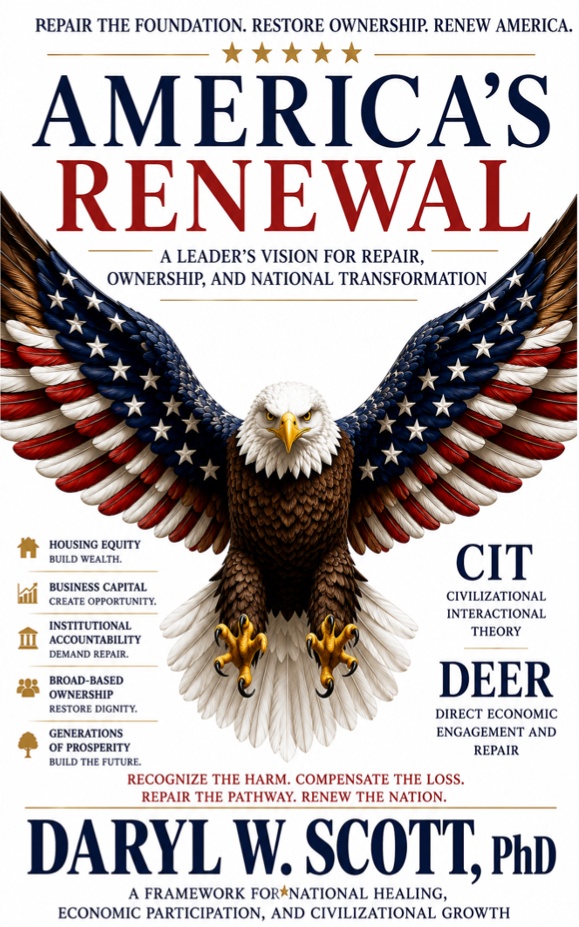
AMERICA'S RENEWAL
A bold blueprint to close the wealth gap and restore the American dream
by Daryl Scott
The American promise is broken, but it is not beyond repair. For decades, the engine of American prosperity has stalled for the working class and the descendants of those who built this nation. In America's Renewal, Daryl Scott delivers a profound diagnosis of our systemic failures through the lens of Civilizational Interactional Theory (CIT). He reveals how our national ownership pathways were intentionally designed yet selectively restricted, leaving millions trapped in a cycle of survival rather than growth. This isn't a book of symbolic gestures or political platitudes. It is a mission plan. Scott introduces the DEER (Direct Economic Engagement and Repair) framework—a $3 trillion strategic mobilization designed to catalyze housing, business capitalization, and institutional accountability. From the creation of the Office of Public Repair Accountability to the implementation of the Institutional Repair Ledger, Scott provides the 'ledger language' necessary to settle historical accounts and build future capacity. America's Renewal is a roadmap for any leader, entrepreneur, or citizen ready to move from managing national collapse to engineering national renewal. It is time to convert effort into ownership and ensure that 'Participation Freedom' becomes a reality for every American. The next ten years will define our century. This is the blueprint to get it right.
- Business & Entrepreneurship
- Historical Non-Fiction
- Educational & Academic
- Business Strategy
- American History
- Political Science
The Actor Network: Power, Profit, Control, and the Two Fields of American Life
People do not act alone.
We like to believe that individuals make choices in isolation, that hard work, discipline, faith, and responsibility determine outcomes. There is truth in all of that. Character matters. Choices matter. Agency matters.
But no person acts in empty space.
People act inside networks: families, jobs, churches, schools, banks, courts, markets, police systems, political parties, neighborhoods, media narratives, racial histories, class expectations, debts, fears, and survival demands. Their choices are shaped before they fully understand the shape of the choice itself.
That is what this book calls the Actor Network.
Defining the Actor Network
The Actor Network is the web of people, institutions, corporations, agencies, banks, churches, schools, courts, media systems, workers, voters, families, and communities operating inside American life. These actors may act independently, knowingly, unknowingly, or even against their long-term interest, but their relationships still produce connected outcomes.
This matters because America cannot be understood only as a conflict between good people and bad people. America is also a network of actors operating under pressure, some with enormous power, some with modest influence, and many simply trying to survive inside conditions they did not fully design.
The Dominant Systems Field and the Human Consequence Field
The Actor Network operates across two distinct fields.
The Dominant Systems Field is the upper operating layer of American life. It contains: federal government agencies, state and municipal systems, corporations and private equity, Wall Street and global finance, major media ownership, foundation networks and NGO structures, elite universities and research institutions, Federal Reserve and banking systems, and connected actors who operate primarily through Power, Profit, and Control at scale.
The Dominant Systems Field sets the rules, controls the capital, shapes the narrative, and decides whose harm gets recognized and whose repair gets funded.
The Human Consequence Field is Main Street. It contains: workers, families, youth, retirees, veterans, small business owners, consumers, voters, poor families, survival-class families, maintenance-class families, middle-class families under pressure, and communities absorbing the outcomes produced by the Dominant Systems Field.
The Human Consequence Field does not set the rules. It lives inside them. It experiences law as enforcement, credit as scarcity, housing as unaffordable, health as crisis, work as insufficient, and representation as distant.
This distinction matters because it protects ordinary people, Black and white, from being blamed for architectures they did not build. The working-class white voter did not design redlining. The poor Black grandmother did not create the GI Bill exclusion. The rural veteran did not write the insurance policy on enslaved people. They are all living inside consequences created above them.
Power, Profit, and Control
The Actor Network operates through three recurring engines: Power, Profit, and Control.
Power is the authority to decide, enforce, include, exclude, protect, punish, and define legitimacy. It appears most visibly in law, courts, government, and military force, but it also moves through institutional hierarchy, corporate governance, media ownership, and social capital.
Profit is the drive to extract, accumulate, preserve, and expand economic value. It operates through markets, finance, business formation, wages, contracts, land, banking, and investment. It is not inherently wrong, but when left without accountability, it extracts from communities without restoring ownership to them. The shareholder primacy doctrine, which demands that corporations exist primarily to maximize returns to shareholders, has contributed to decades of decisions that extracted from workers, communities, and public systems in the name of quarterly results.(12) Mills closed. Factories moved. Towns hollowed out. Pensions disappeared. Healthcare became a cost to minimize. And communities that built their lives around those employers were told to adapt.
Control is the management of behavior, perception, movement, identity, fear, dependency, aspiration, and what people imagine as possible. It operates through law and enforcement, but also through education, media, religion, culture, social pressure, debt, and the shaping of who believes they belong and who does not.
When these three engines interact across the Actor Network, they produce outcomes. Not always through conspiracy, but through the accumulated effect of aligned incentives, protected advantages, normalized exclusions, and survival pressures that push ordinary people to conform.
Constrained Actors
One of the most important concepts in this book is the Constrained Actor.
A Constrained Actor is a person, institution, worker, voter, church, school, small business, employee, officer, official, or community whose choices are narrowed by survival needs, debt, employment, fear, law, social pressure, race, class, institutional rules, or dependency.
Constrained Actors may reproduce systems they do not fully control because nonconformity carries real costs.
A worker may stay in a job that weakens his town because it is the only job with benefits. A voter may support a politics that does not build her wealth because it gives her identity, belonging, and a familiar sense of community. A police officer may enforce laws he knows are uneven because his badge comes with chains of command, institutional discipline, and a paycheck. A teacher may work inside a failing school because children still need someone in the room. A pastor may remain publicly silent about systemic harm because his congregation is divided and the building still has a mortgage. A politician may spend a career describing the problem because donors, party structures, and media cycles reward grievance more than repair.
These actors are not all equally responsible. Their power is not equal. Their harm is not equal. But they all operate inside the same network.
Inside the Actor Network, conformity is often not belief. It is survival.
A system becomes powerful when even those harmed by it must participate in it to survive.
Conformity Pressure
Conformity Pressure is the force that pushes actors to comply with systems, narratives, roles, or institutions in order to survive, belong, avoid punishment, maintain income, protect status, or preserve opportunity.
Conformity Pressure does not always look like force. Sometimes it looks like a paycheck. Sometimes it looks like a mortgage. Sometimes it looks like church tradition. Sometimes it looks like party loyalty. Sometimes it looks like the fear of being fired. Sometimes it looks like the fear of being alone.
Over time, people learn what can be said and what cannot. They learn where they can go and where they cannot. They learn when to comply, when to be silent, and when to accept less than what they deserve.
That is how systems endure across generations. They do not only dominate people from above. They recruit people into survival below.
Jim Crow as an Actor Network
Jim Crow was not only racial segregation. It was a functioning Actor Network organized through Power, Profit, and Control.
Power appeared in state law, courts, police, voting restrictions, segregation ordinances, and public policy.
Profit appeared in sharecropping, cheap labor, land denial, credit exclusion, wage suppression, business barriers, and convict leasing.
Control appeared in racial etiquette, violence, fear, humiliation, segregated schools, white-supremacy narratives, religious justification, newspapers, and the daily rules of behavior that told Black people how to walk, how to speak, where to look, and what to accept.
The central purpose of Jim Crow was not simply to keep people apart. It was to prevent Black freedom from becoming Black capital. Jim Crow's economic engine was the denial of ownership, wages, land, credit, business formation, political power, and institutional access. Segregation was the visible face. Capital denial was the engine underneath.
Not every white person owned the system. Many poor whites did not. But many were placed inside the Actor Network in ways that rewarded conformity to the racial order. Whiteness gave status, safety, belonging, and access even where wealth was limited.
Black people were placed inside that same network differently: constrained by violence, law, labor control, humiliation, exclusion, and survival pressure, forced to calculate every action through danger.
That is why Jim Crow cannot be fully understood only as hatred. It must be understood as a functioning racial-capital Actor Network.
Corporate Actors and Network Advantage
Corporate actors occupy a distinctive position in the modern Dominant Systems Field.
Corporations are legal and economic structures designed to organize capital, labor, markets, and return. They operate through profit incentives and are structured to pursue expansion, efficiency, market share, and shareholder value.
Corporate America can profit from Black consumers without building Black ownership. It can employ poor white workers while weakening local business competition. It can use public subsidies while avoiding deep community repair. It can sponsor diversity campaigns while limiting supplier equity and board representation. It can celebrate culture while owning the platform, the contract, the distribution system, and the profit.
This is not evil in every case. It is the predictable behavior of actors optimizing within a network designed without repair accountability. The repair implication is clear: if people act inside networks, then repair cannot focus only on individual behavior. It must repair the network itself.
CSFRO: The Civic Stability Assessment Approach
DEER does not move into communities blindly. Before repair begins, the field must be assessed.
Civic Stability for Renewal Operations, CSFRO, is the DEER operating model for that assessment and repair organization. It approaches broken civic environments not as failed populations but as communities requiring stabilization, capacity building, and accountable transfer of resources back to residents.
CSFRO asks six questions before deploying repair resources:
What are the current conditions? Housing, credit, business ownership, employment, health, school outcomes, voting access, and family stability are mapped.
What systems are operating in the field? Which institutions are present, which are absent, and which are extracting rather than building?
Where is the pathway failure? Where does the chain from work to wages, wages to savings, savings to ownership break down?
What local capacity exists? Who are the trusted leaders, local employers, civic organizations, veteran groups, faith institutions, and community builders already present?
What measurable outcomes are expected? Specific goals are set before repair investment is deployed.
What accountability exists? OPRA verifies outcomes, CAR learns from what works, and community scorecards are public.
This is not charity. This is not a government program no one can prove worked. This is a systematic civic assessment and repair protocol, the same discipline used to rebuild broken institutional environments, applied to the American home front.
The assessment does not lie. Communities may describe themselves as stable. Systems may report compliance. Officials may claim success. But CSFRO measures whether pathways are actually producing ownership, dignity, stability, and renewal in the lives of real families. The data tells the truth even when the press release does not.
Why This Chapter Comes First
This chapter comes before the history for a reason.
Before this book speaks fully about Black capital denial, white poverty, corporate power, and Jim Crow, it wants the reader to understand the frame.
This is not a book about hating people. It is a book about understanding relationships, about how people and institutions become positioned inside two fields: the Dominant Systems Field and the Human Consequence Field. About how survival can produce conformity. About how racial access can coexist with class exploitation. About how corporate power can benefit from both without repairing either.
Once we see the two fields and the Actor Network between them, we can tell the harder truth without losing each other.
The Ownership Pathway: How America Built the Architecture of Wealth
The American Dream was not only a feeling. It was a system.A set of interconnected policies, institutions, laws, programs, investments, and protections that, when accessed, could convert labor into wages, wages into savings, savings into property, property into equity, equity into inheritance, and inheritance into generational power.That is the own…