

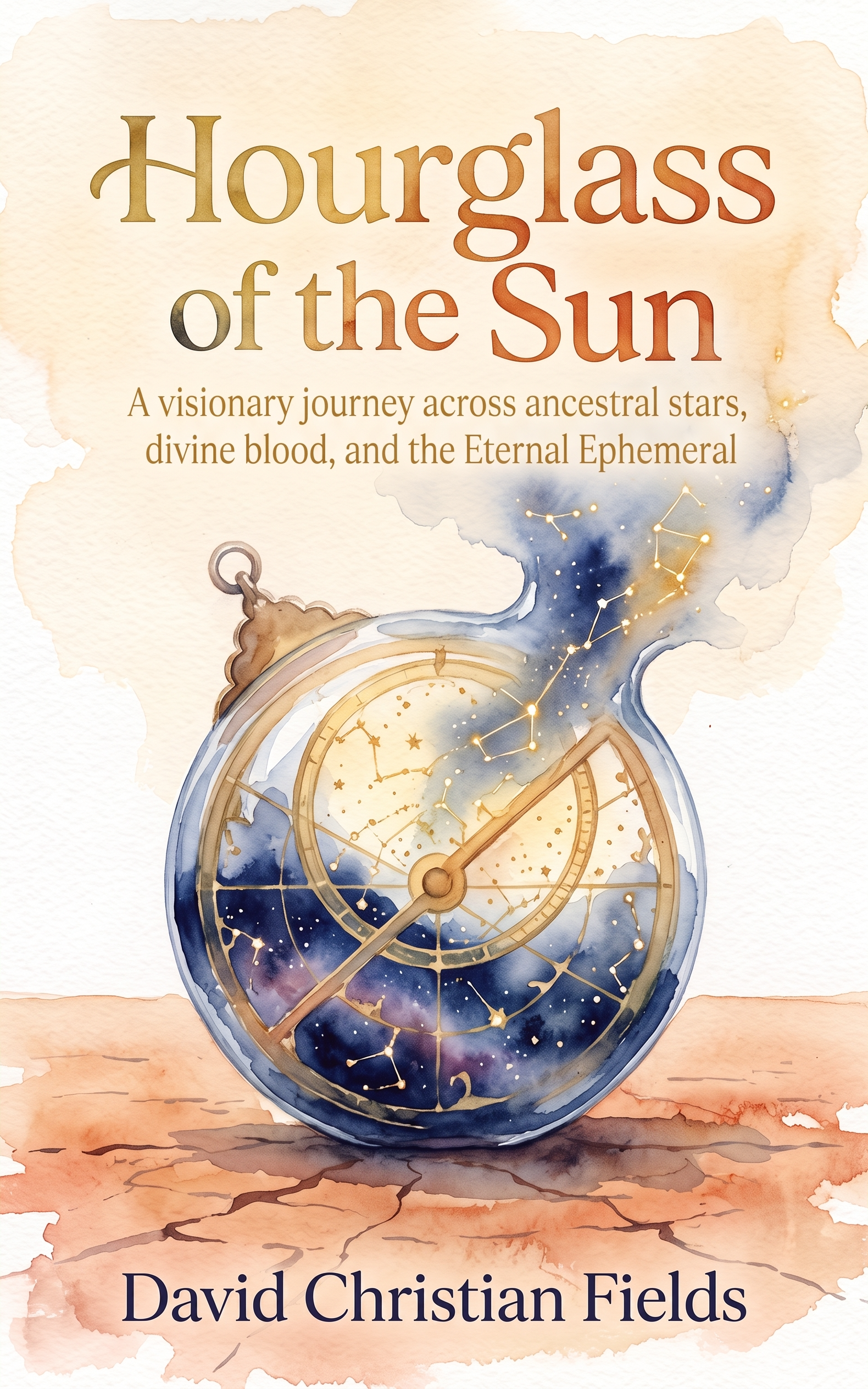
Hourglass of the Sun
A visionary journey across ancestral stars, divided bloodlines, and the architecture of the soul
by David Christian Fields
Caught between two worlds, Noah Pahitu walks a path defined by profound intuition rather than cold logic. Born to a driven Harvard Law student father and a mother steeped in Skidi Pawnee heritage, Noah perceives from an early age what Western academia cannot measure: the eternal reality of the spirit. Guided by the star cosmology of an elder named Joseph Standingbear, Noah begins to understand his destiny. He is called not to conform to the relentless materialism of modern Cambridge, but to build a modern spiritual ark—a sanctuary of consciousness designed to realign human free will with the Great Mystery. As Noah grows into a visionary painter, he faces fierce skepticism from academic gatekeepers and his rationalist father. Alongside Sarah Becker, an artist who shares his metaphysical hunger, Noah channels sacred ancient knowledge onto canvas and into community. But as generations shift and time deepens, he must decide if he has the courage to anchor his sacred vision against the tide of an unyielding world. Hourglass of the Sun is a luminous, philosophical coming-of-age portrait exploring heritage, art, and the transcendent journey of the human soul.
- Literary Fiction
- Coming of Age
- Multicultural
- Identity Journey
The Circle and the Line
The light in the kindergarten classroom came in low and gold that morning, slanting through the tall windows of the old Cambridge building and falling across the construction paper like something poured rather than shone. Noah Pahitu sat at the low table with his crayons lined up beside him, and before Mrs. Whitfield had even finished explaining the assignment, his hand had already begun to move.
"Today we're going to draw our neighborhood," Mrs. Whitfield said, walking between the tables with her hands clasped behind her back. "Remember, houses are squares. Roofs are triangles. Streets are straight lines that go from one edge of the paper to the other. Like a grid. Can everyone say grid?"
The other children repeated the word back to her in a ragged chorus, and Noah repeated it too, though the shape of it meant nothing to him. He looked down at his paper. He was thinking of his mother's voice the night before, low and warm in the dark of his room, telling him about the star that rose before all the others, the one the Skidi called the morning star, and how it moved in circles too slow for eyes to catch but fast enough for the heart to feel. He was thinking of the sun that had woken him that morning, round and burning behind the curtain, and of how the whole sky seemed to bend around it like a bowl.
So he drew circles. Not one circle but many, nested and radiating, spokes of yellow and orange crayon fanning outward from a bright center, smaller circles orbiting the larger one in what almost looked, if you tilted your head, like a diagram of something vast and turning. He did not draw a house. He did not draw a triangle roof or a straight gray street. He drew what he saw when he closed his eyes and let the world arrange itself the way it wanted to.
Mrs. Whitfield stopped behind his chair. He felt her shadow before he heard her voice.
"Noah." She said his name the way she might set down something heavy. "This isn't what I asked for."
He looked up at her, and for a moment he did not understand the trouble in her face, because to him the page was full of exactly the thing he'd been asked to notice: the world, the shape it truly took.
"It's the sun," he said. "And the star that goes around it slow."
"We're drawing houses today. Streets and houses." She tapped the corner of his paper with one finger, and though her voice stayed even, there was an edge folded inside it, the kind adults used when they had already decided something was wrong and only wanted the child to agree with them. "You'll need to start over."
She took a red pencil from her cardigan pocket and marked a check across the top of his paper, but it was not the kind of check that meant yes. She wrote nothing else. She simply moved on to the next table, and Noah sat looking at the mark, at the neat red line slashed over his circles, and felt something in his chest go quiet and small, the way a bird goes quiet when a shadow crosses the yard.
That afternoon his father came to walk him home instead of the sitter, because his father's seminar had let out early and Cambridge in autumn was, Richard Driver liked to say, a thing worth walking through slowly, if only to remind yourself why you had come. They cut across Harvard Yard, the brick paths swept clean, the trees dropping their leaves in orderly amounts, and Richard walked with his hands behind his back in a posture Noah would only years later recognize as an echo of Mrs. Whitfield's, though father and teacher had never met.
"You see how the paths are laid," Richard said, gesturing at the crossing walkways, the buildings set at their careful angles. "Nothing here is accidental. Every line has a reason behind it. A man who wishes to succeed in this world must learn to think the same way, in straight lines, from one fact to the next, until he arrives at a conclusion he can prove." He glanced down at his son. "Do you understand what I mean by a straight line, Noah?"
"Yes, Papa."
"Good." Richard seemed satisfied, though something in his son's flat tone might have given a more careful listener pause. "The mind that wanders in circles gets nowhere. It only returns to where it started. But logic, discipline, the law—these move forward. That is how a man builds something that lasts."
Noah nodded, because that was what was expected, and he watched the shadows of the elm trees fall across the brick in patterns that were not straight at all, but dappled and shifting, and he said nothing about that, because he had already learned, in one day, that some things were better kept inside.
At home that evening, the apartment smelled of onions and the particular sweetness of his mother's cooking, and Noah sat at the kitchen table with his rejected drawing still folded in his backpack. He did not mean to show it to anyone. But Evelyn Bauer had a way of noticing the things her son tried to hide, the same way she noticed when a chord in a piece of music wanted to resolve somewhere other than where it was written.
"What's this?" she asked, drawing the paper from where it had slipped half out of his bag, smoothing it flat on the table beside the bread basket.
Noah watched her face, braced for the same disappointment.
Instead, she was quiet a long moment, her finger tracing the outer ring of yellow crayon without touching the paper. "Noah," she said finally, "this is beautiful. Do you know what this looks like to me?"
He shook his head.
"It looks like the sky my Skidi grandmother-in-spirit would have known. The morning star, the way it turns." She looked at the red check mark, and something tightened briefly at the corner of her mouth before she smoothed it away. "Your teacher wanted squares."
"She said it was wrong."
"It is not wrong." Evelyn took his chin gently in her hand, the way she did when she wanted him to hold still and listen. "A house is only a shape, Liebling. It holds a family for a little while and then it falls down or is torn apart, and something else is built in its place. But what you drew, the circles, the way things turn and return, that is closer to something that does not fall down. Do you understand?"
"Not really," he admitted.
"That's all right. You will." She rose and crossed to the old upright piano wedged against the far wall, its wood worn pale at the edges from years of hands. She sat and began to play something slow, a melody that curved back on itself every few bars, returning to a note it had already visited, softer each time. "You keep seeing the world the way you see it," she said over the music, not looking at him now, her eyes half closed. "I will not let them draw a straight line through you."
Noah sat very still at the table, the folded paper open before him, the red mark small now against all that yellow and orange, and let the music carry the ache out of his chest one slow circle at a time.
Voice Across the Prairie
The plane set them down in Oklahoma City under a sky so wide it seemed to have no edges, and Noah pressed his face to the window the whole descent, watching the land unfold flat and gold beneath them, nothing like the tight brick streets of Cambridge. Evelyn had told him on the flight that they were going to see where her husband's people had never…