

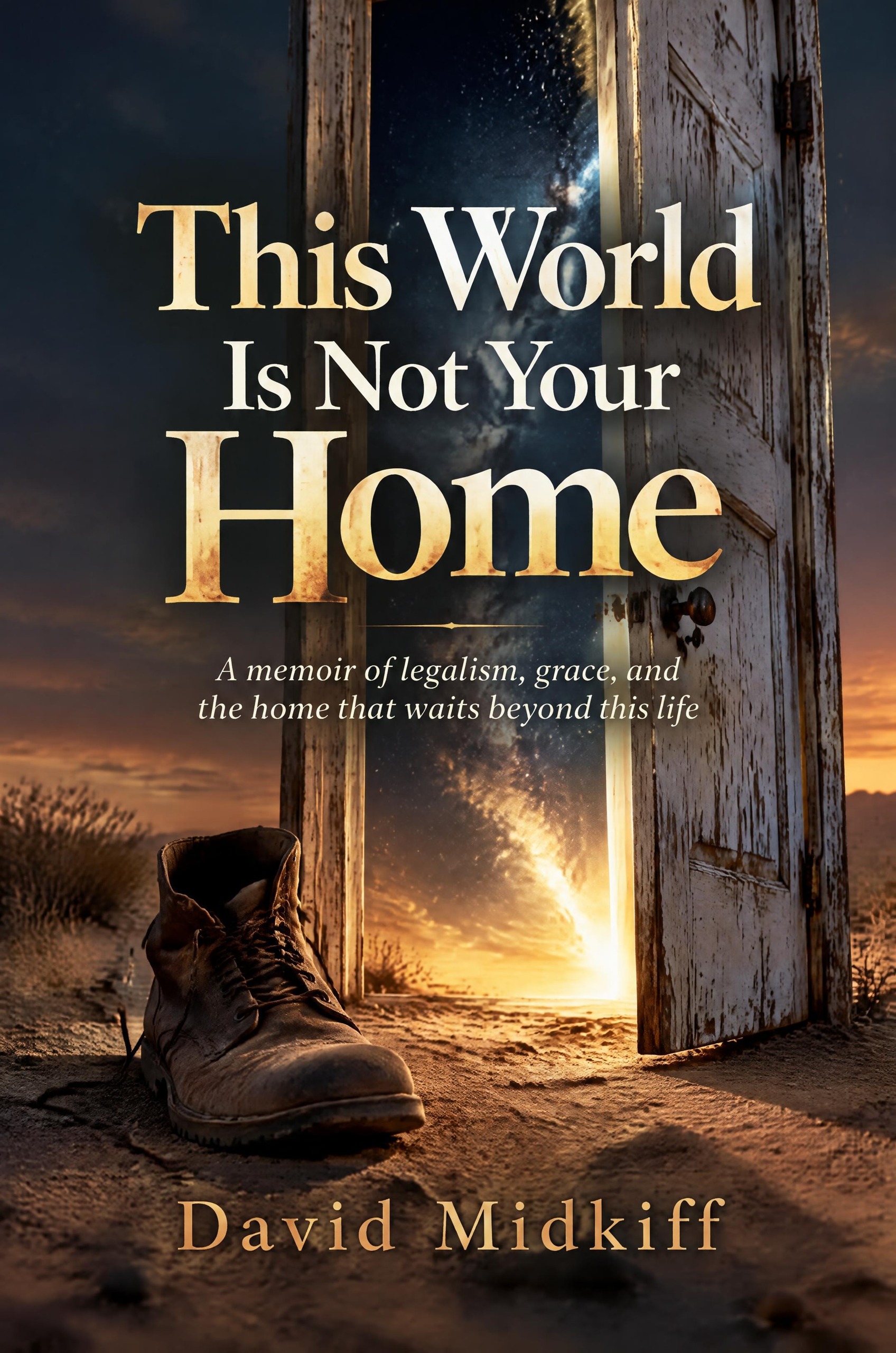
This World Is Not Your Home
A memoir of legalism, grace, and the home that waits beyond this life
David Midkiff grew up in a church that measured holiness by rules, not by a living Savior. From an Ohio childhood and a painful family move to Arizona, through Navy service, gambling, pride, and a secret life of pornography, he chased religion while his heart stayed far from God. Then, at a ministry retreat, healing broke in—and he discovered that effort cannot save what only Christ can remake. This World Is Not Your Home weaves honest autobiography with Bible teaching: spiritual rebirth, crucifying the flesh, walking in the Holy Spirit, prayer by the ACTS model, and the armor of God. It draws a clear line between empty religious duty and a real relationship with Jesus, even when marriage strains, illness strikes, and prayers seem unanswered. Heaven is not a footnote. Midkiff points readers toward resurrection, everlasting fellowship, and the hope that this temporal world is not our last address. If you have been weary of performance faith, this book invites you to come home to Christ—and to live as a pilgrim until He calls you there.
- Religion & Spirituality
- Historical Non-Fiction
- Christianity
- Spiritual Growth
- Faith & Philosophy
- Religious History
A song we used to sing
Growing up in a religious home together as a family was not easy. My mother and father took us to church every Sunday morning, Sunday night, and Wednesday night. We went to church no matter what happened during the week, and we went even when we were not feeling well. My dad used to say that if you were sick, church was the best place to be. His reasoning was simple enough: why stay home when everyone in the congregation could lay hands on you and pray for your recovery? It was my dad's deep conviction to be sitting in the house of God every single time the doors were unlocked, which was an admirable principle in theory, but it really should have included a few practical exceptions.
Our family consisted of four boys and one girl, which meant we were considered a good-sized household in those days. Among those brothers was my identical twin. Between the four boys, we managed to leave our permanent mark on every single house we ever rented or owned. It was simply inevitable. There were holes punched clean through the plaster behind several bedroom doors because we spent our afternoons chasing each other through the hallways at top speed. The routine was always the same: one of us would sprint into the bedroom, throw our weight against the door, and try desperately to latch the lock before the others hit the wood from the outside. That worked on occasion, but when it failed, the door would fly backward under sheer force and the doorknob would punch another round crater right into the wall. When my mom finally reached the end of her patience, she walked straight to the utility closet and grabbed the broom. In today's society, people would call that abusive, but back then it was just common household defense. My mother's broom was her chosen weapon of warfare. It might not have had much spiritual power, but physically it got our attention every single time.
Yet my mom was a genuine Christian woman. She loved the Lord with all her heart, and she loved her children completely, even when our behavior gave her plenty of reasons to throw her hands up. Mothers are usually the glue that holds a home together, and she was certainly that for us. She was a woman of steady prayer and deep faith in God. Even when things were chaotic, she took the time to instill strong biblical truths into our lives, showing us what practical faithfulness looked like when money was tight and patience was thin.
My dad was a good man who worked hard and did the best he knew how to do with the understanding he had. Unfortunately, the church fellowship we attended was steeped in heavy legalism, governed by endless human regulations and rigid expectations. Those standards were manufactured by church leadership based on their specific denominational tradition and their narrow interpretation of Scripture. According to that mindset, if you complied with every outward rule on their list, you were considered properly saved. If you slipped up or openly questioned an expectation, you were treated as backslidden or pushed toward the door. Living under that kind of performance-based religion was an exhausting burden. The pressure was so intense that I often wondered if God truly cared for me at all. Whenever I fell short, I assumed God had turned his back on me and that I needed to walk down the aisle to get saved all over again. That cycle was standard practice in that congregation. Whenever a guest evangelist arrived for revival services, people hovered in the aisles, urging everyone around them toward the altar just to guarantee their salvation was intact. Looking back, I believe going through those motions simply helped folks feel like they were fulfilling their religious duty.
Whenever my twin brother and I crossed the line at home, Mom would report the situation to Dad, letting him know that a spanking was in order. My brother and I naturally pointed fingers at each other, pleading complete innocence, but Dad never bothered sorting through our stories. In his eyes, both of us were guilty by association. His rule of thumb was to apply the belt first and ask questions later. His logic was that even if one of us was innocent of that particular infraction, the discipline would serve as advance credit for whatever trouble we were going to cook up the following day. Before he swung the belt, he looked down at us and offered that familiar parental line: "Son, this is going to hurt me a whole lot more than it hurts you." I could never make sense of that statement, because my brother and I were always the ones crying while he walked away completely fine.
One Sunday afternoon, my twin and I were roughhousing on the living room rug, grappling back and forth to see who could get the upper hand. I finally managed to roll him over and pin his shoulders flat to the carpet. While he was kicking to free himself, his foot swung backward and shattered the glass window in our mother's encyclopedia cabinet. That immediately brought Mom into the room with the broom in hand. But matters grew much worse in an instant: as my brother tried to yank his leg away from the broken glass, his other foot caught awkwardly beneath his body weight. The downward pressure snapped several small bones in his ankle with a sharp pop. He rolled across the floor in genuine agony, and my heart sank into my stomach. It happened to be late in the afternoon, just as the household was getting dressed for Sunday evening service. Dad walked into the room, assessed the broken cabinet and the commotion, and insisted that we all needed to climb into the car anyway. In his mind, an injury was no excuse to miss church, and the church family could pray over the foot. That sparked an immediate, heated argument between my parents. Mom stood her ground firmly, looked at Dad, and declared that my brother was not going anywhere except to rest on the couch. The following morning she took him to the clinic, where the physician set the fracture in a heavy plaster cast. He wore that bulky white cast for months, all the way through our move across the country to Arizona.
Trading Ohio Cold for the Desert Southwest
The journey from Ohio out to the desert was an unforgettable passage in our childhood. Before we ever loaded up our possessions, Mom spent evenings reading through travel brochures and maps, trying to prepare us for how different the Southwest would be from the rolling green hills and winter snow of Ohio. When moving day arrived, we piled into dad's old Hudson, that had running boards, crammed in alongside whatever personal belongings could not fit into the trailer behind us. For several young boys, and our sister being cooped up in the backseat for days on end was an invitation to constant bickering, but the open horizon kept us staring out the windows.
Out along Route 66 in New Mexico, the landscape seemed like another planet entirely. The red dirt, wide-open skies, and strange rock formations were fascinating to young eyes. We begged Dad to pull over whenever we spotted hand-painted signs advertising desert curiosities. He finally relented at an old roadside rattlesnake farm. The place smelled of dusty wood, stale candy, and dry heat. Plexiglass enclosures lined the walls, filled with dozens of thick, coiled timber and diamondback rattlesnakes resting on sandy floor. Watching those pit vipers raise their triangular heads and rattle their tails against the glass left us wide-eyed. It gave us a quick education in the kind of wildlife we might encounter once we settled into our new surroundings.
Not every stop on that cross-country trek went smoothly. Somewhere around Albuquerque, we stopped at an inexpensive roadside diner for dinner and ordered platters of fried chicken. It tasted ordinary enough at the time, but a few hours later, almost every one of us came down with severe food poisoning. The remainder of that drive turned into a miserable sequence of emergency stops along the shoulder of the highway. We were sick, exhausted, and dehydrated, huddled together in the backseat while the desert heat beat down through the glass. By the time we finally crossed the state line into Arizona, we were thoroughly drained, our clothes were rumpled, and my brother was still dragging that heavy plaster cast on his leg. Yet through the discomfort, our mother kept encouraging us, reminding us that God was going to watch over our new beginning in the West.
Broken Vows and the Ache of Absence
Arizona brought plenty of sunshine, but it also brought a season of quiet heartbreak that altered the entire course of our family life. Not long after we settled into our new community, the underlying strain between my parents reached a breaking point. What began as quiet disagreements behind closed doors gradually deepened into emotional coldness. Before long, that distance turned into an official separation and eventually a painful divorce. In the conservative religious circles of our upbringing, divorce was treated as the ultimate failure and a source of deep shame. Very few people in those congregations knew how to walk alongside a broken family with grace. Instead, the legalistic environment tended to isolate those who were hurting the most.
When my father moved out, he left an empty chair that felt enormous in our small home. For a young boy, having your father walk away creates an ache that does not heal overnight. It planted deep seeds of inadequacy inside my heart. I caught myself wondering what my brothers and I had done wrong, or whether I had simply been too unruly, too troublesome, or too demanding to make him want to stay. Children almost always shoulder the blame for things they have no power to control. That emotional injury shaped how I viewed myself for many years. It left me constantly striving to earn approval, trying to perform well enough to prove that I had value and that I was worth keeping around.
It was during those difficult years that my mother's faith became our lifeline. With my dad gone, she and our oldest brother carried the entire financial, emotional, and spiritual weight of five children on their shoulders. She worked long, tiring hours to put food on the table, yet her commitment to the Lord never wavered. She refused to allow bitterness to take root in our home. When she could have spent her evenings complaining about her circumstances or speaking ill of our father, she chose instead to gather us around her and turn our attention toward heaven.
Echoes of an Old Gospel Song
One of my clearest childhood memories is the sound of my mother's voice echoing through the kitchen while she stood over the stove. There was an old phonograph player that often sat on the counter, but more often than not, she provided her own music. She loved the old gospel hymns, and she sang them at the top of her lungs with genuine conviction. One particular song she sang over and over again was that familiar tune:
"This world is not my home, I'm just a-passing through. My treasures are laid up somewhere beyond the blue.
You gotta be born again
Most folks spend their whole lives trying to figure out God with their own natural brains. We read books, we listen to opinions, and we try to measure the Almighty by our own human logic. But the truth is, our thinking simply cannot reach high enough to grasp the things of heaven. The prophet Isaiah wrote down the words of the Lord very plainly in …