

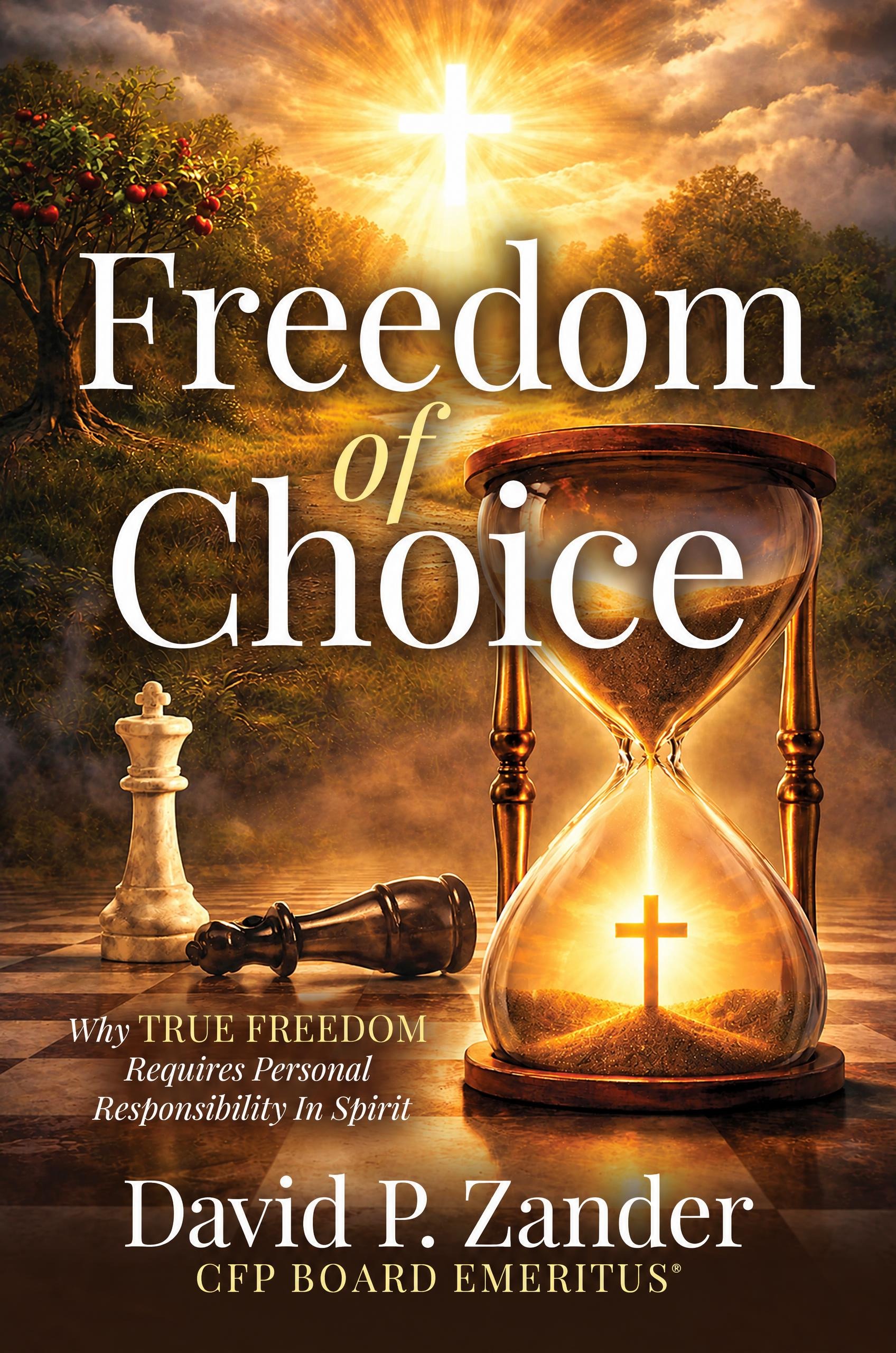
Freedom of Choice
Navigating Faith, Stewardship, and Purpose in Life's Second Half
What happens when achieving worldly success still leaves your spirit feeling restless? For decades, society tells us that life is an endless climb of accumulation, status, and self-reliance. We sprint through the first half of our lives chasing external milestones, only to discover that worldly accomplishments cannot satisfy an eternal hunger. In a culture driven by the relentless fallacy of wanting more, true freedom requires an unexpected pivot. In Freedom of Choice, David Zander draws on five decades in the financial services industry and profound personal turning points to introduce PRISFreedom—Personal Responsibility In Spirit. Using the intuitive framework of golf's 'Front 9' and 'Back 9,' this book provides a roadmap for transitioning from youthful ambition and ego toward intentional stewardship, spiritual surrender, and lasting significance. Discover how to navigate life's uncertainties, reframe suffering as refining grace, and walk in step with the Holy Spirit. Life offers no mulligans, but it presents a daily invitation to trade cultural noise for kingdom clarity. It is time to step onto your life's second half with purpose, peace, and eternal impact.
- Religion & Spirituality
- Self-Help
- Christianity
- Spiritual Growth
- Spirituality & Self-Discovery
- Happiness & Fulfillment
The Foundation of PRISFreedom
There comes a point in life when you finally slow down long enough to ask yourself a few honest questions. Am I really happy? Am I living wisely? Am I chasing the right things?
In my own life, those answers did not arrive all at once. Truthfully, I did not come to them as a theologian, philosopher, or an academic. I graduated in the top two-thirds of my high school class, (which is a polite way of saying I was no honor-roll student). Most of what I learned came later—through mistakes, mentors, books, business experiences, relationships, Scripture, and years of observing both myself and other people.
For nearly fifty years I worked in financial services and retirement planning. During that time, I spoke with thousands of people about money, success, retirement, fears, goals, and the future. On the surface many appeared successful. Yet underneath, I often sensed something else: restlessness. A quiet feeling that even after achieving many of the things they once believed would make them happy, something still seemed missing. Eventually I began recognizing that same tension in myself.
The world constantly tells us fulfillment is found in more:
more success
more money
more possessions
more recognition
more experiences
more security
But the finish line never stays still. In some ways life can feel like Charlie Brown trying to kick the football while Lucy keeps pulling it away at the last second—even after promising she wouldn’t. Another goal. Another accomplishment. Another purchase. Another dream. After a while the excitement fades and the mind starts to search for the next thing again.
That is why I continue to find Solomon so fascinating. He wrote Ecclesiastes—about the vanity of human endeavor—over three thousand years ago! Who says history does not repeat itself? Human nature really has not changed very much.
The book of First Kings tells us Solomon had seven hundred wives and three hundred concubines (see 1 Kgs 11:1–3). Every time I read that passage, I almost laugh. Did he really believe one more would finally do it? But that was Solomon’s point in Ecclesiastes: the appetite is never permanently satisfied.
Three Earthly Truths and One Heavenly Epiphany
Over the years, whether I was conducting a workshop on retirement planning, investment strategies, or Social Security, I almost always started with a few basic truths about life itself. I called them the Three Earthly Truths. After each one, I would stop and ask the audience: “Is it true?” Because until we honestly accept reality, it becomes very difficult to plan wisely for anything. Deep down, most people already know the answers. The hard part is not understanding these truths intellectually, it is accepting them emotionally.
Earthly Truth No. 1: The Only Certainty in Life Is Uncertainty
Human beings crave certainty because certainty gives us the illusion of control. We plan carefully. We build financial models. We insure against risk. We work hard believing life will unfold according to plan. Sometimes it does. Sometimes it does not. Life can change quickly: a phone call, a diagnosis, a market collapse, an accident, a death,
My generation has witnessed events we would have once thought unimaginable: the assassination of a president, a terrorist attack on American soil that took the lives of thousands, and a worldwide pandemic. Each reminded us of the same truth: control is temporary. That does not mean planning is foolish. It simply means we should approach life with humility.
None of us fully controls tomorrow. And once a person truly accepts that, gratitude replaces entitlement.
One of the best illustrations for this basic truth came from Dr. Darryl DelHousaye, whose teaching on Ecclesiastes had a profound impact on me. He described life as a conveyor belt moving steadily forward. Every day an apple passes in front of you. You cannot grab yesterday’s apple because it is already gone. No mulligans. And you cannot take tomorrow’s apple because no one promises tomorrow. The only apple you truly possess is the one sitting in front of you today.
The illustration stayed with me because it captures something most people resist admitting:
Today is where life actually happens.
Not someday.
Not after one more accomplishment.
Not until conditions become perfect.
Today.
- Thought: Establish a Daily Prayer: Lord, thank You for another day not promised.
Earthly Truth No. 2: Life Is Not Fair
This was usually the point in workshops where people became uncomfortable. Most people acknowledge intellectually that life is not fair. Emotionally, however, we still resist it. Something painful happens and immediately, we think: This should not be happening to me. But life rarely unfolds that neatly. Jesus Himself said: “In the world you will have trouble . . .” (Jn 16:33).
That is not negativity. It is reality. Good people suffer. Dishonest people sometimes prosper. Hard work does not always guarantee success. And if a person lives long enough, life eventually teaches this lesson personally.
One of the biggest shifts in my thinking came when I finally realized Scripture never promises fairness. What it promises is faithfulness. That distinction changed a lot for me. Because the seasons that shape us most are not the easy ones. Not because suffering itself is good, but because hardship has a way of humbling us, deepening us, and redirecting us toward what really matters.
- Thought: We only truly learn from our failures.
Earthly Truth No. 3: You Must Play the Hand You’re Dealt
This was usually the point in the workshop where the room became very quiet. Because people started realizing these are not just financial principles. They are life principles.
We do not choose our starting point in life. Some people begin life with tremendous advantages. Others begin life carrying burdens they never asked for. That part is true. But eventually every person faces the same question: Will I allow my circumstances to define me, or will I respond to them?
Today we live in a culture where victimhood is often encouraged. Sometimes painful things truly are not our fault. But while we may not control everything that happens to us, we still remain responsible for how we respond. And that response shapes our future far more than most people realize.
One modern example I have always appreciated is Dr. Ben Carson. By almost every statistic, he should never have become one of the world’s leading neurosurgeons. But his mother refused to allow victimhood to define their family. That mindset changed his life.
Another example is Joseph from the Bible. Years after being sold into slavery by his brothers, he told them, “You meant harm to me, God meant it for good” (Gn 50:20). And the Apostle Paul, writing from prison, said, “My situation has turned out rather to advance the gospel” (Phil 1:12).
Neither man in Scripture denied the hardship they were experiencing. But neither allowed suffering to become their identity. Maybe that is the heart of the third truth: We may not control the hand we were dealt, but we do control how we play it.
- Thought: Victimhood may temporarily remove blame, but it also removes power.
The Cost of Freedom
One of my favorite movies has always been Braveheart, the story of William Wallace, played by Mel Gibson. At the very end of the movie, as Wallace is being executed, the last word he cries out is: “Freedom!”
Countless people who have sacrificed everything for freedom throughout history. Even today, people around the world risk everything for the opportunity to come to America. Why? Freedom. The freedom to work. To worship. To speak openly. To raise a family. To pursue opportunity and hopefully build a better life.
Maybe that is part of the problem for many Americans. When something becomes familiar, we slowly begin taking it for granted. Like health. A loved one. A friendship. A steady paycheck. Even simple things like fresh air or walking freely outside. Most of us assume those things will always be there . . . until suddenly they are not.
As we recently celebrated the 250th anniversary of America’s founding, I find myself wondering whether we still fully understand what freedom actually cost. When the men signed the Declaration of Independence in 1776, they knew exactly what they were risking. The British Crown considered it treason. Many lost businesses, property, wealth, security, and social standing. Some saw their families suffer because of the stand they took. Several died before ever seeing what the country would become.
Yet they still pledged: “Our lives, our fortunes, and our sacred honor.” That is a powerful statement when you really stop and think about it. They understood freedom came with sacrifice, courage, accountability, and responsibility.
That is part of the struggle we face today. We want the benefits of freedom, but often without the responsibility that comes with it. Yet freedom and responsibility have always traveled together. The same thing is true personally. The more responsibility we surrender financially, morally, spiritually, or emotionally, the more freedom we slowly give away right along with it. History shows that societies willing to trade responsibility for comfort eventually lose both. And individuals can slowly drift down that same road without even realizing it.
The Lottery Lesson
Sometimes humor says things more honestly than serious conversation ever could. Years ago, I heard a story about a man who arrived in heaven frustrated. He looked at God and said, “Lord, all my life I prayed to win the lottery. Every week I asked. Every year I begged. Why didn’t You ever answer my prayer?” God supposedly replied, “I heard your prayers. But it would have helped if you had bought a ticket.”
Most people laugh when they hear that story because, deep down, they recognize the truth in it. We want life to improve without changing ourselves. We want better relationships, better finances, better health, deeper faith, or more purpose. But it’s all too easy to hope things will somehow change on their own while we continue doing the same things we have always done.
That is not how life works. And honestly, I do not think Scripture teaches that either. As James wrote, “Faith without works is dead” (Jas 2:26).
Over the years, I gradually came to realize that growth involves a partnership. God reaches toward us through grace. But we must respond. We must move forward, decide, take responsibility, and sometimes surrender our own pride, fear, or stubbornness along the way. Not perfectly, but willingly.
Maybe that is really where PRISFreedom began for me. Personal Responsibility In Spirit.
Not self-help, Spirit-help.
Not trying to carry life entirely on our own, but also not sitting still expecting change without participation.
The Front 9 and the Back 9
Years ago, I started using a golf analogy called the Front 9 and the Back 9 in my financial presentations. Originally, it was simply a retirement-planning concept. The Front 9 represented the accumulation years of life.
Building careers.
Raising families.
Paying off debt.
Saving money.
Trying to get ahead, and hopefully preparing for retirement.
The Back 9 represented distribution. Living off accumulated resources and entering a different season of life.
At first, it was just a practical financial framework. But over time, I realized it described something much deeper than money. It described life itself.
Most people spend the Front 9 chasing things they believe will eventually make them happy or secure. Success. Money. Recognition. Achievement. Status. Accomplishments. And to be fair, there is nothing wrong with working hard, building a business, providing for your family, or trying to improve your situation in life. Responsibility matters. But somewhere along the way, many people quietly discover something they did not expect. Accomplishment alone does not satisfy the soul. I saw this over and over throughout my career. People would finally achieve goals they had spent years pursuing—like financial independence, a bigger house, or retirement itself. For a while, there is excitement. Then life slowly settles back down, and the mind looks toward the next thing again. This is what I eventually began calling The Fallacy of More.
The Fallacy of More
This is the belief that if I just had a little more money, a little more success, a little more recognition, then I would finally feel settled. But the appetite itself keeps growing.
Which brings us right back to Solomon. Throughout Ecclesiastes he keeps using the phrase “under the sun.” I think that phrase explains a lot. Solomon was looking at life strictly from an earthly perspective. Achievement. Pleasure. Wealth. Success. Human understanding. What I sometimes call EGO—Earth Guide Only. And eventually Solomon arrived at the same place many people still arrive at today: “All is vanity . . . a chase after wind” (Eccl 1:14). Not because life itself has no meaning, but we cannot fully understand the meaning without the Spirit.
That realization slowly changed how I began looking at the Back 9 of life. Maybe the Back 9 is not supposed to be about sitting on the sidelines waiting to die. Maybe it is supposed to become the most meaningful part of the round. Maybe it is where wisdom slowly replaces ego. Where accumulation gradually gives way to distribution. Where life stops being only about what we can gain and starts becoming more about what we can give away: our time, our wisdom, our experience, our faith, even what the scars and failures in life have taught us.
That is where many people finally begin to understand the difference between success and significance.
From Ego to Spirit
Over time, I came to realize the true Back 9 does not really begin at retirement. And it certainly does not begin once somebody hits a certain financial number or age. I think it begins the moment a person finally realizes that external success alone cannot answer life’s deepest questions. For some individuals, that understanding comes through failure. For others, through disappointment, illness, loss, burnout, or simply waking up one day and reflecting, “There has to be more than this.” I think most people eventually reach that point somewhere along the way.
Looking back, I realize many of the things I chased earlier in life were not wrong in themselves. But those things were never meant to define us. Eventually, the constant striving wears the soul out.
Little by little, life teaches you the difference between self-direction and Spirit-direction. That does not mean ambition disappears. It simply means priorities change. Success looks different. The life that you once thought was the destination slowly starts looking more like preparation for deeper faith, deeper relationships, deeper purpose, and maybe even a deeper sense of peace.
Centuries after Solomon wrestled with those same questions, Jesus revealed something different. He knew that left entirely on our own, we would eventually drift. That is why throughout the Gospels, He repeatedly referred to people as lost sheep needing a shepherd. He also knew there would come a time when He would no longer physically walk beside His apostles. So, before His death and resurrection, Jesus made them promises through the Holy Spirit:
“The Advocate, the holy Spirit . . . will teach you everything.”
John 14:26
“When he comes, the Spirit of truth, he will guide you to all truth.”
John 16:13
The Holy Spirit was not some abstract, theological idea that suddenly appeared later in Scripture. It was Christ’s promise that after He left physically, His followers would still have a guide. They would not face their challenges by themselves.
The problem was never responsibility itself, but trying to carry responsibility without the Spirit. Trying to solve life entirely through achievement, control, planning, money, or human understanding alone.
Eventually, I realized that life was never meant to be lived completely on our own. That is where PRISFreedom was truly born: Personal Responsibility In Spirit. Not self-help. Spirit-help.
Earthly Truth + Heavenly Truth = PRISFreedom
Because life eventually teaches us tough lessons about uncertainty, disappointment, unfairness, and the reality that we all must play the hand we’re dealt, earthly truth can feel heavy on its own. Most people already know those truths deep down, but if that is all a person sees, life can start feeling empty after a while. That is how heavenly truth changes everything.
God never promised a life without struggle, heartbreak, uncertainty, or pain. Anybody who has lived long enough already knows that. But He promised His presence, His grace, His guidance, and through the Holy Spirit, direction in a world that often feels confused, divided, and spiritually lost. Trying to live “under the sun” strictly through achievement, planning, money, status, control, and human understanding alone will eventually wear out the soul.
Looking back, I understand why so many people become exhausted even after achieving many of the things they once believed would satisfy them. The soul was not designed to carry life by itself. That is really where PRISFreedom was realized: Personal Responsibility In Spirit. We do not abandon responsibility, but we finally recognize that we were never meant to face life alone.
The real question is not when the Back 9 begins, but whether we ever make the turn at all. This is where the ladder analogy comes in: people can spend their entire lives climbing ladders without ever asking whether the ladder is leaning against the right wall. They move faster and faster in pursuit of success, recognition, comfort, security, or status, only to quietly discover that something still feels missing.
Back 9 Reflection
Either you own your habits, or your habits own you. Every choice becomes a habit. Every habit shapes your character. Your character determines the direction of your life.
“For Freedom Christ set us free; so stand firm and do not submit again to the yoke of slavery.”
Galatians 5:1
“I call heaven and earth today to witness against you: I have set before your life or death, the blessing and the curse. Choose life, then, that you and your descendants may live, by loving the Lord, your God, obeying his voice, and holding fast to him.”
Deuteronomy 30:19–20
Ask: Lord, what are You trying to teach me through this chapter and these Scripture verses today?
<<insert four blank lines for the readers to write their reflections>>
The Next Step
Maybe one of God’s greatest gifts is the ability to make the turn before the round is over. And before we can honestly answer where we are going, maybe we first have to ask ourselves a much harder question: Am I lost?
Lost on Earth
There is a strange and unsettling feeling that lives quietly within many people. From the outside, life may look busy, productive—even successful. But beneath the surface of daily routines, there is often something harder to name: a quiet ache, a subtle misalignment, a whisper that refuses to go away.There must be more than this. We don’t alw…