

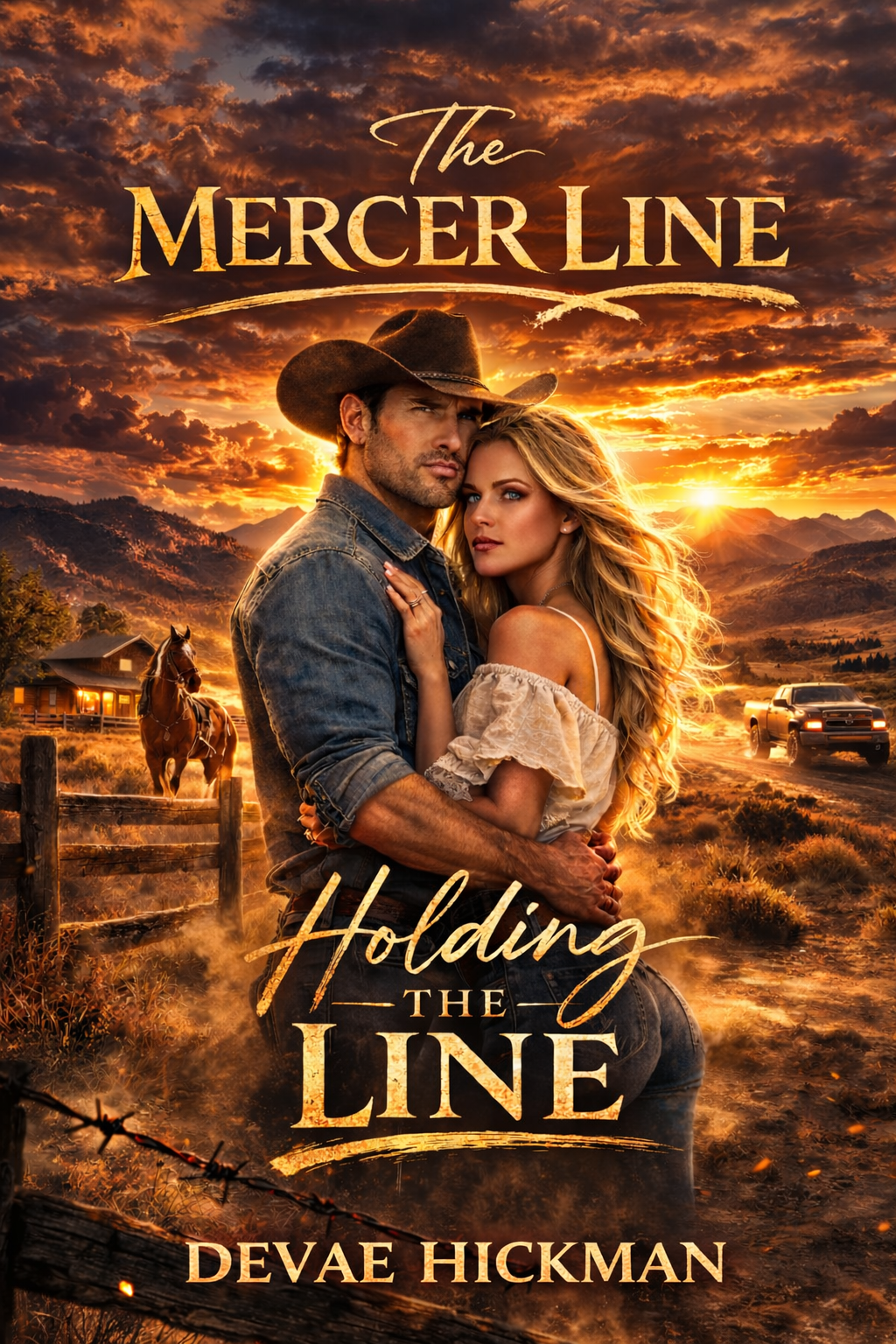
Mercer Line – Holding the Line
A rugged protector and a headstrong heiress defend a Texas legacy against a deadly conspiracy
by Devae Hickman
Boone Mercer’s land is his life, and he’ll be damned if he lets a smuggling syndicate use it as a corridor for crime. When the South Texas ranching patriarch refuses an illicit deal, the threats turn personal, forcing him to hire the best protection money can buy: Colt Maddox. Colt is disciplined, tactical, and used to high-stakes danger. But he isn’t prepared for Savannah Mercer. The headstrong heiress to the Mercer empire has no intention of being a damsel in distress, even as fence-cutting probes escalate into a daring daylight kidnapping attempt. As the dust settles on the ranch, the heat between the protector and his charge begins to simmer. With an informant lurking within the ranch and a corrupt political network pulling the strings, Colt and Savannah must navigate a lethal game of cat-and-mouse. From the sprawling plains of South Texas to the high-stakes arena of the West of the Pecos Rodeo, the line is drawn in the sand. To save her family’s future, Savannah must step into her power, while Colt must decide if he’s willing to risk his heart for a woman who refuses to back down. In the Mercer line, loyalty is everything and the price of failure is blood.
- Romance
- Contemporary Western
- Military Romance
PROLOGUE
Boone Mercer hated San Antonio.
Not the city itself. San Antonio had good bones, good history, and the kind of Tex-Mex that made a man reconsider his stance on dying happy. What Boone hated was what San Antonio meant when somebody asked you to drive three hours north to take a meeting in a restaurant you didn’t pick, at a table you didn’t reserve, with men you didn’t know.
It meant politics. And politics meant sitting still, which Boone had never been good at.
He parked the F-350 himself. Valet wasn’t happening. Not because he couldn’t afford it, but because no twenty-year-old kid in a vest was putting his hands on a truck that had actual mud on the wheel wells from actual work done that morning. He’d been in the south pasture at five a.m. checking a water line that had gone dry near the brush country fence. The fix took forty minutes. The drive to San Antonio took the rest of his patience.
He checked his watch. Six minutes early. Good enough.
The restaurant was upscale without being ridiculous. Dark wood, white tablecloths, low lighting that made everyone look ten years younger and two drinks deeper than they were. A hostess in black met him at the front with a smile that faltered just slightly when she took in all six feet five inches of him. He’d put on a sport coat over a pressed button-down, but he hadn’t bothered with a tie, and his boots were Tony Lamas that had seen more dirt than polish. The gray at his temples and the deep tan line where his hat sat most days told the rest of the story. This was not a man who spent his life indoors.
“Mr. Mercer? Your party is waiting in the private dining room.”
“Thank you, ma’am.”
He followed her through the main floor, past tables of couples and business lunches, through a short hallway paneled in dark oak. She opened a heavy door at the end and stepped aside.
The private room was small. Three men occupied chairs on the far side of an eight-person table, their backs to the wall and their eyes fixed on the door.
Boone’s seat waited opposite them with its back to the only entrance.
The setup was deliberate. Anyone who understood negotiation would have recognized it for what it was—a subtle attempt to put him on the defensive from the moment he walked in.
Boone recognized it.
He sat anyway.
He’d dealt with governors, oil executives, and a U.S. senator who got mean after bourbon. Three men in expensive suits weren’t enough to raise Boone Mercer’s pulse.
“Gentlemen.” He pulled out the center chair on his side and sat. No handshake offered. None expected. “Appreciate you making the trip.”
The man in the middle smiled. Mid-fifties, silver hair swept straight back, manicured hands resting lightly on the white tablecloth like he already owned the room.
His charcoal suit looked untouched by real work.
The two men beside him were younger and quieter. One had a leather folio open with a pen resting across blank paper. The other simply watched, his gaze steady and unblinking.
“Mr. Mercer. Thank you for agreeing to meet.”
“I agreed to listen,” Boone said. “There’s a difference.”
The silver-haired man’s smile didn’t waver. “Of course. We appreciate your time. We understand you’re a busy man.”
“I am.”
A waiter appeared with a bottle of wine already open. Pre-ordered. That tracked.
Boone watched the man pour four glasses in careful silence. Crystal stemware. Expensive red. Probably chosen because somebody in this room thought it looked powerful.
He wrapped his hand around the glass without lifting it.
Across the table, the youngest man hadn’t touched his either.
Boone noticed that immediately.
He’d let them talk first.
The silver-haired man, who had introduced himself only as Mr. Salazar over the phone two weeks ago, leaned back and began.
“Mr. Mercer, we represent a group of investors with significant agricultural and logistics interests along the southern border region. We’ve been quietly expanding partnerships with private landowners who see the value in cooperative corridor development.”
Boone listened. His face gave away nothing. Twenty-five years of negotiating oil leases and federal land easements had built that into a reflex. He could sit through a pitch like this with the same patience he used breaking a green colt. Let them run until they tired themselves out. Then you saw what you were dealing with.
Salazar continued, smooth and practiced, laying out a proposal that sounded almost legitimate if you didn’t know what to listen for. Regional development. Transportation infrastructure. Shared access agreements. The language was clean, the numbers vague, and the intent buried under six layers of business phrasing.
Boone heard every word. And underneath every word, he heard the real ones.
They wanted a corridor across Mercer land. South to north. Brush country to highway access.
Not cattle, crops or oil equipment.
They wanted to move product. Weekly. Quietly. Across land his family had held since before the Civil War.
The pitch took eleven minutes. Boone knew because he’d glanced at his watch when Salazar started, and again when the man finally paused and lifted his wineglass like they’d just finished discussing a golf club membership.
“That’s the broad overview,” Salazar said. “We’d welcome the opportunity to discuss specifics at your convenience.”
Boone picked up his wineglass. Took a single sip. Set it down.
“No,” he said.
The word sat on the table between them like a stone dropped into still water.
Salazar didn’t blink. He tilted his head slightly, the way a man does when he’s already rehearsed his response to a rejection.
“Mr. Mercer, I understand this is a significant consideration. Perhaps if we discussed the compensation structure in more detail...”
“I don’t need your money,” Boone said. Not rude. Just fact. The same way he’d tell a man the gate was locked. “And I don’t need the details. I heard your pitch. The answer is no.”
Salazar set his wineglass down carefully. “We’re talking about a very limited footprint. A corridor, nothing more. Your daily operations wouldn’t be affected in any measurable way. You have, what, seven hundred thousand acres? We’re discussing a fraction of that.”
“Seven hundred and twenty,” Boone said. “And every acre of it has my name on the deed. Has since 1857. That’s not changing on a Tuesday over a bottle of wine I didn’t pick.”
The man with the leather folio shifted in his seat. The paper inside was still blank.
Boone doubted it had ever been meant for notes.
The wine, the business language, the polished smiles—every piece of this meeting had been arranged to look legitimate, designed to ease a landowner into a false sense of security.
None of it was.
Salazar tried a different angle. His voice dropped half a register, not louder, just closer. More personal.
“Boone. May I call you Boone?”
“You may not.”
A pause. The third man, the quiet one who had done nothing but watch since Boone sat down, uncrossed his legs and leaned forward. He was younger than the other two. Dark eyes, clean shave, and a stillness to him that was less patience and more restraint. He hadn’t touched his wine either.
“Mr. Mercer,” the quiet one said. His voice was calm and measured. Almost pleasant. “We’ve done our research. We know the scope of your operation. Cattle. Horses. Oil royalties. Federal leases. Political relationships.” He paused. “Family.”
He said it softly, like the word already belonged to him.
Boone looked at him. Straight on, unhurried. He let the silence do the work. Two seconds. Three.
“Son,” Boone said, and the word carried weight that had nothing to do with age, “I’ve been running that ranch since I was twenty-four years old. My wife was buried on that land. I raised my daughter on it. I’ve sat across from oil executives, federal regulators, and a senator who tried to annex my water rights over a handshake.” He leaned forward, just slightly, just enough. “Every single one of them went home empty-handed. And every single one of them knew better than to bring my family into a business conversation.”
The room went still.
Not tense. Not dramatic. Just... quiet. The way a room gets when a man has said exactly what he means and everyone present knows there’s no second version coming.
Salazar opened his mouth.
Boone stood.
“Gentlemen.” He buttoned his sport coat with one hand. “Thank you for the wine. I’ll see myself out.”
He turned his back on all three of them and walked to the door.
Boone gave them his back the way you give a dog your back when it isn’t worth watching.
He was two steps into the hallway when Salazar’s voice followed him, still smooth, still measured, but stripped now of the performance.
“Mr. Mercer. South Texas is changing. The landscape is shifting. It would be unfortunate if a family with your kind of legacy found itself... on the wrong side of that shift.”
Boone stopped in the hallway.
Restaurant noise drifted faintly through the dark oak paneling behind him. Glassware. Low conversation. A waiter laughing somewhere near the bar.
Normal sounds.
The kind people made when their lives weren’t being threatened.
Boone didn’t turn around.
After a moment, he kept walking.
San Antonio heat hit him like a wall the second he stepped outside. Mid-afternoon in late spring, and the air was already thick enough to chew. Boone loosened the top button of his shirt and pulled his hat from the passenger seat of the truck before he climbed in. Stetson, cattleman crease, sweat-stained at the band. It settled on his head the way it had ten thousand times before, and the world made a little more sense with it there.
He sat in the cab for a minute with the engine running and the AC pushing against the heat. The parking lot was half-full. Normal people having normal lunches. Nobody in there had just been told their family was on the wrong side of a shift.
Boone pulled out of the lot and pointed the truck south toward the ranch. Three hours of highway. Three hours of flat Texas opening up in front of him like a hand spreading wide. He drove with the radio off. He thought better in silence.
The meeting hadn’t surprised him. Not really. He’d known for months that someone was probing the borders of his land. Small things at first. A section of fence cut clean on the south line, not storm damage, not cattle pushing through. Cut. Then a truck spotted on a ranch road that didn’t belong to any of his hands. Then two more fence cuts in the same month, each one further east, like someone was mapping his perimeter.
He’d called the county sheriff. Got a report filed and a handshake, and nothing else. He’d called his attorney in Austin. Got advice about liability and documentation. He’d called his foreman, Hector Villanueva, a man who’d worked Mercer land for thirty-one years, and told him to double the fence patrols on the south division.
None of it had slowed anything down.
Because the fence cuts were never the real problem.
They were the invitation. A quiet way of testing the locks before knocking on the front door.
The meeting today confirmed what Boone had suspected for weeks. Someone had decided that Mercer Ranch was an opportunity. Not a neighbor, not a competitor, not a government agency with an easement request. An organization. Structured, funded, and patient enough to send three men in suits to a private dining room to make it sound like a real estate deal.
The quiet one bothered him most. Salazar was a front man, polished and disposable. The one with the folio was furniture. But the young one with the dark eyes, the one who’d said “family” like he was reading from a file, that had weight behind it. The young one delivered a specific message in the room, and he did it cleanly.
Boone drove past Pleasanton and kept south. The land flattened out, and the brush thickened and the sky turned into that endless pale blue that swallowed everything beneath it. He thought about his father, dead eleven years now, who’d run Mercer Ranch with the same stubbornness Boone had inherited. His father would have handled this differently. Probably worse. The old man had a temper that could scatter a boardroom, and he’d never met a problem he didn’t want to solve with a phone call to somebody who owed him.
Boone was quieter than his father. More deliberate. He didn’t call in favors unless the math was right, and he didn’t raise his voice unless raising it was the only tool left in the box.
Right now, the math said he needed help he couldn’t find locally.
He picked up his phone at the hour mark and called Jim Dawson. Dawson was a retired federal judge out of Houston, an old friend of the family, the kind of man who kept a Rolodex in his head and a glass of whiskey on his desk by four o’clock every afternoon. Boone had known him since he was a kid. Jim had been at his wife’s funeral. Jim had bounced Savannah on his knee when she was three.
Dawson picked up on the second ring.
“Boone Mercer. Tell me you’re calling to go fishing.”
“I’m not calling to go fishing, Jim.”
A pause. Dawson was sharp enough to hear what sat underneath those words. “What do you need?”
“You told me once, maybe two years ago, that if I ever needed security work done right, you knew a man.”
“I told you that.”
“I need that name.”
Dawson was quiet for a beat. Not hesitating. Thinking. “Colt Maddox. Runs an outfit called Maddox Strategic Solutions. Small team, handpicked, all former military. They don’t advertise and they don’t take every contract that walks through the door. But if they take yours, your problem gets handled.”
“What kind of man is he?”
“The kind you’d want standing next to your daughter.”
Boone let that sit. Jim Dawson didn’t say things like that casually.
“Send me his number.”
“I’ll do you one better. I’ll call him first. Tell him who you are. Then you call.”
“Appreciate it, Jim.”
“Boone.” Dawson’s voice dropped half a step. “Whatever this is, don’t wait on it.”
“I’m not waiting. That’s why I’m calling.”
He hung up and drove another forty minutes in silence. The phone buzzed once. A text from Dawson. Ten digits and two words: He’s expecting you.
He waited until he was past Tilden and the highway had narrowed to two lanes with nothing but mesquite and cactus on both sides. No reason for the delay other than habit. Boone liked to make important calls when the land around him felt like his. Down here, south of the pipeline roads and east of the brush country, the air smelled like dust and dry grass and home. It steadied him.
He dialed the number.
Two rings. Then a voice picked up, clear and unhurried.
“This is Maddox.”
No company name. No greeting. Just identification. Boone respected that immediately.
“Mr. Maddox, this is Boone Mercer. Jim Dawson said he’d call ahead.”
“He did. About twenty minutes ago.” A brief pause, but not an empty one. The man was listening. Measuring the call the way Boone measured a horse before he bought it. “What can I do for you, Mr. Mercer?”
Boone kept his eyes on the road and his voice level. “I’ve got a situation on my ranch. Border country. Someone’s been testing my fences for months. Today I sat across from three men who wanted to turn part of my land into a corridor. They dressed it up nice. It wasn’t nice.”
“What kind of corridor?”
“The kind nobody puts in writing.”
Silence on the other end. Not confusion. Processing.
“How did you leave it with them?” Colt asked.
“I said no. Walked out.”
“How’d they take it?”
“One of them mentioned my family on the way out the door. Called it a shifting landscape.”
Another pause. Shorter this time. “Did they reference anyone specific?”
“Not by name. But I’ve got a twenty-year-old daughter on that ranch, and a thousand employees who depend on it running clean. The implication was clear enough.”
“Yes sir, it was.” No drama in Colt’s voice. No false urgency. Just a man who heard what was being said and didn’t need it repeated. “Judge Dawson gave me the broad strokes. Former military family, oil and cattle legacy, political connections. He also said you don’t waste people’s time.”
“I don’t.”
“Then I won’t waste yours. I run a team of ten. Five deploy with me on-site, five handle operations from headquarters. We specialize in property-level threat assessment, perimeter security, and strategic containment. We coordinate with federal and local law enforcement as needed, and we don’t operate outside legal boundaries. If I take your contract, my people live on site for the duration. Full access, full cooperation. No half-measures.”
“And if I don’t like how you operate once you’re there?”
“Then you tell me to leave, and I leave. But nobody’s fired me yet.”
Boone almost smiled at that. Almost. “What do you need from me to get started?”
“Property maps, current staff roster, any incident reports you’ve filed in the last six months. I’ll want a conversation with your foreman and anyone responsible for perimeter maintenance. And I’ll want to walk the south line myself before I make any recommendations.”
“I can have all of that ready.”
“Then I can have boots on your land inside of seventy-two hours.”
Boone watched a hawk cut low across the highway and pull up into the white sky. Seventy-two hours. Three days. He could hold his ground for three days.
“One more thing,” Boone said.
“Go ahead.”
“My daughter doesn’t know about the meeting today. She knows about the fence cuts. She doesn’t know about the men behind them. I’ll tell her in my own time, my own way.”
“Understood.”
“And Mr. Maddox... she’s not going to like having your people on her ranch.”
There was the faintest suggestion of dry amusement in Colt’s voice when he answered. “Most clients don’t, Mr. Mercer. We show up because the situation requires it, not because anybody’s happy about it.”
“Fair enough.”
“I’ll have a preliminary proposal to you by tomorrow morning. If the term’s work, we move.”
“They’ll work,” Boone said. “Get your people ready.”
He hung up and set the phone on the seat beside him. The highway ran straight ahead, flat and endless, cutting through land that had belonged to the Mercers for over a hundred and sixty years. Oil had come and gone beneath it. Cattle had grazed every mile of it. His wife was buried on a hill overlooking the east river, under a live oak that his grandfather had planted.
Nobody was taking any of it.
Not the land. Not the ranch. Not the Mercer name attached to it. Boone put both hands on the wheel and drove home.
CHAPTER 1
Savannah POV — Fence Line The south division was best at dawn, before the heat turned the brush country into something you had to survive instead of enjoy. Savannah had Havoc saddled and moving by five-thirty. Havoc knew the fence line as well as Savannah did, picking his way through rock and rut with lazy confidence. He was fifteen hands of dark b…