

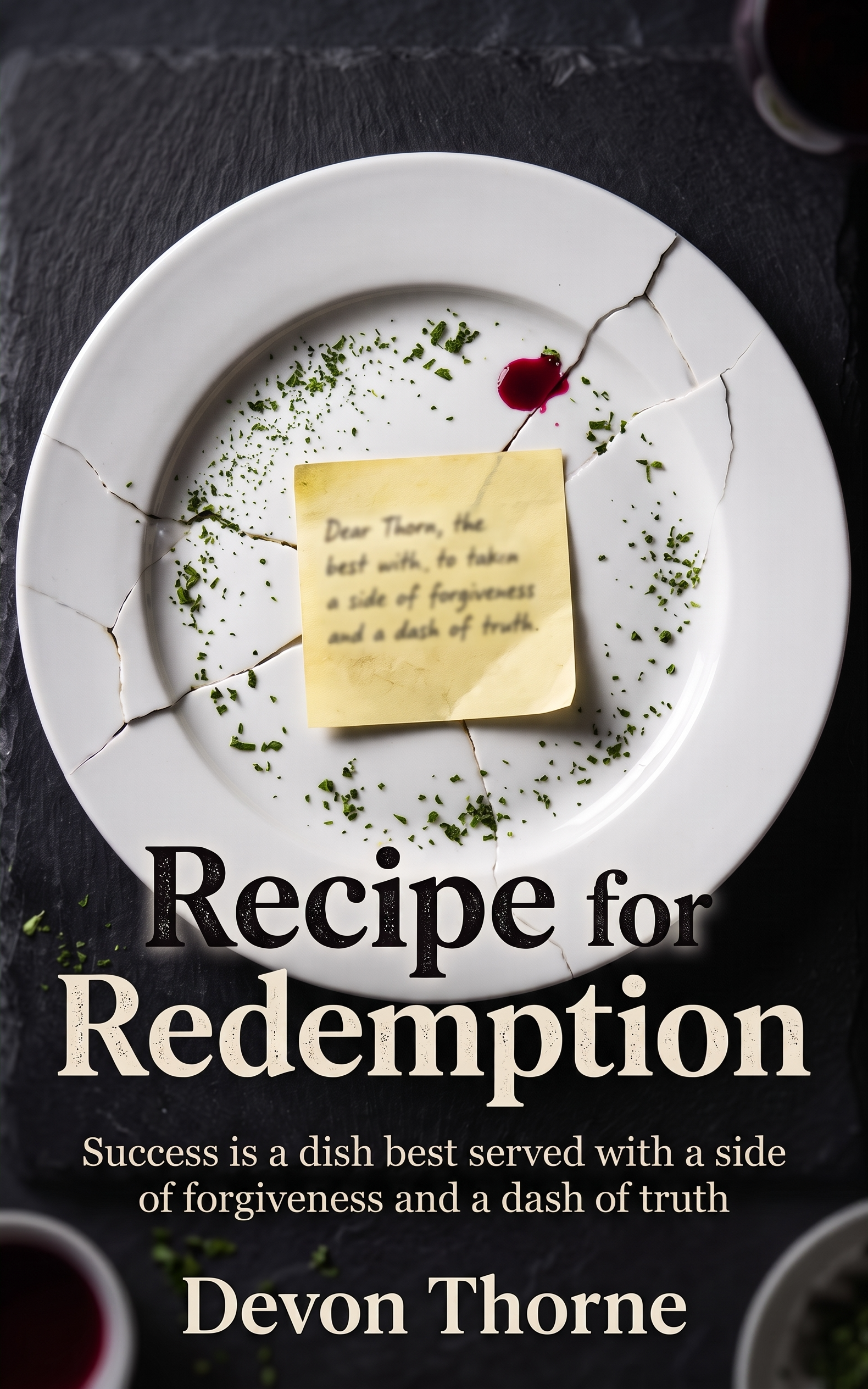
Recipe for Redemption
Success is a dish best served with a side of forgiveness and a dash of truth
by Don Brown
Celia Montgomery was the golden girl of the culinary world, the youngest woman to ever earn a Michelin star. But in the age of viral videos, one explosive kitchen meltdown was all it took to turn her into a pariah. Blacklisted and broken, Celia retreats to the only place left: her childhood home in Bell County, Vermont. Her family's legendary produce empire is crumbling, and the only job in town is at The Hearth—a sophisticated bistro owned by Grady Sutton. He’s the man Celia left at the altar ten years ago with nothing but a post-it note and a trail of heartbreak. Working under her former flame is a recipe for disaster, but as the heat rises in the kitchen, Celia realizes her professional downfall might have been a calculated hit. Between missing ledgers and anonymous threats, someone is trying to drive the Montgomerys out of business. Now, Celia must cook the performance of her life to save her family’s legacy. But as secrets from the past simmer to the surface, she has to wonder: is redemption truly on the menu, or is she just playing with fire? Devon Thorne delivers a mouthwatering tale of second chances and small-town suspense that proves some recipes are worth perfecting.
- Romance
- Literary Fiction
- Mystery
- Enemies to Lovers
- Small Town Drama
- Second Chance Romance
The Bitter Reduction
The hiss of the pneumatic brakes felt like a final, mocking sigh as the bus doors groaned open. I stepped down onto the cracked asphalt of the Bell County bus station, the heavy, humid air of late summer hitting me like a physical wall. It was a suffocating contrast to the climate-controlled kitchens I had lived in for the last decade. I gripped the strap of my heavy canvas duffel bag, my fingers cramping around the only items of value I had left to my name: a set of professional, custom-forged carbon steel knives. They were tucked securely in their leather roll, wrapped in canvas at the bottom of my bag, a heavy, silent weight that felt more like a anchor than a tool kit.
I stood on the gravel shoulder, looking around. The station was nothing more than a rusted metal awning and a single wooden bench with peeling green paint. Nothing had changed. The faded tourism poster on the bulletin board still featured a smiling family picking apples under the slogan, Bell County: Where Sweet Memories are Made. The irony tasted like ash. Ten years ago, I had left this valley with a suitcase full of burning ambition and a heart I had deliberately hardened. I had been the youngest woman to earn a Michelin star in New York, a culinary prodigy celebrated for my razor-sharp precision and uncompromising standards. Now, I was returning as a disgraced spectacle, blacklisted from every reputable kitchen in the country, my career incinerated by a viral video of a single, catastrophic meltdown.
Adjusting the heavy strap on my shoulder, I began the walk toward the Montgomery estate. The morning sun was already high, baking the scent of damp earth and wild clover out of the roadside ditches. My minimalist black trousers and crisp linen shirt—wardrobe staples from my city life—felt absurdly out of place against the dusty gravel. Every step felt like a regression, a slow descent back into a life I thought I had outrun.
As I neared the edge of the Bradford town square, the quiet murmur of a crowd drifted through the warm air. The Bradford town square was unusually busy for a Saturday morning. The farmer’s market was in full swing, held every other weekend, and it was clear the entire town had turned out. The scent of sweet flower blossoms, damp soil, and roasted coffee beans filled the air, creating a sensory blanket that made my chest tighten with a strange, nostalgic ache. It was a beautiful day, objectively speaking, but it felt entirely disconnected from the cold reality of my own existence.
Through the shifting crowd, I spotted the Barrow Farms booth. It was already shaping up to be the busiest stop at the market. Ben Barrow was up on a sturdy step stool, hanging a freshly painted wooden sign over a brand-new green canopy. He was twenty-six now, tall and lean, and he handled the heavy wooden crates of root vegetables with an effortless, practiced strength, lifting two at a time without his stride breaking. Even from a distance, I could see the steady, down-to-earth demeanor that made him so popular in the county. Beside him, his sister Beatrice was busy unloading crates of fresh produce, arranging jars of golden honey and dark berry jams with practiced efficiency. She paused to wipe a smear of soil from her cheek, laughing at something Ben said.
I watched them from the shade of a maple tree at the edge of the square, keeping myself hidden behind the thick trunk. A line of local residents was already beginning to form near their display table, stretching back toward the steps of the stone courthouse. It was a scene of pure, undisturbed community. Once, I had belonged to this world, or at least I had convinced myself I did. Now, I was an outsider, a ghost observing a life that had moved on without me. If any of them looked up and saw me standing there with my duffel bag and my ruined pride, the gossip would spread through the valley before the morning dew finished drying from the leaves. I pulled my dark sunglasses down over my eyes, turned my back on the square, and hurried toward the edge of town.
The gravel driveway of the Montgomery estate wound through a thick grove of ancient oak trees, but the grand reveal at the end no longer held the same magic it did when I was a child. The Victorian manor, with its sprawling wrap-around porch and white trim, looked weathered. Up close, the paint was flaking around the window sills, and the gardens, once my mother’s absolute pride, were overgrown with weeds. The air here felt different—stagnant, colder, and thick with an unspoken decline.
I climbed the wooden steps, the boards creaking under my boots, and pushed the heavy oak front door open. The interior of the house was quiet, smelling of lemon polish and old paper.
"Celia? Is that you?"
My mother, Margot Montgomery, stepped out of the morning room. She looked as elegant and sharp as ever, her silver-blonde hair kept in a perfect, rigid bob, a silk scarf tied neatly around her neck. She didn't rush forward. There was no warm embrace, no motherly relief at her daughter’s return. Instead, she stopped a few feet away, her piercing amber eyes scanning me from head to toe, evaluating my appearance with the cold precision of a health inspector.
"You look tired, darling," Margot said, her voice a polished, sugary drawl that carried a distinct, chilling edge. "And those dark circles under your eyes. We simply cannot afford to have people thinking you’ve come home with your tail between your legs. The whispers in town are already quite loud enough."
"Hello, Mother," I said, my voice flat, matching her emotional temperature. "It’s good to see you, too."
"I’ve moved your things into your old room," she continued, dismissing my sarcasm with a slight wave of her hand. "We need to discuss how we are going to present this transition to the community. A temporary retreat, perhaps. A sabbatical to find inspiration for your next project. We must maintain our standing, Celia. The Montgomery name still means something in this county, even if you’ve forgotten."
"I haven't forgotten anything," I muttered, the weight of her expectations pressing down on my chest like a physical hand. "I’m going to go unpack."
I retreated up the winding staircase to my old bedroom. The space was exactly as I had left it, frozen in time like a museum exhibit of my teenage years. But the room felt smaller now, the ceiling lower, the air holding a chill that the summer heat couldn't seem to penetrate. I dropped my duffel bag onto the faded quilt of the bed and unzipped it, carefully pulling out my knife roll. I laid the heavy canvas wrap on the desk, feeling a deep, hollow ache. My entire identity was tied to those knives, and right now, they felt entirely useless.
Seeking some sense of distraction, some tangible piece of my family’s history to anchor myself to, I walked down the hall to my father’s old study. The room was dark, the heavy green velvet curtains drawn tight against the morning sun. I walked over to the corner where the small floor safe was hidden behind a false panel in the wainscoting. My father had always kept the family’s agricultural ledgers there—the detailed records of land values, harvests, and contracts that had sustained our produce dynasty for generations.
I knelt on the dusty carpet, spun the dial to the familiar combination, and pulled the heavy iron door open. The safe was empty.
I reached inside, my hand sweeping across the bare metal shelf, finding nothing but a thin layer of dust. The ledgers, which should have contained decades of financial history, were completely gone. My breath caught in my throat. I plunged both hands deeper into the dark cavity, frantically clawing at the empty corners, hoping my fingers would catch on a stray piece of paper, a loose receipt, or a forgotten folder. I pulled back the false wainscoting panel further, scraping my knuckles against the rough wood as I searched the surrounding gap, then began tearing through the desk drawers, scattering old envelopes and dried-up pens onto the floor. Nothing. A cold knot of dread settled heavy in my stomach. My mother’s obsession with appearances, the neglected gardens, the empty safe—it wasn't just a personal retreat I had stumbled into. It was a full-blown family crisis.
I closed the safe door, spun the dial, and stood up, my hands trembling slightly. I walked back to my room, poured a glass of cheap white wine from a bottle I had found in the kitchen, and sat on the edge of my bed. I stared up at the cracked plaster of the ceiling, the silence of the old house pressing in on me. I had thought that losing my career in New York was rock bottom. Now, surrounded by the quiet decay of my childhood home, I realized the descent was far from over.
A Table for One
The kitchen of the Montgomery estate had once been a place of culinary inspiration, but on Sunday morning, it felt more like a tomb for bad taste. I stood before the open refrigerator, the low hum of the appliance vibrating through my bare feet on the cold linoleum. I wanted nothing more than to prepare a proper breakfast for my mother, a quiet ges…