

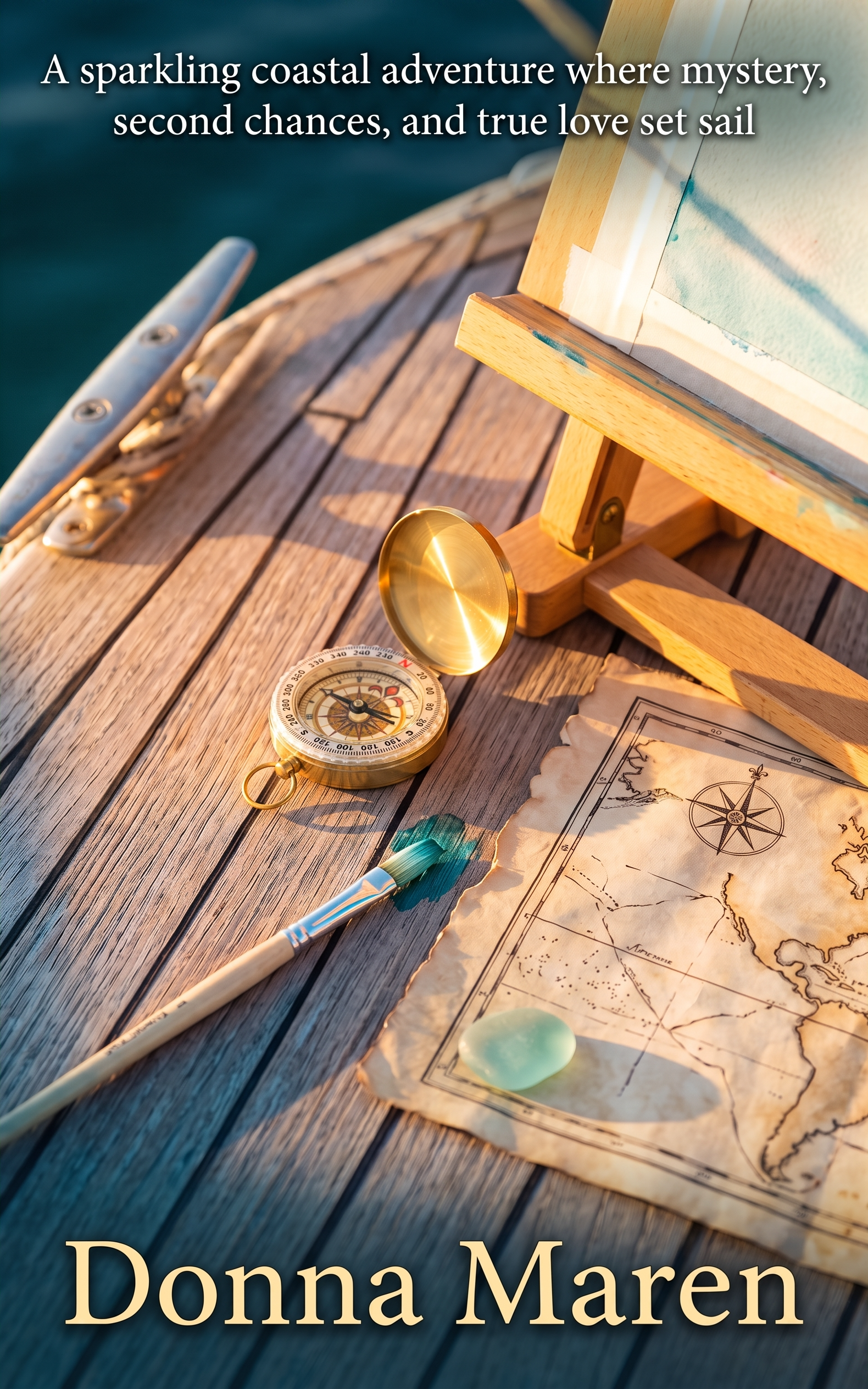
Love on Hidden Harbor
A sparkling coastal adventure where mystery, second chances, and true love set sail
by Donna Mazat
Eleanor Vance has spent decades conquering the boardroom. Arriving in the picturesque seaside town of Heron's Cove with a set of watercolors and a desire for peace, she expects nothing more challenging than capturing the ocean tide on canvas. Enter Arthur Pendleton: a charming, widowed venture capitalist and avid sailor currently untangling his family's chaotic coastal estate. A hilarious spat over property boundaries quickly transforms into an irresistible partnership when the pair discovers cryptic survey markers and a centuries-old maritime mystery hidden beneath the bluffs. Yet paradise is never simple. A predatory relative schemes to seize the historic waterfront for a luxury development, while Eleanor's fiercely protective daughter arrives armed with corporate audits, certain Arthur is out to break her mother's heart and bank account. As Eleanor and Arthur brave sailing expeditions, midnight clue deciphering, and family skepticism, they realize the greatest discovery of all might be each other. In this heartwarming and witty tale, Donna Maren proves that life's most thrilling adventure can begin at any age.
- Romance
- Literary Fiction
- Small Town Romance
- Slow Burn Romance
- Romantic Comedy
- Family Drama
Tides and Easels
The wind off Heron's Cove smelled of salt and low tide, and Eleanor Vance had decided, somewhere around her third cup of coffee that morning, that this particular combination of scents was the closest thing to peace she'd found in thirty years.
She planted her easel legs into the thin soil at the edge of the limestone bluff, testing the ground the way she'd once tested drill sites in Patagonia and the Pilbara, out of habit more than necessity. The canvas in front of her was still mostly white, save for a rough charcoal sketch of the shoreline where it curved away toward the harbor. Below, the Atlantic threw itself against the rocks in long, unhurried sighs. Above, gulls wheeled and complained about nothing in particular. It was, Eleanor thought, exactly the kind of morning she had sold her company to earn.
She had just mixed a promising shade of slate blue when she heard footsteps crunching through the sea grass behind her, unhurried, confident, entirely too close.
"You're standing on my bluff," a man's voice said.
Eleanor did not turn around right away. She dabbed her brush against the canvas, added a shadow beneath a rock formation that didn't strictly exist yet, and only then looked over her shoulder.
The man was tall, broad through the shoulders in the way of someone who'd spent decades hauling lines and hoisting sails rather than sitting behind a desk, though something in his tailored canvas jacket suggested he'd done plenty of both. Iron-grey hair, a neatly trimmed beard, and blue eyes that crinkled at her with an amusement she found almost as irritating as his claim.
"I'm fairly certain," Eleanor said, "that I'm standing on public trail, about four feet from the edge, with a rather nice view that has nothing to do with you."
"That would be true," the man said, "if the boundary line ran where the town thinks it runs. It doesn't. My uncle's parcel extends to the old stone cairn just past that gorse bush, which puts your easel roughly two feet inside Pendleton land."
Eleanor set her brush down with the particular precision of a woman who had once negotiated seven-figure surveying contracts with far less patient men. "Mr. Pendleton, I assume."
"Arthur Pendleton." He extended a hand, then seemed to reconsider the gesture given the circumstances and withdrew it with a small, self-deprecating shrug. "I've got a deed that says otherwise, if you'd like to see it."
"I would love to see it," Eleanor said, "because I happen to have a deed of my own, and mine has a surveyor's seal from 1962 that puts this entire bluff, gorse bush included, on the Whitmore parcel, which I have leased for the season."
Arthur's eyebrows rose, and something in his expression shifted from proprietary irritation to genuine interest, the look of a man who had just discovered the crossword was harder than expected and was pleased about it. "1962," he said. "Mine's from 1889. Older usually wins, in my experience."
"Not if the 1962 survey was a formal re-platting that superseded it," Eleanor said. "Which, given the neatness of the ink, I suspect it was."
"You've read a lot of deeds."
"I spent thirty-five years reading rock strata for a living, Mr. Pendleton. Land documents are considerably less honest than stone, but I've learned to squint at both."
That earned her a laugh, low and unguarded, the kind that seemed to surprise him as much as it did her. "Eleanor Vance," he said. "You ran that geo-survey outfit. The one that found the lithium deposit in Chile everyone said didn't exist."
"You've done your homework."
"I read the financial pages compulsively. Bad habit from forty years of trying to guess which mergers would blow up in everyone's face." He glanced past her toward the water, and for a moment the teasing dropped away, replaced by something more tired. "I sold Pendleton Maritime Logistics eighteen months ago. Told myself I'd spend my retirement sailing and staying out of other people's business affairs. And now here I am, arguing with a stranger over four feet of scrub grass."
"Welcome to retirement," Eleanor said dryly. "It's every bit as relaxing as advertised."
They stood there a moment, the wind snapping at the corner of her canvas, both of them apparently reconsidering the argument they'd been so ready to have. It was Arthur who broke first, gesturing down the trail toward the harbor.
"There's a cafe by the marina," he said. "Decent coffee, better view, and a table where we could lay out both deeds without them blowing into the Atlantic. I'd rather compare notes than call a lawyer. Lawyers have taken enough of my money over the years."
"That," Eleanor said, closing her paint box with a satisfying snap, "is the first sensible thing you've said."
The marina cafe smelled of espresso and fry oil, and Eleanor claimed the corner table with the view of the docks while Arthur ordered for them both, apparently assuming, correctly, that she took her coffee black. They spread their respective deeds across the table between the sugar caddy and a chipped ceramic creamer, and for twenty minutes traded observations about metes and bounds, about a stone cairn that might or might not still exist, about the peculiar habit of nineteenth-century surveyors to measure distance in rods and then never explain what a rod actually was.
"You know," Arthur said, tapping his own deed, "for a woman who claims to be retired, you argue property law like someone billing by the hour."
"I spent three decades negotiating mineral rights with governments who changed their minds every election cycle. This is practically a vacation."
"A vacation," he repeated, smiling into his cup. "Is that what you call sitting on a cliff arguing with a man you'd just met?"
"I call it Tuesday, Mr. Pendleton."
He laughed again, and Eleanor found herself unexpectedly pleased by the sound of it, which annoyed her slightly, because pleasure of that particular kind belonged to a version of herself she'd retired along with the company.
It was on the walk back up the bluff trail, deeds tucked under their arms, that Arthur stopped so abruptly Eleanor nearly ran into him.
"There," he said, crouching near the edge of the path.
Embedded in the packed dirt, half hidden beneath a curl of dried sea grass, was a small brass disk, tarnished green with age. Eleanor knelt beside him, brushing away the grit with two fingers. It wasn't a municipal marker, not the kind she'd seen stamped on every surveyed parcel from here to the county line. This one bore a raised crest, a ship under full sail crossed with an anchor, and beneath it, worn nearly smooth, a set of initials she couldn't quite make out.
"That is not a standard survey pin," Eleanor said quietly.
"No," Arthur agreed, and when he looked up at her, the amusement in his eyes had sharpened into something closer to genuine curiosity. "It is not."
Neither of them spoke for a moment, the wind moving through the grass, the gulls circling lower now over the harbor.
"Town hall," Eleanor said finally. "Tomorrow morning. Whoever put that in the ground had a reason, and I'd like to know what it was before I decide whether you owe me two feet of bluff or I owe you nothing at all."
Arthur grinned, and it was, Eleanor thought, an entirely too charming expression for a man she'd known for less than three hours.
"Tomorrow morning," he said. "I'll bring the coffee."
Dust and Old Ledgers
The Heron's Cove Municipal Archives occupied the basement of a building that had once been a customs house, and it smelled, Eleanor decided the moment Arthur pulled open the heavy oak door, of every basement she had ever descended into on three continents: mildew, dust, and the particular mineral tang of old paper slowly turning to nothing. "Charmi…