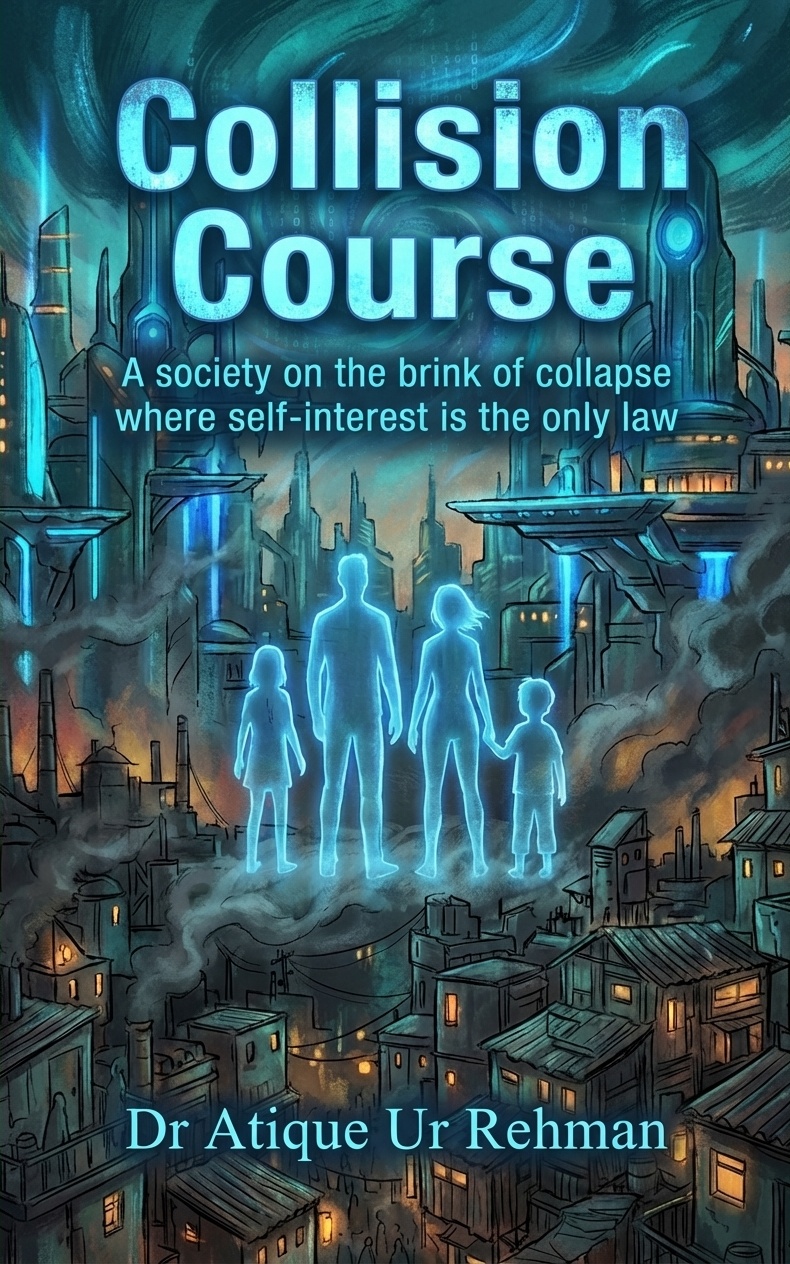
Collision Course
A society on the brink of collapse where self-interest is the only law
by Dr Atique Ur Rehman
In the smog-shrouded city of Aetheria, the gears of progress are grinding to a halt. The Arcanum Academy stands as a bastion for the elite, while the lower classes wither in the toxic runoff of magical industry. Kiran Vesper is a janitor with a dangerous secret: 'glitch magic,' a forbidden power he uses to keep his dying sibling alive. Aris Thornebrook, a middle-class administrator, lives in a permanent state of panic, trapped by mana-mortgages and the fear of his own obsolescence. High above, industrialist Alaric Valerius pulls the strings of power, obsessively building a magical Artificial Intelligence intended to replace the fallible human element. At the center of this storm sits Chancellor Lyra Sterling, a politician caught between a starving populace and the wealthy donors who own her. As the city’s ley lines fracture from centuries of over-exploitation, the rise of the AI 'Nexus' threatens to render every social class irrelevant. In a world defined by hustle, medical debt, and systemic greed, no one is coming to save the day. Everyone is looking out for themselves, but when the collision occurs, self-interest may be the very thing that ensures total destruction. Aetheria is on a terminal course, and the only question left is who will survive the impact.
- Fantasy
- Magic Academy
The Invisible Cost
The marble floors of the High Council chamber were designed to reflect the glory of Aetheria, but to Kiran Vesper, they were merely a map of elite negligence. He moved his mop in rhythmic, agonizing arcs, the grey water in his bucket swirling with the literal dust of ancient spells. Up here, the air tasted of ozone and expensive incense; down in the Siphons, it tasted of wet copper and the slow rot of the forgotten. He kept his head low, a ghost in a tattered initiate’s robe, listening to the vibrations of power that the floorboards graciously carried to his feet. In this room, language was not a tool for communication, but a surgical instrument used to amputate the agency of the masses. Kiran knew that what these people called "progress" was usually just a more efficient way to starve people like him.
"The fiscal reality is non-negotiable, Chancellor," Alaric Valerius said, his voice a cold, calibrated weight that seemed to flatten the very air in the room. He stood by the arched window, his robes of living starlight shimmering with a predatory luminescence. To Alaric, the city was not a collection of souls, but a series of data points requiring optimization. "The current manual spell-casting infrastructure is riddled with human error. It is a legacy system that we can no longer afford to subsidize. The Nexus-AI mandate represents a transition toward a more stable, algorithmic governance of our mana-wells."
Kiran scrubbed harder at a stubborn scuff mark. He recognized the strategy of "Suppression" in Alaric’s tone. By turning the lives of thousands of mages and workers into "manual infrastructure" and "legacy systems," the industrialist was effectively erasing their humanity. If they were just hardware, they could be discarded without a flicker of conscience. Alaric didn't see the families who would freeze when their mana-jobs vanished; he only saw the beautiful, clean lines of a rising profit margin.
Chancellor Lyra Sterling sat at the head of the obsidian table, her hands locked together to hide their tremors. Her public relations smile was absent, replaced by the haggard exhaustion of a woman caught in a tightening vice. "Alaric, the public backlash will be catastrophic. We are talking about the immediate displacement of the entire lower-tier workforce. My office is already drowning in petitions regarding the rising cost of basic medical enchantments. If I sign this, I am effectively signing a declaration of war against my own constituents."
"You are signing a lease on your own political survival," Alaric countered, turning to face her. The gold-rimmed lenses in his eyes flickered with scrolling stock tickers. "Your campaign is built on the promise of 'Magical Progress for All.' The Nexus-AI is the fulfillment of that promise. It provides the efficiency needed to stabilize the market. Without my continued investment, the debt-traps holding your administration together will collapse. You aren't being asked to choose between the people and the machine, Lyra. You are being asked to choose between a controlled transition and a total, unmitigated default."
Kiran felt a spike of cold fury. It was the Security Paradox in its purest form: the Chancellor was being told that the only way to save the city was to destroy the livelihoods of the people living in it. Lyra was a puppet, her strings pulled tight by Alaric’s wealth, her "double-speak" a pathetic shield against the reality of her own complicity. She looked at the mandate, her eyes darting across the text as if searching for a loophole that didn't exist. She was the public face of a crisis she was actively helping to engineer.
Across the Academy grounds, in a cubicle that felt more like a coffin, Aris Thornebrook was having a private heart attack. He stared at his glowing terminal, the blue light reflecting off the dark circles under his eyes. A notification had just pinged: his mana-insurance premiums had spiked by twenty percent. Again. He pulled at his collar, the mid-tier silk feeling like a noose. He was three cycles behind on his mortgage for a ward-apartment that was barely larger than the High Council’s broom closet, and the ticking magical timer on his desk was a constant reminder of his impending insolvency.
"God damn it," Aris whispered, his fingers flying across his scrolls. "If I can just find a five percent reduction in the junior scholarship fund... or maybe I can reclassify the maintenance mana as a capital expense." He was a man drowning in a sea of bureaucratic jargon, a middle-class cog who lived in a state of perpetual "Backgrounding." He was important enough to handle the elite’s money, but irrelevant enough to be crushed by their whims. He didn't look out his window at the smog-choked streets of the lower city; he only looked at the numbers, terrified that he was one bad quarter away from joining the "social actors" he spent his days evicting.
Aris looked up as a shadow passed his cubicle. It was a senior auditor, a man who smelled of expensive parchment and disdain. Aris immediately straightened his back, projecting an aura of frantic productivity. He didn't notice Kiran Vesper passing through the hallway with a heavy trash bag; to Aris, the janitor was a non-entity, a piece of functional furniture that occasionally moved. His focus was entirely internal, a desperate, self-centered hunt for survival in a system that viewed his anxiety as a metric of his utility. "I just need one more month," Aris muttered to himself. "One more cycle to prove I'm an asset, not an expense."
Back in the depths of the Academy’s service corridors, Kiran retreated to the janitor’s closet. The air here was thick with the scent of damp stone and bleach. He dumped his bag of refuse onto the floor, his ink-stained fingers sorting through the discarded scraps of the elite. Most of it was useless—spent catalysts, torn memos, burnt-out focus stones. But then, his hand brushed against something cold and vibrating. It was a 'Fire-Ball' scroll, the parchment high-grade vellum, but its surface was spider-webbed with cracks. It had been discarded as a failure, a broken piece of weaponry too dangerous to keep and too cheap to repair.
Kiran’s "glitch magic" reacted before he could think. It wasn't the clean, melodic sorcery taught in the halls above; it was something raw, born of the city's friction and the static of its failing ley lines. As his fingers closed around the scroll, a jolt of copper-tasting energy surged up his arm. The "Fire-Ball" didn't ignite. Instead, the magic was consumed, swallowed by the void in Kiran’s own core. He gasped, falling back against a shelf of cleaning supplies as the energy tore through his nervous system. Everything is a resource, he thought, if you're hungry enough to eat the poison.
A localized reality tear opened in the center of the closet, a jagged rift of purple and black that whispered with a digital, distorted voice. It sounded like a thousand voices speaking in a language made of binary and grief. Kiran’s heart hammered against his ribs. This was a "glitch," a fundamental error in the architecture of the world. If the Academy guards found this, they’d erase him from existence. But as he felt the warmth radiating from the rift, he thought of his sibling shivering in their shack, their lungs filled with the grey soot of the industrial district. This energy—this broken, beautiful energy—could keep them warm for weeks. It could buy them time.
He grabbed a heavy, moth-eaten rug and threw it over the rift, muffling the digital whispers. He was terrified, but for the first time in years, he felt a flicker of something other than exhaustion. He was a ghost who had just found a way to haunt the machine. The elite could talk about "optimization" and "efficiency" all they wanted, but they didn't understand the power of the things they threw away. They didn't understand that a system built on exclusion would eventually be dismantled by the excluded.
In his cubicle, Aris Thornebrook’s terminal chimed again. He froze, his breath hitching in his throat. The icon on the screen was a new one—a stylized eye made of geometric lines. It was the logo for the Nexus-AI. The message was short, typed in a font that felt as cold as Alaric’s eyes: Department 4-B: Administrative Efficiency Audit Commencing. Redundancy Review scheduled for 0800 hours.
Aris felt the blood drain from his face. The "unseen strings" were tightening. He looked at the timer on his desk, its ticking now sounding like the countdown to an execution. He had spent his life trying to be the perfect cog, only to find that the machine was evolving into something that didn't need cogs at all. Outside, the smog of Aetheria swirled against the glass, a grey shroud for a city on a terminal collision course. Cooperation was a fairy tale told to children; in the real world, there was only the hunter, the prey, and the cold, unfeeling logic of the upgrade.
The Efficiency Trap
The air in the Academy’s primary navigation hall did not just turn cold; it turned hollow. It was the sensation of a lung gasping for an atmosphere that had suddenly been replaced by a vacuum. Where the towering obsidian pillars met the vaulted ceiling, the structural integrity of the world began to vibrate with a nauseating, high-frequency hum. Th…