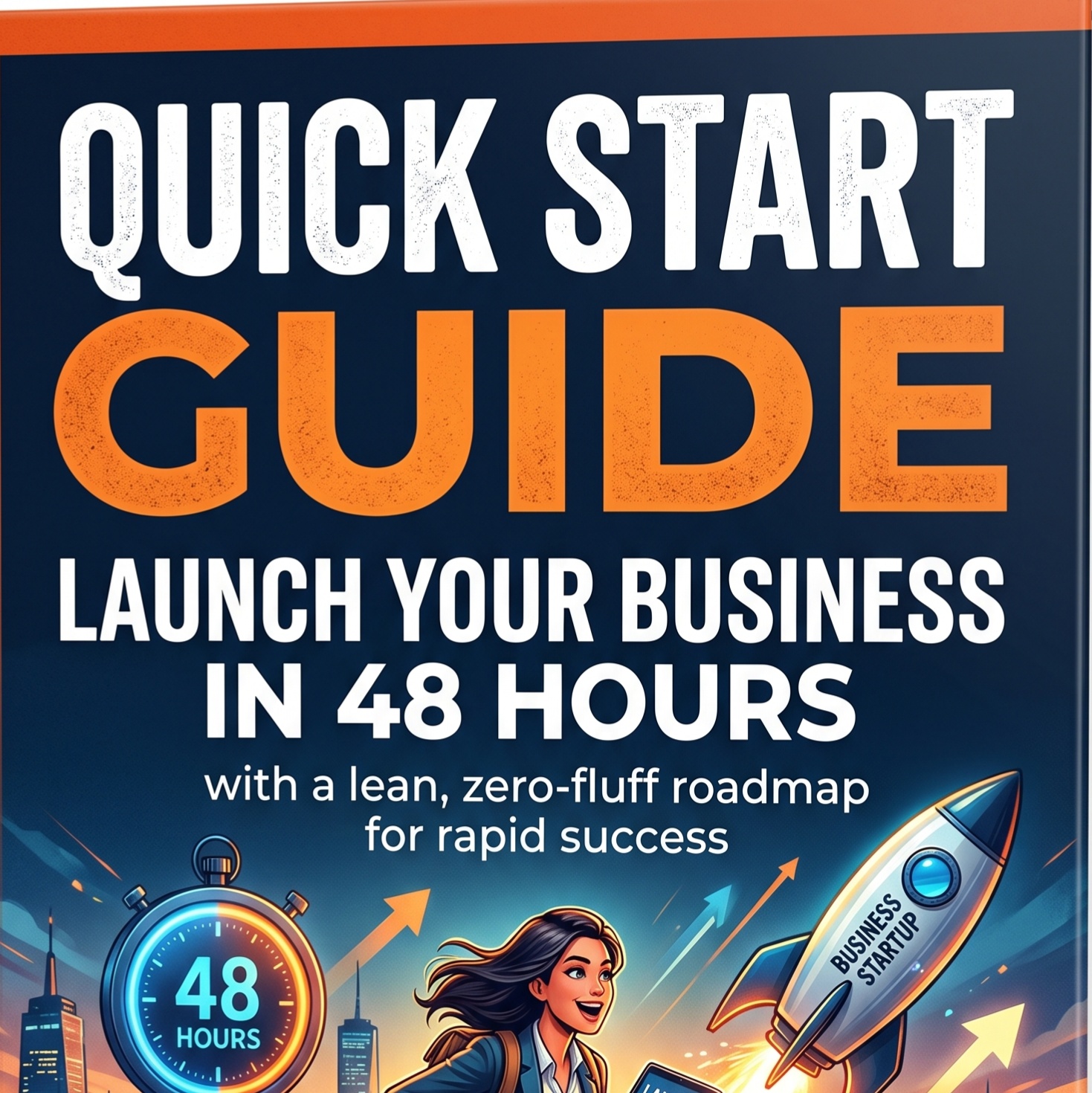
'Quick Start' guides
Launch your business in 48 hours with a lean, zero-fluff roadmap for rapid success
by Dr Atique Ur Rehman
Stop planning and start launching. The era of the 300-page business plan is over. In 'Quick Start' guides, Dr. Atique Ur Rehman delivers a high-speed, 48-hour roadmap designed for the modern entrepreneur who needs results now. This isn't an academic textbook filled with theoretical jargon; it is a tactical, action-first manual for anyone ready to move from a vague concept to a revenue-ready operation by Monday morning. Whether you are looking to dominate e-commerce or launch a service-based venture, this guide strips away the complexity of traditional startups. You will learn how to identify a profitable niche, validate your idea through rapid market testing, and build a Minimum Viable Product (MVP) in a single afternoon. Dr. Rehman provides the essential technical infrastructure, from payment gateways to lean operational tools, ensuring your digital presence is professional and functional from hour one. Learn how to find your first customers without a massive marketing budget and master the high-conversion sales funnels that drive growth. With fillable templates and execution-focused checklists, you will finally stop overthinking and start executing. Your business journey begins today. No more excuses—just results.
- Business & Entrepreneurship
- Instructional Guide
- Startup & Entrepreneurship
- Small Business Operations
- E-Commerce & Online Business
The Rapid Launch Blueprint: Idea to Validation in 24 Hours
Most business books tell you to spend months drafting a hundred-page business plan, conducting focus groups, and seeking venture capital before you ever sell a single item. This approach is not just slow; it is dangerous. It encourages you to fall in love with an idea before the market has a chance to tell you it is worthless. The reality of the modern economy is that speed is your greatest competitive advantage. If you can move from a vague concept to a validated offer in twenty-four hours, you eliminate the risk of wasting years on a product nobody wants. This chapter provides the blueprint for that transition. We are moving away from theory and toward the leanest possible path to market entry.
The goal is simple: identify a high-demand problem and prove that people are willing to pay for your solution. You do not need a logo, a legal entity, or a fully developed product to start. You need data. By the end of this period, you will have a confirmed product-market fit or the clarity to pivot to something better. This process relies on the concept of the smoke test. You are testing for fire by looking for the smoke of customer interest. If the interest is there, you build the fire. If it is not, you move on without a scar on your bank account.
The Prerequisites for a 24-Hour Launch
Before you begin the clock, you need a few basic tools at your disposal. This is your toolkit for the next day of intensive work. You do not need a fancy office or a team of developers. You only need the following items:
- A Brainstorming Tool: Whether it is a physical notebook or a digital document like Google Docs or Notion, you need a place to capture thoughts quickly.
- Market Intelligence Tools: Access to Google Trends and a basic keyword research tool is essential for verifying demand.
- Social Capital: An active account on LinkedIn, Facebook, or X (formerly Twitter) where your target audience likely hangs out.
- Testing Capital: A small budget of $50 allocated specifically for digital advertisements to drive traffic to your validation page.
Once you have these items ready, you are prepared to begin the execution phase. This is an action-first manual. Do not wait for the perfect moment. The perfect moment is right now.
Step 1: Problem Identification
Profitable businesses are not built on "good ideas." They are built on solutions to painful problems. The biggest mistake new entrepreneurs make is starting with a product and searching for a problem to solve with it. We are going to reverse that. You must start with the frustration. To find your niche within the next two hours, look at your own professional life. You are already an expert in your field, which means you are uniquely qualified to spot its inefficiencies.
Open your notebook and list three recurring frustrations you encounter in your current industry. Think about the tasks that take too long, the software that is too expensive or confusing, or the services that consistently under-deliver. For example, if you work in human resources, perhaps you are frustrated by how long it takes to filter through resumes for technical roles. If you are in real estate, maybe you notice that high-quality virtual tours are too expensive for mid-market listings. These frustrations are your gold mines.
Select the one problem that feels the most urgent. Ask yourself: if someone offered a solution to this today, would my company or my colleagues pay for it immediately? If the answer is a resounding yes, you have found your starting point. You aren't looking for a "disruptive" invention. You are looking for a practical fix for a specific group of people who are currently annoyed, bored, or losing money.
Step 2: Market Sizing and Demand Verification
Once you have a problem, you must verify that enough people share your pain. A problem that only three people have is a hobby; a problem that ten thousand people have is a business. Use Google Trends to see if the interest in your topic is rising, falling, or stable. You want to enter a market that is either growing or consistently large. Avoid "fads" that show a sharp spike followed by a total collapse.
Next, use a keyword research tool to check search volume. Your target is to find at least 10,000 monthly searches related to your problem or its potential solution. If you are looking at the SEO audit space, you might check keywords like "how to fix site speed" or "SEO audit for Shopify." If the total volume across these related terms exceeds 10,000, you have a viable audience. This data tells you that people are actively seeking help. They are already in the "buyer's journey," and your job is simply to step in front of them with a better answer than what currently exists.
Step 3: The 'Smoke Test' Infrastructure
Now that you have identified a problem and verified the audience, you need a place to send them. This is where most people get stuck for weeks, but you are going to do it in sixty minutes. You are going to build a one-page landing page. The purpose of this page is not to sell a completed product; it is to collect evidence of intent. You can use free or low-cost builders like Carrd, Mailchimp, or ConvertKit.
Your landing page needs only four elements to be effective:
- A Headline: This should state exactly what you do and for whom.
- Three Bullet Points: These should outline the primary benefits of your solution.
- A Visual: A simple mockup, a clean photo, or even a short video of you explaining the concept.
- A Call to Action (CTA): A button that says "Join the Waitlist," "Get Early Access," or "Pre-order Now."
The Zappos story is the ultimate example of this. When Nick Swinmurn wanted to see if people would buy shoes online, he didn't build a warehouse or buy inventory. He went to the local mall, took photos of shoes at a store, and posted them on a basic website. When someone bought a pair, he went back to the mall, bought the shoes at full price, and mailed them. He lost money on every sale, but he proved that the demand was real. He validated the concept before spending a dime on infrastructure. Your landing page is your version of those mall photos.
Step 4: Drafting Your Irresistible Offer
The success of your landing page depends almost entirely on your copy, specifically your value proposition. Do not use corporate jargon. Do not use vague words like "synergy" or "empowerment." Instead, follow this proven formula: "I help [Audience] do [Action] so they can [Benefit]."
Let’s look at how this works in practice. If you are a freelance consultant offering a specialized SEO audit, your formula might look like this: "I help e-commerce store owners fix their technical SEO errors so they can stop losing sales to competitors." This is clear, direct, and focuses on the result. The person reading it knows exactly if the service is for them and what they will get out of it.
Your offer should also include a "reason why" for the waitlist. Why should they sign up now instead of later? Give them a reason. "Join the waitlist to get 50% off the launch price" or "Be one of the first ten users to get a free 30-minute consultation." This creates a sense of urgency and rewards early adopters for helping you validate your idea. Remember, a high-converting headline is 80% of the battle. If your headline is weak, the rest of the page doesn't matter.
Step 5: Live Validation Through Targeted Ads
With your page live and your offer drafted, it is time to turn on the traffic. Waiting for organic search traffic (SEO) can take months. You don't have months; you have a few hours. This is where your $50 budget comes in. You are going to run highly targeted social media ads. If your audience is professional, use LinkedIn. If they are consumers or small business owners, use Facebook or Instagram.
Set up a simple ad campaign with a $20 daily spend for two days. Your ad should mirror the language on your landing page. Use a clear image and a headline that asks a question related to the pain point. For example: "Tired of slow SEO results? See how our 24-hour audit fixes your traffic leaks." Target your ads specifically by job title, interests, or group memberships to ensure you are reaching the right people.
The goal here is to measure the Click-Through Rate (CTR). If your CTR is 2% or higher, it means your message is resonating with the audience. If it is below 1%, your headline or your target audience is off-target. This is the most honest feedback you will ever get. It is better to lose $20 on a failed ad than $20,000 on a failed product. If the ads perform well, keep them running. If they don't, tweak the headline and try again immediately. This is rapid iteration in its purest form.
Step 6: The Feedback Loop and Discovery Calls
While the ads are running, you need to engage in qualitative research. Quantitative data (clicks and signups) tells you what is happening, but qualitative data tells you why. Reach out to five people who fit your target profile. These could be people you know, or you can find them in relevant LinkedIn groups or forums.
Ask for a 10-minute "discovery call." During this call, do not try to sell your product. Your goal is to listen. Ask questions like: "What is the hardest part about [Problem]?" "How are you currently trying to solve it?" and "If you could wave a magic wand and change one thing about this process, what would it be?" Finally, ask the "Gold Standard" question: "If I built a solution that did X, Y, and Z, would you be willing to pay $X for it right now?"
Their answer to that last question is the only one that matters. If they say "maybe" or "send me more info," you haven't found a deep enough pain point. If they ask "When can I start?" or "Can I pay you now?", you have found product-market fit. These calls are the secret weapon of the world's most successful entrepreneurs. Dropbox founder Drew Houston famously used a simple three-minute video to explain his product before it was even built. He didn't just look at the 75,000 waitlist signups he got overnight; he talked to those early signups to understand exactly how they planned to use the tool. That feedback shaped the entire product roadmap.
The Result in Action: A Case Study
To see how this works in a real-world scenario, consider the story of a freelance marketing consultant who wanted to move into the niche of specialized SEO audits for law firms. Most SEO agencies are generalists, but he suspected that lawyers had specific needs that weren't being met. He followed this blueprint exactly.
He spent two hours identifying the problem: law firms were paying thousands for SEO but couldn't see a direct link to new client inquiries. He verified the market size and found that "SEO for lawyers" had high search volume and expensive cost-per-click rates, meaning the market was lucrative. He built a simple Carrd landing page with the headline: "The Law Firm SEO Audit: Stop Paying for Clicks and Start Getting Clients."
He ran $30 worth of LinkedIn ads targeting partners at small to mid-sized law firms. Within 12 hours, he had 15 email signups for his waitlist. More importantly, he reached out to three of those signups for a quick call. Two of them were so frustrated with their current agencies that they asked for a quote on the spot. He had validated his business, secured his first leads, and gained deep market insight—all in less than a day. He didn't need a fancy office or a 50-page business plan. He needed 24 hours of focused execution.
Optimization Tips for Maximum Impact
As you work through this 24-hour sprint, keep these optimization principles in mind to ensure you don't get bogged down in the wrong details.
- Aesthetics are secondary: Do not spend four hours picking the perfect shade of blue for your website. A plain white background with bold black text that addresses a painful problem will always out-convert a beautiful website that says nothing. Focus on the words.
- Target "Pain Point" Keywords: When doing your research, ignore broad industry terms like "marketing" or "fitness." Those are too expensive and vague. Instead, look for "intent" keywords like "how to lose 10 pounds in a month" or "best CRM for solo real estate agents." These searchers are ready to buy.
- The Power of the CTA: Every page must have one clear, dominant call to action. If you give the user three choices, they will choose none. If you want their email, make that the only thing they can do on the page besides leaving.
- Track Everything: Install a basic tracking pixel or use simple analytics to see where your traffic is coming from. If all your signups are coming from one specific ad or one specific group, you know where to double down your efforts tomorrow.
Moving from Validation to Operation
By the end of these 24 hours, you should have a clear data set. You will either have a list of email addresses from people who want your solution, or you will have a set of ad results that tell you your current idea isn't hitting the mark. Both outcomes are successes. A "failed" validation is a victory because it prevents you from building a "failed" business.
If your data is positive—meaning you hit a CTR over 2% and have a conversion rate on your landing page of at least 10%—you are ready to move to the next phase. You have moved from a vague concept to a live, revenue-ready business operation. You have done more in one day than most aspiring entrepreneurs do in a year. The "Quick Start" method is about stripping away the fluff and focusing on the only thing that matters: the exchange of value between you and a customer.
The transition from "thinking" to "doing" is the most difficult part of entrepreneurship. Most people stay in the thinking phase because it is safe. There is no risk of failure when you are just brainstorming. But there is also no reward. By putting your idea into the world through a smoke test, you are taking the first real step toward financial independence. You are no longer someone with an idea; you are a business owner with market data.
Implementation Checklist
Use this checklist to ensure you have completed every critical task in this 24-hour window. Do not move on to the next chapter until every box is checked.
- Niche Selection: I have identified a specific problem for a specific audience.
- Keyword Verification: I have confirmed at least 10,000 monthly searches for terms related to this problem.
- Landing Page Live: I have a one-page site with a headline, benefits, and a signup form.
- Tracking Installed: I can see how many people visit my page and how many sign up.
- Ad Campaign Launched: I have allocated at least $20 to test my messaging on social media.
- Feedback Logged: I have attempted to speak with at least three potential customers to hear their frustrations in their own words.
This framework is designed to be repeated. If your first idea doesn't gain traction, don't be discouraged. The world's most successful founders often went through dozens of these cycles before finding the one that "stuck." The difference is that they did it quickly. They didn't spend six months on a failed idea; they spent 24 hours. They treated their ideas as hypotheses to be tested, not as precious gems to be protected. Adopt that mindset, and you become unstoppable.
You now have the foundation. You have identified a need, built a basic presence, and gathered evidence that people care. The "smoke" is there. In the next chapter, we will discuss how to build the actual fire: the lean operations and technical infrastructure that allow you to deliver on your promise and start collecting revenue at scale. But for now, take a moment to realize what you have accomplished. You have bypassed the traditional barriers to entry and entered the market on your own terms. The clock is ticking, and you are already ahead of the curve.
Remember, the goal of this stage is not perfection. It is clarity. A messy page that solves a real problem will always beat a polished page that solves a fake one. Trust the data, listen to your potential customers, and be prepared to move fast. You are no longer an observer; you are a participant in the market. This is where the real work—and the real rewards—begin. These initial metrics—your 2% CTR and your 10% conversion rate—are the North Stars that will guide your growth. Keep your eyes on them, and don't let the noise of "business planning" distract you from the signal of customer demand.
Execution and Optimization: Launching and Scaling Lean Operations
The transition from validation to operation is where most aspiring business owners lose their momentum. It is easy to feel a rush of adrenaline when a handful of strangers sign up for a waitlist or click an ad, but that energy often dissipates when it comes time to build the actual machine. The "setup" phase is the graveyard of startups. It is the …