

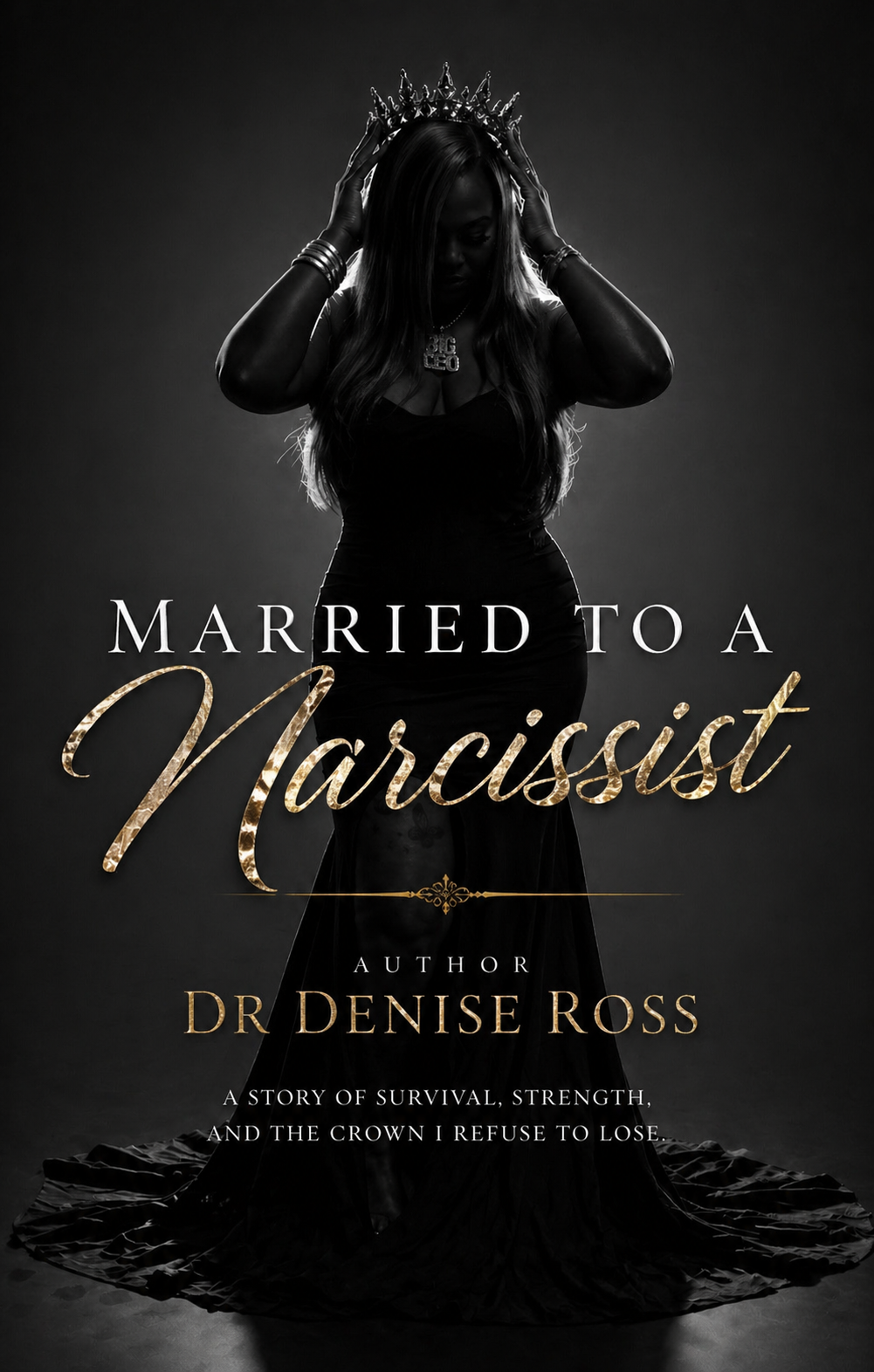
Married to a narcissist
Break free from the cycle of manipulation and reclaim your strength for your family
by Dr Denise Ross
How do you find your way back to yourself when the person you love has turned your home into a psychological battlefield? At nineteen, Dr. Denise Ross believed she had found a fairytale romance. What began with intense 'love bombing' and promises of forever slowly devolved into a harrowing reality of emotional control, gaslighting, and systemic manipulation. In this courageous memoir and practical guide, Dr. Ross deconstructs the invisible walls of a marriage to a narcissist, revealing how toxic dynamics can fracture a family and erode a person's very identity. Through fourteen transformative chapters, you will discover: • The subtle signs of trauma bonding and battered woman syndrome. • Strategies for protecting your children from high-conflict household dynamics. • Practical tools like the 'Grey Rock' method and emotional detachment techniques. • A roadmap for establishing unshakeable boundaries and rebuilding your life. This is more than a story of survival; it is a powerful framework for recovery and long-term mental health stability. Whether you are currently navigating a high-conflict relationship or seeking to heal from the past, Dr. Ross provides the clarity and empathy needed to prioritize your well-being. It’s time to stop just surviving and start reclaiming your independence.
- Parenting & Family
- Biography
- Family Relationships
The Prince and the Puppet: The Love Bombing Phase
I was only 19.
Fresh out from under my mother’s roof, I was still trying to figure out life. I was still learning who I was in a world that felt vast and often overwhelming. I didn’t know anything about love—real love. I only knew what I thought it was supposed to look like based on movies and the hollow spaces I felt inside myself. I was looking for a hero, though I wouldn’t have admitted that at the time. I was looking for a place where I finally belonged, a person who would make the chaos of the world go quiet.
Then I met him.
He was older—10 years older. That decade of difference felt like an ocean of wisdom and experience. He was confident. He was smooth. He was the type of man who looked like he already had life figured out, from the way he carried himself to the way he spoke with such absolute certainty. To a 19-year-old girl searching for stability, that didn't just feel like attraction. It felt like safety. It felt like I had finally found the anchor I didn't even know I was searching for.
He promised me everything. He told me I’d never have to struggle again. He told me I’d be treated like a queen, a word he used so often it became my new identity before I even had a chance to define myself. He told me he would protect me from the world, from my past, and even from my own insecurities. And for the first three months, he did exactly that.
Those three months felt like a fairytale. There were flowers delivered to my door for no reason other than it being a Tuesday. There was constant attention, a barrage of texts that made my phone buzz with validation every few minutes. There was constant reassurance. He made me feel chosen. He made me feel special. He made me feel like I finally mattered in a way that no one else had ever made me feel. I fell in love fast because everything felt perfect. It felt like we were two halves of a whole, two souls that had finally found their way home.
But what I didn’t know was that those three months weren’t real. They were the setup. They were the bait on a hook that I swallowed whole, driven by a hunger for a kind of love that doesn't actually exist in the healthy world. I was the puppet, and he was the prince, pulling the strings of my heart with such precision that I never even noticed the tension.
Deconstructing the Dynamic: The Anatomy of Love Bombing
In the world of psychology, what I experienced is called love bombing. It sounds like a positive term—who wouldn't want to be bombed with love? But in reality, it is a calculated tactic used by narcissists to bypass your logical defenses. When someone showers you with an overwhelming amount of affection, praise, and attention early on, your brain actually changes. You are flooded with dopamine and oxytocin. You are essentially high on the validation this person is providing. This high makes it nearly impossible to see the red flags that are waving right in front of your face.
The narcissist uses love bombing to create an artificial sense of urgency. They want to move the relationship forward at lightning speed. Within weeks, they might be talking about marriage, moving in together, or having children. They tell you that they have never felt this way about anyone else. They tell you that you are their soulmate, their "twin flame," or the missing piece of their life. This is designed to make you feel like you have found something rare and precious, something you can't afford to lose. If you feel like you've found a once-in-a-lifetime connection, you are much more likely to overlook the small inconsistencies or the way they talk about their "crazy" ex-partners.
This phase is an investment. The narcissist isn't giving you all this love because they are full of it; they are giving it to you because they are buying your future compliance. They are creating a version of themselves that you will spend the rest of the relationship trying to get back to. Later, when the abuse starts, you will tell yourself: But he can be so sweet. I know the real him, the man from the first three months. You will work yourself to the bone trying to please him just to get one more glimpse of that prince. But the prince was a mask. The man who treats you poorly is the reality.
Love bombing also serves to establish a "soulmate status" that makes you feel obligated to the relationship. You start to think that because the beginning was so intense, the relationship must be significant. You believe that the depth of the initial connection justifies the pain that follows. It is a psychological trap. By the time the mask slips, you are already emotionally, and often physically or financially, invested. You aren't just losing a boyfriend; you feel like you are losing the only person who ever truly "got" you.
The Impact on the Home: Setting the Stage for Isolation
While I didn't have children yet during those first few months, the precedent for a skewed power dynamic was being set in stone. The foundation of our home was being built on a lie. In a healthy relationship, two people come together as equals, maintaining their individual identities while building a life together. In a narcissistic relationship, the narcissist becomes the sun, and you are expected to be the planet that orbits them. Your needs, your friends, and your family are all secondary to the gravitational pull of the narcissist's ego.
The isolation began early, though it was disguised as romance. He would say things like, "I just want you all to myself tonight," or "Your friends don't really understand our connection." He made it seem like it was "us against the world." This was a clever way to cut off my support systems. If he could convince me that my mother was overbearing or that my best friend was jealous of my happiness, he could ensure that I had no one to turn to when things turned sour. He wanted me to be alone in his world so that he could be my only source of truth.
Consider the case of a woman named Sarah. Sarah was a bright, ambitious young woman with a mountain of student loan debt. She met a man who, within three weeks of their first date, offered to pay off her entire balance. He promised her a life of luxury and ease. He told her she shouldn't have to work so hard and that he wanted to take care of her. To Sarah, this felt like a miracle. It felt like the ultimate act of love. She married him a month later. What Sarah didn't realize was that by paying off her debt, he wasn't freeing her; he was buying her. He used that "gift" as a weapon for years, reminding her that she owed him her life. He isolated her from her career and her friends, using his financial "generosity" as the ultimate tool of control. Like me, Sarah was love-bombed into a cage she didn't even know was being built around her.
This early isolation is a key component of the narcissistic framework. By the time you realize you are in trouble, you look around and realize you have no one left to call. You've canceled so many plans, ignored so many texts, and defended the narcissist's behavior so many times that you feel ashamed to reach out for help. The narcissist has effectively cleared the field so they can have total control over your reality. This sets a dangerous precedent for any future children. They are born into a home where one person's mood dictates the weather for everyone else, and where outside perspectives are viewed as threats to the family "unity."
Reframing the Narrative: You Are Not Weak
If you are reading this and recognizing your own story, I want you to hear me clearly: your intense feelings during the love-bombing phase were not a sign of weakness. You are not "stupid" for believing the promises. You are not "naive" for falling for the flowers and the late-night phone calls. You were responding to a highly effective form of psychological manipulation that is designed to exploit the very best parts of you—your capacity for love, your empathy, and your desire for connection.
The narcissist doesn't pick weak people. They pick strong, vibrant people with a lot to offer. They pick people who have a "light" they want to consume. They use love bombing as a way to study you. During those first few months, while you were sharing your dreams and your fears, he was taking notes. He was learning exactly what you needed to hear so he could play the role of the person who could provide it. He wasn't falling in love with you; he was profiling you.
We have to stop blaming victims for being "tricked." If a professional con artist tricks you out of your savings, we blame the con artist. If a predator tricks you into a relationship using the most powerful human emotion—love—why do we blame the person who was seeking a connection? Reframing this narrative is the first step toward healing. You have to realize that you were targeted because you have a beautiful heart that believes in the best in people. That is a strength, not a flaw. The narcissist simply used that strength against you.
When you look back at that time, don't look at it with shame. Look at it with the understanding that you were under the influence of a powerful psychological drug. The "fairytale" was a carefully constructed illusion. You weren't a puppet because you lacked a spine; you were a puppet because someone else was holding the strings and you didn't even know the strings existed. Recognizing the manipulation is the beginning of cutting those strings forever.
Practical Boundary Setting: Recognizing the Speed Traps
The best way to protect yourself from love bombing—or to start pulling back if you're in the early stages—is to learn how to recognize when a relationship is moving too fast. Healthy love is like a slow-burning fire; it builds over time as trust is earned through consistent actions. Narcissistic love is like a flash fire; it's hot, intense, and burns out everything in its path. You have to learn to be the one who controls the pace.
One of the most effective tools is the 'Slow Down' technique. This involves intentionally waiting 24 hours before responding to big promises or making major decisions. If he suggests moving in together after two months, don't say yes or no right away. Say, "I'm flattered, but I need some time to think about that. Let's talk about it tomorrow." A healthy partner will respect that boundary. A narcissist will likely become agitated, defensive, or try to guilt-trip you into a faster decision. Their reaction to the word "no" or "not yet" is the most honest information you will ever get about their character.
To help you assess your current or past situation, ask yourself these reflection questions:
- Did the relationship start with an unusual amount of praise or "soulmate" talk within the first few weeks?
- Did I feel pressured to move in, get married, or commit more quickly than I felt comfortable with?
- Did he seem "too good to be true," appearing to have no flaws and agreeing with every single one of my opinions?
- Did he react poorly or with subtle guilt when I wanted to spend time with my friends or family without him?
- Did I feel like I was on an emotional "high" that made the rest of my life seem dull by comparison?
If you answered yes to more than two of these, you were likely being love-bombed. The goal now is to re-establish your external support systems. Isolation is the narcissist's greatest weapon. Your greatest defense is a community of people who know you and love you for who you actually are, not the version the narcissist wants you to be.
Your first action step is simple but powerful: Re-establish contact with one friend you've drifted away from since the relationship began. You don't have to explain everything yet. Just send a text. Say, "I've been thinking about you and I realized it's been too long. I'd love to grab coffee soon." This one small act is a declaration of independence. It is you reaching outside of the bubble the narcissist has created around you. It is the first step in reclaiming your world.
The Investment in Future Control
It is vital to understand this key takeaway: Love bombing is not love; it is an investment in future control. When a narcissist gives you that intense affection, they are essentially putting money into a "favor bank" that they intend to draw from for the rest of your life. They will use those early memories to gaslight you when things get bad. They will say, "How can you say I'm mean? Remember when I bought you those flowers and took you to that expensive dinner?" They use their past "kindness" as a shield to protect themselves from accountability for their current cruelty.
In a healthy relationship, kindness is a gift, not a transaction. In a narcissistic relationship, every "nice" thing comes with a hidden price tag. If you can see the love bombing for what it really is—a tactic—it loses its power over you. You stop looking back at those first three months as the "golden age" and start seeing them as the "recruitment phase." This shift in perspective is painful, but it is necessary. It allows you to stop mourning a man who never existed and start protecting the woman who does.
We often stay in toxic relationships because we are waiting for the prince to return. We think that if we just say the right thing, or act the right way, or become "perfect" enough, he will go back to being that man who made us feel like a queen. But that man was a character in a play. He was a performance designed to get you to sign the contract. The man who is hurting you now? That is the director of the play. He was always there, behind the scenes, waiting for the right moment to step into the spotlight.
By learning the mechanics of love bombing, you are arming yourself with knowledge. You are learning to trust your gut over your dopamine levels. You are learning that real safety doesn't come from an older, "confident" man who promises to solve all your problems. Real safety comes from your own ability to set boundaries, to maintain your friendships, and to walk away from anything that feels like it's moving too fast. You were 19, or 25, or 40, and you were searching for love. There is no shame in that. But now, you are learning how to find a love that is built on a foundation of reality, not a foundation of fireworks and manipulation. This is the beginning of your strength.
As you move forward, remember that your identity is not tied to being his "queen." Your identity is yours alone. The strength that allowed you to survive the setup is the same strength that will allow you to dismantle the cage. You have already taken the hardest step by being willing to look at the truth. The fairytale is over, but your real life is just beginning.
The cycle of narcissistic abuse relies on your silence and your isolation. By reaching out to that one friend today, you are breaking the silence. By slowing down your responses, you are breaking the control. It might feel small, but in the world of recovery, small steps are the only way to cover great distances. You are not a puppet anymore. You are a woman finding her own voice, and that voice is the most powerful tool you have.
In the next chapters, we will look at what happens when the mask begins to slip—the small shifts in tone, the subtle criticisms, and the way the prince begins to transform into the jailer. But for now, sit with the realization that the beginning wasn't your fault. You were loved-bombed. You were targeted. And most importantly, you are now waking up. The spell is breaking, and for the first time, you can see the strings. Once you see them, he can never use them to dance you around again.
Small Shifts: When the Mask Starts to Slip
It was a Saturday evening, and we were getting ready for a dinner party at his boss’s house. I remember standing in front of the full-length mirror in our bedroom, smoothing out the fabric of a deep emerald green dress. I liked the way I looked. I felt like a woman who was finally coming into her own. I had spent the afternoon doing my hair and mak…