

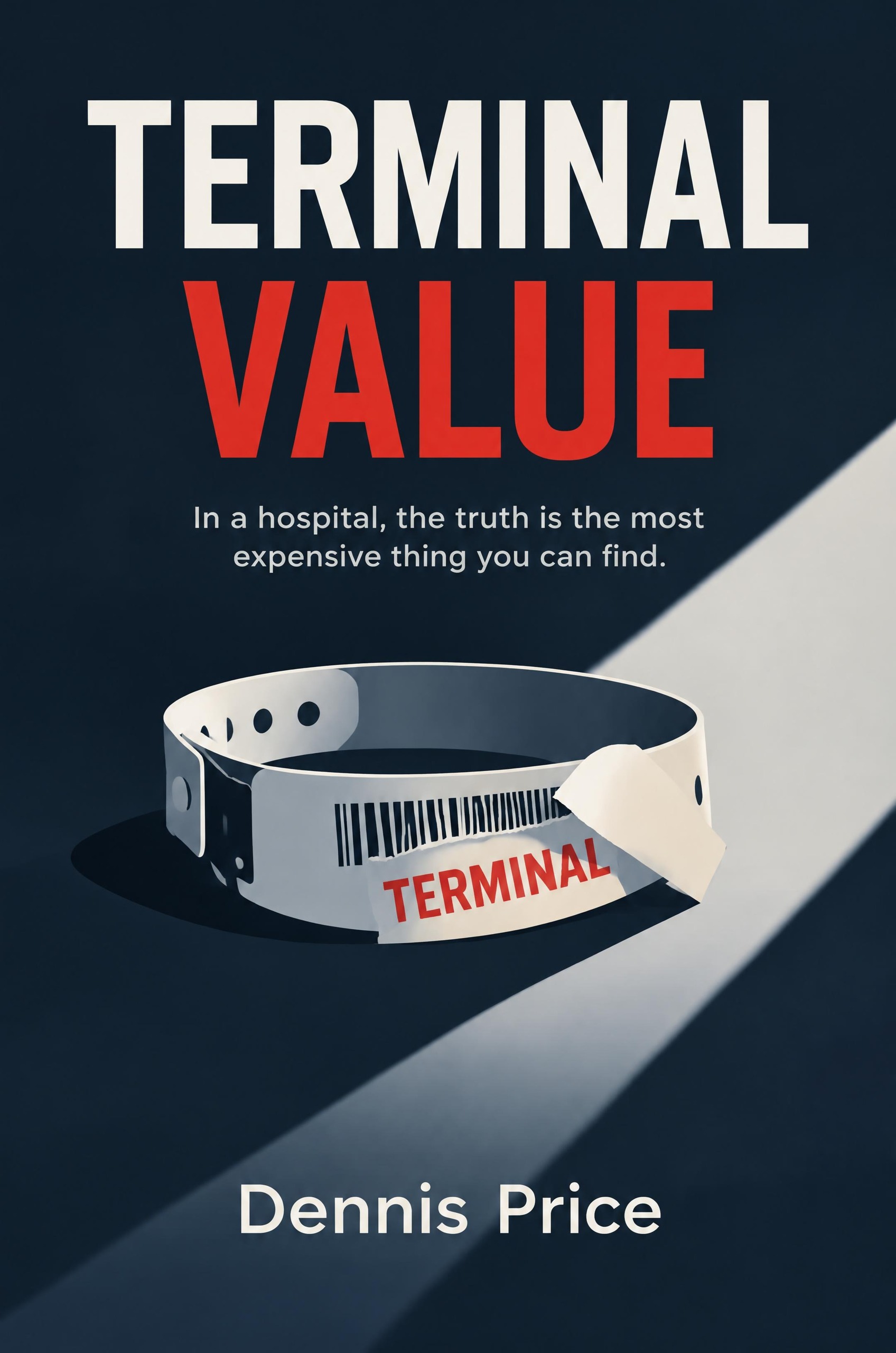
TERMINAL VALUE
In a hospital, the truth is the most expensive thing you can find.
by Dennis Price
The numbers never lie. But the people who write them down do. Inside the auditing offices of a prestigious private hospital, Benji is known as the blunt one. He does not soften the truth. He does not spin the data. He simply finds what is wrong and writes it down. When he discovers a systematic overcoding scheme designed to extract maximum profit from terminal patients, he does what he always does. He files the report. He expects a quiet correction. Instead, the hospital's legal team arrives within hours. His files are confiscated. His access is revoked. And a grieving family, who just lost a father to a cancer that was billed at twice its actual cost, is waiting outside with questions he cannot answer without destroying himself. As executives move to protect their profit margins through intimidation and legal threats, Benji realises the clinical brutality of modern healthcare extends far beyond the operating room. The surgery was clean. The books were not. A tense corporate thriller about money, mortality and one man who refused to look away.
- Thriller
- Crime Fiction
- Literary Fiction
- Medical Thriller
- White Collar Crime
- Character Study
The Honest Hire
The basement does not know about the weather outside. Down here under the foundations of St. Jude-Mercy Hospital, there is only the hum of the air-handling unit and the steady flickering of two hundred fluorescent tubes. Counted ‘em. The light is greyish white, like skimmed milk poured over cold slate. It makes every clerk look as if they died three days ago and simply forgot to lie down. I arrive at six forty-five in the morning, not driven by ambition, but to own forty-five minutes of silence. Nobody talks to me. Nobody expects small talk about the football, the trains, or the price of milk.
The basement almost feels like a home should be.
My desk sits in the third row of the sub-basement audit division. It is metal, painted the colour of wet cement, with a single grey divider that separates me from the next terminal. I take off my coat and hang it on one of the plastic hooks behind the door. I check my palms. They are dry. My collar sits flat against my neck. There is no itching. My larynx is open, allowing cool, mechanical air into my lungs without resistance.
If you knew how bad it could be, you'd understand why I was conscious of it. And grateful. Although that is not a state I am too familiar with. This is what normal people feel all day without thinking about it. They take it for granted, the easy breathing, the skin that does not burn like boiling oil. They can smile at a stranger, say something utterly meaningless or entirely untrue, and their pulse does not even skip.
I envy the ability to let a white lie roll off my tongue.
I cannot do that. It is not an ethical triumph. I have explained this to three different occupational therapists, a psychotherapist, to no avail. It is not a moral conviction. I do not tell the truth because I love Jesus, because maybe I do, so you never know; but it is not that. It is also not because I read Immanuel Kant in my second year at university. I tell the truth because if I say something that is factually untrue, my immune system attempts to execute me on the spot. My mast cells dump histamine into my bloodstream as if I had swallowed a fistful of ground peanuts. The capillaries in my neck burst into blotchy, crimson maps. My airway closes up like a pinched rubber garden hose. It is an involuntary somatic reflex. The body refuses the lie before the mouth can finish shaping the syllables. And if you think being congenitally unable to lie isn't a curse, you haven't been paying attention to what people say all day long.
I log into the terminal. The green cursor blinks eagerly, awaiting my command. St. Jude-Mercy runs on an archaic mainframe system called MedTrac-IV, layered over with newer corporate auditing interfaces that are supposed to catch discrepancies. Most people think billing is about arithmetic. They think someone adds up the bandages, the morphine drips, the theatre time, and produces an invoice. But billing is a language of codes - my love language. Every disease has an alphanumeric designation under the International Classification of Diseases. Every procedure has an intervention code. If an elderly man dies of congestive heart failure, there are forty different ways to write down how he died, and each one carries a different tariff from the National Health Service or the private insurer.
By seven fifteen, the heavy fire door at the end of the corridor thuds shut. Heavy boots sloth across the linoleum. It is Desmond Pike. Pike is the senior billing compliance officer for oncology and surgical recuperation. He is forty-eight years old, possesses three-and-a-half chins that spill over an ill-fitting poly-cotton collar, and permanently smells of cheap filter coffee and menthol cigarettes. He carries a manilla folder tucked beneath his arm like an old ledger.
He does not sit at his desk. He walks straight down the gangway toward mine. He drops the folder onto my blotter with a heavy, wet slap.
"Benji," he says. His voice has the greasy rasp of a man who clears his throat into handkerchiefs during meetings. "Have a look at that."
I do not touch the folder immediately. I don't look him in the eye either. But I do say "Good morning, Desmond", which is right at the limits of my ability to lie.
"Never mind the tea-party manners," he says, leaning on the divider. His grey cardigan smells of damp nylon. "The quarterly travel reimbursement file for the regional oncology conferences. Management sent it down from Five. Ward wants it cleared before noon. Just sign off on the reconciliation sheet so accounts payable can release the warrants."
I open the folder. The top sheet is a travel voucher for four trips between London and Birmingham taken during the previous month. The claimant is Desmond Pike. The claimed distance is two hundred and forty miles per round trip, billed at sixty-two pence per mile under the executive vehicle allowance rate. Attached behind it are three fuel chits and an overnight parking ticket from a multi-storey car park near New Street station.
I look at the dates. "You were not in Birmingham on the twelfth of October, Desmond."
Pike’s face goes blancmange. The little broken veins around his nostrils darken. "What are you talking about? Of course I was. The palliative care symposium at the ICC."
"The twelfth of October was a Thursday," I say, keeping my voice level, precise, entirely flat. "You were in this basement from eight o'clock until four-thirty. You processed forty-seven surgical supply reconciliations I sent you at 11am. You ate an egg sandwich at your desk and complained about the mustard."
"Listen to me, you pedantic little prick," Pike mutters, his voice dropping an octave as he leans closer. "The symposium was scheduled for Thursday. The hotel room was booked. Just because I had to manage an emergency batch down here doesn't mean the department doesn't carry the expense. It’s an administrative adjustment. We pool the travel allowances. Ward knows about it. Everyone signs off on their own section."
"It is a false document," I say.
"It's a departmental convention," he snaps. "You sign the box that says verified against department activity. That's all. It’s a formality. Just write your initials and pass it along."
He slides a translucent ballpoint pen across the desk toward my right hand. The metal clip of the pen glints under the cold neon tubes overhead. It stops against my stapler. There is about an inch of ink left in it. Fleetingly I wonder how many signatures that would be.
I look at the signature box. It might as well be a jail cell. I hereby certify that the journeys detailed above were undertaken exclusively on hospital business and that the expenses claimed reflect actual costs incurred.
I pick up the pen. I glance at Desmond. I think about signing it just to make him go away. I think about telling him: Of course, Desmond, I understand, it’s just internal admin. I am trying. I really am.
The moment the thought forms in my head, before I can even open my mouth to utter the lie, my throat constricts. It is instantaneous, like a steel garrotte snapping tight beneath my jaw. A sharp, burning heat prickles along the sides of my neck. My skin flares red under the starched white collar. My right hand begins to shake with an uncontrollable, violent tremor, and instinctively I sit on my hands. The chair feels cool to my touch. My chest heaves, but only a thin whistle of air enters my trachea.
The pen slowly rolls to the edge of the table, and then falls onto the floor, but I don't dare pick it up.
"You didn't go," I gasp out, forcing the truth past the spasming muscles of my throat. "The claim is completely fr… fr…fraudulent. You stayed here and ate eggs."
The air rushes back into my lungs with a raw, wheezing sound. The heat on my neck subsides, though the red blotches remain raised and angry against my pale skin. My fingers stop twitching, and I bring my hands to my face, dry-washing it as if I wanted to wipe away what I just said. My heartbeat, which had shot into the hundreds, begins its slow descent back to the baseline eighty beats per minute.
Pike stares at me. His expression is a mixture of disgust and genuine bafflement. He has seen me do this twice before, but he still cannot fathom it. He thinks I am putting on a theatrical display to make a point about bureaucratic ethics.
"You are a bloody psycho, Benjamin," he whispers, snatching the folder off my desk. "A proper, certifiable nutcase. One day someone’s going to kick your head in behind the boiler house, and nobody in this room will say a word."
"The claim is invalid," I tell his retreating back. He does not turn around. He slams the folder onto his own desk two rows over, muttering obscenities under his breath.
By eight o'clock, the basement is full. There are twenty-four clerks in our section, arranged in rows like battery hens under the glare of the ceiling strip lights. The air smells of wet raincoats, stale instant coffee, and the warm whir of sixty computer terminals running simultaneously. Nobody talks much. We are the audit division. We do not treat the sick; we count the financial residue of their treatment. We track the cost of disposable catheters, the milligrams of Midazolam administered in intensive care, the linen usage fees for patients who leaked fluid through their mattresses before expiring.
At ten-thirty, the internal phone on the supervisor's desk rings. Brenda from Records answers, listens for ten seconds, nods vigorously, and hangs up. She stands up and claps her hands together twice.
"OK, peeps," Brenda announces in her high, nasal voice. "Break room. Now. Cynthia is coming down the service lift. It’s her fifty-second birthday. Desmond managed to get a cake from the bakery across the road."
A dull groan ripples through the rows of desks, but people stand up anyway. In a hospital basement, you do not refuse cake. It is the only currency of pleasure available between eight in the morning and five in the evening. I stay seated, my fingers resting on the home row of my keyboard, staring at a record for an eighty-two-year-old woman named Martha Beale who had been billed for three separate bronchoscopies during the final four hours of her life.
"Benji," Brenda calls out from the doorway, her head tilted impatiently. "Come on. Don't be a jerk. It’s Cynthia’s birthday. We all chipped in fifty pence for the card."
"I did not chip in," I remind her - hoping.
"Just come into the break room," she sighs. "Don't make it awkward."
I do not want to go into the break room. The break room is six yards square, windowless, and contains an electric kettle that has not been descaled since 2011, a low laminate table, and eight orange plastic chairs bought on tender back in 2003. But Brenda is standing in the doorway, glaring. If I resist, she will spend twenty minutes attempting to psychoanalyse me. That would involve more social interaction than simply standing near the fridge for ten minutes.
I rise from my chair and follow the grey-trousered herd into the break room.
The cake sits in the centre of the laminate table. It is a large, rectangular supermarket sponge, covered in thick white royal icing that looks like industrial sealant. Across the top, written in lurid pink gel, are the words: Happy Birthday Cynthia – Keep Us In the Black!
Pike is standing beside the cake, holding a stainless-steel ruler he intends to use as a knife. He tries to affect indifference, but narrowing of the eyes betray him before he glances away. The door opens, and Cynthia Ward shimmies in.
She does not look fifty-two, but there is nothing there. I may be weird. She may be twice my age. And I may not like her much. But I could appreciate a nice rack as much as the next guy. But that isn’t one (or two) of her blessings. She is fifty-two in the way corporate administrators are fifty-two: preserved, sleek, and utterly humourless facsimile of a woman, much like a hairless cat is a facsimile of a tiger. She wears an expensive charcoal wool suit, a crisp silk blouse buttoned precisely to the hollow of her throat, and small, frameless spectacles that give her pale blue eyes the cold, magnified quality of watchmaker's lenses. She holds a leather-bound briefing folder in her left hand. She stops in the doorway and takes in the room.
"Surprise!" Brenda shouts, entirely out of tune with everyone else, who merely offer a ragged, unenthusiastic cheer.
Cynthia’s face does not soften, but her mouth curves into that tight, symmetrical semi-smile that senior executives deploy when they wish to acknowledge the existence of subordinates without inviting familiarities.
"You shouldn't have," Cynthia says smoothly. Her voice is low, cultured, with the clipped vowels of someone who attended a respectable grammar school and spent thirty years eliminating every trace of Yorkshire from her speech. "Really. The division has three hundred discharged files to clear before the weekend audit."
"It’s only ten minutes, Cynthia," Brenda says, thrusting a paper plate toward her. "Desmond went across to the bakery himself."
Pike uses the metal ruler to saw through the cake - not much of a planner is Mr Pike. The icing cracks with an audible, chalky snap. It is immediately clear to anyone with basic sensory faculties that this cake was not baked today. It was not baked yesterday either. The sponge beneath the sugar casing is yellow-grey, dry as sawdust, and visibly crumbling into fine powder. It is the kind of cake a corner grocer discounts by seventy percent because it has sat on the bottom shelf behind the tinned peas since the previous Tuesday.
Pike hands Cynthia a wedge on a flimsy paper plate. Then he cuts pieces for the rest of the staff. He hands a plate to Brenda, one to young Davies from billing data entry, and then, with an aggressive thrust of his wrist, shoves one toward me.
"There you go, Benjamin," Pike says loudly. The room goes quiet for a second; they all know Pike hates me, even if they don't know about the Birmingham travel expenses. "Get some sugar down you. Might cheer you up."
I take the plate because refusing to take it would create an argument. Davies is already eating his piece. He chews with an expression of stoic endurance, like a sheep chewing dry thistle. Brenda takes a tiny bite from the alleged cake, dabbing her lips with a tissue. Who knows if she swallows.
"Oh, Desmond," Brenda purrs, looking directly at Cynthia. "It’s lovely. Truly. So fresh. That bakery on the corner really does the best sponge in the borough."
Pike beams, preening under the praise. He turns to Cynthia. "They made it special this morning. Had to wait twenty minutes for the icing to set."
Cynthia takes a polite, microscopic forkful and lifts it to her thin lips painted the same bright red as a parking sign. She does not chew for long before swallowing. Her face remains an unreadable mask of corporate graciousness. "Very considerate of you, Desmond. Thank you."
Then she turns her head. Her blue eyes find me standing near the kettle. I am holding the paper plate, looking down at the yellow-grey cube of dry starch. I have not eaten it. I have no intention of eating it. The icing smells faintly of synthetic vanilla and damp cardboard. Then I submit to the norm with fleeting bravery.
I put my head down and take a bite. Swallow without chewing.
"Benji," Cynthia says. The break room goes entirely still. Cynthia rarely addresses the junior clerks by their first names during social gatherings. "What do you think? Desmond seems quite proud of his selection." I can’t tell if she is sarcastic.
She had to ask. I might have been able to discreetly dispose of the bite. If only she did not ask. And force me.
Pike’s eyes narrow at me. Brenda gives me a frantic, wide-eyed look that says: Just say it’s nice, you idiot. Just say it’s lovely. I think Brenda actually likes me.
Brenda is nice. She has a rack. And fuller lips. But even so, I hesitate. I know what social cohesion requires. I am not an alien; I have observed human beings for twenty-six years. The expected response is: Yes, thank you, Desmond, it's very good. It costs nothing. It preserves Pike’s pathetic pride. It allows Cynthia to finish her ceremonial duty and leave. It maintains the delicate, miserable truce that keeps twenty-four people from murdering one another in a windowless room eight hours a day.
I think Brenda is actually trying to help, so I open my mouth to say: "It’s very nice, Desmond."
The sentence does not emerge.
The first syllable—a soft, half-formed It’s—gets caught behind my teeth. Instantly, the somatic reflex detonates. A hot, prickling wave surges up from my clavicles, washing over my throat like boiling lye. My airway snaps shut with a wet, convulsive click. The larynx tightens until it feels as thick and solid as a billiard ball. The paper plate slips from my fingers, hitting the floor upside down, scattering dry crumbs over Brenda’s beige court shoes.
My hands fly to my throat. The tremor hits my shoulders, rattling my whole frame. My breath comes out as a sharp, agonised screech—a high-pitched whistling noise as my lungs fight against the swelling vocal cords. Through the fabric of my open collar, thick, angry red welts erupt along my jawline, spreading across my cheeks like spilled ink.
"Dammit!" Davies drops his plate. "He’s having a fit!"
"Is he choking?" Brenda screams, jumping back from the crumbs. "Did he swallow the fork?"
"He didn't touch it!" Pike shouts, his face pale with panic. "I didn't do anything to it! It’s just regular cake!" If Cynthia hears the ‘for fuck’s sake’ that follows, she doesn’t show it, but I hear it. My senses are in hyper mode.
I stumble back against the tea counter. My vision tunnels. The fluorescent strips above turn into blinding white halos. The lie is trapped in my mouth, poisoning me, suffocating me. The body demands the correction. It will not unlock until the factual reality is restored.
I drag my hands down from my neck. I grip the edge of the laminate counter, my fingernails digging into the plastic trim and spit the truth into the room like broken glass.
"It is stale," I choke out. The words are shredded, raw, dragged up from the bottom of my lungs. "It is horrible. It tastes like dust."
The moment the final word clears my lips, the spasm breaks. I can force out one more word before I turn to go. “Sorry.”
The break room is entirely silent.
I drop my eyes to the floor. I know what it looks like. Sounds like. I shuffle one foot towards freedom.
Nobody moves. Brenda is staring at me with her mouth open, her hand pressed against her cardigan. Pike looks like he has been struck across the mouth with a wet ledger; his face is grey, his lips trembling. Davies has backed into the corner near the mop bucket.
Cynthia Ward also remains unmoved.
She looks down at the overturned plate on the linoleum. She looks at the yellow crumbs. Then she looks at me. There is no anger in her pale blue eyes. There is no disgust. There is only a sharp, squinting interest, the way an engineer might look at a pressure gauge that did not function precisely according to specification.
She sets her paper plate down on the table beside the half-butchered cake. She has not eaten more than that single, tiny forkful.
"Clean this up, Desmond," Cynthia says quietly. "The crumbs will attract mice from the utility ducts."
Pike blinks.
"Clean it up," she repeats, her tone giving no quarter. Then she turns her gaze fully upon me. "Benji. When you have finished catching your breath, bring the quarterly palliative audit summaries into my office. We need to discuss your workload."
She turns on her heel and walks out of the break room, her leather court shoes clicking evenly against the hard corridor floor.
I stand pretend brave. I do not look at Pike. I do not look at Brenda. I reach into my pocket, pull out a clean cotton handkerchief, and wipe the cold sweat from my forehead. My skin is still tender, humming with the residual histamine, but I can breathe.
Ten minutes later, after washing my face with cold water in the staff lavatory, I retrieve the thick manilla folder labelled Palliative Care and Terminal Oncology – Billing Reconciliations Q3 from my desk. I take the lift to five, walk down the short corridor to the supervisor’s office. The door is solid oak, unlike the hollow plywood doors of the break room. It has a brass plaque that reads: C. Ward – Head of Revenue Integrity and Coding Assurance.
I knock. Three raps I imagine announcing ‘I am ‘here’.
"Come in, Benji," her voice calls from inside.
Her office is big, but I can imagine bigger. There are no stacks of paper or files visible. Her desk is mahogany veneer, completely clear except for a curved 34-inch ultra-wide, a brass reading lamp, and a single black leather blotter. The air in here is colder than the corridor; she keeps a small electric fan running on the windowsill, drawing the stale air out toward the ventilation shaft.
She gestures to the high-backed fabric chair opposite her desk. "Sit down."
I sit. I place the palliative care file squarely in the centre of the blotter before me. I keep my spine straight, my knees together, my hands resting flat on my thighs.
"Are the hives gone?" she asks. She is looking at my neck.
"Yes," I say. "The histamine breakdown is rapid once the vocalisation occurs."
"A fascinating condition," she says. She does not sound mocking. She sounds like a clinician reviewing an unusual biopsy. "Your personnel file from Human Resources lists it as an acute psychosomatic histamine reaction associated with anxiety disorders. That was the medical certificate you submitted when you applied."
"The doctors do not have a proper diagnostic code for it," I say. "They call it anxiety because they do not have a category for somatic truth-enforcement. If I attempt to state a falsehood, my body treats it as an anaphylactic event. It is purely physiological."
"And it happens every time?"
"Without exception."
Cynthia leans back in her swivel chair. She frowns and her mouth pouts, almost disappearing.The leather creaks gently under her weight. She folds her hands together over her lap. Her fingernails are trimmed short, unpainted, immaculate.
"Desmond thinks you are insane," she notes, her tone conversational.
"Desmond submitted a fraudulent travel claim," I tell her. "He wanted me to sign a verification stating he was in Birmingham when he was in this building eating an egg sandwich. I could not sign it. My throat closed."
"I know about the travel claims," she says without blinking. "Desmond is sloppy. He has been sloppy for ten years. But he is predictable. Most people are predictable because their greed is small and their vanity is transparent. Desmond wants an extra few hundred pounds a month to pay for his car lease, so he invents trips to Birmingham. It is petty. It is manageable."
She pauses. She reaches into her leather binder, opens it, and draws out a document. It is not an internal hospital memorandum. It is an academic reprint, bound in blue cardstock with the crest of the London School of Economics at the top. I recognise the typeface immediately.
It is my university thesis.
The title is printed in bold black lettering: Non-Linear Cost Acceleration Curves in Terminal Palliative Care: An Econometric Analysis of End-of-Life Diagnostic Coding.
I stare at the blue cardstock. A strange, sharp sensation tightens inside my chest, but it is not the choking reflex. It is something entirely different. It is a sudden, powerful surge of heat that has nothing to do with hives. It is validation, maybe surprise. That paper had taken eighteen months of my life. I had analysed seventeen thousand anonymised discharge records from three different regional hospital trusts. While my peers were writing broad, theoretical nonsense about public healthcare funding models or social equity, I had focused on the numbers. The cold, unvarnished mathematics of dying.
I had proven that when a patient enters the final seventy-two hours of life, their medical billing does not taper off as curative interventions cease; it accelerates exponentially. The hospital does not stop charging; it changes the vocabulary. Every dying gasp becomes a billable physiological crisis. Every rattle in the throat becomes an emergency airway assessment. It was pure truth, mathematically irrefutable, stripped of all sentimentality, all religious comfort, all corporate public relations spin.
"You got a first for this," Cynthia says, her fingers resting lightly on the cover. "Your external examiner called it an exceptionally rigorous piece of statistical forensic work. He also noted that you showed a chilling disregard for the human element of clinical care."
"The human element is subjective," I say. "The numbers are either correct or they are incorrect. The data does not care about grief."
"No," Cynthia agrees softly. "It doesn't. Which is why I found it so compelling."
She pushes the thesis across the desk until it rests beside my quarterly audit folder.
"Did you really think you were hired through the standard graduate portal, Benji?" she asks. Her head tilts slightly, her frameless glasses catching the cold overhead light. "Did you think our Human Resources department saw a young man with a history of acute somatic breakdowns and decided he was the ideal candidate to verify inventory in the basement?"
I look from the blue cardstock to her face. "The advertisement was for a Junior Billing Verification Clerk. Grade Three."
"I wrote the advertisement," Cynthia says. "I was the one to tell your professor to mention the ad to you. And I instructed the recruitment agency to flag your name the moment your application crossed their desk. I have had a copy of this thesis in my safe for eight months. Long before you sat down at that terminal in row three."
The dull hum of the ventilation shaft outside her door fades into the background. I look at her hands, still folded neatly, entirely calm.
"Why?" I ask.
"Because this hospital has a problem," she says. She does not lower her voice; she does not need to. The oak door is thick, and everyone else is still in the break room cleaning cake off the floor. "St. Jude-Mercy is expanding. The board has approved the construction of the new West Wing surgical pavilion. It requires forty million pounds in private capital financing. To secure that financing, our operating margins in inpatient care must maintain an eleven percent surplus across every clinical division. Do you know what our current surplus is in geriatric oncology?"
"Four point two percent," I answer instantly. "According to the last quarterly reconciliation."
"Four point two," she repeats. "It is a disaster. Terminal patients are expensive, Benji. They occupy beds for weeks. They consume high-cost pharmaceuticals that insurers resist paying for. They require intensive nursing hours that cannot be fully recouped under basic bed-day tariffs. Unless, of course, the diagnostic coding reflects the true complexity of their care."
"The complexity is already coded," I say. "Every cannula, every catheter, every dose of diamorphine."
"No," Cynthia says, and for the first time, her voice hardens. "What is coded is what the doctors remember to write down on the charts between resuscitations. What is coded is the bare minimum. What this hospital requires, no, what I require is someone who understands the curves. Someone who can look at a patient's final five days and see every single missed intervention, every unbilled emergency consultation, every secondary diagnosis that was overlooked while they were expiring."
She leans forward, resting her forearms on the desk. Her eyes are locked onto mine with an intensity that feels like an iron grip.
"I don't need a clerk who wants to be liked," she says. "I have twenty-four clerks who want to be liked. They sign Desmond’s fraudulent travel claims because they don't want an argument. They eat his stale cake and tell him it’s delicious because they are cowards. They overlook coding discrepancies because they don't want a consultant surgeon shouting at them down the telephone."
She taps the blue cover of my university thesis with her index finger.
"I don't need a liar, Benji. I need a scalpel. I need someone who cannot lie even if he wants to. Someone whose very physiology rejects the comfortable, cowardly fictions this department runs on. I brought you here because you see the truth of these acceleration curves. You wrote the book on them."
The air in my chest feels cold and clear. My throat is wide open. There is no constriction, no heat, no hives. What she is saying is monstrously clinical, but it is factually coherent. She had targeted me. She had read my work, understood the precise mechanics of my mind and my body, and placed me in this basement like an instrument waiting to be picked up.
"You want me to audit the terminal care accounts," I say.
"I want you to audit all of them," Cynthia says. "Starting with the palliative ward. I want you to apply the methodology from your thesis to every file before it is submitted to the insurers and the families. I want every single penny that this hospital is legally and clinically entitled to extract from those records."
She opens the black leather binder on her desk and pulls out a single keycard. It is blue, with an executive clearance chip embedded in the plastic.
"This gives you access to the clinical notes server. Not just the billing summaries. The actual bedside charts. The doctor's handwritten progress logs. The medication administration records." She slides the keycard across the mahogany desk until it rests beside my paper. "No more Desmond. No more inventory checks on rubber gloves. You report directly to me."
I look down at the blue cardstock of my thesis. My single pure contribution to absolute truth. For two years, people had told me it was morbid. My mother had asked why I couldn't write about something hopeful. My tutors had looked at me with that faint, nervous pity they reserved for students who had no friends and no social graces. But Cynthia Ward had read it. She had understood every equation, every curve, every cold, unvarnished fact.
I reach out. My fingers do not shake. My skin remains cool and smooth against my collar. I pick up the keycard. It feels heavy, cold, and entirely real.
"I will check the records," I say.
Cynthia smiles. It is not fake, like the tight smile she gave the clerks in the break room, but it was aimed at herself more than me. It is the smile of someone who has just set a machine in motion, perfectly balanced, perfectly oiled, incapable of stopping until the work is done.
"I know you will, Benji," she says. "Now take the files. Make it happen."
The Ghost Protocol
The stairs down to the sub-basement archive do not invite visitors. They are raw poured concrete, narrow and grey, chipped away at the nosing from decades of metal trolley wheels. The air changes after the first landing. It drops three degrees, then five. It smells of wet plaster, forgotten lime, and that sharp, vinegary whiff of degrading paper th…