

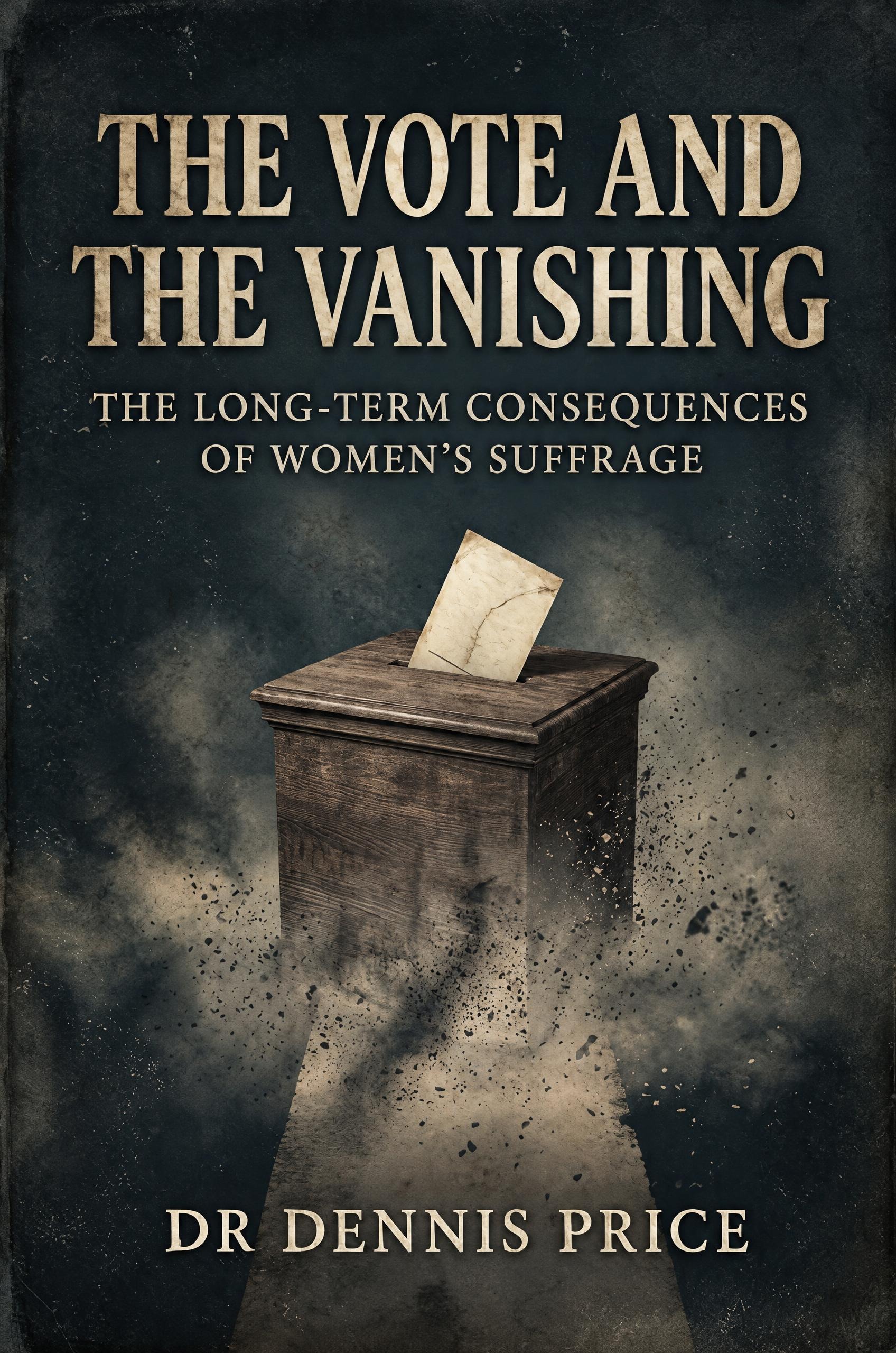
THE VOTE AND THE VANISHING
How household democracy gave way to the vanishing family
by Dennis Price
The textbook story of women's suffrage is a tale of moral inevitability. The Vote and the Vanishing asks a harder question: what happened after the household ceased to be the basic political unit of the West? Dennis Price traces female-led anti-suffrage campaigns in Britain and the United States, then shows how wartime administration, parliamentary horse-trading and contingent rivalries—not philosophy—carried the franchise. He argues that Enlightenment liberalism confused equal human dignity with identical social function, hollowing out the home from a productive jurisdiction into a site of consumption. Drawing on demography, housing markets, fertility, credential inflation, no-fault divorce and the contraceptive pill, the book scores the old anti-suffragist predictions against modern evidence: swelling bureaucracy, the dual-income trap, and deaths of despair. It does not offer costume nostalgia. It proposes non-coercive, family-centred reforms—income splitting, carer credits, subsidiarity, Demeny voting—rooted in Christian anthropology. For readers willing to examine what the West traded when the vote was unbundled from the household.
- Historical Non-Fiction
- Educational & Academic
- Religion & Spirituality
- Political History
- Cultural & Social History
- Political Science
The Story We Were Told
On the afternoon of 4 June 1913, a woman named Emily Wilding Davison ducked under the guardrail at Tattenham Corner, on the Epsom Downs, and walked into the middle of the most famous horse race in England.
She had picked her spot with some care. Tattenham Corner is where the field bunches and slows before the long run to the winning post, and by the time she stepped onto the course, nine horses had already thundered past her. She let two more through, reaching up towards their bridles and missing both. Then she turned to face the King's horse.
Anmer belonged to George V, and his jockey, Herbert Jones, rode in the royal colours — easy to pick out of a field of fifteen. Davison had something in her hands, by several accounts: a folded flag, possibly the purple, white and green of the Women's Social and Political Union. We don’t know what she meant to do with it; pin it to the bridle, wave it, force the newsreel cameras to catch some gesture the newspapers would have to print the next morning. The not-knowing has never once stopped anyone from being certain. What the film shows, and what several eyewitnesses agreed on afterwards, is this: she reached up as Anmer came round the bend at something close to thirty-five miles an hour, the horse's shoulder took her full in the chest, and she went down under half a ton of moving animal in front of the King, the Queen, and several hundred thousand witnesses.
She was taken to Epsom Cottage Hospital. She never regained consciousness. Four days later, on 8 June, she died of a fractured skull.
The inquest that followed could not settle what everyone wanted settled, which was, maybe, why she had done it. Some witnesses swore she was trying to catch the reins of every horse that passed, working her way down the field looking for the King's colours specifically. Others thought she was simply trying to cross the track, misjudging the gap the way you might misjudge a gap in traffic, and that the whole catastrophe was an accident dressed up afterwards as a martyrdom because a martyrdom is sexier than a mere mistake. A hundred and ten years of historians have argued about it since, and we still do not know, and we are not going to know now. What we do know is what she had already spent a decade proving about herself, which is why the ambiguity of that one afternoon matters less than it looks like it should.
It is one of the most genuinely dramatic things anyone did for a political cause in the twentieth century, and Emily Davison had spent the better part of a decade proving she is a woman of her word. She had been arrested time and again over the previous six years. She had been force-fed on multiple occasions after hunger strikes in prison — a procedure that meant being held down while a tube was forced through her nose or her throat so that liquid food could be pumped straight into her stomach, against her body's every attempt to refuse it. On one occasion in Holloway Prison she threw herself down an iron stairwell, an act she later explained as a deliberate attempt to make the public reckon with what force-feeding actually was — believing that one serious injury reported in the papers might do more than another year of quiet suffering behind a wall nobody could see over. She survived that fall. It was the King's horse that finally killed her.
It is worth knowing who she had been before she became a headline. Emily Wilding Davison was a scholarship girl from south-east London who won a place to study literature at Royal Holloway College, only to have her studies cut short when her father died and her mother could no longer meet the fees. She did it the hard way — working as a teacher, saving what she could, eventually earning a degree from London University and spending a term at St Hugh's College, Oxford, at a time when a woman finishing an Oxford term was itself a small act of quiet defiance. This was not an unstable or a marginal woman. This was one of the more formally educated people, of either sex, in the entire movement — which makes the nine seconds at Tattenham Corner harder to write off as an aberration, and easier to read as exactly what it was: the calculated act of a highly capable woman who had run out of patience with every other tool available to her.
No one can argue that this woman was foolish, hysterical, or somehow less serious in her convictions than any man who has ever died for a cause the history books later approved of. This is not a book about whether women are capable of reason, courage, or sacrifice. Emily Davison is proof of that, if proof were ever needed, and I am happy to let her stand as the proof and move on. The question this book asks is a different one. In the current climate, my question may be claimed to be ‘triggering’. If you knew me, you'd know that trying to stop me usually has the opposite effect, so I will ask it anyway. It is therefore not even really about women, women’s rights or the ability of women. I will ask if women’s suffrage turned out to be a good idea. It is a question that will explore systems, unintended consequences not whether women were equal to this fight. It is what, exactly, was this fight, and who actually won it, on whose behalf, and whether that is what we wanted. The question starts somewhere the received history tends to walk past rather quickly — with what the Women's Social and Political Union actually was, and what it actually did.
The WSPU was founded ten years before Davison's death, in October 1903, at the Pankhurst family home in Manchester. Its motto was "Deeds, not Words," and it meant it in a way that the older suffrage organisations had never quite managed. The WSPU had split off from the National Union of Women's Suffrage Societies — the NUWSS, a much larger and older body under Millicent Fawcett that had spent decades lobbying Parliament through entirely constitutional means, and getting almost nowhere for its patience. The moment that is usually credited with turning patience into militancy came in October 1905, at a Liberal Party rally in Manchester's Free Trade Hall, when Christabel Pankhurst and a millworker named Annie Kenney stood up and asked the platform, again and again, whether a Liberal government would give women the vote. They were manhandled out, arrested on the street outside on a trumped-up charge of obstruction, and chose prison over paying the fine. It is a small, almost comic episode by the standards of what came later, and it is also the exact moment the WSPU discovered that being arrested was worth more to the cause than being polite had ever been.
Emmeline Pankhurst's answer to forty years of polite failure was to stop being polite, permanently and by design. Between 1908 and 1914, WSPU members smashed windows on a scale that turned whole stretches of the West End into a controlled demolition site. They set fire to postboxes. They burned down unoccupied houses, churches, and at least one grandstand. Over a thousand of them were imprisoned in that six-year window, and inside prison the hunger strikes began — the first of them started by a sculptor named Marion Wallace Dunlop in 1909, who refused all food after being denied recognition as a political prisoner, and who was released within days rather than be allowed to become a martyr on the spot. It didn't stay that simple. The tactic spread, the government's tolerance for early release hardened, and force-feeding followed — met, in turn, when even that produced too many stretcher cases and too many bad headlines for the government to stomach, by the Prisoners (Temporary Discharge for Ill Health) Act of 1913, nicknamed on the spot the Cat and Mouse Act: release the starving woman until she recovers, then arrest her again and put her straight back inside. It is a genuinely ugly piece of statecraft, and the WSPU's response to it — keep starving, keep coming back — is a genuinely remarkable piece of collective nerve. Some of that militancy exceeded the boundaries of admirable resistance and evolved into terrorism: the arson campaign of 1912 to 1914 killed at least five people and injured dozens more, mostly by accident, in a campaign that was not always as careful about who might be inside an "empty" building as its planners liked to claim afterwards. This was not a tea party. It was not meant to be.
The press, for its part, mostly could not decide whether to mock the WSPU or to be terrified of it, and frequently managed both in the same edition — the coinage "suffragette," diminutive and faintly ridiculous, was itself a piece of newspaper condescension that the women wearing it as a badge of honour eventually reclaimed so thoroughly that we still use their term rather than the sneer it was minted as. That reclamation is a genuinely impressive piece of political branding, and it worked, and it is one more reason the received history remembers this movement so much more vividly than it remembers the one standing against it.
That is the movement Emily Davison belonged to, and that is the story most of us were handed at school, shaped as a long, dark night of legal and social subjugation, in which women could not vote, could barely own property in their own name until the Married Women's Property Acts of the 1870s and 1880s, and were treated by the law as extensions of their husbands rather than as citizens in their own right. A story of a heroic band of women who refused to accept it any longer, first through decades of petitions and polite lobbying, then, when that failed to move a Parliament that could simply ignore them forever, through direct confrontation with the state itself; escalating sacrifice met by escalating state cruelty, prison for windows, force-feeding for hunger, a nation's newspapers alternating between mockery and horror; and finally, vindication — the vote, the recognition, the arc of history bending, at last, towards justice, with Davison's body under the King's horse standing as the story's dark, necessary turning point, the sacrifice that finally made the cost of continued refusal too high to bear. It is a good story, and it is told with such consistency, in so many textbooks and so many documentaries.
But most people who have absorbed it have never once been asked to consider that it might not be the only true story available about the same set of events. Large parts of it are true, in fact. The courage was real, the cruelty of force-feeding was real, and the women who went through Holloway and came out the other side deserve exactly the reverence the received history gives them.
But there is a sentence buried inside that story that almost nobody stops to examine, and it is doing an enormous amount of quiet work. The sentence is: this is what women wanted. Not some women. Not an intensely committed minority of women, prepared to go further than most human beings of either sex are ever prepared to go for any cause. Women — as a class, as a sex, as a settled and near-unanimous constituency whose collective will history was finally, belatedly, catching up to. Once you accept that sentence, everything downstream of it follows smoothly: the suffragettes were the authentic voice of womanhood, their opponents were a rump of collaborators and cranks, and the eventual granting of the vote was simply reality arriving to correct an obvious injustice.
It's a clean story. It is also, as you will learn , not remotely the whole one, and therefore also not true. But as is always the case, history is written by the victors.
There is a number most readers won’t know, and it changes the shape of everything that follows.
By 1914, the year before the war swallowed the whole controversy whole, the NUWSS — the large, patient, non-militant suffrage organisation — had grown to somewhere in the vicinity of fifty-four thousand members, making it by a wide margin the biggest single suffrage organisation in Britain. The WSPU itself, the militant wing, the one that gets the documentaries and the biopics, was a great deal smaller: the most careful estimates put its active membership somewhere between two and five thousand at its peak, a passionate vanguard rather than a mass movement. Add the two together generously and you get a suffrage movement, organised into paying members, of somewhere around sixty thousand women.
Now set that beside this. And notice, before you even get to the numbers, that organised female opposition to the vote did not spring up as some belated rearguard action once the suffragettes had already won the argument in the court of public opinion. It predates the WSPU by fourteen years. In 1889 — while Emily Davison was still a schoolgirl — Mrs Humphry Ward published, in the pages of the Nineteenth Century, an open appeal against extending the parliamentary franchise to women. It carried the signatures of a hundred and four prominent women at launch, and was followed within weeks by an accompanying "female protest" that gathered roughly two thousand more. Historians who have looked closely at the episode credit it with real political weight, plausibly nudging William Gladstone himself towards the public opposition to suffrage he voiced a few years later. None of this made the front page of the story most of us were handed. It should have.
In July 1908, that same current organised itself properly, when a group of women in London founded the Women's National Anti-Suffrage League. It was led, in its public face, by Mrs Humphry Ward — at the time one of the best-selling novelists in England, a woman whose books regularly sold over a hundred thousand copies in their first six weeks and whose intellectual standing among the literary establishment was, if anything, higher than that of most of the suffragist leadership. Within a year the League had gathered a petition against women's suffrage carrying somewhere north of three hundred thousand signatures — the largest petition on the suffrage question either side had managed since 1874, and one that comfortably outran the pro-suffrage petition of the following year. In December 1910 Ward's League merged with the Men's League for Opposing Woman Suffrage to form the National League for Opposing Woman Suffrage, and by 1914 — the same year, the same country, the same electorate — that organisation had accumulated forty-two thousand paying members of its own, five out of every six of them women.
Read those two numbers side by side: roughly sixty thousand organised women fighting for the vote, and roughly thirty-five thousand organised women fighting against it, inside a single formal league, on top of the three hundred thousand who had already put their names on paper. This was not a movement facing down a fringe of embarrassed collaborators. This was one faction of British women in open, organised, well-funded political combat with another faction of British women, at a scale that made the contest a genuine civil war within the sex the received history insists spoke with one voice.
Ask yourself, honestly, how many documentaries about the suffragettes you have watched that mention the forty-two thousand. How many textbook chapters give the League for Opposing Woman Suffrage so much as a footnote, rather than folding it silently into a vague gesture at "opposition from conservative quarters" as though the opposition had no organisation, no numbers, and no names. The erasure is not an accident of space. It is what happens to the losing side of every argument once the winning side gets to write the curriculum.
To be clear, this does not prove the Antis were right. It does not prove suffrage was a mistake. What it proves — and this is enough, for now, to be getting on with — is that the sentence this is what women wanted was never a description. It was always a claim, made by one side of a genuine and substantial argument, about the side that happened to be losing it.
You may already be composing the obvious reply: fine, but they did lose, didn't they — and doesn't losing an open political argument, fought under known rules, settle the question of who was right? I don't think it does, and I don't think you think so either, once you sit with it for a moment. Plenty of arguments have been lost by the side later vindicated by events, and plenty have been won by the side later regretted by almost everyone involved in winning it.
When John Maynard Keynes published The Economic Consequences of the Peace in 1919, his argument that the Versailles Treaty's harsh reparations would trigger a European economic collapse was widely rejected by Allied leaders, only to be entirely vindicated by the rise of Nazi Germany and World War II. Conversely, the momentous congressional vote in 1999 to repeal the Glass-Steagall Act—championed by its congressional proponents as a triumph of modern deregulation that would secure American financial dominance—was won with overwhelming bipartisan support, yet was universally regretted a decade later when it supercharged the systemic greed that fuelled the 2008 global financial crisis.
Here we're about to look at one of the clearest examples of the second kind in American history, and it happened at almost exactly the same moment as this one. Political victory tells you who had the better organisation, the better tactics, the more favourable historical moment, and, as the next chapter is going to argue in considerable and I think uncomfortable detail, the better war. It does not, by itself, tell you who had the better argument. Those are different questions, and this book exists because a century of retelling has quietly let the first one answer the second.
Better, then, to look at the argument itself, on its own terms, made by the woman who made it most effectively — and she was not the caricature you are probably picturing. Mrs Humphry Ward (in my mind, a modern JK Rowling’s) did not believe women were stupid, and she did not run a movement that told them so. Her actual position — the position of the League's serious wing, as distinct from its cruder pamphleteers — was considerably more interesting than the popular memory of "Antis" as women who thought their own sex incapable of thought. The League supported women voting in local and municipal elections. It always had; that support was written into its founding aims.
What it opposed, specifically and only, was the parliamentary franchise — the national vote, the one tied to war, empire, and foreign policy. Ward's argument was that women's political influence was real, was valuable, and was best exercised through the areas of public life closest to the concerns she believed women actually held and actually understood in depth: education, health, housing, poor relief, the whole machinery of municipal governance that touches a child's life far more directly than a decision made in the Foreign Office ever will. Bring that influence into the distant, adversarial, party-line world of national parliamentary politics, she argued, and you don't multiply it — you dilute it, and you drag it into a kind of combat for which it was never suited and to which it had nothing distinctive left to contribute. You can disagree with that argument. I happen to think it deserves a great deal more credit than a century of retrospective mockery has allowed it. But you cannot honestly call it the argument of a woman who thought her own sex was incapable of reasoning about politics. It is the argument of a woman who thought the unit being asked to reason about politics had been wrongly specified — a question this book is going to come back to with considerably more weight in Part Two.
Ward did not run this alone, and she did not run it from the fringe of respectable society. The League's founding committee included Gertrude Bell, the archaeologist and Arabist who would go on to help draw the borders of modern Iraq — as its secretary, along with Violet Markham, a formidable social reformer and local-government campaigner in her own right who spent much of her career doing exactly the kind of hands-on civic work the League's philosophy said women should be doing more of, not less. These were not women hiding from public life. They were women who had already built substantial public careers within it, and who looked at the specific mechanism of the parliamentary vote and concluded, on the evidence available to them, that it was the wrong tool for the job they had already spent years actually doing.
None of which is to say the League's hands were entirely clean, because they weren't. John Sutherland, Ward's biographer, notes that her own opposition to suffrage was shaped in part by a genuine horror of WSPU militancy and a fear — not an unreasonable one, given some of what the arson campaign actually did — that women entering formal politics through the door the suffragettes were kicking down would come to be seen as unserious, embarrassing, or worse. That is a defensible motive. It is also, notice, a motive rooted in disapproval of tactics, not contempt for capacity — precisely the distinction the received history tends to erase when it flattens every Anti into the same cartoon.
Cross the Atlantic and the numbers get, if anything, more startling.
In 1911, Josephine Jewell Dodge founded the National Association Opposed to Woman Suffrage in New York. Ms Dodge is worth pausing on, because she is not who the caricature predicts. She was not a woman defending a life of leisured domesticity against the horror of paid work. She was a genuine social reformer, a pioneer of day nurseries for the children of working mothers, a woman who had spent years building institutions to help poor women hold down jobs. Her objection to suffrage was not that women belonged only in the home. It was, in her own account, that the vote would pull women's organised energy away from the direct, hands-on social reform she had built her career around, and into the more abstract, more diffuse arena of electoral politics — a trade she did not think was a good one. NAOWS grew under her leadership into what became, by the movement's own peak in 1919, an all-female organisation of somewhere around half a million members. Half a million American women, organised, paying dues, actively campaigning against their own enfranchisement, on the very eve of the amendment that would grant it.
Dodge was not an outlier in the company she kept. The muckraking journalist Ida Tarbell — a woman who had spent her career exposing the corrupt practices of Standard Oil, and whose credentials as a serious, independent, professionally accomplished woman were beyond dispute even to her enemies — was an Anti. So were prominent figures in women's higher education, who worried, among other things, that a movement built around the vote would eclipse the harder, slower work of getting women into universities and professions on their own merits. In Illinois, a separate state association claimed fifteen thousand members by 1908 and was organised enough to petition a national party convention that same year. This was not, in other words, a single eccentric New York drawing room. It was a genuine national network, with genuine intellectual firepower behind it, running in open parallel to the suffrage movement for the better part of three decades before the country finally settled the question by amendment.
No one should pretend the anti-suffrage coalition on either side of the Atlantic was funded by nothing but conviction, because it wasn't. The liquor industry — the brewers and distillers of the United States — poured money and organising muscle into the anti-suffrage cause for reasons that had nothing to do with the domestic vocation and everything to do with the ledger. The United States Brewers' Association had, years earlier, adopted an internal resolution stating flatly that once women had the ballot, they would "vote solid for Prohibition," and made opposing woman suffrage — in its own words — a matter of policy "everywhere and always." In 1912 the president of the National Retail Liquor Dealers' Association told his own convention, without much subtlety, to fear the Women's Christian Temperance Union and fight woman suffrage accordingly. In Nebraska, brewers and distillers bankrolled anti-suffrage petitions so aggressively that entire pages of signatures later turned out to be forged, copied in a single hand or lifted from the names of dead men. This is dirty money, attached to a self-interested and largely successful campaign of fear, and it belongs in this book precisely because I am asking you to trust the rest of it.
To be fair even to the brewers, the United States Brewers' Association itself publicly denied, in a 1913 letter to a New Jersey newspaper, that it had ever formally endorsed the Anti-Suffrage Association or funded it directly, and insisted that any support flowing from "liquor interests" in individual states was neither authorised nor coordinated from the top. That denial may well have been self-serving, and the state-level evidence from places like Nebraska suggests the industry's fingerprints were on the ground regardless of what the national association claimed in New York. But an honest accounting includes the denial along with the accusation, and I will let you weigh both. I am inclined to think money had an influence and the critics has a point.
But dirty money funding one side of an argument does not retroactively determine whether that argument's central factual claim was true, and the claim in question here was a narrow, checkable one: do women, as a group, actually want this? On that question, dirty money notwithstanding, the most honest witness we have is not an Anti at all. It is Carrie Chapman Catt — the president of the NAWSA, the principal architect of the "Winning Plan" that finally delivered the Nineteenth Amendment, a woman with every incentive in the world to claim a landslide of female support behind her. Publicly, she did claim it. Privately, in a letter written around the time of ratification itself, she put the real number at something close to a third of women in favour, a third opposed, and the remaining third simply indifferent. That is Catt's own private arithmetic, not an Anti's polemic — and it describes, not a movement riding a wave of near-unanimous female demand, but a genuinely divided electorate in which the side that eventually won was, by its own leader's private accounting, outnumbered by the women who either opposed it or couldn't be bothered.
There is one piece of evidence better than any of this, because it doesn't rely on anyone's estimate, anyone's petition count, or anyone's private letter. It relies on what happened when women were actually, formally, given the chance to vote on the question themselves.
In 1895, the Massachusetts legislature — under pressure from a suffrage movement demanding proof of its mandate, and, as it turned out, from an anti-suffrage movement confident of exactly the opposite — agreed to a non-binding referendum on municipal suffrage for women. The question put to voters was as plain as a question can be made: Is it expedient that municipal suffrage be granted to women? Crucially, women who were already registered to vote in school-committee elections were entitled to cast a ballot on that question themselves, on a separate slip, alongside the men voting in the regular state election. This was, for a brief moment, the closest thing the nineteenth century produced to actually asking women what they wanted, rather than inferring it from who showed up to march.
The town-level detail, where the records survive, is almost unbearably specific, and specificity shouts loudly. In the small town of Acton, west of Boston, the local paper later noted that just two women in one precinct, five in another — the "five brave ladies" of South Acton, as one later local history fondly dubbed them — and fourteen in a third were even registered to vote on the question at all, out of a female population many times that size. Multiply that pattern across every town in the Commonwealth and you get the state total: a little under four in every hundred eligible women turning out, on a question that existed for the specific purpose of letting them speak for themselves. That’s 4%, let that sink in.
The state's own suffragist leadership hated the idea before a single vote was cast. Some in the Massachusetts Woman Suffrage Association wanted to boycott it outright, calling it a "sham" and a trap — because, as one historian of the episode puts it with admirable bluntness, the suffragists "had everything to lose and nothing to gain from it." If the vote failed, opponents would use it as proof women didn't want the ballot. If too few women turned out, the same conclusion would follow by a different route. They were, in other words, afraid of exactly what happened.
On election day, the men of Massachusetts rejected the measure roughly two to one. And of the women who were registered and entitled to vote on their own enfranchisement — a genuine, concrete, once-in-a-generation opportunity to settle the question definitively, in their own voices, with no man standing between them and the ballot box — a little under four in every hundred bothered to turn up.
The temptation to overclaim is strong. Of the small number of women who did vote, the historical record suggests most were in favour of suffrage — this was not a case of women turning out in force to vote against themselves. But that is precisely what makes the 96 per cent who stayed home the more important number, not the less important one. Given a real, direct, unmediated chance to register a preference on the single question this entire movement claimed to speak for them on, the overwhelming majority of eligible women simply declined to bother. That is not the behaviour of a population straining against its chains. It is the behaviour of a population for whom the question, however passionately a committed minority felt about it, had simply not reached the threshold of urgency the received history retrospectively assigns to it.
Which brings us to the question I promised at the start of this chapter, and which deserves to be answered directly rather than left hanging as an implied accusation: if most women, by the best evidence available, did not particularly want the vote — or did not want it urgently enough to organise, march, or even walk to a ballot box already open to them — then why on earth were so many women fighting so hard to get it?
The answer is not complicated, and it does not require believing the WSPU was lying about anything. Social movements are not referenda, and they have never once in human history operated as if they were. They are driven, always, by an intensely committed minority prepared to sacrifice far more than the median member of their own constituency, acting on behalf of a majority whose passive consent — or passive indifference — they then retroactively describe as a mandate. This is not a scandal unique to suffrage. It is the standard operating mechanism of essentially every major political transformation of the last three centuries, and pretending otherwise flatters nobody's history, including the histories conservatives tell about their own movements.
The global campaign to dismantle apartheid in South Africa was driven for decades by a persecuted, deeply committed minority of underground activists and international boycotters who endured exile and imprisonment to drag a largely indifferent Western political establishment and a passive domestic majority toward forced economic isolation. A contemporary parallel is the rapid ascent of the global climate strike and civil disobedience movement, where a dedicated fringe of youth activists blockaded highways and paralysed city centres, converting widespread public apathy into an unstoppable cultural baseline that retroactively claimed a broad generational mandate.
There is a piece of political science hiding inside that observation. Preference intensity and preference breadth are not the same variable, and any political system that only measures one of them will systematically misread what a population actually wants. A referendum measures breadth: how many people, however faintly, lean one way.
As someone who grew up under Apartheid, and who raised a vegan child, I know a little about this principle. A single committed vegan in a household possesses such extreme preference intensity that they refuse to compromise on shared meals, effectively overriding the broader, more relaxed culinary preferences of the rest of the family who might casually prefer chicken or steak on any given night. Because standard systems of choice usually only measure breadth (how many people mildly lean in a certain direction), a simple majority vote would miss the disproportionate leverage of asymmetrical passion, proving that political and social outcomes are regularly captured not by what the majority broadly wants, but by who cares enough to make neutrality impossible.
A social movement measures intensity: how much a much smaller number of people are willing to give up, suffer, or sacrifice for their side of the question. Under ordinary democratic conditions the two are meant to check each other. What suffrage demonstrates, with unusual clarity because we happen to have both the intensity data and, in Massachusetts at least, a genuine breadth measurement taken in the same population at nearly the same moment, is how completely intensity can win the argument in the history books while breadth quietly loses the vote at the actual ballot box, unnoticed, at a turnout of four per cent.
You do not have to take my word for how this mechanism plays out, either, because the temperance movement that ran alongside suffrage for decades gives you a second, independent demonstration inside the very same period. Prohibition was won by exactly this pattern — a fiercely organised, morally certain minority, allied for years with the suffrage movement itself, converting intensity into federal law in 1919 over the passive indifference (and, in plenty of cases, the active enjoyment of a drink) of a much larger population that had never demanded it with anything like the same fervour. Fourteen years later, the country repealed it, by the widest constitutional margin ever recorded for an amendment, because the actual breadth of public sentiment finally caught up with and overran the intensity that had put it there. Nobody serious argues that the temperance women were insincere, or that their suffering under an unjust liquor trade was invented. Everybody serious agrees, looking back, that the policy their intensity delivered turned out to be a catastrophe the country spent a decade and a half correcting.
I raise Prohibition here simply to show you, with a case history nobody currently has an emotional stake in defending, that "an intensely committed minority achieved a historic legal victory" and "the outcome was good for the country" are two entirely separate claims, only one of which follows from the other, and that the gap between them is precisely where honest history is supposed to do its work.
The question worth asking about any such transformation, then, is never were the advocates sincere — they almost always are, and Emily Davison's body under the King's horse is not a fact anyone needs to argue them out of. The question worth asking is whether the outcome the intense minority achieved was, in fact, good — for the majority who never asked for it as urgently as the minority who delivered it anyway. That is a question the wartime settlement of 1918 never let anyone properly ask, for reasons the next chapter takes up directly. But it is not a question that gets to stay unasked simply because the people who won the argument won it by force of will rather than by force of numbers. Those are different kinds of victory, and only one of them tells you whether the victors were correct.
Let’s return to Tattenham Corner.
By the time Emily Davison stepped under that guardrail, roughly three hundred and thirty-seven thousand of her fellow Englishwomen had already put their names to a petition asking Parliament not to give her what she was about to die trying to secure. Tens of thousands more belonged to an organisation built specifically to stop her. Somewhere close to half a million American women would soon join a parallel movement doing exactly the same thing on the other side of the Atlantic, and the most candid assessment of where the rest of American womanhood actually stood would come, in the end, not from any of them, but from the very woman who led the campaign to victory — admitting, in private, what she would never admit in public: that the women in her favour were outnumbered by the women who were against her, or who simply didn't care — by a very long shot.
None of that makes what happened to Emily Davison any less real, or her nine seconds under Anmer's hooves any less deliberate a piece of political theatre paid for with her own body. She believed, with everything she had, that she was acting for her gender. What the numbers tell us — quietly, inconveniently, a full century after the fact — is that she was acting for a faction of it, an intensely committed and historically consequential faction, pursuing its vision with a totality of commitment its opponents, whatever their numbers, could never quite match stride for stride. That faction won. Winning is not the same thing as having been right, and it is certainly not the same thing as having spoken, that afternoon at Epsom, for the hundreds of thousands of Englishwomen who had already said, in writing, that they wished she wouldn't.
Somewhere in London that same week, women who had signed the League's petition were going about entirely ordinary lives — running households, sitting on hospital boards, raising children, doing the unglamorous municipal work Mrs Humphry Ward thought was the real business of female citizenship — utterly unaware that a woman none of them had met was about to die in a field outside Epsom on their behalf, whether they had asked her to or not. History does not generally pause to ask the beneficiaries of a sacrifice whether they wanted it made. It makes the sacrifice first, canonises the person who made it second, and only much later, if it bothers at all, gets around to asking whether the people supposedly being rescued had a vote on the rescue itself. This book is that much-delayed asking.
The horse did not know the difference between one Englishwoman's convictions and another's. It just ran the course it had been trained to run. The history that got written afterwards did know the difference — and chose, for a hundred years, to write down only one side of it. That is not a small editorial choice. It is the whole reason a book like this one still needs to be written, and it is where the next chapter has to go: not to the argument suffrage eventually won, but to the war that made the argument irrelevant before it was ever properly finished.
The War That Won the Vote
On 10 August 1914, six days after Britain declared war on Germany, the doors of every prison in England holding a suffragette swung open. There had been no trial, no appeal, no royal pardon. There had been a deal, struck in a matter of days between Home Secretary Reginald McKenna and the WSPU leadership, while the rest of the country was still abs…