

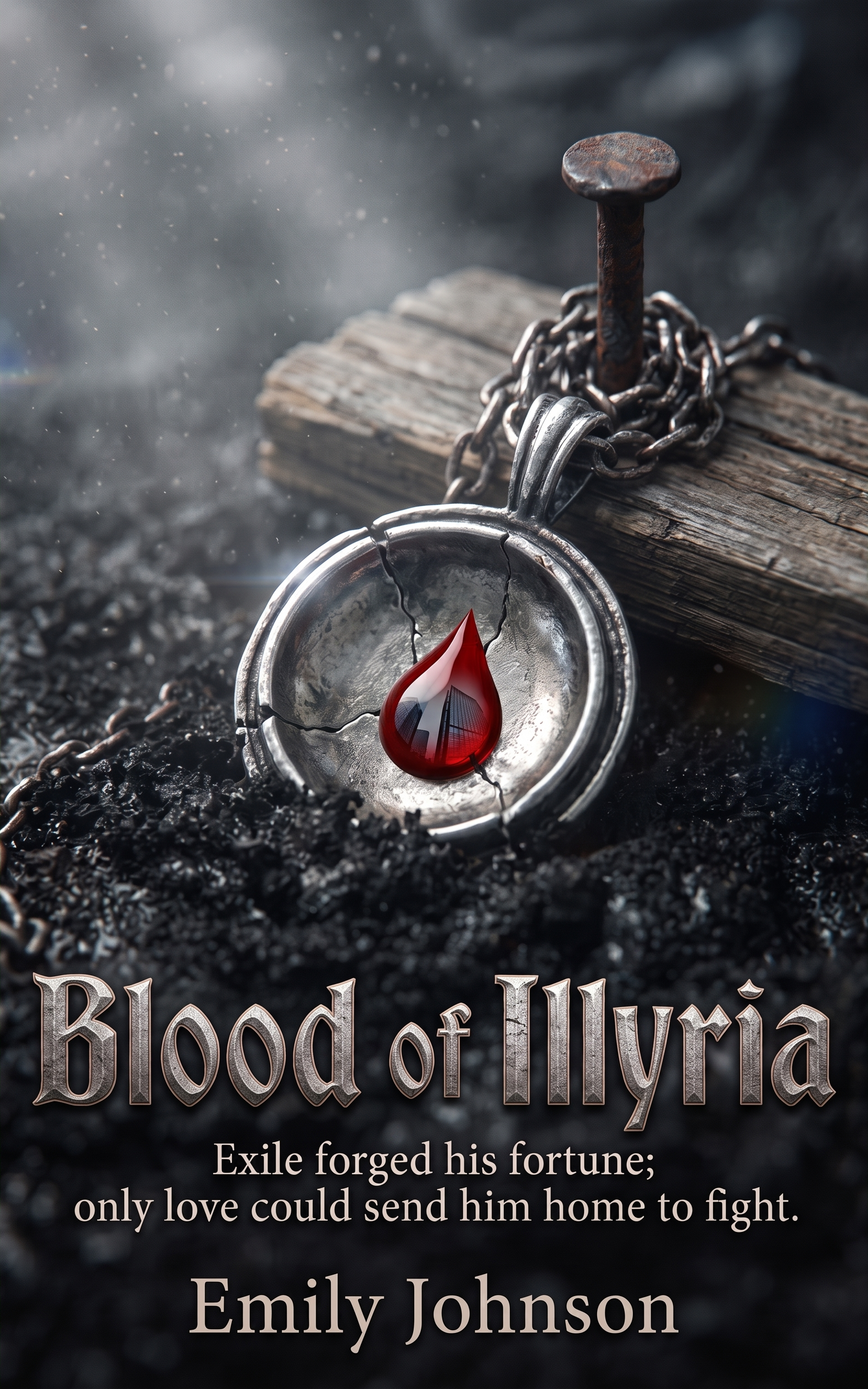
Blood of Illyria
Exile forged his fortune; only love could send him home to fight
by Dritan Mata
Seventeen years after his mountain village burned, Ilir Dardani wears tailored suits and hides an ancestral silver pendant against his skin. In the West he has become a ruthless construction magnate, rich enough to forget the fire—until Drita Krasniqi walks into his high-rise and tells him the truth. Lira, the woman he left behind, is still alive. She leads a stubborn highland resistance. Colonel Viktor Radek has her now, and he means to hang her in public to break the valley forever. Ilir burns his boardroom life, walks away from financier Sandra Ellison, and follows his mentor Harold Brennan back across hostile borders with weapons, cash, and no way home if he fails. Guided by young courier Beni Gashi, he storms a garrison to tear Lira from the gallows. What begins as a rescue becomes guerrilla war in the peaks. Trauma and sweat rekindle a fierce second-chance love. With village elders and borrowed guns they ignite rebellion, storm Radek’s citadel, and choose stone lanes and each other over sterile Western fortune. Blood of Illyria is a brutal, intimate epic of identity, desire, and the land that will not let you go.
- Adventure
- Romance
- Literary Fiction
- Erotica
- Action Adventure
- Second Chance Romance
Ghosts in the Rain
Rain had been falling on the city for six days without pause, and from the fortieth floor it looked less like weather than judgment, a gray curtain drawn across every rooftop and crane between the river and the harbor. Ilir Dardani stood at the window of his office with his hands clasped behind his back, watching the taillights smear red down Adams Street, and did not turn when the door opened behind him.
"Mr. Dardani." His assistant's voice carried the particular tightness of someone who had already been kept waiting too long. "The board is seated. Mr. Whitfield asked me to remind you the Turkish consortium is on the line in twenty minutes."
"Tell them I'm coming," Ilir said, though he made no move toward the door.
Beneath the wool of his jacket, under the silk of a shirt that had cost more than most men in his valley once earned in a season, his fingers found the small hard shape at his sternum. He did this without deciding to, the way another man might check his watch or his phone. The pendant was cold through the fabric this morning, and he pressed his palm flat against it until the metal warmed, the way it always did, the way it had warmed for seventeen years under a hundred different shirts in a hundred different cities that all smelled of diesel and ambition and nothing at all like orchard smoke.
"Sir." The assistant again, more careful now. "There's a woman in the outer office. She doesn't have an appointment. Security wanted to remove her but she gave a name and said you would know it."
Something in his chest went still, the way the valley air used to go still before a storm broke over the ridge. "What name."
"Krasniqi. Drita Krasniqi."
The word moved through him like a blade turned sideways, all edge and no entry wound, cutting without yet drawing blood. He had not heard that name spoken aloud in this city in seventeen years. He had built an entire life on the assumption that no one who carried it would ever cross an ocean to find him.
"Send her in," he said, and his voice came out steadier than he had any right to expect.
The mahogany doors swung inward before the assistant reached them, pushed by a small, upright woman who did not wait to be announced twice. She came into the room the way water comes down a mountainside after the thaw, unhurried and entirely certain of where it means to go. Her coat was city-bought and city-wrong, too thin for the season, and it carried into the sterile air of his office the smell of wet wool and, underneath it, faint and unmistakable, the smell of woodsmoke that no dry cleaning in this hemisphere would ever fully take out of mountain clothes.
Drita Krasniqi had aged the way stone ages, not softening but wearing down to something harder at the core. Her hair had gone the color of iron. Her hands, folded now in front of her, were the hands of a woman who had spent two decades doing work that broke younger hands than hers. But her spine had not bent, and her eyes, when they found his across forty feet of glass and steel, did not blink.
"Leave us," Ilir said to his assistant, who left without a word, closing the doors with the soft click of a woman who had decided this was not her business to understand.
For a moment neither of them spoke. Rain ticked against the window glass. Somewhere below, forty floors down, a truck laid on its horn and let it go.
"You look like the men who took our mountain," Drita said finally, in English learned late and spoken slow, each word set down like a stone she had carried a long way. "The suit. The clean hands. I did not think I would find that man in you."
"Drita." Her name in his mouth after so many years sounded strange to him, like a word from a language he had once been fluent in and had let atrophy on purpose. "How did you find me?"
"Money leaves tracks," she said. "Even hidden money. We are not as stupid as your city thinks we are."
He did not sit, and he did not offer her a chair, and some part of him understood that she would not have taken one, that she had crossed an ocean standing and meant to deliver whatever she carried standing as well. He made himself ask the question that had lived under every hour of every day since the night he last saw the orchard.
"Is she dead."
It was not a question the way he said it. It was a sentence he had rehearsed for seventeen years, worn smooth from repetition, the only way he had found to hold the fear at arm's length.
"No," Drita said.
The single word did something to the room that no amount of rain against glass could do. The floor seemed to tilt very slightly, the way a boat tilts when a wave passes beneath it that no one else on deck has felt.
"She did not die that night," Drita went on, and her voice did not soften to deliver this, did not perform mercy. "She went back up the higher paths after you were gone. She has been fighting since. Fourteen years in the crags, running the boys who carry messages, hiding children when the soldiers come for tribute. The valley calls her by a name now that is not her own, because a name is a thing they can hang a man for knowing."
Ilir found that he had crossed the room without deciding to move, that his hand had found the edge of his desk and was gripping it the way a man grips a rail on a listing ship. Fourteen years. She had been alive for fourteen of the seventeen years he had spent building glass towers and burying a boy who believed love could outlast fire, and no one had told him, and there had been no one to tell.
"Where is she now."
Drita's chin lifted, and for the first time something in her composure cracked, not into weeping, which he understood she had spent long ago on other losses, but into a kind of contained fury that made her look, for a moment, exactly like the girl who had raised her daughter to refuse names.
"Radek has her," she said. "Colonel Viktor Radek. He took the garrison at Pristela two winters ago and has been hunting her since. Three weeks ago his men caught her at the old mill with two of her runners. He means to hang her in the square. Twelve days from today. He has already sent word to the villages. He wants them to come and watch."
The words landed in him the way artillery lands, a distant concussion first, then the ground itself buckling. He had imagined her death a thousand times over seventeen years, had grieved it in the private architecture of sleepless nights, and had built, without ever admitting it to himself, an entire fortune as a kind of headstone for a girl he had failed to save. Now she was not a headstone. She was a woman with twelve days left to live, and the difference between those two facts was the difference between mourning and war.
"Twelve days," he said, mostly to himself.
"He wants a spectacle," Drita said. "A hanging with cameras, so the other valleys understand what happens when a woman refuses to kneel. He has scheduled it for market day, so the square will be full." She paused, and when she spoke again her voice had dropped into the older register, the one he remembered from courtyard councils and funeral rites, the register mountain people used only for oaths. "You swore on your father's blood that you would come back and be something they could not break. I did not come here to remind you of comfort, Ilir. I came to remind you of debt."
He looked at his own reflection in the rain-streaked glass, a tall man in a tailored suit with a burn scar along his jaw that no surgeon in this city had ever offered to remove because he had never asked, and for one long moment he did not recognize the shape looking back at him. The West had given him language and money and a name that opened any door in this hemisphere. It had never once asked him to be dangerous in the way the mountains had made him, and he understood, standing there with Drita's eyes on him, that the danger had never left. It had only been waiting, folded small under twenty years of contracts, for someone to say her name and mean it.
He pressed the intercom without sitting down. "Get me Whitfield. Now."
His assistant's voice, startled. "Sir, the board—"
"Tell the board the meeting is canceled. Tell them all of it is canceled. Every contract signed this quarter, every acquisition in motion, I want frozen by end of day." He was already moving toward the closet where he kept a second phone, one whose number existed on no company directory. "Get Harold Brennan on the line. Tell him I'm calling in the debt he's owed me for saying no to for eleven years."
"Sir, the Turkish consortium alone is worth—"
"I don't care what it's worth." His voice did not rise, but something underneath it had gone flat and final, a tone his staff had never once heard from him in nineteen years of careful civility. "Liquidate the offshore accounts starting with Zurich. I want it in cash and untraceable instruments by the end of the week. Cancel my calendar for the next month. Cancel it for longer if you have to. If anyone asks where I've gone, tell them I've gone home."
He turned back to Drita, who had not moved from the center of the room, who watched him with an expression that was not quite relief and not quite grief, the expression of a woman watching a debt finally come due.
"Twelve days," he said again, and this time it was not a question.
"Eleven, now," Drita said. "The clock did not stop while you thought about it."
Outside, the rain kept falling on a city that had never known what it meant to lose a home. Ilir Dardani stood in the middle of his glass office with the pendant burning against his chest like a coal someone had just fanned back to life, and understood, with the cold clarity of a man stepping off a ledge he had been standing on for seventeen years, that the empire behind him no longer mattered at all.
A Kingdom in Bed
Sandra Ellison did not knock. She never had, not in the four years since she had first walked into his boardroom in a suit that cost more than his first excavator and told him his numbers were wrong in front of eleven men who agreed with her by the end of the meeting. She let herself into the penthouse with the key he had given her the year the sec…