

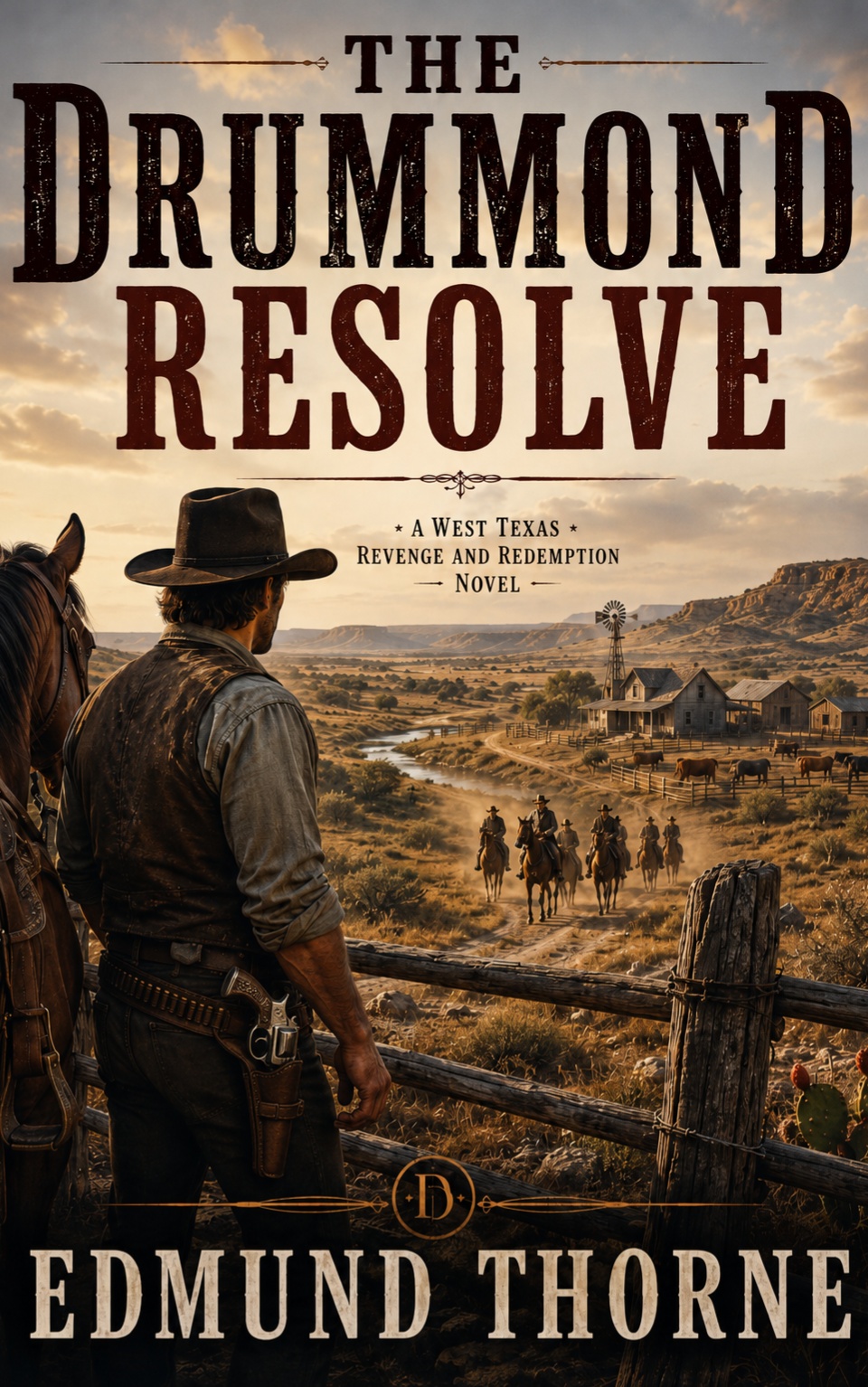
The Drummond Resolve
A West Texas Revenge and Redemption Novel
Six years in a Texas penitentiary can change a man. Caleb Drummond comes home determined not to waste the years he has left. Framed for the murder of a trusted family friend, Caleb lost his freedom at twenty-three. By the time he returns to West Texas, both of his parents are dead, the woman he once expected to marry has built another life, and the family ranch has fallen into the hands of Charles Conway, a powerful cattleman with good reason to keep the past buried. Caleb soon discovers that clearing his name will take more than a gun. Old survey records are missing. A witness was paid to lie. His own defense attorney has secrets he spent six years drinking to forget. And the land his father lost may have been taken by methods that will not stand up once the right men begin looking closely. So Caleb sends word to Montana. The Drummonds do not gather lightly. But when family comes, they bring ranchers, riflemen, a lawyer, a financier, miners, woodsmen, and men who know hard country from Texas to the northern border. Together they will have to uncover what Conway built his empire on without becoming the kind of men Caleb was accused of being. The Drummond Resolve is a traditional Western of family loyalty, hard-earned justice, dangerous men, and the long work of reclaiming a life after everything familiar has been taken away.
- Western
- Historical Fiction
- Crime Fiction
- Revenge Western
- Wild West
- Ranch Life
A Bitter Homecoming
The gate at Huntsville shut behind Caleb Drummond a little after seven in the morning, and the sound of it carried farther than iron had any business carrying. He stood in the road a moment with his release papers folded inside his coat and a canvas bag holding everything he owned: two shirts, a razor, twelve dollars, and a Bible he had never once opened in six years but had kept because there had been little reason to throw away anything that belonged to him.
He did not look back at the walls. He had told himself for the better part of two thousand mornings that he would not look back at them, and now that the moment had come, he found he did not want to. He walked to the depot instead, bought a ticket with money he could not really spare, and sat on a bench with his hat low and his hands folded in his lap the way a man learns to sit when he has spent years being watched.
The train ran west through country that changed by the hour, from the pine and red clay of East Texas into flatter land, and then into the country he remembered, brown and open and cut by dry creek beds that only ran water twice a year if they were lucky. He watched it pass through the window glass and let himself think, for the first time in a long while, about what he might find at the end of the line. He pictured the house the way it had been. He pictured his mother at the stove and his father coming in from the pens with his hat pushed back, and Samuel not yet grown, still a boy of eighteen with a boy's temper. He knew enough not to trust the picture. Six years change a place the way they change a man, and Caleb Drummond had learned in prison not to build his hopes on anything he could not see with his own eyes.
The town had grown some when he stepped off the stage that carried him the last stretch from the rail spur. There was a new bank building with a stone front, and the mercantile had been repainted, and a hotel stood where he remembered only a boarding house. He walked the main street slowly, carrying his bag, and he felt the town's eyes on him before he had gone twenty steps. A man he did not know stopped sweeping his porch and watched him pass. A woman drew her two children a little closer as she crossed the street, though Caleb had done nothing to earn the caution beyond existing. An older man outside the feed store looked at him hard, then looked away fast, the way a man looks away from something he does not want to be caught noticing.
He did not blame them. A man convicted of killing the county surveyor was not likely to be greeted with open arms, whatever the truth of it had been. He kept his pace even and his eyes forward and went into the general store because he needed a few things before he rode out, and because he was not going to let the town decide where he could and could not walk.
Inside the store he saw her standing near the dry goods with a boy of perhaps five tugging at her skirt and an infant balanced on her hip. For a moment Caleb did not recognize her, because the girl he remembered had been seventeen and unmarried and laughing at something he'd said behind the Baptist church. This woman was thinner in the face, tired around the eyes in the way that motherhood and years put on a person, but it was her. Ellen Whitfield, though he supposed she carried a different name now.
She saw him too. He watched the recognition cross her face and remain there for a moment. She did not call out to him, but neither did she look away in the way the others had. She simply held his eyes long enough for both of them to acknowledge what had once been expected and what was gone now. Then she looked down at her boy, said something quiet to him, and moved toward the counter to pay for her thread and flour.
Caleb bought his own goods without speaking to her. There was nothing to say that would not sound foolish or bitter, and he had promised himself somewhere in the second year of his sentence that he would not become a man who gave bitterness voice every time life disappointed him. He paid the clerk, who handled the coins with more care than was necessary, and walked back out into the sun with his purchases under his arm.
He stood for a moment on the boardwalk after leaving the store. Seeing Ellen had not undone him the way he might once have feared. It had shown him plainly that the life he remembered had gone on without him and that some parts of it were beyond recovery. He had known that in prison, but knowing something inside stone walls and seeing it with his own eyes were different matters. After a moment he stepped down from the boardwalk and went to see about a horse.
The old Drummond place lay eleven miles north and west of town, out along the low rise of hills where the good water ran, and Caleb rode it on a rented sorrel with the sun dropping behind him and throwing his shadow long across the road. He knew this country the way a man knows his own hands. He knew where the road dipped near Calder's Creek and where the mesquite thickened past the old Pruitt boundary line, and he knew, before he ever came in sight of the house, that something in the shape of the land had changed, though he could not yet say what.
When the house came into view, he reined in the sorrel and sat looking at it. The house still stood, but it stood wrong. The porch his father had built with his own hands sagged on one side where a post had rotted through and nobody had fixed it. Two of the front windows were boarded over. The barn beyond it had lost half its roof, and what stock pens remained were empty and falling in on themselves, rails scattered where nobody had cared enough to put them back. Weeds had come up thick along the foundation. It was not a burned house or a torn-down house. It was a house that had simply been left to rot by people who did not care whether it stood or fell, and Caleb found that harder to look at than damage done quickly.
He was still sitting the sorrel and taking in the ruin of it when he heard a horse blow somewhere past the old smokehouse and then a man's voice, wary, calling out to ask who was there.
"It's Caleb," he called back as he swung down from the saddle.
Samuel came around the corner of the smokehouse with a rifle held loose but ready in one hand and stopped when he saw who it was. For a moment neither of them moved. Caleb saw a young man where he had left a boy, broader through the shoulders, sun-darkened, with their father's jaw and their mother's eyes, dressed rough in a shirt gone thin at the elbows and boots that had been resoled more than once. Samuel set the rifle against the smokehouse wall without seeming to think about it and crossed the yard. The two of them stood close for a moment before Samuel gripped Caleb by the shoulder and Caleb returned it. Neither man seemed to know whether more was called for, and after six years the simple contact was enough.
"You got word I was coming?" Caleb asked.
"No. I've been camping out here most weeks. Didn't know the day. I'd have met you at the gate if I'd known."
Caleb shook his head. "Didn't want anybody meeting me at that gate. Wanted to walk out of it alone."
Samuel nodded slowly, as though that made sense to him, and looked his brother over. "You look older than six years ought to make a man."
"Prison does some things faster than years."
They walked together toward the rough camp Samuel had set up in the lee of the old barn, a canvas lean-to and a fire ring and a picket line for two horses. Samuel set about making coffee while Caleb sat on an overturned crate and looked at what was left of the home he had grown up in. Neither of them spoke for a while. The coffee smell rose thin against the evening air, and somewhere off in the brush a nighthawk was already calling.
"I expected to find Mother and Father here," Caleb said at last. "Or somewhere close by."
Samuel poured coffee into two dented cups before he answered, and when he did, his voice had gone flat and careful. "Mother passed the second winter you were gone. Her heart gave out. Doctor said it had been weak for some time."
Caleb sat still with the cup in his hands. He had known there might be deaths waiting for him when he came home. Letters from Samuel had grown less frequent as money tightened and the family moved about, and some had never reached him at all. Knowing that bad news might be waiting had not made hearing it easier in the yard where he remembered his mother hanging wash on a line that was gone now.
Samuel waited before continuing. "Father lasted another year. He never quit saying you didn't do it, Caleb. Not once, not to anybody. He said it in town, he said it at church, and he said it to the sheriff before Hale ever took the badge. Folks got tired of hearing it. Tired of a man standing up in the mercantile telling them the county surveyor's killer was still walking free. It cost us customers and goodwill, and after a while it cost us the kind of neighbor help a ranch needs to get through a bad year. Folks quit coming around."
Caleb turned his cup slowly in his hands, feeling the heat of it. "You said he lasted another year. Was that when he took sick?"
"That last winter. He took a fever and went down hard with it. Lung fever, the doctor called it, though I don't know that the doctor knew much more than the name. Father was out of his head with it more days than not, and that's when the ranch went."
Caleb looked toward the sagging house before bringing his eyes back to Samuel. "Tell me about that."
"The story around town is that he sold the place himself to raise money for a doctor and treatment, and that he did it clear-headed and willing. That's what's in the county record, anyway. His signature's on the deed."
Caleb heard enough in Samuel's tone to know there was more. "But you were here."
"I was twenty-one by then. I sat up with him through the worst of those nights, and there were whole stretches where he didn't know me from a stranger. Some days he didn't know what year it was. Once he asked where you were and then asked it again ten minutes later. I don't believe for one minute he sat down clear in his mind and sold off the water and the land his father worked for. Somebody put a paper in front of him when he wasn't fit to know what he was signing, or somebody signed for him. I've turned it over a hundred times and I can't make it come out honest."
Caleb let that sit between them for a while before asking who owned the place now.
"Man named Charles Conway," Samuel said. "Came out here from Arizona a handful of years back with mining money, or what was left of it, and started buying land and water rights all through this end of the county. He's got this place now, and the creek, and he's building something big out past the old Pruitt line. Biggest outfit anybody around here has seen. Folks say he means to be the largest cattleman in this part of Texas before he's through, and from what I've seen riding past his fence lines, I'd say he's most of the way there."
Caleb looked out at the dark bulk of the barn, the collapsed pens, and the porch sagging under years of neglect. He had expected his anger to come quickly once he learned who had the place, but what he felt was steadier than that. Six years in prison had taught him what happened to men who spent anger before they understood where to aim it.
"He's got the water," Caleb said after a while. "That's what matters."
Samuel nodded. "That's my thinking. Whole county knows this creek don't run dry, not even in the worst years. A man building the kind of spread Conway's building needs water like that."
Caleb drank the last of his coffee, bitter and gone half cold, and set the cup beside the crate. Above them the sky had gone dark enough for the first stars to show past the ridge where his father used to ride the fence line.
"I served six years thinking I'd come home to something," he said.
Samuel rested his forearms on his knees and looked into the fire. "I've had six years to get used to there not being much left. You've had about six hours."
Caleb looked across the fire at the man his brother had become while he was gone. Samuel had carried the deaths, the ranch, and the town's judgment without Caleb there to shoulder any of it, and Caleb knew he had heard only the beginning.
"Then you'd best tell me the rest," he said. "I've got some catching up to do."
Samuel reached for the coffee pot again and began to talk.
The Weight of the Badge
The Drummond burying ground sat on a low rise a half mile from the house, a windblown shoulder of land their father had chosen because it caught the morning sun and looked out over the creek bottom he had loved. Caleb rode there beside Samuel without much talk, the two horses picking their way up through bunch grass gone brittle with the season. He…
Want to read the rest?
Get the full book here: