

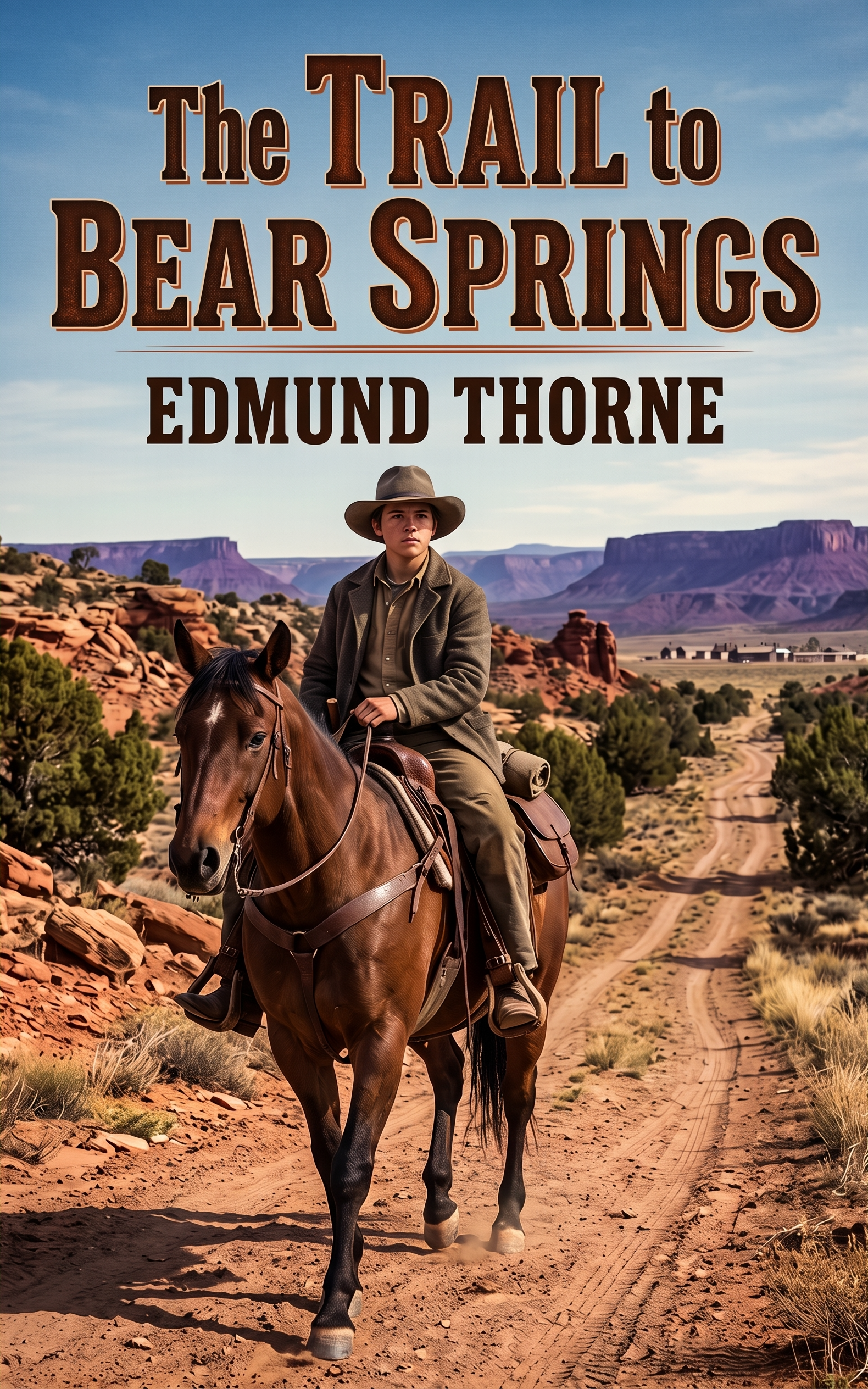
The Trail to Bear Springs
by Harper Wynnley
New Mexico Territory, 1879. Fifteen-year-old Luke Redding knows horses, rifles, cattle, and hard country. None of it is enough to save his family when a small band of renegade raiders strikes their isolated ranch. Left for dead beneath the wreckage, Luke wakes to find his parents and younger brother gone and his sister Hannah missing. The riders who discover him the next morning are not rescuers. They are a Navajo pursuit party already hunting the same raiders for attacks of their own. Luke has a horse, a Winchester, and a choice. He can remain behind—or keep up. The trail eventually carries him to Fort Wingate at Bear Springs, where he finds Hannah safe and discovers that surviving is only the beginning. With winter coming and no ranch to return to yet, Luke earns his keep in the post stables and freight yard under veteran teamster Nick Turner. There he learns a different kind of frontier work: mules, harness, wagons, water, freight, and the judgment to know when action matters—and when it does not. By spring, Luke is riding the freight road as a paid hand. But old tracks have crossed that road too, and some unfinished trouble is waiting in the broken country ahead. The Trail to Bear Springs is a traditional historical Western of survival, hard-earned judgment, and a boy learning to carry responsibilities larger than himself.
- Western
- Historical Fiction
- Adventure
- Frontier
- Wild West
- Wilderness
A Cartridge Counts
The mule deer stood at the edge of a stand of piñon a hundred and twenty yards off, feeding along the slope where the grass still held some green from the last rain. Luke had followed fresh tracks along the damp sand of the wash for the better part of an hour, moving slow on foot with the buckskin left ground-tied below a rock shelf, until he found where the deer had climbed out onto the bench. He eased down behind a boulder and waited for the buck to lift its head.
It took its time. The doe beside it browsed a while longer, and a second deer, smaller, moved behind a piñon and out of sight. Luke did not force the moment. His father had told him more than once that a man who could not wait for his shot had no business carrying a rifle, and Luke had come to believe it the way he believed water ran downhill. He settled the Winchester across the rock, worked his elbow into a hollow that would hold steady, and watched the buck's shoulder come clear of a branch.
The range was good, but the buck stood half-turned behind the scrub, offering no clean broadside. Luke settled his breathing, rested the rifle steady against the stone, and waited for the animal to take another step and plant its near foreleg. When it did, he fired.
The buck dropped where it stood, and the doe and the yearling broke uphill into the piñon with a clatter of loose stone. Luke stayed where he was a moment, working the lever and feeding a fresh round into the chamber before he stood, because a wounded animal that only looked dead could still get up and run itself into the rocks where he'd never find it. But this one did not move, and when he walked up on it, the shot had taken it just behind the shoulder.
He worked quickly once he had the buckskin brought up. He had done this enough times that his hands did not need much thought, and he kept an eye on the horse while he worked, since the smell of blood unsettled some animals more than others. He bled the deer, opened it, and set the organs aside for the ravens and coyotes, keeping the liver wrapped in a piece of burlap for the house. By the time he finished dressing it and had the intact carcass lashed securely across the saddle behind the buckskin's withers, the sun had moved a good hand's width lower, and his shirt was dark with sweat despite the dry cold in the air.
He led the horse rather than rode, since the animal did not care for the smell close against its flank, and they came down off the ridge slow, picking their way through rock and brush until the ranch buildings showed below in the flat, the house and the barn and the corrals strung along the little creek that never went dry even in the worst years. Smoke stood up thin and straight from the kitchen chimney. His father was out by the corral working a hind shoe loose from a bay gelding, and he looked up once when the buckskin came into the yard and went back to his work without comment, though Luke saw him take in the meat across the saddle before he did.
"Clean shot?" Isaac asked, when Luke had led the horse close enough to speak without raising his voice.
"Hundred and twenty, maybe a little better," Luke said. "Waited on him to plant his leg."
"That's the way to do it." Isaac straightened, pressed a hand against his own lower back, and looked the deer over with the flat, appraising eye of a man who had butchered a good many animals in his life and expected the job done a certain way. "Get him hung and skinned before dark. Your mother'll want the liver tonight."
"Already got it wrapped."
"Good." Isaac went back to easing the loose shoe free with his pincers, and Luke led the buckskin toward the barn where a stout beam crossed between two posts and a length of rope hung ready for hanging game. Within the half hour the deer hung skinned and cooling properly in the shade where the flies were fewer.
He found Jonah waiting for him just inside the barn door, sitting on an overturned bucket with his knees drawn up, watching with the particular interest an eight-year-old boy took in anything involving a knife and blood.
"You get both of them?" Jonah asked.
"Both of what?"
"Ma said sometimes there's two bucks together."
"There was a doe and a yearling with him. I let them go." Luke wiped the knife blade on a rag and set it down on the shelf where his father kept the skinning tools. "No sense taking more than we can use before it spoils."
Jonah seemed to accept this, though he looked a little disappointed that the story had not turned out to include more killing. He trailed Luke back out into the yard, asking after the shot, how far, and whether the buck had run any distance, and Luke answered him plainly as they walked.
Martha came out onto the porch when she heard them, wiping her hands on her apron, and she looked over the hanging carcass with the same practical eye Isaac had used, though she was already thinking ahead to the smokehouse and what portion would keep and what would want salting soon.
"That'll do us a good while," she said. "You bring the liver?"
"In the burlap by the well."
"Good boy," she said, and went to fetch it before the heat of the day spoiled it any further. Hannah came out behind her, twelve years old and already useful around the kitchen, carrying a bucket of wash water she meant to dump behind the henhouse, and she stopped to look at the deer a moment with more curiosity about the meat than the hunting of it.
"That's a lot of venison," she said.
"Enough to last us a spell if Ma salts it right."
"I know how to salt meat, Luke Redding." Hannah said it without much heat, the way brother and sister traded such remarks a dozen times a week, and went on to dump her bucket, and that was the end of it.
The afternoon went on with the work waiting around the ranch. Isaac finished with the bay gelding's shoe and moved on to mending a section of the corral fence where a rail had come loose from its post, and Luke joined him there once the deer was properly hung and the tools put away. They worked without much talk, Isaac holding the rail steady while Luke drove the nails, and when a nail bent under a bad angle Isaac simply pulled it and handed Luke another.
"Water's low in the north trough," Isaac said, when the rail was set and they stood back to check it. "We'll need to clean out that pipe before the week's out."
"I can ride out there tomorrow."
"We'll go together. Take most of a day, and there's tack wants mending before that." Isaac nodded toward the tack shed, where a bridle hung with a cracked cheek strap that had been waiting on attention for the better part of a week. "You get to that before supper."
Luke went to it without complaint, since mending tack was no different from any other job that had to be done sometime, and a man who let small repairs wait usually found himself with bigger ones later. He sat on the bench outside the tack shed with the bridle across his knees, working a new strap of latigo into place, cutting it to length and punching the holes with the awl his father kept for such work. Jonah wandered by twice to watch and once tried his hand at the awl before Isaac caught him at it and set him instead to carrying water, which Jonah did with the particular resentment of a boy who felt he'd been given the lesser job.
Supper that evening was venison liver fried with onions, and cornbread, and the family ate at the long table the way they ate most nights, without much ceremony, Isaac at the head and Martha near the stove where she could reach the coffee pot, Hannah and Jonah squabbling briefly over the last of the cornbread until Martha settled it by cutting it evenly herself. Luke ate quietly, worn out some from the day's ride and the work after, and when Isaac asked him what kind of ground the deer had been taken on, Luke told him about the wash and the piñon slope and the wind, and his father listened the way he always listened to such reports, nodding at the parts that mattered and asking nothing about the parts that didn't.
"You'll want to check that same country again before long," Isaac said. "Deer'll hold to it this time of year if the feed stays good."
"I figured the same."
After supper Martha set Hannah to the dishes and took up her mending by the lamp, and Jonah fell asleep sitting up before he'd been sent to bed, worn out from carrying water buckets he was still too small to carry easily. Isaac went out once more before full dark to check the stock, and Luke went with him, the two of them walking the fence line by the fading light while the horses moved restlessly in the corral, settling for the night. The air had gone cold quickly the way it did in that country once the sun dropped behind the ridge, and Luke pulled his coat closer without much thought to it, the way he did most evenings.
"Good day's work," Isaac said, when they'd finished the walk and stood a moment by the gate.
"Yes, sir."
"Get some sleep. North trough tomorrow, and we'll want an early start on it."
Luke said he would. They went inside together, and Luke turned in soon after, knowing he had to be up before sunrise to ride out with his father and clear the north trough.
Smoke to the South
They found the north trough clogged with silt where the pipe let into it, and Isaac spent the better part of the morning clearing it while Luke rode the fence line checking posts and watching the cattle work down toward the water. It was slow work, the kind that filled a day without much to show for it beyond a trough that ran clean again, and by m…