

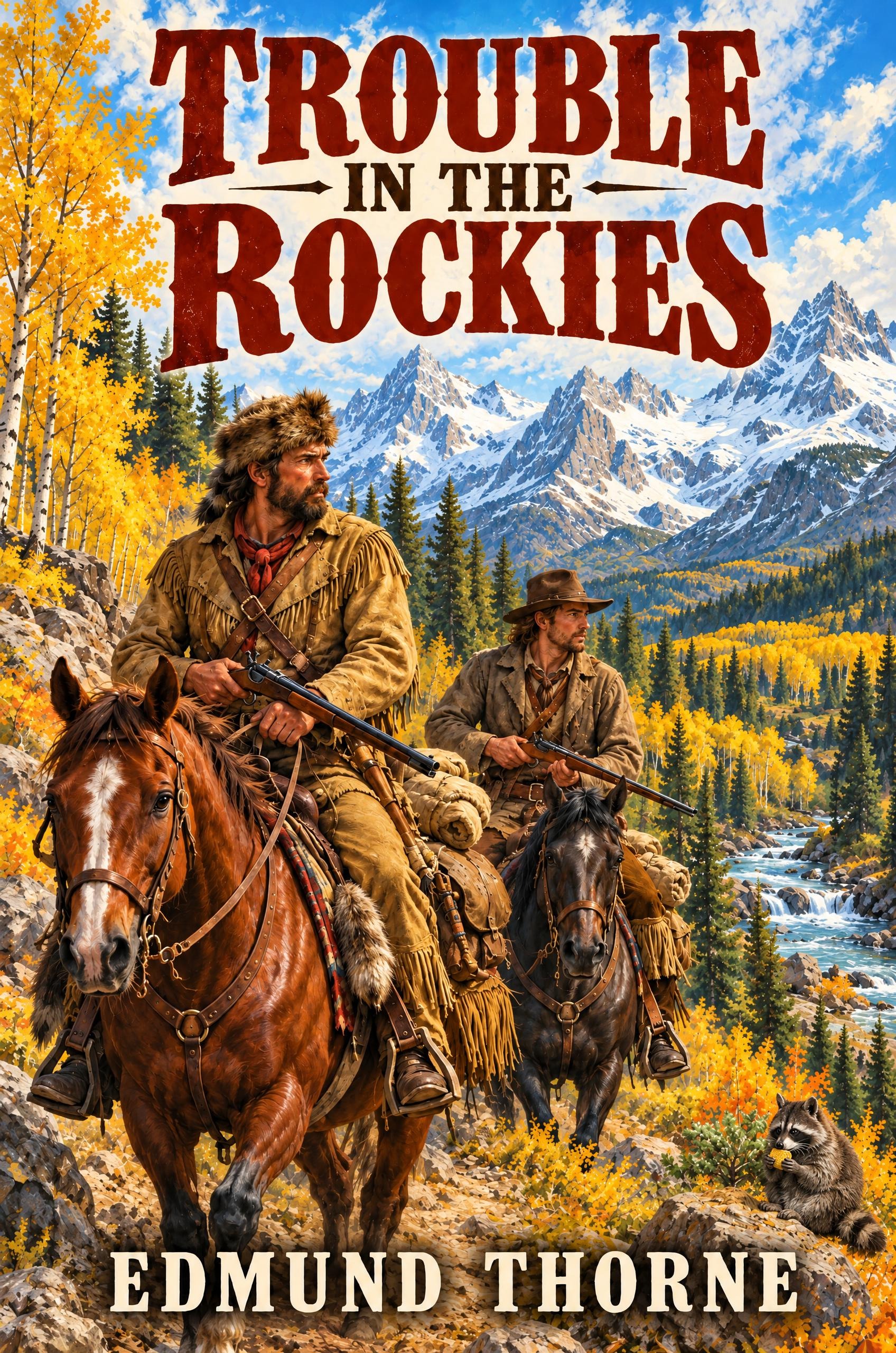
Trouble in the Rockies
A season of pelts, peril, and the will to survive
1834. The Rocky Mountains are still American ground in name only. Three independent fur trappers push deep into the high country, chasing a season's fortune in beaver pelts. They are young, stubborn, and too far from help to matter. The spring rivers run fast and cold, and before the first month is out, one man is gone — swept under by a current that does not give back what it takes. The two who remain press on. They work the valleys and ridges, setting traps through long days and longer nights, building a pile of furs that could buy them out of this life for good. But the wilderness does not yield easily. A grizzly attack leaves one man crippled. A raid by an outcast warrior takes the other to the edge of death. And when the first winter storm howls down from the peaks, the two partners must decide how much they are willing to lose. The frontier does not care about your plans. It only cares if you survive. Trouble in the Rockies is a raw, unflinching story of endurance, greed, and the brutal cost of a fortune made in the wild.
- Western
- Adventure
- Historical Fiction
- Frontier
- Survival
- Wilderness
The High Country
Sam crouched at the edge of the beaver pond with his sleeves pushed above his elbows, his hands red from the cold water, and worked the chain of his trap free from the stake he had driven into the mud three days before. The beaver inside was a good one, dark and heavy, its pelt thick with the last of the winter growth. He lifted it clear of the water and laid it on the bank, then knelt to reset the trap in the same spot, baiting the float stick with a fresh daub of castoreum from the horn he carried at his belt. The creek ran noisy and cold beside him, swollen with snowmelt from the high country, and he could feel the chill of it through his leather leggings even where he knelt well back from the bank.
"That makes six for this stretch alone," Eli said, coming up through the willows with two beaver already slung over his shoulder. He dropped them beside Sam's and studied the fresh one with the satisfied look of a man counting money he had not yet spent. "If the rest of the line runs like this, we'll have more plews than we've got horses to carry them."
"Good problem to have," Sam said. He wiped his knife on his trouser leg and began the work of skinning, his hands moving with the ease of long practice. "Though I expect we'll find a few empty sets before we're through. Can't all be this generous."
Tom came splashing along the near bank a few minutes later, his own trap dangling empty from one hand and a grin on his face that suggested he had not caught the beaver but had found something else worth telling. "There's a big one working the dam up above," he said. "Cut a cottonwood near as big around as my leg sometime in the night. I didn't see him, but the sign's fresh. We ought to move a trap up that way tomorrow."
"How fresh?" Sam asked, not looking up from his work.
"Fresh enough the chips were still pale," Tom said. "He's working close to the bank too, not out in the deep water. Ought to be an easy set."
Sam nodded and kept skinning. He had learned two years before that Tom's eye for sign was better than his patience for waiting on results, and the two things together made him a useful man to send ahead along a trapline. "We'll move a trap up there in the morning," he said. "No sense doing it today when we've still got four sets left to check on this stretch."
They worked their way upstream through the late morning, Eli wading out to the deeper sets where the current ran strongest, Sam and Tom handling the shallower water nearer the banks. The valley opened wide around them, meadows still patched with old snow in the shaded hollows, the peaks above white and sharp against a sky that had not yet decided whether it meant to stay clear. Beaver sign was everywhere along the creek, fresh cuttings and well-worn slides, dams holding back broad still ponds that mirrored the mountains upside down in their black water. Sam had trapped a good many creeks in his sixteen years in the mountains, and he could not recall one that had shown this much promise so early in the season.
They came to the fifth set at a place where the bank dropped steep into a deep pool, the current cutting hard against an undercut shelf of dirt and root. Tom waded out to check it, the water rising past his knees, and when he reached down for the trap chain his boot slid on a stone beneath the surface and he went down hard against the bank, one arm plunging into the water to his shoulder.
"Tom," Sam said, already moving toward him.
"I'm all right," Tom called back, though his voice had gone tight with the cold shock of the water. He had caught himself against the undercut bank, but his footing was gone, the current pulling steadily at his legs, and the soft earth he gripped was already crumbling in wet clumps beneath his fingers. "Just can't get my feet under me on this blasted rock."
Eli was there in three strides, planting himself on firmer ground above the undercut and extending his rifle barrel-first toward Tom's reaching hand. "Grab hold," he said. "Don't fight the current, just hang on and let me pull."
Tom closed his fist around the barrel and Eli hauled, bracing his boots against a half-buried stone, while Sam came up on the other side and caught Tom under the arm the moment he was close enough to reach. Between the two of them they drew him up out of the pool and onto solid ground, where he stood dripping and swearing cheerfully at his own clumsiness.
"Well," Tom said, wringing water from his sleeve, "that's one way to check if the trap's still set."
"Was it?" Eli asked.
Tom looked down at his empty hands and then laughed, shaking his head. "I never did get hold of the chain. Reckon one of you fellows will have to go in after it, seeing as I've already had my swim for the morning."
Sam eyed the undercut bank, the way the current folded back on itself beneath the overhang, and decided against sending anyone else into that particular pool without better footing. "We'll come at it from above," he said, "work our way down along that gravel bar instead of wading straight into the deep part. No sense in two of us taking a bath before dinner."
They managed it without further trouble, Eli working his way down the gravel bar while Sam held the pack animals and Tom wrung out what water he could from his leggings. The trap came up with nothing in it, sprung and empty, likely robbed by some creature too clever to be caught in it twice, and they moved on without much regret over a single missed set when the rest of the morning had gone so well.
It was past midday, the sun climbing high enough to throw short shadows beneath the spruce, when Sam stopped at a place where the creek narrowed between two rock outcrops and studied the water with a frown that Eli recognized from long acquaintance.
"What is it?" Eli asked, coming up beside him.
"Water's higher than it was three days back," Sam said. "See that line of mud along the rock there? That's where it was running then. It's come up near a foot since." He nodded toward the mountains rising pale and sharp above the timber. "Warm spell up high, most likely. All that snow's got to come down sometime, and it looks like it's started in earnest."
Eli studied the water a moment, then glanced at the peaks himself. "We were figuring on crossing over to that valley west of here inside the week. The one with the good beaver sign from two years back."
"We were," Sam agreed. "River crossing's liable to get worse before it gets better, though, not easier. If we're going to make that crossing, better we do it soon than wait for the snow up high to finish melting."
"Or we could wait it out," Tom offered, wringing the last of the water from his sleeve. "Let the worst of the runoff pass before we try it. I've seen rivers get plenty rough this time of year."
Sam considered that, turning it over the way he turned over most decisions, weighing one risk against another before settling on a course. "We could," he said. "But waiting costs us trapping time in a valley we already know is good, on the chance that the water gets friendlier later instead of worse. I'd rather make the crossing while we can still read the river, before it gets so high we can't tell a safe ford from a drowning hole." He looked to Eli. "What do you think?"
"I think you're probably right," Eli said, "though I notice you waited to ask my opinion until after you'd already made up your mind."
"Just confirming good judgment when I see it," Sam said, and Eli snorted and shook his head, and they turned back toward camp with their catch slung across the pack horses, the matter settled well enough between them, as it generally was.
They reached camp with the sun still an hour or more above the western ridge, the horses picketed on good grass near the edge of the timber, their small fire ring already black from three nights of use. The work of the evening began the moment the last pack came off the last horse. Eli saw to the animals first, as he always did, checking each one's legs and feet before turning them loose to graze, while Tom gathered wood enough to last through supper and into the evening. Sam set about the beaver, working through the catch one skin at a time, fleshing each hide carefully with his knife to scrape away the fat and loose tissue before stretching it on a willow hoop to dry. It was tedious work, and cold on hands already stiffened by a day spent in creek water, but it was the kind of work that turned a dead animal into money, and none of the three men begrudged the hours it took.
"Six today," Sam said, counting the hoops as he set them in a row near the fire where the heat would help dry them without scorching the hide. "Four yesterday, and five the day before that. If this creek keeps paying out the way it has, we'll have more plews before the week's out than we took in the first month last season."
"At six dollars a pound, give or take what Fontaine's willing to pay," Eli said, settling down near the fire with his own hoops to tend, "that's a fair sight of money for a handful of days' work."
"Provided Fontaine's still paying six dollars and not some lower figure he dreamed up over the winter," Tom said, crouching to feed a stick into the flames. "Prices have a way of changing when a man's got the only post for two hundred miles."
"They do," Sam admitted. "But even at five, we'd be sitting pretty by fall. A man could buy himself considerable comfort on a season like this one's shaping up to be." He thought of the little he had managed to put aside over the years, enough for supplies and powder and the occasional indulgence at rendezvous, never quite enough to call himself secure against a bad season or a worse injury. A fortune built from beaver pelts was not an impossible thing, not for a man willing to work hard country and take his chances with the weather, and the valley they had found this spring seemed determined to make good on that promise.
"I been thinking on it," Tom said, turning a hoop in his hands to check the stretch of the hide. "A season like this, man could buy himself some land somewhere. Settle a little, maybe. Not quit the mountains entirely, but have something waiting when a fellow gets too old or too broke up to keep trapping."
"Listen to him," Eli said, grinning at Sam across the fire. "Twenty-three years old and already planning his retirement."
"Man's got to think ahead," Tom said, unbothered. "You two have been at this how long now, nine years together? Ten? And what have you got to show besides good horses and a lot of stories?"
"We've got each other's fine company," Eli said. "Which is worth more than any parcel of Missouri dirt, I'll have you know."
"I'll remind you of that next winter when the company's all you've got to eat," Tom said, and Sam laughed despite the sting of truth in it, because there was truth in what Tom said as well. A man could spend a whole life in the mountains and come out the other end with nothing more solid than memory and a worn-out body, unless he was careful, unless a season like this one came along and a man had the sense to make the most of it.
They ate well that evening, a haunch of venison Eli had shot two days before roasted over the coals alongside a kettle of beans softened with salt pork, and coffee strong enough to keep a man's teeth on edge. The talk drifted from money to the country ahead of them, the valley west where Sam had trapped two seasons back, the stream Tom had scouted that afternoon where the big beaver was cutting cottonwood close to the bank. They were still at it, comfortable and full, when Tom rose to fetch something from his pack near the base of a spruce a few yards off and let out a sudden curse that brought both older men's heads up sharp.
"What is it?" Sam asked.
"Something's been at my pack," Tom said, crouching over the disturbed canvas with a scowl. "I had a good piece of jerky wrapped up in here, and a twist of sugar besides, and now there's nothing but the wrapping left."
A rustling came from the brush just beyond the firelight, low and deliberate, and Sam turned in time to see a pair of eyes catch the glow of the flames, round and pale, set in a masked face that regarded the three men with no particular alarm. The animal was a raccoon, stout and well fed for the season, its ringed tail curled behind it and a strip of Tom's jerky still clamped in its jaws. One ear bore a deep notch near the tip, as though it had survived some old quarrel with a larger animal or another of its own kind.
"There he is," Tom said, rising with a stick in hand. "Get out of here, you thieving son of a gun."
The raccoon did not run so much as amble, unhurried and faintly contemptuous of the whole affair, pausing at the edge of the firelight to look back over its shoulder before it melted into the dark timber with its prize still held fast. Tom took two steps after it, waving his stick with more enthusiasm than purpose, and came up short against a spruce trunk in the dark, which drew a laugh from Eli loud enough to carry across the camp.
"Little bandit didn't even hurry," Tom said, coming back to the fire rubbing his shin where he had caught it against a fallen branch. "Walked off with my sugar like he'd paid good money for it."
"He probably figured he had," Sam said. "Spent all evening casing our camp for the right moment, same as any outlaw."
"That's exactly what he is," Tom said, settling back down with considerable indignation. "A bandit, plain and simple. Did you see that notch in his ear? Like he's already been shot at once and figures the rest of us are too slow to try again."
"The Bandit," Eli said, trying the name out and finding it suited him. "I like it. Has a nice ring, for a thief."
"Go ahead and laugh," Tom said, though he was laughing some himself by then, the sting of losing his sugar fading faster than his pride. "See how funny it is when he comes back for your jerky tomorrow night."
"I'll hang mine higher," Sam said. "You might consider doing the same, unless you mean to keep feeding him out of pure generosity."
"I mean to shoot him if he shows his masked face around here again," Tom said, though there was no real heat in it, only the particular aggravation of a young man outsmarted by an animal with no hands to speak of and a reputation for cunning. They settled in after that, hanging what remained of their food supplies from a line strung between two trees well above the reach of climbing paws, and the matter of The Bandit passed into the easy sort of camp story that would get told again at other fires, embellished a little more each time it was told.
The evening wore on toward full dark, the fire burned down to a bed of orange coals, and the talk turned at last to the practical matter of the morning ahead. Sam scraped a rough map into the dirt with a stick, marking the creek they had worked that day and the line of the river beyond it that stood between them and the western valley.
"If we break camp early," he said, "we can make the river crossing by midday and still have light enough to make camp on the far side before dark. No sense dawdling on it once we've decided."
"We'll want to scout the ford before we commit the pack animals to it," Eli said. "Water's higher than it was, like you said. Might be the old crossing's not the best one anymore."
"Agreed," Sam said. "We'll ride down along the bank a stretch first, see where the current runs slowest and the bottom's firmest, same as we always do. No reason to rush into deep water when we've got eyes to look first."
Tom nodded, turning a stick in the coals until the end caught and glowed. "I crossed worse than that river back in Tennessee, more times than I care to count. Long as we take it slow and keep the horses roped together, we'll manage fine."
"We generally do," Eli said.
They talked a while longer of small things, the condition of the horses' feet, the dwindling store of powder that would need replenishing before the season ran much further, the chance of finding more beaver sign once they reached the far valley. The fire burned low, and one by one they rolled into their blankets beneath the spruce, the horses stamping quietly in the dark beyond the firelight, the creek running on without pause toward the river that waited for them in the morning. Sam lay awake a few minutes longer than the others, listening to the water and thinking of the crossing ahead, turning the matter over once more in his mind the way he turned over most things before he let them rest. He had crossed a good many rivers in sixteen years, some worse than this one promised to be, and he saw no particular reason this one should prove any different. The decision was made, the course set, and there was nothing more to do about it until morning came and showed them the water for themselves.
The fire settled into ash sometime before midnight, and the three men slept on, the mountains dark and silent above them, the melting snow already beginning its long, steady work of filling the river that lay between the camp and the valley they meant to reach.
The River Takes Its Own
Sam was up before the gray light had settled into anything a man could properly call morning, and he found Eli already working the picket line, checking hooves one at a time by feel in the dark. Frost lay thin on the grass, and the creek beside their camp ran loud with the night's melt, louder than it had run the evening before. Tom came out of his…