

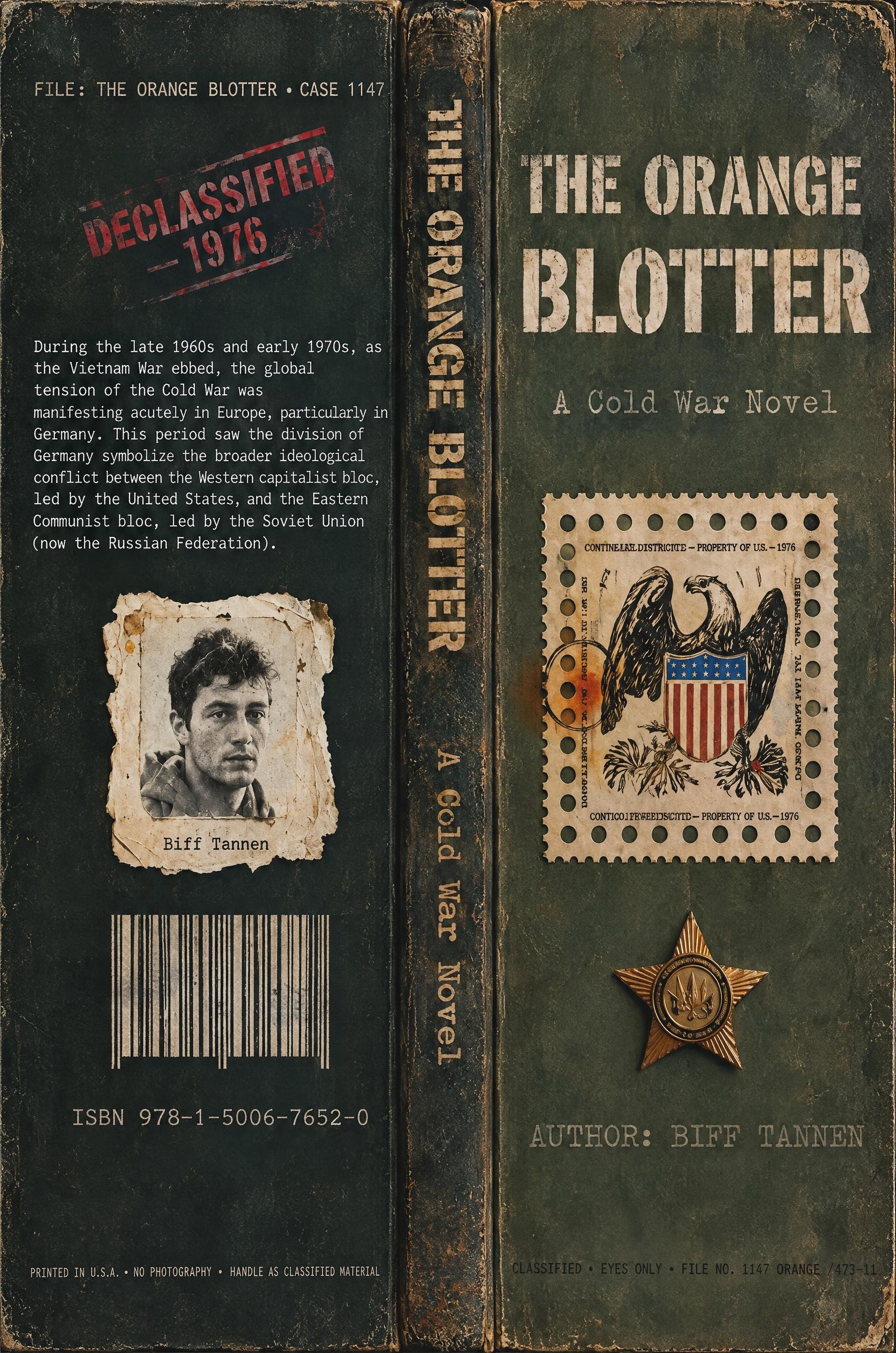
The Orange Blotter
Twin brothers, covert experiments, and the shadow of Cold War military service
by Eduardo Berdugo
At the height of the Cold War and the fading wake of the Vietnam era, Private Biff Hale and his fraternal twin brother, Noah, step into uniform together. What follows is a descent into a fractured military reality neither could have anticipated. While Noah is dispatched to the razor's edge of the Demilitarized Zone at Camp Bonifas in South Korea, Biff finds himself stationed across the Atlantic in West Germany. Behind the disciplined facade of Spangdahlem and Bitburg Air Bases lurks an epidemic of substance misuse and the ominous presence of Project Prometheus: a clandestine initiative utilizing LSD-infused orange blotter paper to probe human cognition, compliance, and twin psychology. From surviving the devastating 1974 tornado outbreak at Redstone Arsenal to enduring an ill-fated crossing at the German border with contraband from Amsterdam, Biff must navigate the moral costs of silence, whistleblowing, and institutional betrayal. Through military postal letters sent across hemispheres, the brothers cling to an unraveling tether of loyalty and sanity. The Orange Blotter is an unflinching, reflective memoir tracing the psychological scars of institutional experimentation, bureaucratic failure, and the hard-won journey toward ethical awareness and resilience.
- Biography
- Historical Non-Fiction
- War & Military Memoir
- Overcoming Adversity
- Military History
- Historical Events
Cold War Shadows and Project Prometheus
The vivid images of the Nazi concentration camps still fill me with revulsion; they are deeply ingrained memories. Although the camps no longer hold God’s chosen people, their inconceivable suffering and torment still haunt the structures—now grim—of weathered wood and barbed wire. Today, I come as a member of the occupying forces that subdued the evil that once stalked this wretched and loathsome land.
During the late 1960s and early 1970s, as the Vietnam War was ebbing, the global tension of the Cold War was manifesting acutely in Europe, particularly in Germany. This period saw the division of Germany symbolize the broader ideological conflict between the Western capitalist bloc, led by the United States, and the Eastern communist bloc, led by the Soviet Union (now the Russian Federation).
West Germany (now the Federal Republic of Germany) was emerging as a stronghold of Western democracy and economic growth, in sharp contrast to East Germany (the German Democratic Republic), which grappled with economic challenges and political repression. The Berlin Wall, erected in 1961, stood as a poignant physical and ideological barrier, encapsulating the struggle between these opposing forces.
In the Cold War, Germany became a critical theater for military and political posturing. NATO and Warsaw Pact forces were on high alert, and nuclear weapons intensified the potential for confrontation. This period also saw momentous events, including mass protests and movements within West Germany against the military and arms race, influenced by the broader anti-war sentiment fueled by the Vietnam War.
Diplomatic efforts such as the Strategic Arms Limitation Talks (SALT) and the Ostpolitik, started by West German Chancellor Willy Brandt, aimed to ease tensions between East and West, reflecting a desire for peaceful coexistence despite the prevailing hostilities.
Overall, while the Vietnam War unfolded in Southeast Asia, Germany remained a focal point of Cold War dynamics, with its division and the interplay among global superpowers shaping the geopolitical landscape.
The young man, Private Biff Hale, never imagined that his life would veer so dramatically from the ordinary path he had envisioned. He and his twin brother, Noah, went to South Korea and enlisted together, driven by a shared desire to serve their country. But their fate had drawn them to an unsettling distinction: they were chosen for a clandestine military initiative known only to a select few—Project Prometheus (a fitting analogy to the mythological Greek punished by Zeus with eternal torment).
Barely a block away from the 52d Fighter Wing Headquarters at Spangdahlem Air Base, as he entered the stark, sterile confines of the reception facility, Biff was struck by the cold detachment of the low-level scientists who ran the program—who looked like regular airmen. The air was thick with tension, and the walls were adorned with garish artwork that seemed to warp under the fluorescent lights. It was within this disquieting atmosphere that he was introduced to the potent hashish (a compressed form of resin derived from the marijuana flowers), the gateway to “orange blotter,” and other hard drugs.
The first few doses passed in a blur of vivid hallucinations and revelations—Biff felt as if the universe itself expanded within him, every thought unfurling like petals of a flower. He could see patterns in chaos, hear whispers of forgotten memories, and grasp concepts that had previously eluded him. Yet, as his mind soared, the ground beneath him crumbled.
With each session, the side effects grew more profound. Doubts twisted into paranoia, and vivid dreams morphed into nightmarish realities. Biff lost the boundaries that defined him, blurring the lines between himself and his brother, as flashes of Noah’s memories invaded his psyche. In frantic moments, he would call out for him, yearning for the familiar comfort of their bond, only to be met with the oppressive silence of his isolation.
The researchers seemed oblivious to Biff’s unraveling psyche. Instead, they recorded data, eagerly analyzing shifts in his brain activity, each spike a tantalizing sign of potential success. To them, he was not a soldier but a means to an end, a vessel to unlock untold secrets that could redefine humanity’s understanding of consciousness. But as his mind splintered further, Biff realized the monstrous implications of their quest for knowledge.
What had once been a quest for enlightenment spiraled into madness. The orange blotter’s influence became as intoxicating as it was debilitating, ensnaring his senses and pushing him to the brink of his sanity. Desperate for a way out, he sought sanctuary in his brother’s presence, determined to hold on to the last remnants of his identity. But Noah, unaware of the dark currents that had swept Biff away, faced his own trials—a parallel reality of unending anguish permeating their once inseparable fraternal bond.
In this subterranean maze of manipulation, Biff realized that Project Prometheus harbored far darker secrets than mere experimentation. Whispers of past trials circulated among the staff—failed subjects, people who had been irrevocably altered or driven to insanity. As he pieced together fragments of information, a chilling truth unfurled before him: the orange blotter was not intended solely to enhance; it controlled.
Determined to escape, Biff plotted his rebellion not just against the program, but against the very essence of what had been done for him. He |knew he needed to reclaim his mind—not only for himself but for his brother, imprisoned in a hostile environment that threatened to obliterate their connection. With all he had left, he harnessed the remnants of his consciousness to confront the architects of his own demise.
In a last act of desperate courage, Biff launched his escape, beckoning Noah to join him. Together, they would navigate the facility’s treacherous machinery, fighting the shadows of their own minds and the darkness of an unyielding military complex. As the orange blotter began its final, chaotic unraveling, the twins discovered a new power—their bond, forged not only in blood but in shared resilience.
And as they emerged from the depths of madness, with the world beyond stretched out like a canvas yet to be painted, the brothers vowed to reclaim their lives from the clutches of CIA experimentation, determined to ensure that no one else would fall victim to the diabolical promise of a mind unleashed. The future lay ahead, uncertain but undeniably theirs, and guided by the light of their unbreakable bond.
As the tale progresses, the enlisted young man, grappling with existential questions of identity and loyalty, navigates a labyrinthine web of espionage, psychological control, and ethical dilemmas. The program’s scientists, shrouded in secrecy and ambition, aim to harness the drug’s capabilities to enhance cognitive functions and create super-soldiers. However, as the experiments take a toll on his psyche, he experiences vivid hallucinations and fragmented memories, blurring the lines between reality and illusion.
His twin brother, unaware of the program’s true nature, becomes an unexpected anchor for him, as they share an unbreakable bond that transcends the horrors of the tests. However, the strains of the program tore their relationship, introducing paranoia and a sense of betrayal. The enlisted man feels torn between his duty to his country and his growing awareness of the moral compromises being fabricated in the name of military progress.
Within the confines of the new chamber, Biff confronts haunting visions of his past, including memories of their childhood and moments of innocence now overshadowed by the dark realities of their current situation. The “orange blotter” not only unlocks hidden corners of his mind but also exposes suppressed fears and insecurities. Each dosage deepens his struggle with identity, as he questions what it means to be a soldier, a brother, and ultimately, himself.
As he delves deeper into the experiment, he uncovers a conspiracy that goes beyond mere psychological manipulation—a plot intertwined with international espionage, where the stakes are not just his own mind but the very substance of humanity. The narrative crescendos into a harrowing climax in which he must make a choice: either escape the clutches of the program and expose the government’s clandestine dealings or succumb to the edges of his mind that the “orange blotter” has so perilously frayed.
In the gripping conclusion, the lines between loyalty and betrayal, sanity and madness blur, forcing Biff to confront not only his own demons but also the sinister implications of the world around him—a world where truth is a commodity and self-determination comes at an unspeakable price. “The Orange Blotter” serves as a chilling reflection on the ethical quandaries of manipulation, the fragility of the human mind, and the cost of unthinkingly following orders in the shadowy era of the Cold War.
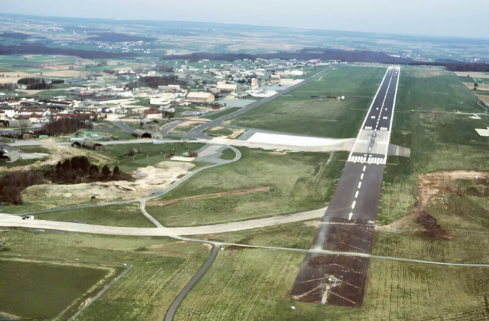
Bitburg AFB Aerial View
Visions and Inner Conflict
As the orange blotter’s patterns swirled in his vision, Biff drifted into a state that was both freeing and frightening. Each flash of color drew hidden thoughts into the open, and the plain barracks seemed to shift into a tight, confusing space where memories mixed with fantasies.Voices echoed in his mind: quiet reminders of friendship mixed with …