

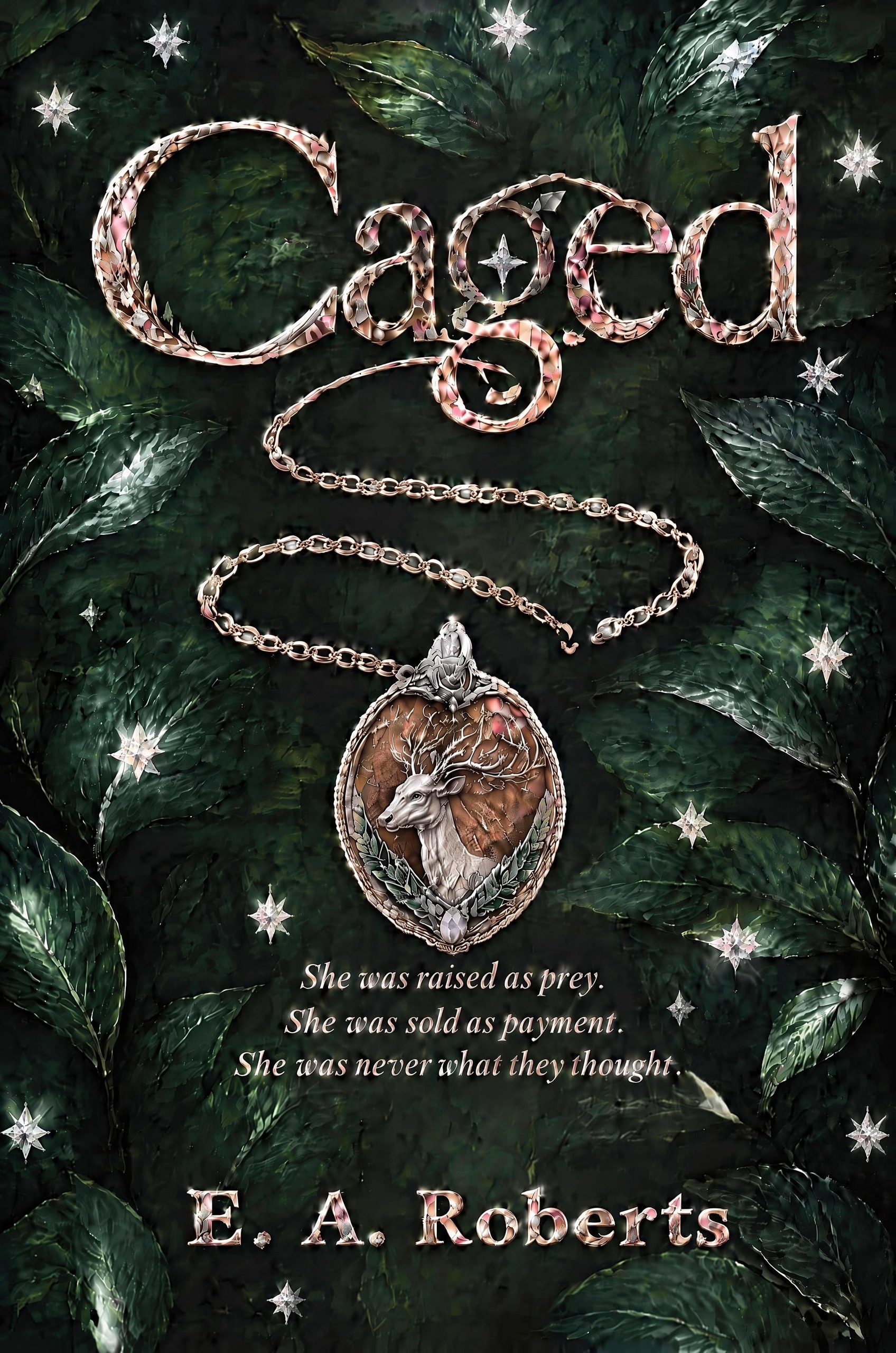
Caged
She was raised as prey. She was sold as payment. She was never what they thought.
by elizabeth roberts
She was raised as mutt. She was treated as prey. She was sold for debt. Isolde Penelope Grey has spent her entire life at the bottom of a wolf pack's hierarchy, scrubbing floors and taking beatings. The only thing that keeps her going is the countdown to her eighteenth birthday, when she can finally run. But when she fights back against the pack's bullies, her so-called Alpha doesn't punish her. He trades her to vampires to cover his gambling debts. And the blood house she ends up in is not just a cage — it is a revelation. Because Poppy is more than she seems. Now she must escape a world that wants to own her, drain her, or trade her, while discovering powers she never knew existed. But the dark forces that took her once are not done with her yet. Caged is a dark urban fantasy about survival, rage, and the terrifying cost of becoming who you really are.
- Fantasy
- Paranormal
- Urban Fantasy
- Dark Fantasy
- Shifter
- Vampire
Chapter 1
The Alpha liked me to serve his meetings for the same reason he liked the grandfather clock in the corner of his study. I was useful, I was quiet, and nobody ever had to think about me.
That was what Ms. Crawford told me the first time she sent me in with the coffee service, when I was fourteen and still learning how to carry a full silver tray without rattling the cups. The other girls were shifters. They had shifter ears, and shifter tongues, and families in the pack who would be very interested in anything they happened to overhear. I had human ears and no family worth speaking of. Whatever I heard in that room stayed in that room, because there was nobody I could tell and nobody who would have believed me.
So on the first Thursday of every month, I stood in the corner of the Alpha’s study beside the drinks cart in my best uniform and the low-heeled pumps that pinched my toes, and I waited to be needed. The cart held two silver pots, one of coffee and one of tea, a pitcher of cream, a bowl of sugar cubes with tiny silver tongs, and a plate of Lena’s shortbread that nobody was allowed to touch until the Alpha had taken the first piece.
The rules were simple. Eyes down. Cups never empty. Remember who takes cream, who takes sugar, and who takes tea instead, and never, ever ask. Never speak unless spoken to, and if spoken to, answer with as few words as possible. Never be seen arriving and never be seen leaving. If someone said something cruel, I had not heard it. If someone said something important, I had not heard that either. The first rule was the one I broke the most. I had the scars to prove it. In the Alpha’s study, though, I bit my tongue until it bled, because the punishment for talking back in that room was not the cane. It was losing school, and school was my only way out.
The council that month was the usual. Alpha Browning sat behind his enormous desk with his sons on either side of him like a pair of bookends. The pack elders filled the leather chairs, old Mr. Hollis with his cane and Mrs. Abernathy with her knitting that she never actually knitted. I had a theory that it was the same scarf she’d been not-knitting since before I was born, and that when she finally finished it, the world would end. And by the window, standing the way he always stood, with his back half turned to the room, was the beta. My father.
He didn’t look at me. He never looked at me in that room. I had stopped waiting for it a long time ago, but some small, stupid part of me still checked every single time.
I poured the Alpha’s coffee first, black, then his sons’, then the elders’ in order of rank. My hand was steady on the silver pot. I had practiced that until my wrists ached. A shaking hand meant a spill, a spill meant a stain, and a stain meant the cane.
“The rail tolls are down again,” Thomas was saying. “Third month running. The Hudson pack is routing their freight south through the valley instead of through us.”
Freight. That was the polite word for it. Everyone in Pine Crossing knew what really rode out of town in the pack’s sealed boxcars, and it wasn’t lumber. The lab out past the old quarry, the one everybody pretended was a sawmill, ran day and night, and the pack’s product went out on the rails to every city on the line. Nobody said the word drugs in the Alpha’s study. Nobody had to.
“Then we raise the tolls on what’s left,” the Alpha said.
“If we raise them, we lose what’s left.”
The Alpha waved that away the way he waved away most things that he didn’t like. I moved to Mr. Hollis and topped off his tea, two sugars, a splash of cream. He grunted without looking up. I stepped back to my corner and became furniture again.
They talked about the roads that had washed out in the spring and still weren’t repaired. They talked about a dispute over hunting rights along the northern ridge. They talked about money, and money, and money. I didn’t understand most of it, but I watched the Alpha’s heavy thumb rhythmically dig into the mahogany desk until the varnish creaked, his jaw locked so hard the tendon in his cheek pulsed like a trapped insect every time Thomas or Abernathy named a figure. For a man who owned half the valley, he kept dragging a hand over his mouth and sweating through his collar like someone waiting for the bailiff’s knock.
Near the end, Mrs. Abernathy cleared her throat. “There is one more thing. I had a letter from my cousin in the Great Lakes territory. Two more of their young ones are gone. A boy of sixteen and a girl of seventeen, both taken within a month of each other. That makes five this year that they know of.”
The room went quiet. I kept my eyes on the carpet.
“Runaways,” William said.
“Shifter children don’t run from their packs,” Mrs. Abernathy said sharply. “Not that young. They’d die out there and they know it.”
“Then it’s their problem,” the Alpha said. “Great Lakes can look after their own. We have enough to worry about here.”
“My cousin says there are rumors of houses in the cities. Places where the young ones are sold to—”
“Rumors.” The Alpha set his cup down hard enough to rattle the saucer. “I won’t have this council wasting time on rumors, Margaret. Poppy. More coffee.”
I moved. I poured. Nobody looked at me, and Mrs. Abernathy didn’t say anything else.
But I noticed things. I noticed that the Alpha’s hand wasn’t quite steady when he set his cup down. I noticed that Thomas and William were very careful not to look at each other. And I noticed that my father, at the window, had gone completely still, the way wolves do when they hear something in the brush.
There were nights, a few times a year, when the trucks that came back up the quarry road from the city didn’t sound empty. When the guards on the late shift were told to stay on the other side of the house, and to keep their mouths shut, and the staff were told the same. I had heard crying once, through the attic window, in the middle of the night. Muffled, and then gone. In the morning, the trucks were gone too, and nobody said a word about it.
And the pack didn’t do any of it alone. Nobody ever said that out loud either, but I had poured enough coffee to piece it together. The pack made the product and moved it, and a vampire house in the city sold it, in their clubs and their blood houses and on their streets, where wolves couldn’t go. The vampires paid the pack in money and protection and favors. The pack paid the vampires in product, and in safe passage on the rails, and sometimes in other things. The Alpha called them “our partners” on the rare occasions he had to call them anything. Mostly he just called them the House, the way you’d say the bank, or the weather.
The partnership made both sides rich. It also meant the Alpha was never really the most powerful person in his own study, and everyone in the room knew it, including him.
When the meeting was over, they filed out one by one, and I collected the cups and wiped the rings off the desk and emptied the ashtray that the Alpha thought no one knew about. My father was the last to leave. He paused in the doorway, and for one breathless second I thought he might turn around.
He didn’t. The door clicked shut behind him, and I went back to stacking saucers.
Pack house staff weren’t allowed to wear jewelry on duty, except for a simple necklace and a set of earrings. It was the only rule in the whole house that suited me, because I couldn’t have followed any other version of it. My necklace and my earrings did not come off. The locket hung on a fine chain just below my collarbone, an oval no bigger than my thumbnail made of a strange metal that wasn’t quite silver. In the right light it blushed pink, like the inside of a shell, and it was always warm, even when I wasn’t. A thin sliver of dark polished wood was set into the face of it in a curling pattern that looked almost like a vine. I had never been able to open it. There was no hinge that I could find and no clasp on the chain, just one smooth unbroken loop, as if it had been made around my neck. Dad said I had been wearing it the day I arrived. When I was eleven, Madison tried to cut it off with the kitchen shears and snapped the blade instead. Ms. Crawford had once decided it was far too fine for a servant and spent ten minutes pulling at it before she gave up, sniffed, and declared it cheap pewter that wasn’t worth the trouble. I let her think so.
The earrings were the same. Two tiny stones, so dark they looked black until the light caught them and turned them the deep color of old wine. They had no backs that I could find and no way to take them out. The one time I tried to pry one loose, my whole ear burned so hot I thought it would blister, and I never tried again. Nobody else ever looked at them twice. They were just part of me, like the white streak in my hair and my too-big eyes, and the pack had long ago decided that nothing about me was worth a second look.
The only other thing I wore that I couldn’t take off was the pack mark. Every member of the pack had one, the pack crest on the inside of the right wrist, no bigger than a coin. It wasn’t optional. Pack law said every member had to be branded, because the brand wasn’t just ink. It was part of the pack magic, the thread that tied each of us into the whole, the thing that let the Alpha feel his people and let the pack run as one. I got mine the week I arrived, the day my father stood up in front of the Alpha and claimed me as his. I was three. I don’t remember it, but I’ve been told I screamed the whole time.
Most days I forgot it was there. I never felt the pack magic the way the others did, that warm hum they talked about on full moon nights. Mine just sat there on my wrist like a stamp on a package. But it was the reason I couldn’t simply walk out the door. Until the Alpha released me, the mark said I was his. Eighteen was supposed to change that. Stay and keep the mark, or ask to be released and leave for good. That was the law, and the Alpha had promised me that choice since I was small.
I had a feeling, a cold, quiet certainty that sat in my stomach like a stone, that nobody was ever going to offer that choice to me. So I wasn’t going to wait to be asked.
* * *
The meetings were all like that, more or less. Some months it was the council. Some months it was traders from the city, or a visiting alpha from one of the smaller packs to the west, come to negotiate over a marriage or a border or a debt. I poured coffee for men who called me girl and tea for women who didn’t call me anything at all. I learned that the Alpha drank more when the news was bad, and that the news was bad more often than it used to be. I learned that the trader from Albany always tipped his glass toward me when he wanted more instead of asking, and that the bear shifter who came down from the ridge every spring would leave a wrapped candy on the corner of the drinks cart when he thought nobody was watching. I never found out his name. I never ate the candy, either. I kept them in a tin under my bed, all eleven of them, because they were the only gifts anyone had given me in years.
That fall, William started watching me.
I noticed it at the October council first. I was pouring his tea, milk first, the way he liked it, and his nostrils flared. Just once, the way a wolf’s do when the wind changes. He turned his head and looked at me, really looked, which nobody in that room ever did. His eyes flickered yellow and back. Then he frowned, as if I were a word he’d forgotten the meaning of, and went back to his papers.
After that it kept happening. At every meeting, I could feel his eyes on me while I moved around the room. Twice I came out of a guest room with my cart and found him standing at the end of the hall, doing nothing, just watching me with that same frown. Once he stopped me on the back stairs and stood there breathing in, slow and deep, his head tilted like a dog hearing a whistle too high for people.
“What did you do?” he asked.
“Nothing, sir.”
“Something’s different.” His lip curled back from his teeth, not quite a snarl. “You smell different.”
“I changed soap, sir,” I said, which was a lie, and also the stupidest thing I had ever said out loud.
He stared at me for a long moment. Then he pushed past me down the stairs and didn’t say another word.
The blood dropped out of my head so fast my vision went gray at the edges, and bile surged up into the back of my throat, hot and sour. My lungs seized, refusing to draw air until my ribs ached. Two of the cuff links under my floorboard had come out of William’s dresser, and the money clip, and more cash than I wanted to count. I stopped cleaning his rooms myself and traded with Daisy, who thought I’d lost my mind. I didn’t take so much as a penny for weeks. I lay awake listening for his footsteps on the attic stairs.
He never came. He just kept watching, and frowning, and breathing in when I walked past, like a wolf circling something in the grass that it couldn’t identify and didn’t trust.
Other things were strange that fall too, though I didn’t put any of it together. The ferns I watered in the front hall turned brown and curled up no matter what Ms. Crawford did to them, while weeds forced their way up through the gravel under my attic window in the middle of November. Lena’s kitchen cat, who had slept on my feet every winter for years, started hissing at me and refusing to stay in a room I was in. My earrings itched constantly, a deep hot itch inside the bone of my ears that no amount of scratching could reach. And my locket was warm. It had always been warm, but now it was warm all the time, like something alive. Even my eyes were changing. There had always been a little starburst of pale green and gold in the very center of the blue, so faint you had to be close to see it. That fall, every time I caught myself in the cracked mirror over my sink, it seemed a little brighter, spreading out from the pupil like sunlight through ice.
* * *
I wasn’t the only one who noticed William watching me.
His mate, Celia, noticed too. Celia Browning was the kind of woman who noticed everything that happened under her roof, down to the last teaspoon. She was the cleverest person in the pack house, and probably in Pine Crossing. Everyone knew it, even the Alpha, who asked her opinion on the ledgers when he thought nobody was watching. She sat at his right hand at every council dinner, and she knew exactly how much a servant who poured the coffee in that study might hear.
And something about me had always bothered her. I could tell. Not the way I bothered the others, all hackles and shoves. Celia watched me the way a scholar looks at a sum that won’t come out right. I was the beta’s daughter, they said, by some woman from the city. Plenty of half-bloods in the world never shifted. But even they had something. A little extra speed, a nose a bit too sharp, eyes that flashed when they were angry. Some echo of the wolf in the blood. I had none of it. Not a hint. Not one single thing in me that said wolf. And I knew, without knowing how I knew, that Celia had spent years quietly turning that over in her clever mind, trying to make it add up, and failing.
She noticed the rest of it, too. I know she did. She was the only one who ever seemed to. That fall, when the guards started shoving me in the halls instead of just ignoring me, I saw Celia stop on the landing above and watch, her head tilted, her lips slightly parted, like she’d heard a wrong note in a song. When Ms. Crawford started finding new reasons for the cane, Celia looked from her to me and back with a small frown. Once, after James had left me on the pantry floor, I saw her in the doorway, looking at the blood on the tiles. Wolves didn’t do this to children. Every wolf knew that. Celia knew it better than anyone. She opened her mouth as if she was about to say something to someone.
Then she closed it again, and smoothed her skirt, and walked away.
I watched her do that a dozen times over those months. Notice. Frown. Wave it off. Whatever she saw growing in that house, whatever was turning mild dislike into something you could get hurt by, she had decided it wasn’t her business. Or she had decided I wasn’t worth it.
I saw it too, of course. I wasn’t stupid. It was my skin they were taking it out of. I could feel the whole house tilting against me, a little more every week, and I didn’t understand it, and nobody would tell me why. I lay awake going over everything I’d done, every smart remark, every eye-roll, every stolen bill, trying to find the thing that had changed. The thing that had made it my fault. I never found it.
So I did the only thing I knew how to do with something I didn’t understand: I let it turn into fury. Celia had earned it by seeing everything and walking away. So had Ms. Crawford, the guards, Stephanie, and my father—every wolf in Pine Crossing who would have died to protect any other kid in town while refusing to cross the hall for me. Still caring made me sick with myself, but mostly the rage came from failing to make any of it add up. I was a kid with a mop and a bad mouth, and the whole world had decided to hate me without even doing me the courtesy of saying why.
She found me in the upstairs linen closet the week after the stairs, folding towels. She didn’t shut the door. She just leaned in the doorway, pleasant as anything, and then she picked up a pillowcase from the basket and started folding it alongside me, which no Browning had done in my entire life.
“You’ve been serving in the study a long time now,” she said. “Since you were fourteen?”
“Yes, ma’am.”
“You must hear all sorts of things in there.”
“I pour the coffee, ma’am.”
“Of course you do.” She smoothed the pillowcase flat with the side of her hand. “It must be terribly dull. The rail tolls. The quarry. All those numbers.” She folded it in half, and in half again. “I’d imagine anyone would be tempted to talk about it with someone. Just to have something to say.”
“Nobody talks to me, ma’am.”
“No,” she agreed softly. “I suppose they don’t.”
She set the pillowcase on the shelf, perfectly square, and turned to go. I let out a breath, and my eyes rolled up toward the ceiling all on their own. I had been rolling my eyes at Celia Browning for years, behind her back, behind doors, behind the stacks of linens I carried past her in the hall. It was practically a reflex.
This time she turned back from the doorway at exactly the wrong moment, and she saw it.
She didn’t say anything. She didn’t have to. She just looked at me for one long moment, and something in her face went still and careful, like someone marking a page in a book to come back to later. Then she smiled, the same pleasant smile, and walked away down the hall.
Except it wasn’t just my insolence she took in. In that narrow doorway, framed against the dark hall, her gaze dropped from my face to the hollow of my throat where the locket rested, then flicked to the dark studs in my ears. Her nostrils twitched once, faint and precise, testing the air between us like she was balancing a column in a ledger. She wasn’t just looking at an impudent maid with a bad attitude. Standing that close, she was looking at a sum that refused to add up—and seeing, perhaps for the very first time, something that wasn’t a wolf’s bastard at all.
It took me until that night, lying awake in the attic, to work out what she had really been asking me. I had been standing in the corner of the study when Thomas complained that the Hudson pack had known about a shipment before it left the yard. I had been there when Mrs. Abernathy said the Great Lakes were asking questions in all the wrong places. Somebody was talking. And Celia Browning, who had never once in her life wondered what I did all day, had just spent ten minutes folding linens with me.
I knew the law. Everybody in Pine Crossing knew it. Pack law was very old and very simple about informers. They went up the quarry road, and they didn’t come back down.
* * *
She was careful. I’ll give her that.
Two days later, I came home from school and knew the moment I opened my door that someone had been in my room. There was nothing you could have pointed to. Nothing torn, nothing thrown. My quilts were folded the way I folded them, almost. My schoolbooks were stacked in the right order, but with the spines turned out instead of in. My few clothes hung in the wardrobe in the right order too, but every pocket had been smoothed flat, as if someone had turned it out and put it back. On the inside of the wardrobe door, across the pencil marks of my countdown, there was the faintest smudge of a thumb.
Daisy told me later that Celia had come down to the staff dining room that morning and asked her, very sweetly, who Poppy talked to. Whether Poppy ever got letters. Whether Poppy ever went anywhere she shouldn’t, or came back from town smelling like somebody who wasn’t pack. Daisy, who was a lot of things but not a snitch, said she didn’t know anything about it. I owed her more for that than I could ever repay.
The tin under the bed sat a finger’s width to the left of where I always left it. I opened it. All eleven of the bear shifter’s candies were still there. But someone had taken them out, and looked at them, and put them back in a neat little row, which they had never been in in their lives.
One thing was missing. A note that had come tucked into a sack of textbooks left on the kitchen step, the one that said *Chapters 4 through 9. Answers in the back of the green one, but do the work first. —H.* It had been folded inside my algebra book. Now it was gone.
It was nothing. A homework note. But Celia had taken it, and I knew she would be quietly finding out who H was.
I knelt down on the floor beside the tin and put my hand flat on the boards, right on top of the loose one.
It hadn’t moved. The line of dust along its edge was still unbroken. She had knelt right here, inches from everything I owned in the world, and she had never once thought to lift it.
I should have been relieved. I was, for about a minute. Then I sat there in the cold with my hand pressed against the floor, and it frightened me more than a wrecked room ever could have. A mess would have meant she was angry. This meant she was patient.
I hadn’t told anyone anything. I didn’t even know who I would have told. But somebody in the pack was talking, and Celia had decided it might be me, and in Pine Crossing that was all the proof anyone ever needed.
I couldn’t wait for the date on my birth certificate anymore. I needed a better plan. And I needed it fast.
* * *
I was never at the pack gatherings, though. Not the full moon runs, not the solstice bonfires, not the long summer cookouts down by the lake where the whole pack ate and sang and the little ones fell asleep in piles on the grass. Every pack had a few members who couldn’t shift. Old Mr. Hollis had lost his wolf in the Wars. Two of the Abernathy grandkids were half-human and never would. They all still came. They sat at the long tables with everybody else, and somebody always saved them a plate.
Not me. Whenever there was a gathering, there was suddenly an errand. A package for the rail yard. A message for the ridge. A crate of something heavy to drag down to the hotel. I spent every full moon of my life walking through the dark with a sealed envelope in my coat while the howling went up behind me.
The funny thing was, the Alpha trusted me. He trusted me more than he trusted most of his own wolves. I carried his letters, his messages, his little sealed packets to men in town whose names I wasn’t supposed to know. I had never once opened one, never once been late, never once given him a single reason to doubt me. He knew it, too. He kept me close, where he could use me. Nobody else in that house would have been sent to the quarry road with a message for the night shift.
And in all those years, he never once looked at what his pack was doing to me. He saw the bruises. He had to. He just looked through them, the same way he looked through the furniture.
I filed all of it away. Who drank too much and talked when they did. Who owed the Alpha money, and who he owed. Which nights the trucks went down the quarry road, and how long they took to come back. Which of the guards took the long way around the east wing on his rounds, and how many minutes that left the kitchen door unwatched. I didn’t know yet what any of it was good for. I just knew that someday I was going to get out of this house, and when I did, I wasn’t going to do it stupid. My temper was a match. I was learning, slowly, to be the kind of person who knew exactly where to drop it.
Books were the other thing I stole. I took them whenever I could, from the guest rooms, from the boxes of castoffs in the pack house basement, from the Alpha’s own library on nights when the house was dark and I was supposed to be asleep. He had shelves and shelves of them that nobody ever opened, old leather histories and law books and atlases, and a whole row on the fae and the witch covens and the Emergence that looked like they hadn’t been touched since before I was born. I read them under my quilts by the light of a stolen candle stub until my eyes burned, and then I put them back exactly where I’d found them, dust and all. The ones nobody would miss, I kept, under the floorboard with everything else.
Every time the Alpha pulled me out of school to punish me, sometimes for a week and once for most of a semester, I kept learning anyway. I taught myself the algebra I was missing out of a textbook I’d lifted from a guest’s kid. I read the pack law on membership and release until I could recite it, every clause about the choice at eighteen and every loophole they could use to take it away. I memorized the train routes out of Pine Crossing from an old timetable, and the names of the cities at the ends of them. If they wouldn’t let me learn, I would steal that too.
I wasn’t entirely alone in it, though I never said her name out loud in the pack house. Ms. Hale taught history at the high school, and three nights a week she worked the front desk at the Pinewood Hotel downtown, because a teacher’s pay in Pine Crossing didn’t stretch far. She wasn’t pack. She’d married into the town a long time ago, and her husband had died, and she’d stayed anyway, for reasons nobody understood. She was small and grey-haired and wore cardigans with the elbows patched, and she was the only adult I had ever seen look straight at Kayla in the hallway and say, “That’s enough.”
The first time the Alpha pulled me out of school for a whole month, a paper sack turned up on the back step of the pack house kitchen with my name on it. Lena handed it to me without a word. Inside were three textbooks, a stack of worksheets, and a note in neat, slanting handwriting outlining the chapters I was to cover and warning me to finish the problem sets before checking the keys in the back, signed simply with an H.
After that, it happened every time. Sometimes it was school materials. Sometimes it was books that had nothing to do with school at all: a history of the fae courts, a collection of maps, a battered paperback about a girl who disguised herself as a boy and ran away to sea. Once it was a library card for the public library in the city, two hundred miles down the rail line, in a name that wasn’t mine. I kept that under the floorboard too.
I never knew how she always knew. I never asked. In Pine Crossing, asking was how people got hurt.
And I learned about poker night.
Poker night was different. Poker night happened every Saturday, after dark, and not at the pack house at all. It happened downtown, at the Pinewood Hotel, the old brick hotel across from the train station that the pack had owned since the railroad first came through. The Alpha kept a private card room on the top floor, with heavy velvet curtains and a round table covered in green felt. The guests at poker night were not pack, and they were not the kind of visitors who were lined up for on the front walk. The Alpha didn’t want them in his house. They arrived after sunset, they left before dawn, and what happened in that room stayed at the hotel.
I had never served poker night. That was Daisy’s job, and Daisy was very proud of it, because the guests tipped. But the week before Thanksgiving, Daisy came down with a fever, and Ms. Crawford found me scrubbing the guard barracks and looked at me for a long moment with her lips pressed together into a thin line.
“You will serve tonight, at the hotel,” she said. “And you will listen to me very carefully, because I will only say this once.”
I sat back on my heels and waited, sponge dripping.
“The Alpha’s guests tonight are not shifters. Some of them are not anything you have met before. You will not stare. You will not speak. You will not let anyone touch you if you can avoid it without causing offense, and if you cannot avoid it, you will not react.” She leaned closer. “And whatever happens, you will not bleed. Do you understand me?”
I didn’t. Not really. But I nodded anyway, because that was what you did.
* * *
One of the guards drove me downtown in the back of a pack truck, still in my uniform, with my good shoes in a paper bag on my lap. The hotel’s night manager, a tired-looking cousin of somebody’s cousin, took me up the service elevator without a word.
The card room smelled of cigar smoke and old leather and something sweet and heavy that I couldn’t name. Five people sat around the green table when I came in with the tray. The Alpha, his collar already loosened. A thin man from the city with rings on every finger, who Ms. Crawford had called a banker. A witch with iron-gray hair and spectacles on a chain, who smelled faintly of sage. The bear shifter from the ridge, who saw me come in and gave me the smallest nod.
And a woman I had never seen before.
She was the kind of beautiful that made you forget what you were doing. Dark hair piled up on her head in a way that looked effortless and probably took hours. A deep green dress that wasn’t like anything Luna Marie owned. Skin so pale it nearly glowed in the low lamplight, and long, elegant fingers that turned her cards over with a lazy kind of grace. She smelled like lavender and, underneath that, something cold and metallic, like the air right before snow.
“Estelle,” the Alpha said, gesturing expansively with his glass, “allow me to introduce the finest whiskey north of the city. Girl, pour.”
I poured. I went around the table in the order Ms. Crawford had drilled into me. The Alpha, the banker, the witch, the bear. When I reached the woman, she put two fingers over the top of her glass without looking up.
“Wine,” she said. “Red. The oldest you have.”
I fetched it from the hotel bar downstairs. I poured it. She lifted the glass and breathed in the scent of it without drinking, and her eyes flicked up to my face for just a moment. They were the darkest eyes I had ever seen. I looked down at my shoes so fast I nearly lost my balance.
The game went on for hours. I didn’t understand poker, but I understood the Alpha. I understood his voice getting louder and his laugh getting harder and the way he signed little slips of paper and pushed them into the middle of the table when he ran out of chips. I understood that the little slips kept ending up in front of Estelle.
“You’re having a dreadful night, Henry,” she said around midnight, sweetly, stacking another slip on top of the others.
“The night is young.”
“It is,” she agreed. “I am not.”
The witch laughed into her whiskey. The banker didn’t laugh at all.
I refilled glasses. I emptied the ashtray. I rode the creaking service elevator down to the hotel kitchen for a platter of cold sandwiches when the Alpha got hungry, then back down again when the banker decided he wanted something hot, then down a third time because the bear shifter quietly asked if there was any pie left. Estelle never ate anything at all. I stood in the corner and made myself as small as I could, and somewhere around one in the morning, I realized that Estelle was watching me.
Not the way the guards watched me, or the way James did. It was stranger than that. Quieter. Every time I moved, her head turned just slightly to follow, the way a cat’s does when it hears something in the walls. When I leaned over to fill the Alpha’s glass, she breathed in slowly through her nose, and I felt the hair on my arms stand up.
“Henry,” she said, “who is your little shadow?”
The Alpha didn’t even glance at me. “The beta’s bastard. Some witch he rutted with left her on our doorstep. She can’t shift.” He took a long swallow of whiskey, and then, as if it had only just occurred to him, he added, “But she’s smart. Obedient. Discreet. One of my more trusted servants, actually.”
I nearly dropped the bottle. In all my years in that house, the Alpha had never said one good word about me, not to my face and not where I could hear it. Smart. Trusted. For one stupid, treacherous second, something warm bloomed in my chest, and I hated myself for it, because I knew exactly what he’d left out. Obedient meant I didn’t talk back in his study. Discreet meant I never opened his envelopes. Trusted meant useful. He was talking about me the way he talked about a good truck, or a dog that came when it was called. I stared at the carpet and imagined pouring the rest of the whiskey into his lap.
It was only much later that I understood what he’d really done. He hadn’t been praising me. Without knowing it, he’d been listing my selling points. Estelle had leaned back slightly, her gaze drifting down my throat to my wrists with the detached, measuring appraisal of a horse buyer checking teeth at an auction. Her painted red lips had parted, just enough to catch the dim lamplight, her dark eyes glittering as she mentally pinned a price tag to my skin.
“Is she?” Estelle tilted her head. “Come here, child.”
I looked at the Alpha. He waved me forward impatiently. I went.
Up close she smelled even more strongly of lavender, and the cold underneath it was stronger too. She didn’t touch me. She just looked, starting at my shoes and slowly working her way up until her gaze stopped at my throat.
“What a pretty necklace,” she said softly. “Wherever did a pack-house maid get something like that?”
My hand went to the locket before I could stop it. It was warm under my fingers, warmer than usual. “I’ve always had it, ma’am.”
“Always?”
“It doesn’t come off.” The words were out before I could stop them. “Believe me, ma’am, people have tried.”
The Alpha’s head snapped toward me. Out of the corner of my eye, I saw the bear shifter cough into his fist to hide what might have been a laugh.
Something flickered across her face, too fast for me to read. Then she smiled, slow and pleased, and reached out one long finger toward the locket.
I stepped back. I didn’t mean to. My feet just moved. The Alpha made an irritated noise in his throat, and I froze, waiting for the blow.
But Estelle only laughed, a low, amused sound, and lowered her hand. “No, no, Henry, leave her. I startled her. She’s right to be careful.” She picked up her cards again. “I like careful things. They last longer.”
I went back to my corner with my heart hammering so hard I could hear it.
* * *
It happened an hour later, on the last hand.
The Alpha had pushed everything he had left into the middle of the table, and two more slips of paper on top of that. The banker had folded. The witch had folded. The bear shifter had folded long ago and was watching the whole thing with his arms crossed and a frown on his face.
Estelle turned over her cards one by one. I didn’t know what they meant, but I knew what the Alpha’s face meant when he saw them.
He slammed his fist down on the table. The glasses jumped. His whiskey tumbler toppled off the edge, and I lunged for it on instinct and missed, and it shattered on the hearthstones at my feet.
“Clean that up,” he snarled.
I dropped to my knees and started gathering the pieces into my apron as fast as I could. My hands were shaking. I wasn’t careful. One of the shards slid sideways under my palm and bit deep, and I hissed and jerked my hand back.
A bright bead of red welled up in the center of my palm, then another, then a thin line of it ran down my wrist.
The room went completely still.
I didn’t understand, at first. I just knelt there, staring at my hand, with Ms. Crawford’s voice in my head. Whatever happens, you will not bleed. Then I looked up and saw that the witch had gone pale, and the banker had pushed his chair back from the table, and the bear shifter had half risen out of his seat.
And Estelle was looking at me. Her eyes had gone black. Not dark. Black, all the way across, like ink spilled over the whites.
She took a long, slow breath through her nose and closed those terrible eyes, and when she opened them again, they were almost normal.
“Henry,” she said, and her voice was very soft. “Your girl is hurt.”
“She’s fine.” The Alpha sounded wary for the first time all night. “She heals.”
“Does she.” Estelle rose from her chair in one smooth movement and crossed the room, and then she was crouching in front of me in her beautiful green dress among the broken glass. She held out her hand, palm up. Waiting.
I didn’t want to give it to her. Every instinct I had was screaming at me not to. But the Alpha was watching, and everyone was watching, and I had never in my life been allowed to say no.
I put my bleeding hand in hers. Her skin was cold, so cold that I gasped.
She turned my palm toward the lamplight and studied the cut for a long moment. Her cold thumb brushed over the pack mark on the inside of my wrist, once, as if she were reading it. Then she lifted it slowly toward her face, and I squeezed my eyes shut.
She only breathed in. One long, deep breath, the way you’d smell a flower. I heard her let it out again in something that was almost a sigh.
When I opened my eyes, she was folding a white silk handkerchief over my palm, pressing it closed with her cold fingers.
“Keep it,” she said. “Silk is good for cuts.” She looked at me for another long moment, at my face, at the white streak in my hair, into my eyes, where the green and gold always caught the light, and at the locket resting against my collarbone. Then she rose and turned back toward the table, and the spell, whatever it was, broke.
“Go home, child,” the Alpha said roughly. “Someone else will finish this.”
I didn’t need to be told twice. I gathered my apron full of glass and fled for the door. But I was slow, and I was clumsy with my hand wrapped in silk, and so I was still close enough to hear what Estelle said next, in her low, pleasant voice, as I pulled the door shut behind me.
“About those markers, Henry. I’m not an unreasonable woman. And I happen to have a very dear friend in the city who collects rare things.”
The latch clicked. I didn’t hear the Alpha’s answer.
I threw the glass away and went down the back stairs to the lobby, because the service elevator was stuck again. Ms. Hale was behind the front desk with her cardigan buttoned wrong and a book open face-down beside the register. She took one look at my hand and came around the counter.
She didn’t ask what had happened. She sat me down on the bench by the door, cleaned the cut with something from a first aid kit under the desk that stung like fire, and wrapped it properly in gauze. Then she looked at the white silk handkerchief I was still clutching, and her mouth went very thin.
“Who gave you that?” she asked quietly.
“A lady at the game. Estelle.”
Ms. Hale was silent for a long moment. Then she reached under the desk and pressed a book into my good hand. It was thick and old, with a cracked blue cover, and the title on the spine was too worn to read.
“The section on the old vampire houses starts on page two hundred and twelve,” she said. “Read it tonight. Don’t let anyone see it.” She squeezed my fingers. “And Poppy. Be careful.”
I wanted to ask her what she meant. But the guard was already honking the truck horn outside, so I tucked the book under my coat and went.
I rode back to the pack house in the back of the truck with my hand wrapped in gauze and the silk handkerchief balled in my fist, and climbed the stairs to my cold little room under the eaves. I put the handkerchief in the tin under my bed, in with the bear shifter’s candies, because it was the nicest thing anyone had given me since them, and I didn’t know what else to do with it.
Then I slid the tin aside, pried up the loose floorboard underneath it with a butter knife, and added the poker chip, the folded fifty and Ms. Hale’s blue book.
I’d palmed the chip off the floor while I was picking up the glass. Nobody had noticed. Nobody ever noticed the maid. It was a heavy black one with a gold rim, the kind the Alpha’s guests tossed around like pennies, and the banker had told the table it was worth a hundred dollars at any card house in the city. The fifty had come out of the banker’s coat while I refilled his whiskey around eleven. He hadn’t noticed either.
It went into the hole with everything else, and everything else was a lot.
Two years of wages, the little that was left after the pack house took its cut for my room and my meals, folded tight and rolled in rubber bands. But my wages were the smallest part of it. The rest had come from the rooms I cleaned, one careful piece at a time. Wolves were careless with their things. They shifted on a whim and left whatever they’d been wearing wherever it fell, jeans on the bathroom floor with wallets still in the pockets, rings and watches tossed on dressers, cash stuffed in jackets and forgotten. The guards in the barracks were the worst, and the Alpha’s sons were nearly as bad. Half of them couldn’t have told you what they owned, let alone what was missing. I never took much from anyone, never more than a bill or two at a time, never anything they’d look for. And not only from rooms. I had quick hands, quicker than anyone in that house knew. I’d taught myself on the guards’ coats in the hall closet when I was small, then on the guests at big dinners, one brush past a crowded doorway at a time. A wallet lifted, a bill peeled off, the wallet back in the pocket before its owner finished his sentence. A watch unbuckled while I leaned in to refill a glass. Nobody watches the maid’s hands. I had built half of everything under that floorboard on that one simple fact. Mostly they never noticed. When they did, they blamed each other, or the laundry, or the fact that they’d been drunk. Coins from under couch cushions. Rings left on bathroom sinks. Cufflinks from the guest wing, a gold one with a little green stone and a pair of silver ones engraved with somebody’s initials. Earrings that had rolled under beds, and their twins, which hadn’t rolled anywhere until I helped them. A man’s gold watch that a visiting alpha had blamed on his own driver. A thin bracelet set with tiny diamonds that I’d found tangled in the sheets two summers ago and waited three months to be sure nobody had reported missing. A strand of real pearls. A brooch shaped like a dragonfly with sapphire wings.
All of it was wrapped in an old pillowcase and packed into the space between the joists, along with the few stolen books thin enough to fit, along with a thick envelope of bills that I’d stopped bothering to count past a certain point because counting it made my hands shake. I had done the math once, late at night, by the light of the window. If I was careful, and I was always careful, it would be enough for a train ticket to anywhere I wanted to go, and a place to live when I got there, and a year or more to figure out what came next.
The tin sat right on top of the loose board for anybody who came snooping. That was the point. It had already fooled Celia Browning.
Nobody knew my real birthday, least of all me. By the guess on my birth certificate, I was a little under two years from eighteen, from the day I wouldn’t need the Alpha’s travel papers to buy that ticket anymore. I had meant to wait. After Celia, I wasn’t sure I could afford to. I had a stash, and I was learning every crack in this house. All I needed was a way out of Pine Crossing that didn’t go through the Alpha’s front door.
And then there was James.
There was something wrong with James. Not just mean. Plenty of people in the pack house were mean. Something missing.
Wolves are hot-blooded creatures. They feel everything too much, all at once, and it shows: the hackles, the flashing eyes, the growls that come up out of their chests before they can stop them. Even the cruelest wolf I ever knew was cruel the way a storm is, loud and hot and over. James wasn’t like that. James was huge, a head and a half taller than me and nearly twice as broad, with big, soft-looking hands that were not soft at all. Most days his face was a blank, pleasant mask, and his smile never went anywhere near his eyes. The only time I ever saw anything real come into them was when someone was hurting. Then they lit up. Not hot, like a wolf’s. Cold and bright and hungry, the way other people look at a meal. He didn’t lose his temper when he hurt people. He didn’t need a temper. He just liked it. He took his time with it, and he made it last, and afterward he was always in a better mood.
And he was always there. Wherever I was working, sooner or later James would be leaning in the doorway, watching. He never seemed to arrive. He was just suddenly there, filling the frame, so quiet I’d turn around with a bucket in my hands and nearly drop it. He’d run one thick finger along a mantel I’d just dusted and hold it up to the light. He’d lift the corner of a bed I’d just made and let the sheet fall crooked. He’d tip over the bucket of ash I’d just carried down three flights of stairs, look at the gray mess spreading across the floor, and say, very kindly, “Oh dear. Ms. Crawford won’t like that.”
Nothing I did was ever right. A streak on a window. A fold in a towel. A cup set down a quarter-inch off its saucer. He kept a list, I was sure of it, of every small failure, real or invented, and he always knew exactly who to bring it to. Ms. Crawford, for the cane. The guards, who would happily shove a mutt down the back stairs if someone told them she’d been rude. Stephanie, whenever she visited the house. If he couldn’t hurt me himself without breaking the Luna’s rules, he would find someone who could, and stand in the doorway and watch.
And he liked it best when I fought back.
Everyone else in that house wanted me quiet and broken. James didn’t. When I spat at him, or swung at him, or told him exactly what I thought of him, his eyes would light up like a kid’s on Christmas morning. It made it a game. It made it last longer. A girl who curled up and took it was over too fast to be any fun. A girl who kept getting up was a toy that never wore out. He told me so once, almost fondly, while I was bleeding on the pantry floor: “Don’t ever stop, Poppy. You’re the only interesting thing in this house.”
That was the worst part of all. Everything in me was made to fight. Every bone in my body wanted to get up and hit back. And with James, fighting was exactly what he wanted. The only thing I could take away from him was the reaction, and it took every ounce of will I had to lie still and give him nothing.
It started the week he arrived. He and Daisy had come to Pine Crossing only a couple of years ago, traded into our pack from another pack somewhere further south, as part of some deal between alphas that nobody ever explained to the help. Nobody ever said what our pack had given up for them, or why their old pack had been so willing to let them go. I was new to the pack house myself that winter, still learning which stairs creaked. James saw me on his first day, scrubbing the front steps with my sleeves pushed up, and he stopped and looked at me for a long time. Like he had found something he hadn’t known he was looking for. From that day on, he never stopped looking.
I wasn’t just one of his favorites. Out of everyone in that house, I was the one he always came back to, the way a cat keeps going back to the one mouse that still runs. And he didn’t want to have to share me, or ask permission, or stop when the Luna said so. He hated the Luna’s rules, the ones she had laid down last year after the night he broke my arm. They were the only thing that had ever stopped him, and he talked about them the way other people talk about a fence around something they want.
Daisy told me once, back when she still talked to me, that he had been saving his wages for years. In the pack, the service of a servant with no family could be bought outright from the Alpha once they came of age, if nobody else claimed them, and nobody had ever claimed me. James meant to be standing in the Alpha’s study the morning the law said I was old enough, with the money in his hand. He had already made his arrangements, Daisy said. James couldn’t challenge anyone above him in the pack. He wasn’t strong enough, and he knew it. So he had been clever instead, and patient. He had spent years making himself useful to Thomas, the Alpha’s elder son, doing the quiet, ugly jobs nobody else wanted, and in return Thomas had promised him that when the day came, nobody else would bid. Thomas collected people like that. Useful people, hungry people, people who owed him. Everyone in the house knew, without ever saying it aloud, that the Alpha’s elder son was quietly building something of his own, for the day he decided his father had ruled long enough. Then I wouldn’t be the pack’s anymore. I would be his. No Luna, no rules, nobody to hear me through the dampening charms. Just James, and all the time in the world.
That was the other reason I had a stash under my floorboard, and a countdown on my wardrobe door. I had to be gone before that morning came.
When his own sister cried, he looked at her like she was a word in a language he didn’t speak. The wolves felt it too. I saw them do it a hundred times without noticing they were doing it: the guards stepping just a little wider around him in the halls, the Alpha’s hounds going quiet when he passed the kennels, even Ms. Crawford never quite turning her back on him. Whatever it is in a person that makes them a person, the warm, messy thing that even wolves have, that even I had, it wasn’t there in James. There was only a very good copy of it, and every so often, if you watched closely, you could see the seams.
I didn’t read page two hundred and twelve the night Ms. Hale gave me the blue book. I was too tired, and I told myself it could wait until morning. It was one more thing I should have thought harder about.
I put the floorboard back, set the tin on top of it, pushed it into the shadows under the bed and climbed in with my cut hand throbbing.
The next Saturday, Ms. Crawford came looking for me again.
Daisy was well. Daisy was standing right behind her in the hall, short and round in her good uniform, with her arms crossed and her face blotchy from crying. Her lazy eye had drifted off toward the window the way it always did when she was upset, while the other one glared straight at me. But the Alpha’s guests had asked for me. Not the maid. Me. By name.
“They found you more interesting,” Ms. Crawford said, in a voice like she’d bitten something sour. “Heaven knows why. Apparently the lady from the city enjoyed your mouth.”
So I went. And the Saturday after that, and the one after that. Every week, the guard drove me down in the back of the truck, and every week I climbed the service stairs and stood in the corner of the card room and poured, and every week Estelle was there in the same chair, watching me the way she’d watched me that first night. She asked me questions sometimes, little ones, in between hands. What I read. What I thought of the Alpha’s whiskey. Whether the locket was warm today. She laughed at my answers, especially the rude ones, and the Alpha let her, because he owed her more every week.
The banker tipped me, once, a folded twenty tucked under his empty glass, and called me the most entertaining thing in Pine Crossing. The bear shifter stopped coming. Daisy stopped speaking to me altogether.
I wasn’t stupid. I knew being interesting wasn’t a compliment. In my experience, when people found you interesting, it meant they wanted something from you, and they hadn’t decided yet how to take it. But the tips went under the floorboard, and the card room was warm, and every Saturday I lifted a little something from somebody’s coat on the way out. So I kept my eyes down, and my hands quick, and I tried not to think about why a woman who never ate anything always seemed so very hungry when she looked at me.
Daisy took her time. I’ll give her that.
For two weeks she didn’t say a word to me. She stopped saving me a plate when I worked late. She banged the attic door shut behind her when she went past, and once I found my clean uniforms soaking in the mop bucket, and once salt in my tea, which was so childish I almost laughed. I thought that was the worst of it. I thought, honestly, that I’d have done the same in her place.
Then, the second week of December, Lena caught me at the bottom of the back stairs and pulled me into the pantry with her hand clamped on my arm.
“What did you do to that girl?” she hissed.
“Who? Daisy? Nothing, I—”
“She went to Celia Browning this morning.” Lena’s face was grim. “Told her you go down to the hotel every Saturday night. Told her you talk to that schoolteacher at the front desk, the widow, Hale. Told her about the sacks on my kitchen step, all the books and the notes. Said you’ve been getting letters from the woman for years.” She gave my arm a little shake. “And then she went and told her brother.”
My stomach dropped. Daisy and James were twins. Nobody who met them would have guessed it, her short and round and tearful, him towering and smiling and cruel, but they’d come into the pack together, and whatever else Daisy was, she was James’s sister first.
“You know what Celia’s been wondering about you,” Lena said. “You know what she’ll do with that. And you know what James will do with it, given half a chance.”
I did. Celia had a note in her pocket signed with an H. Now she had a name to go with it, and a place, and every Saturday night for weeks, and a whole pack house full of people ready to believe the worst about me.
I thought about Ms. Hale, behind the front desk in her buttoned-wrong cardigan, pressing a book into my hand and telling me to be careful.
I should have warned her. I should have gone down to the hotel that very night and told her to get out of Pine Crossing. But I didn’t know how to without making it worse, and I was so tired, and I told myself Celia couldn’t really do anything to a schoolteacher.
I didn’t think about what Estelle had said that first night, either. I was tired, and my hands hurt, and I was busy counting days.
I should have thought about it. I should have thought about it very hard.
Chapter 2
At Pine Crossing High, everybody knew whose kid I was. That was the problem.Pine Crossing High was the only school for thirty miles, so everybody went there: the pack kids, and the town kids too. Human kids whose parents ran the hardware store or worked the rail yard, a couple of witchkin, a quiet family of fox shifters who weren’t pack and made ve…