

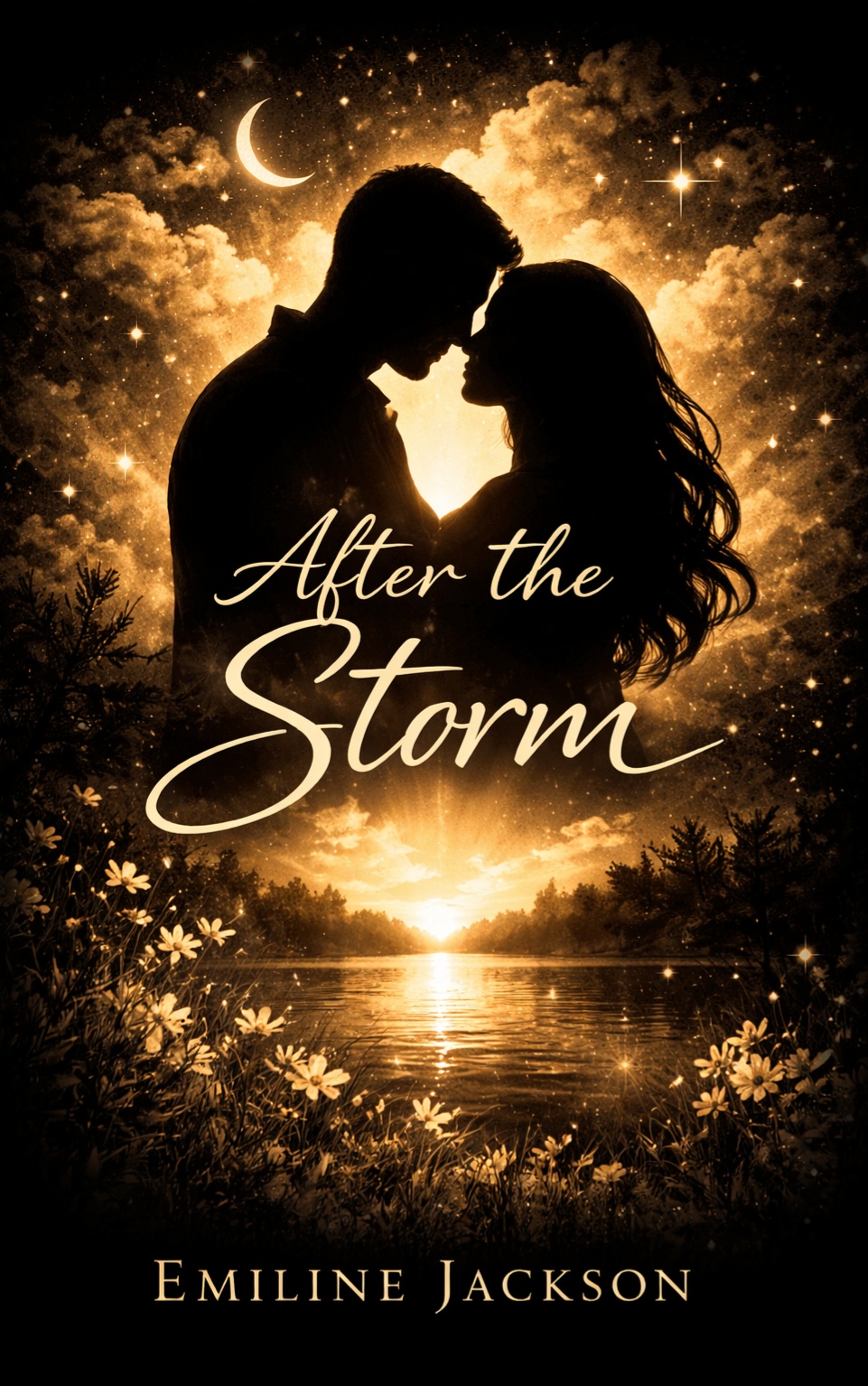
After the Storm
Finding the safe, soft love they both earned after a lifetime of storms
by Emiline Jackson
At forty-two, Elle Marsten is finally breathing again. After surviving a marriage defined by infidelity and emotional abuse, she has dedicated herself to her three children and her own healing, convinced that her heart is permanently closed for repairs. Then she meets Sullivan “Sully” Baptiste. A former football player with a gentle soul and eyes that see right through her defenses, Sully isn’t looking to conquer; he’s looking to connect. What begins as a professional friendship at a seminar quickly evolves into the kind of safe, tender romance Elle never thought possible. For the first time in decades, she is cherished, protected, and truly seen. When an impossible medical miracle brings a surprise pregnancy, Elle and Sully begin to dream of a future they never dared to imagine. But when tragedy strikes in the form of a devastating loss, the strength of their new bond is put to the ultimate test. Guided by the wisdom of family and the resilience of their own spirits, they must learn that even after the most destructive storms, the sun can still rise on a life filled with grace. After the Storm is a raw, intimate journey of healing, hope, and the courage to love again when you have everything to lose.
- Romance
- Friends to Lovers
The Professional Pivot
The fluorescent lights of the Downtown Conference Center hummed with a low-grade persistence that seemed to vibrate right through my skull. It was only nine o’clock in the morning, but I already felt like I had run a marathon while carrying a backpack full of stones. My hands, cold and slightly unsteady, gripped the handle of my briefcase as I stood in the lobby, watching the sea of professionals in their sharp blazers and polished shoes flow past me. I felt like an imposter in my own skin, a woman trying to play a role she hadn't quite memorized yet. This was the annual regional marketing seminar, an event I used to look forward to before my life had been dismantled and haphazardly glued back together.
I smoothed the front of my navy blue sweater, a garment I’d chosen specifically because it was soft and didn’t draw too much attention. At forty-two, I’d learned the art of blending into the beige of the walls. It was a survival tactic, a habit forged in the fires of a marriage where standing out meant becoming a target. If I was quiet, if I was invisible, if I didn’t make waves, I could stay safe. But standing here, surrounded by the scent of expensive coffee and the sharp chatter of networking, my hyper-vigilance was screaming at me. Every loud laugh made me flinch; every person walking too closely behind me made the hair on my arms stand up. I hated that I was still like this, a year after the divorce papers had been finalized and the locks had been changed. I was free, technically, but my nervous system hadn’t received the memo.
“You can do this, Elle,” I whispered to myself, the words barely a breath. “Just get through the breakout sessions, take your notes, and go home to the kids. No one is looking at you. No one is going to hurt you.”
I checked my schedule. The first session was in Room 302, a deep dive into digital engagement strategies. I navigated the hallway with my head down, counting the tiles on the floor to keep my mind occupied. One, two, three, four. It was a grounding exercise my therapist had taught me, a way to keep the panic from rising into my throat and choking the air out of my lungs. By the time I reached the room, my heart was still racing, but I was breathing. The room was large, filled with rows of round tables, and I chose one in the very back corner, tucked away near the emergency exit. It was my favorite spot—a clear view of the door and no one behind me.
The room began to fill up. People were laughing, exchanging business cards, and dragging chairs across the carpet with a screeching sound that made me wince. I opened my notebook and began to doodle in the margins, trying to look busy so no one would try to strike up a conversation. I wasn't ready for small talk. Small talk required a level of presence I didn't possess today. I was just trying to exist.
Then, the chair next to mine moved. I didn't look up immediately, my body tensing in anticipation of an intrusion. A shadow fell over my notebook, and I realized whoever had sat down was large. Very large. Out of the corner of my eye, I saw a pair of broad shoulders clad in a crisp, light blue button-down shirt with the sleeves rolled up to reveal muscular, dark-skinned forearms. My breath hitched. I felt that familiar spike of adrenaline, the primal urge to get up and run because a large man in my personal space usually meant trouble.
“Is this seat taken, or are you saving it for a very important stack of papers?”
The voice was deep, resonant, and unexpectedly gentle. It didn't have the sharp, demanding edge I was used to. I finally looked up, my blue eyes meeting a pair of soft, chocolate-brown ones. The man was striking—tall and built like he could move mountains, with short-cropped hair and a face that seemed to be etched with kindness rather than the arrogance I usually associated with men of his stature. He was smiling at me, a small, tentative smile that didn't reach for anything. It just offered a greeting.
“It’s... it’s free,” I managed to say, my voice sounding thin even to my own ears. I cleared my throat and tried again. “No, no one is sitting there.”
“Good. I’m Sullivan,” he said, extending a hand that looked large enough to crush mine, but when I hesitantly reached out to take it, his grip was incredibly light. It was a careful touch, as if he knew I was a person who might break if handled too roughly. “Most people call me Sully.”
“Elle,” I replied, pulling my hand back and tucking it under the table. “Elle Marsten.”
“Nice to meet you, Elle. You look like you’re about as thrilled to be here as I am,” he joked, leaning back in his chair. The movement gave me a bit more space, which I appreciated. He wasn't looming; he was just... there. “Don’t get me wrong, I love marketing, but these chairs were definitely designed by someone who hates backs.”
I felt a tiny, unexpected corner of my mouth twitch. “They are a bit clinical, aren't they?”
“Clinical is a polite word for it,” Sully said with a chuckle. “I was thinking more along the lines of medieval torture devices. But hey, at least the coffee is hot. Even if it does taste like it was brewed in a shoe.”
I looked at my own cup of lukewarm catering coffee and then back at him. For the first time in an hour, the tightness in my chest eased just a fraction. There was something about his energy—it was steady, like an anchor. He wasn't trying to impress me, and he wasn't looking at me with the predatory gaze I’d spent decades avoiding. He was just a man at a conference, making a joke about bad furniture.
The presenter took the stage, a frantic-looking woman in a lime green suit, and the room went quiet. She began her lecture on the evolution of brand loyalty, but my mind kept drifting to the man sitting next to me. I could feel the warmth radiating from him, a solid presence that felt surprisingly protective. It was a strange sensation. Usually, being near a man of his size made me feel small and vulnerable. With Sully, I just felt... seen. But in a quiet way. Not like a specimen under a microscope, but like a person who belonged in the room.
About halfway through the session, the presenter announced a breakout exercise. “I want you to turn to the person next to you,” she said, her voice booming through the speakers. “I want you to brainstorm a 30-second pitch for a struggling local brand. You have ten minutes. Go.”
I felt the familiar spike of social anxiety. I hated group work. I hated having to perform. But Sully turned to me immediately, his expression open and encouraging. “Well, Elle, looks like we’re a team. Any thoughts? Or should we just talk about how much we want a donut?”
I laughed, a genuine sound that surprised me. “A donut sounds much better than a pitch. But I suppose we should probably do the work.”
“Probably,” he agreed. “What’s your niche? I work in community development marketing. I’m all about the small guys—the mom-and-pop shops that are getting squeezed out by the big chains.”
“I’m in non-profit marketing,” I said, finding my footing as we moved into professional territory. “I work with a local shelter and a few youth programs. It’s a lot of trying to make a very small budget look like a very large one.”
Sully nodded, his brown eyes focusing on me with an intensity that wasn't intimidating, but rather deeply attentive. “That’s the hardest kind of work. It’s also the most important. You’re not selling soap; you’re selling hope. That’s a whole different ballgame.”
We spent the next ten minutes working through a pitch for a hypothetical local bakery. Sully was brilliant, but he didn't dominate the conversation. He would suggest an idea and then wait, looking at me as if my input was the missing piece of the puzzle. He listened—really listened—in a way I wasn't used to. He didn't interrupt. He didn't talk over me. He didn't patronize me when I stumbled over a word. By the time the presenter called us back to order, I realized I hadn't checked the emergency exit once.
“Okay,” the presenter said, looking around the room. “Who wants to share their pitch first? Let’s see some hands.”
I looked down at my notes, my heart doing a nervous dance. I didn't want to speak in front of eighty people. But before I could sink into the floor, I saw Sully’s hand go up. He didn't volunteer me; he volunteered us. “We’ve got something,” he said, his voice carrying effortlessly across the room.
“Great! Come on up,” she said, gesturing toward the front. “Let’s hear it.”
I felt the blood drain from my face. “Sully,” I whispered, “I can’t. I don’t do public speaking.”
He leaned in close, his voice a low rumble that only I could hear. “You’ve got this, Elle. I’ll stand right next to you. If you get stuck, I’ll take over. Just read what you wrote in your notebook. It was genius.”
I don’t know why I trusted him. Maybe it was the way he didn't pressure me, or the way he stood up and waited for me to follow, like a gentleman. I found myself walking toward the front of the room, my legs feeling like they were made of jelly. We stood at the podium, and I felt the weight of eighty pairs of eyes on me. I opened my mouth to speak, but the words wouldn't come. My throat felt like it was full of sand. I looked at the screen behind us, where I was supposed to show a quick graphic I’d pulled up on my tablet, but the screen was flickering. A technical glitch. The worst-case scenario.
The silence in the room stretched out, becoming heavy and suffocating. I felt the prickle of tears in my eyes. This was it. This was the moment where I failed, where everyone saw that I didn't belong here. I looked down at my shaking hands, ready to walk off the stage and never come back.
Suddenly, I felt a warm presence at my elbow. Sully stepped forward, not pushing me aside, but simply filling the gap. He looked at the flickering screen, then back at the audience, and let out a long, dramatic sigh. “Well,” he said, his voice bright and booming. “I told the IT department that my personality was too electric for this equipment, but they didn't believe me.”
A wave of laughter rippled through the room. The tension snapped like a dry twig. Sully gave me a quick, encouraging wink and continued. “While the ghosts in the machine decide if they want to join us, my colleague Elle here has come up with a strategy that’s so good, it doesn't even need a screen. Elle, tell them about the 'Bread and Butter' community initiative.”
The way he said it—my colleague Elle—made me feel like a professional, an equal. He’d given me the opening I needed. I took a deep breath, looked at my notes, and began to speak. To my surprise, the words came out steady. I talked about how the bakery could use local stories to build a brand that people felt a personal connection to. I talked about the importance of authenticity in a world of corporate gloss. As I spoke, I realized the room was quiet not because they were judging me, but because they were listening.
When we finished, there was a round of genuine applause. We walked back to our table, and I felt a strange, buzzing sensation in my chest. It was pride. I hadn't felt that in a long, long time. I sat down and let out a shaky breath.
“You did it,” Sully said, his voice low and full of warmth. “You were great, Elle. Truly.”
“I wouldn't have been able to do it without you,” I admitted, looking at him. “Thank you for stepping in. And for the joke. It really... it helped.”
“That’s what teammates do,” he said simply. “And besides, I really do think I’m electric. My grandmother says it’s because I’m so handsome, but I think it’s just static from the carpet.”
I laughed again, and this time, it felt lighter. I looked at him—really looked at him—and noticed the fine lines around his eyes. They were laugh lines. He was a man who had seen things, who had lived a life, but he hadn't let it make him hard. I found myself wondering about him. Who was Sullivan Baptiste? And why was he being so kind to a stranger in a navy blue sweater?
The session ended shortly after, and the room began to clear for the lunch break. I started packing my bag, ready to head to my car and find a quiet park where I could eat my sandwich alone. But as I stood up, Sully stood up too. He was so tall I had to tilt my head back to look at him. He was a solid six-three or six-four, and his presence was massive, yet it didn't feel overwhelming anymore. It felt like a shield.
“Hey,” he said, rubbing the back of his neck with a large hand. “I was thinking about heading to that little bistro across the street. The one with the green awning? I hear they have actual food that wasn't prepared in a vat. Would you... would you like to join me? I’d love to hear more about those youth programs you mentioned.”
My first instinct was to say no. No was safe. No meant I could go back to my cocoon and breathe. But then I looked at his eyes—those soft, chocolate-brown eyes that held no hidden agenda, no demand, just a simple, honest invitation. I thought about the way he’d stood by me at the podium. I thought about the way he’d made me laugh when I wanted to cry.
“I’d like that,” I said, and the words felt like a small rebellion against my own fear. “I’d like that very much.”
The walk to the bistro was short, but it felt significant. We stepped out of the sterile environment of the conference center and into the crisp autumn air. The city was bustling, but Sully walked at a pace that matched mine, never outstripping my shorter strides. He stayed on the outside of the sidewalk, a subtle gesture of protection that didn't go unnoticed. We didn't talk much on the way, but the silence wasn't awkward. It was the kind of silence that allowed you to just be.
The bistro was small and cozy, filled with the smell of toasted bread and roasted garlic. We found a small table in the back, away from the windows. Sully pulled out my chair for me, a gesture that made me feel a strange flutter in my stomach. It had been years since a man had treated me with that kind of quiet respect. I sat down, and he took the seat opposite me, his large frame making the bistro chair look like dollhouse furniture.
“So,” he said, after we’d ordered our sandwiches. “Tell me, Elle Marsten. How did you end up in the world of non-profits? You seem like someone who cares a lot about people.”
I took a sip of my water, trying to decide how much to share. “I think... I think I just wanted to do something that mattered,” I said carefully. “After I had my kids, I realized how much the world can be a difficult place. I wanted to be part of the solution, even if it’s just in a small way. I’ve been doing it for about five years now, ever since...” I trailed off, not wanting to mention the divorce.
“Ever since things changed?” he offered gently, filling in the gap without prying. “I get that. Life has a way of throwing a wrench in your plans, doesn't it?”
“It certainly does,” I agreed. “What about you? You said you work in community development. Was that always the plan?”
Sully shook his head, a wry smile touching his lips. “Not even close. If you’d asked me twenty years ago, I would’ve told you I’d be retired by now with three Super Bowl rings and a house in the Maldives.”
My eyes widened. “You played football?”
“I did,” he said. “College ball at State, then a short stint in the pros. I was a linebacker. I loved every second of it. The noise, the physicality, the feeling of being part of a machine. But my knees had other ideas.” He tapped his right leg. “One bad tackle, one loud pop, and that was that. The career I’d spent my whole life building was over in three seconds.”
“I’m so sorry,” I said, and I meant it. I knew what it was like to have your world collapse in an instant. “That must have been devastating.”
“It was, for a while,” he admitted, his gaze turning reflective. “I felt lost. Like I didn't know who I was if I wasn't 'Sully the Football Player.' But my grandmother—she’s a force of nature, that woman—she sat me down and told me that the Lord didn't give me those shoulders just to hit people. She told me I had a heart for my community and that I needed to find a way to use it. So, I went back to school, got my degree in marketing, and here I am. Trying to help the small businesses in my neighborhood keep their doors open.”
I watched him as he spoke, struck by his resilience. He hadn't let his injury embitter him. Instead, he’d taken the wreckage of his old life and built something new, something meaningful. It was a mirror of my own journey, though mine had been far more jagged and painful. We talked for an hour, our conversation flowing from our careers to our families. He told me about his grandmother, Jada, who sounded like the kind of woman everyone needs in their corner. I found myself telling him about my three children—my two sons and my daughter—and how they were the lights of my life. I didn't mention their father. I didn't mention the years of being told I was worthless. For this hour, I wasn't a survivor. I was just a woman having lunch with a man who seemed to actually care about what she had to say.
“You know,” I said, picking at a crust of bread. “I haven't talked this much in a long time. My kids usually do all the talking at my house.”
Sully smiled, and this time, it reached his eyes, creating little crinkles at the corners. “I’m glad you’re talking, Elle. You have a lot of good things to say. And you have a great laugh. You should use it more often.”
I felt a blush creep up my neck. I looked down at my plate, feeling a strange mixture of warmth and terror. It had been so long since someone had complimented me like that—without an ulterior motive, without a hidden barb. It felt dangerous to believe him, yet I wanted to. I wanted to believe that I was someone worth listening to. I wanted to believe that my laugh was something beautiful.
“I think... I think I forgot how,” I whispered, almost to myself.
“Well,” Sully said, his voice soft and steady. “Maybe you just needed the right audience. I’m a very good listener. It’s one of my few skills, along with being able to reach things on high shelves.”
I laughed again, and he was right—it felt good. It felt like a muscle I hadn't used in years finally beginning to stretch. We finished our lunch, and as we walked back toward the conference center, the air didn't feel quite so cold. The noise of the city didn't feel quite so overwhelming. I felt a sense of peace that I hadn't experienced in a decade.
When we reached the lobby, it was time for the afternoon sessions. The spell was broken, and the reality of the conference returned. We stood near the elevators, a moment of transition that felt heavier than it should have.
“I should get to my next session,” I said, though part of me wanted to stay right there and keep talking until the sun went down.
“Me too,” Sully said. He reached into his pocket and pulled out a business card. It was simple and professional. He handed it to me, and as our fingers brushed, a small spark—not of electricity, but of something much more profound—flickered in my chest. “Here. If you ever want to brainstorm more pitches for local bakeries, or if you just want to grab a cup of coffee that doesn't taste like a shoe... I’d love to hear from you, Elle.”
I took the card, my heart hammering against my ribs. I reached into my own bag and found one of mine, handing it to him with a hand that was surprisingly steady. “I’d like that, Sully. Thank you. For everything today.”
“You’re very welcome,” he said. He gave me one last, lingering smile, then turned and walked toward his session. He moved with a grace that was surprising for a man of his size, a steady, confident stride that seemed to anchor the very ground he walked on.
I stood there for a moment, watching him go. I looked down at the card in my hand. Sullivan Baptiste. Community Development Marketing. It was just a piece of cardstock, but to me, it felt like a lifeline. I quickly tucked it into the inner pocket of my briefcase, right next to my heart, and felt a tiny flame of hope ignite in the darkness I’d lived in for so long. I tried to suppress it, to tell myself that he was just being polite, that I shouldn't get my hopes up, that men like him didn't really exist. But as I walked toward my next session, I found myself standing a little taller. I didn't count the tiles on the floor. I didn't look for the emergency exit. I just walked, the memory of his laugh echoing in my mind like a promise of something better.
The rest of the afternoon passed in a blur. I took my notes, I attended the lectures, but my thoughts kept returning to Sully. I thought about the way he’d looked at me when I was struggling at the podium. I thought about the way he’d talked about his grandmother and his failed football career with such honesty and grace. He was a man who had been broken, too, in his own way. Maybe that was why he could see the cracks in me without being afraid of them.
When the conference finally ended for the day, the sun was beginning to set, casting long, golden shadows across the pavement. I walked to my car, my mind buzzing with the events of the day. As I pulled out of the parking garage, I saw a familiar figure standing on the corner, waiting for a bus. It was Sully. He was looking at his phone, his broad shoulders slightly hunched against the evening chill. For a moment, I considered pulling over and offering him a ride. But then, the old fear—the one that had been my constant companion for fifteen years—whispered in my ear. Don’t. It’s too much. You’re moving too fast. He’ll think you’re desperate. He’ll realize you’re broken.
I kept driving. But as I passed him, I looked in my rearview mirror. He looked up just then, his eyes catching the light of the setting sun. He didn't see me, but he smiled at something on his phone, and for a fleeting second, I felt like that smile was for me. I drove home to my children, to the chaos of homework and dinner and bedtime stories, but for the first time in a very long time, I didn't feel like I was just surviving. I felt like I was beginning to live.
That night, after the kids were tucked into bed and the house was finally quiet, I sat at my kitchen table with a cup of tea. I pulled Sully’s card out of my briefcase and laid it on the table. The white cardstock glowed under the dim light of the overhead lamp. I traced his name with my thumb, feeling the slight embossment of the letters. Sullivan. It was a strong name. A safe name.
I thought about the man I had been married to. The way he would have mocked me for being nervous at a conference. The way he would have made my technical glitch about his own embarrassment. The way he would have spent the entire lunch talking about himself and his own achievements, never once asking me a question about my life. The contrast was so sharp it made my chest ache. I had spent so long in the dark that I had forgotten what it felt like to be in the light. Sully was like a warm sun that had suddenly appeared in my sky, and I wasn't sure if I should bask in his warmth or run for cover before I got burned.
I picked up my phone and opened my contacts. I started to type in his number, my heart racing, but then I stopped. What would I even say? Hi, this is Elle from the conference. Thanks for not letting me die of embarrassment. Also, you have nice eyes. I shook my head and set the phone down. No. Not yet. I needed to breathe. I needed to make sure this wasn't just a fluke, a momentary lapse in the universe’s plan to keep me tucked away in my safe, quiet corner.
But as I went to bed and closed my eyes, I didn't see the flickering screen or the eighty judgmental faces. I saw a man with soft brown eyes and a deep, comforting laugh. I saw a teammate. And for the first time in over a decade, I fell asleep without checking the locks three times. I fell asleep with the ghost of a smile on my face, a small, fragile spark of hope tucked away in my heart, waiting to see what the morning would bring.
The next morning, the house was a whirlwind of missing socks and lukewarm oatmeal. “Mom, I can’t find my soccer jersey!” my youngest, Leo, yelled from the laundry room. “Mom, did you sign my permission slip?” Sarah asked, shoving a crumpled piece of paper toward me while I was trying to pour coffee. My eldest, Ben, just sat at the table, his hoodie pulled low, nursing a bowl of cereal and staring into the middle distance with the typical teenage angst that had become his default setting. This was my life—a constant, rhythmic chaos that I had managed to organize into a semblance of stability. I loved them fiercely, my three children. They were the reason I had survived, the reason I had found the strength to walk away from a life that was slowly killing me. But sometimes, in the quiet moments between the yelling and the chores, I felt a profound sense of loneliness that no amount of motherly duty could fill.
As I packed their lunches, my mind kept drifting back to the conference. Back to Sully. I wondered if he was sitting at his own kitchen table, maybe having breakfast with his grandmother, or if he was already at his office, working on a pitch for another small business. I wondered if he had thought about me at all, or if I was just another face in a crowd of professionals he’d met over the years. The thought that I might be insignificant to him stung more than it should have, considering I’d only known him for a few hours.
“Mom? You’re pouring the milk on the counter,” Ben said, his voice flat but not unkind. I looked down and realized he was right. A white puddle was spreading across the granite. I quickly grabbed a rag, my face heating up. “Sorry, Ben. Just had a lot on my mind.”
“You’ve been weird since you got home yesterday,” Sarah noted, her sharp eleven-year-old eyes narrowing as she took a bite of her toast. “You’re... I don’t know. You’re not as jumpy. Did something happen at the boring meeting?”
I paused, the rag in my hand. Not as jumpy. Even my children had noticed. I hadn't realized my hyper-vigilance was that visible to them, though I suppose children are the most observant people on the planet. “It wasn't that boring,” I said, trying to keep my voice casual. “I met someone. A colleague. We worked on a project together.”
“Was it a boy?” Leo asked, popping his head around the corner, his jersey finally found and clutched in his hand.
“He’s a man, Leo,” I corrected, my heart doing a nervous little skip. “And yes, his name is Sullivan. He was very nice. He helped me when the computer stopped working.”
“Like a superhero?” Leo asked, his imagination already taking flight.
I laughed, and the sound felt surprisingly natural. “Not exactly a superhero. But he was definitely a good teammate.”
The kids eventually moved on to other topics, their interest in my professional life short-lived, but the conversation stayed with me all day. Not as jumpy. It was a small observation, but it felt like a monumental shift. Could a single afternoon with a kind man really have that much of an impact? Or was it just that for the first time in years, I had allowed myself to be a person outside of my trauma? I went to work, sitting in my small office at the non-profit, and found myself looking at my phone every few minutes. I was waiting for something, though I wasn't sure what. A text? A call? We hadn't even exchanged numbers, only business cards.
By three o’clock, I decided to take a risk. I opened my email and typed his name into the search bar of the conference attendee list. There it was. Sullivan Baptiste. I clicked on his profile and saw his professional email address. I sat there for a long time, my cursor blinking in the empty subject line. My heart was pounding, and my palms were sweating. This was the part where I usually retreated. This was the part where I told myself I was being foolish and that I should just stay in my lane. But then I remembered the way he’d looked at me—the way he’d really seen me—and I started to type.
Subject: Great Pitching with You
Hi Sully, I just wanted to send a quick note to say thank you again for your help yesterday. I’m still thinking about that bakery pitch—I might actually suggest some of those ideas to one of our local partners! It was a pleasure meeting you and hearing about your work. I hope the rest of the conference was productive for you. Best, Elle Marsten.
I hit send before I could talk myself out of it, then immediately closed my laptop and put it in my bag. I felt like I had just jumped off a cliff without a parachute. I spent the rest of the afternoon in a state of high-strung anxiety, convinced I had made a terrible mistake. He would think I was being too forward. He would think I was unprofessional. He would see right through my thin veneer of professional courtesy and realize I just wanted to talk to him again.
I was at the grocery store, trying to decide between two types of pasta sauce, when my phone buzzed in my pocket. I pulled it out, my breath hitching in my throat. A new email. From Sullivan Baptiste.
Elle, so good to hear from you! I was just about to look up your info myself. I’m glad you’re thinking about the bakery—I really think those ideas have legs. And the pleasure was all mine. To be honest, you were the highlight of the whole seminar for me. I’m not just saying that because of the bread. How about we keep the conversation going? I’d love to hear more about your youth programs. Are you free for coffee sometime next week? My treat.
I stood in the middle of the pasta aisle, the phone trembling in my hand, and I felt a warmth spread through me that had nothing to do with the store’s heating system. The highlight of the whole seminar. He wasn't just being polite. He actually wanted to see me again. I felt a laugh bubble up in my throat, a real, joyful sound that made an elderly woman nearby look at me with a confused smile. I didn't care. For the first time in a decade, I wasn't just a survivor. I wasn't just a mother. I was a woman who had been invited for coffee by a man with soft brown eyes and a heart of gold.
I typed back a quick reply—I’d love to. How does Tuesday morning sound?—and then I finished my shopping with a spring in my step that I hadn't felt since I was twenty. The storm wasn't over, I knew that. There would be more challenges, more moments of fear, more ghosts from my past to fight. But as I walked to my car under the bright city lights, I felt like I finally had an anchor. I felt like I was finally walking toward the light, and for the first time in my life, I wasn't walking alone.
Tuesday morning arrived with a crispness that made me reach for my favorite emerald-green sweater—a color that always made my blue eyes pop, though I rarely wore it for that reason. Today felt different. Today felt like a beginning. I dropped the kids off at school, my heart doing a nervous little pitter-patter against my ribs. I’d spent more time on my hair than usual, letting it fall in soft waves around my shoulders instead of pulling it back into its customary tight bun. I felt exposed, yet strangely empowered.
The coffee shop we’d agreed on was a small, independent place on the edge of downtown, known for its strong brews and quiet atmosphere. I arrived five minutes early, my old habits of punctuality—born from a need to never give my ex-husband a reason to be angry—still firmly in place. I found a small table by the window and sat down, my hands clasped tightly in my lap. I watched the door, every chime of the bell making my heart jump.
Then, the door opened, and a familiar, broad-shouldered frame stepped inside. Sully was wearing a dark grey sweater that made him look even more solid, more dependable. He looked around the room, and when his eyes found mine, his face lit up with a smile that felt like a warm embrace. He walked toward me, his stride confident and easy, and I felt that same sense of safety wash over me.
“Elle,” he said, his voice a low, melodic rumble. “You look beautiful. That green is definitely your color.”
I felt the blush rise to my cheeks, but this time, I didn't look away. I met his gaze and smiled back. “Thank you, Sully. It’s good to see you again.”
“It’s good to see you, too,” he said, sitting down and leaning toward me. “I’ve been looking forward to this all weekend. My grandmother was starting to get worried—she said I was moping around the house like a lovesick teenager.”
I laughed, a sound that felt like music in the quiet shop. “I doubt you ever mope, Sully. You seem like the kind of man who always has a plan.”
“I try,” he admitted with a grin. “But sometimes, the best plans are the ones you don’t see coming. Like meeting a brilliant woman at a boring marketing seminar.”
We spent the next two hours talking, the world outside the window fading into a blur of motion and light. We talked about our dreams, our fears, the things that made us laugh and the things that made us cry. He told me more about his injury and the long road to recovery, the physical pain and the even deeper emotional toll of losing his identity. I found myself opening up to him in ways I never thought possible, telling him about the years of silence and the slow, painful process of finding my voice again. He didn't flinch when I spoke of the trauma. He didn't look at me with pity. He just listened, his brown eyes full of a deep, abiding respect that made me feel like I was finally, truly heard.
“You’re a survivor, Elle,” he said, reaching across the table to lightly touch my hand. It was a brief, gentle contact, but it sent a jolt of warmth through my entire body. “And you’re one of the strongest people I’ve ever met. Don’t ever let anyone tell you otherwise.”
I looked at our hands—his large and dark, mine small and fair—and I felt a sense of rightness that I couldn't explain. It wasn't just a spark; it was a connection, a deep, soul-level recognition that we were two people who had both weathered the storm and come out on the other side. We were both a little broken, a little scarred, but we were both still standing. And in that moment, I realized that I wasn't just falling for a man; I was falling for the possibility of a life where I didn't have to be afraid anymore.
As we eventually stood up to leave, the sun was high in the sky, casting a bright, clear light over everything. We walked out of the coffee shop together, our shoulders occasionally brushing in a way that felt like a promise. We stopped at the corner where our paths diverged, a moment of parting that felt more like a beginning than an end.
“So,” Sully said, his eyes searching mine. “Same time next week? Or is that too much for a first coffee date?”
“I think same time next week sounds perfect,” I said, my voice steady and full of a hope I hadn't felt in a lifetime.
“It’s a date then,” he said, his smile widening. He leaned down and gave me a quick, gentle kiss on the cheek—a touch so light it was almost a breath, yet it left a trail of fire in its wake. “See you then, Elle. Have a good week.”
“You too, Sully,” I whispered, watching him walk away. I stood there for a long time, the warmth of his kiss still lingering on my skin, and I felt a sense of peace that was deeper and more profound than anything I had ever known. The storm was over, and the sun was finally beginning to shine. I turned and walked toward my car, my heart light and my spirit renewed. I was forty-two years old, a mother of three, a survivor of abuse—and I was a woman who was finally, beautifully, falling in love. And for the first time in my life, I knew that I was exactly where I was meant to be.
As I drove home, the radio was playing a soft, acoustic song about new beginnings, and I found myself humming along. The road ahead was still long, and I knew there would be moments of doubt and fear. But as I looked in the rearview mirror and saw the clear, bright blue of my own eyes, I realized that I wasn't the same woman who had walked into that conference center a week ago. I was someone new. Someone who had found the courage to open her heart again. Someone who had found a teammate. Someone who was finally, after all the years of struggle, ready to embrace the light. And as the city skyline faded behind me, I knew that whatever the future held, I was ready to face it—not with a spirit of fear, but with a heart full of hope and a hand held firmly in mine. The storm had passed, and the world was new again. And I couldn't wait to see what the next chapter would bring.
Slow Burn and Strong Coffee
The transition from a stranger to a fixture in my life happened so gradually that I barely noticed the shift until it was the only thing holding me upright. Over the next few months, our Tuesday morning coffee at the Community Coffee House became my new Sabbath. It was the one hour of the week where I wasn't just a mother, an employee, or a woman t…