

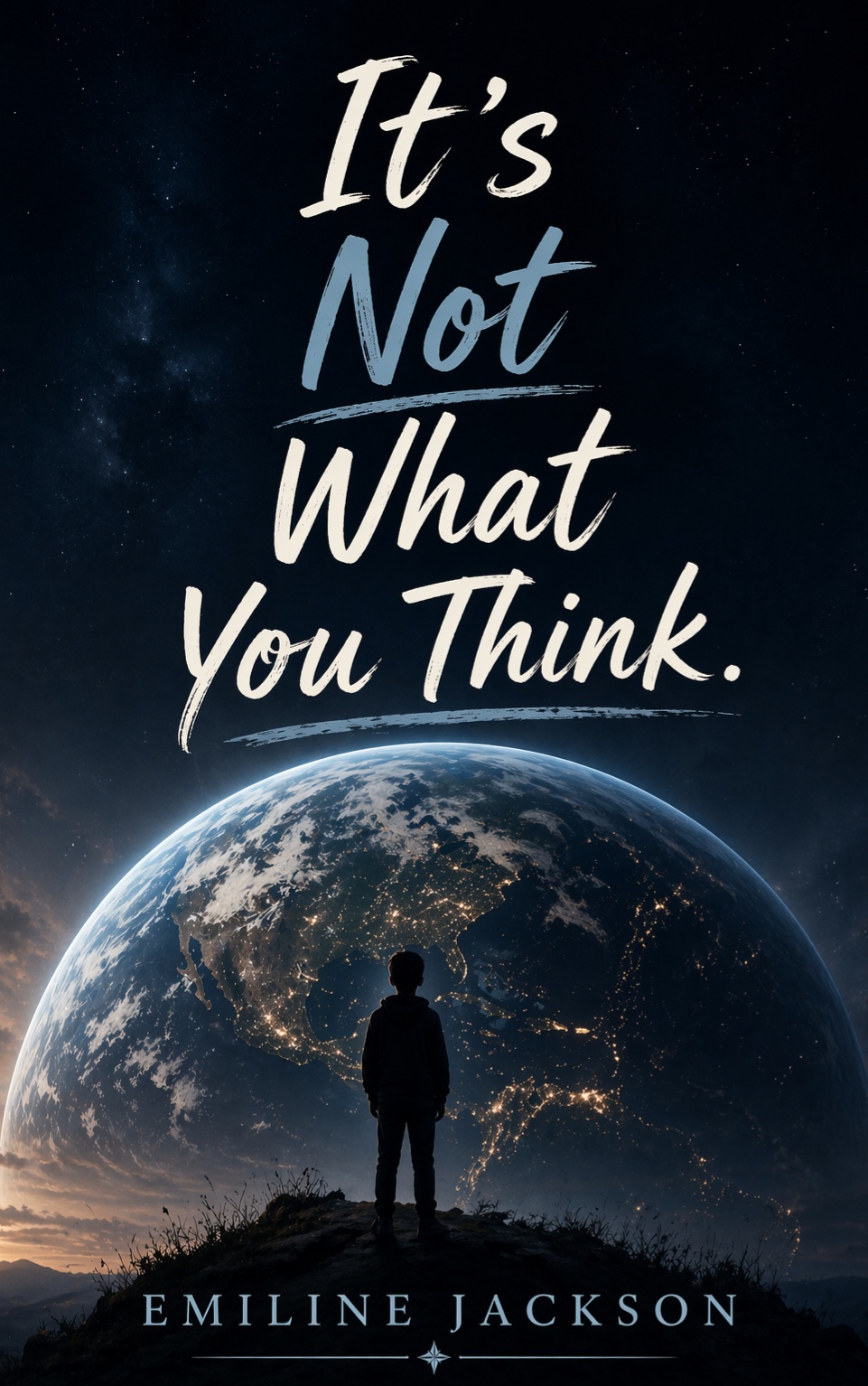
It's not what you think
One boy's quest to uncover the hidden truth behind the veil of deception
by Emiline Jackson
Thirteen-year-old Jayden Brooks is a genius on the autism spectrum who always looked at the stars with wonder. But when his homemade sensors detect synthetic hallucinogens in the atmosphere, his dreams of space travel turn into a startling awakening. Everything Jayden was taught is a lie. The earth isn't a globe spinning through a void; it is a stationary plane protected by a divine firmament. The skyscrapers we see and the horizons we perceive are part of a massive chemical illusion maintained by shape-shifting reptilian rulers. These entities use chemtrails to keep humanity docile, hiding the true nature of God’s creation behind a holographic fog. Joined by a disgraced pilot who has seen the world beyond the veil, Jayden embarks on a dangerous mission to find the edge of the world. As the elite move to silence him, Jayden must reconcile his scientific brilliance with the ancient truths found in the Bible. He isn't just looking for answers; he is starting a revolution. In a world where seeing isn't believing, Jayden is the only one who can see the truth. Will he shatter the illusion before the rulers of this world extinguish his light?
- Science Fiction
- Space Exploration
The Ripples in the Sky
The lens of my telescope was a cold, precise circle of glass, a gateway I had spent half my thirteen years peering through. My room was dark, save for the rhythmic blue blink of the atmospheric sensors and the soft hum of my cooling fans. I liked the dark. It made the data clearer. Tonight, the moon was high and unusually bright, a silver coin hanging in the void. At least, that was what my eyes told me. My sensors, however, were screaming a different story.
I leaned in, my eye pressing against the rubber guard of the eyepiece. I adjusted the fine-focus knob with a slow, deliberate twist of my fingers. I needed to see the craters, the shadows of the lunar highlands that I had memorized from my favorite NASA textbooks. But as I watched, the surface of the moon didn't remain still. It wavered. It began to ripple, the edges of the Sea of Tranquility blurring and shifting like a pebble had been dropped into a still pond. My heart began to thump against my ribs, a fast, syncopated rhythm that made me want to tap my fingers against the desk. I forced myself to stay still.
"It is a lens error," I whispered to the empty room. "Atmospheric refraction. Temperature inversion."
I checked the alignment. I wiped the lens with a microfiber cloth, though I knew it was clean. When I looked back, the ripple was gone, replaced by a strange, shimmering distortion. It wasn't the air between me and the moon that was moving; it was the moon itself. It looked less like a three-dimensional sphere of rock and more like a high-definition projection onto a curved screen. My high-frequency sensors, which I had customized to detect subtle electromagnetic shifts, were spiking in the red zone. The data on my tablet scrolled by in a blur of white numbers on a black background. The moon wasn't behaving like a mass with gravity. It was behaving like a frequency.
I turned to my secondary monitor, which tracked the stars. They were worse. In the textbooks, stars were distant suns, massive balls of fusion millions of light-years away. But tonight, through my specialized filters, they didn't look like suns. They looked like flickering lights, tiny electric sparks trapped behind a thick, crystalline barrier. I recorded the data points, my hands moving with practiced precision. According to the official math, the lunar orbit should have been a steady arc. My sensors showed a series of micro-fluctuations that defied Newtonian physics. It was as if the sky was a giant clock with gears that were starting to slip.
The door to my room creaked open, and a sliver of warm yellow light spilled across the carpet. I didn't turn around. I knew the scent of lavender and old paper meant my mother was there.
"Jayden? It is nearly midnight," Jane Brooks said softly. I heard her footsteps, the gentle tread of someone who didn't want to disturb a delicate process. "You have been at that telescope for five hours."
"The moon is rippling, Mom," I said, my voice flat and fast. "The mathematical inconsistency of the lunar orbit is exceeding three percent tonight. That shouldn't be possible. If the moon is a solid body in a vacuum, it cannot exhibit fluid dynamics."
She came to stand beside me, her hand resting lightly on my shoulder. She didn't dismiss me. She never did. She looked through the eyepiece, squinting as she tried to see what I saw. After a moment, she pulled back and smiled, though there was a hint of worry in her amber eyes.
"It looks beautiful tonight, honey," she said. "Maybe it's just the heat rising from the rooftops. You know how the air gets heavy in the summer."
"The sensors are calibrated for heat haze," I replied, pointing to the tablet. "This is something else. It is a structural distortion. It is like... like the sky is a veil, and something is moving behind it."
Jane sighed and brushed a stray curl away from my forehead. "You have such a big brain, Jayden. Sometimes I think it runs too fast for the rest of us to keep up. But even geniuses need to sleep. You have school in the morning, and you know how Mr. Garrison gets when you're tired and start correcting his lectures."
"Mr. Garrison's lectures are based on outdated data sets," I muttered, but I allowed her to kiss the top of my head. "I will be in bed soon. I just need to finish this log."
"Ten minutes," she warned, pointing a finger at me before she retreated into the hallway. "I mean it, Jayden."
The door clicked shut, and I was alone with the truth again. I didn't go to bed. Instead, I moved to the window and looked up with my naked eyes. In the distance, far above the suburbs, I saw them. A fleet of planes, appearing as tiny blinking lights, were crossing the night sky in a perfect grid pattern. They were flying much higher than commercial airliners, and they were leaving thick, white trails in their wake. Unlike normal contrails, which dissipate within minutes, these stayed. They spread out, catching the moonlight and turning into a thin, milky haze that obscured the stars.
I grabbed my portable chemical scanner and my tablet, slipping out of my room and down the stairs. I moved silently, avoiding the creaky floorboard near the linen closet. I stepped out into the backyard garden, where the air felt strangely heavy and smelled of something metallic, like a penny on your tongue. I knelt by the tomato plants, where the dew was starting to settle on the leaves. I ran the scanner over the foliage, watching the progress bar on my screen. It took forty-two seconds to process.
The results made my stomach churn. The scanner detected a high concentration of an unknown organic compound. I cross-referenced the molecular structure with my private database. It was a synthetic match for a potent class of hallucinogens, but amplified, stabilized for atmospheric dispersal. It wasn't just a chemical; it was a delivery system. I looked up at the white streaks stretching across the sky like the ribs of a giant cage. They were spraying us.
I sat on the grass, the dampness seeping into my cargo pants, but I didn't care. The logic was unfolding in my mind with terrifying clarity. If the air was filled with a constant, low-grade hallucinogen, then we couldn't trust anything we saw. The tall buildings downtown, the shape of the horizon, even the roundness of the earth itself could be a collective fabrication, a chemical trick played on the human brain to keep it from seeing what was really there. We were breathing the lie.
I pulled my tablet out and opened my private research folder. I hit the record button, the front-facing camera catching the glow of the screen on my face. I needed to document this before the fog in my own head got too thick.
"Log entry one," I said, my voice steady despite the trembling in my hands. "The lunar ripples have been confirmed by electromagnetic sensors. The atmospheric fallout contains aerosolized hallucinogens. The data suggests that our perception of the physical world is being artificially managed. I used to want to go to the moon, but now I realize the moon might not be a place you can go to. It might just be a light in the firmament. I am going to find the edge. I have to see what they are hiding behind the veil."
I saved the file and encrypted it. Above me, the white trails continued to expand, turning the midnight sky into a blurred, gray ceiling. I looked at my tattered Bible, which I had left on the garden bench earlier that day. I remembered the verses about the pillars of the earth and the dome of the heavens. I used to think they were just metaphors. Now, looking at the rippling moon and the poisoned air, I realized they were the only things that made sense. The truth wasn't in the textbooks. It was right there, hidden in plain sight, while the rest of the world slept in a chemical dream.
The Chemical Fog
The fluorescent lights of Oak Ridge Middle School hummed at a frequency of sixty hertz, a constant, irritating drone that felt like a needle pressing against the back of my skull. I kept my noise-canceling headphones around my neck, ready to pull them up if the sensory input became too much. Today, the air in the hallway felt thicker than usual, a …