

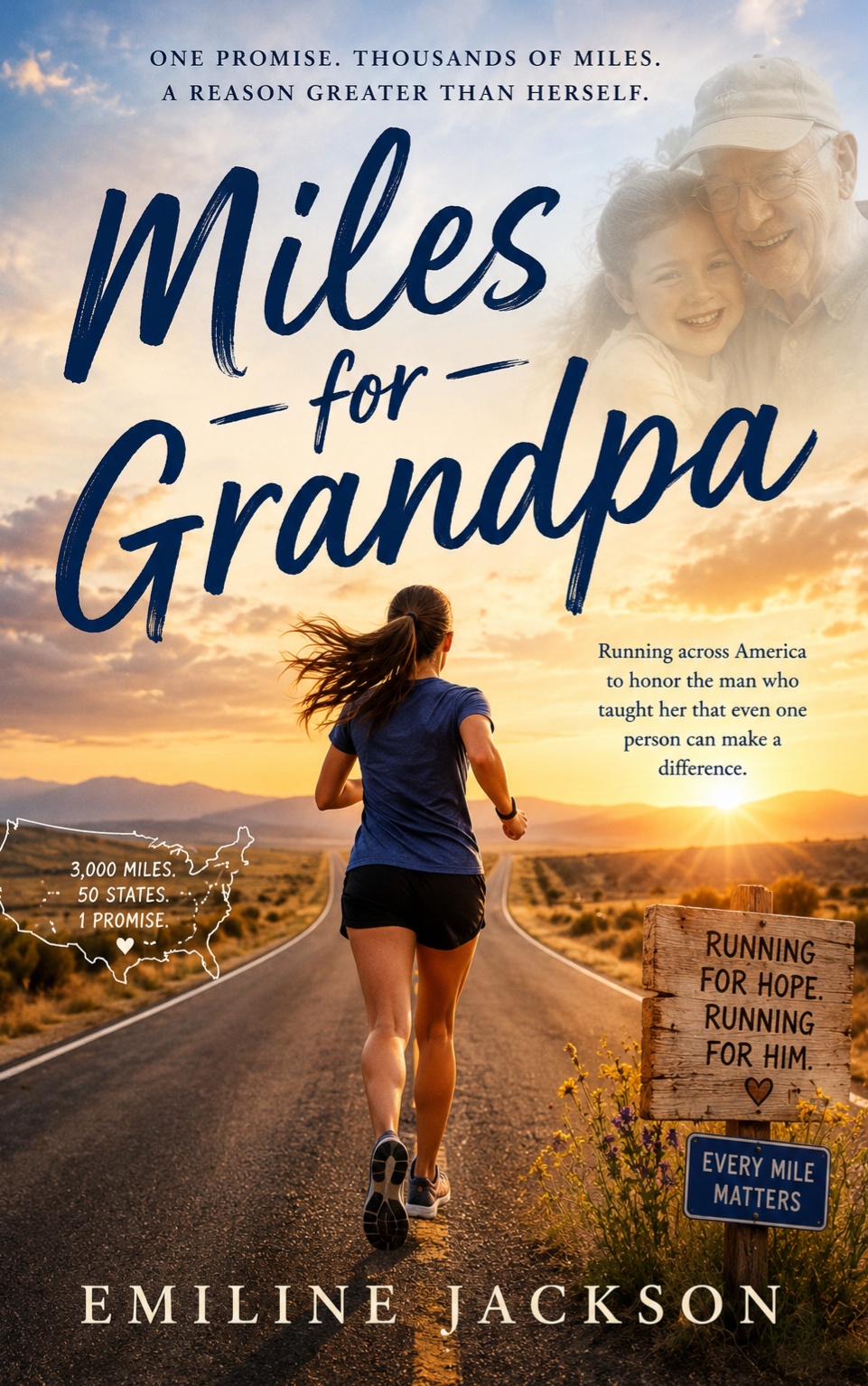
Miles for Grandpa
One girl, three thousand miles, and a promise that changed everything
Seventeen-year-old Maren Whitaker was never a runner. She was the girl who preferred quiet afternoons on her grandfather’s porch, soaking in his stories of resilience and kindness. But when 'Pop' passes away, the silence he leaves behind is deafening. Lost in a sea of grief and powerlessness, Maren makes a radical decision: she is going to run across the United States. With nothing but a worn pair of sneakers and a beat-up camper van driven by a skeptical college dropout named Reid, Maren begins an impossible trek from the Atlantic coast to the Pacific. Her mission? To raise a million dollars for the hospice that cared for Pop. But the road is a brutal teacher. From the blistering heat of the Midwest to the thin air of the Rockies, Maren faces physical agony, a mother desperate to pull her off the road, and a public critic who wants to see her fail. Miles for Grandpa is a soaring tribute to the bonds of family and the strength we find when we have no choice but to keep moving. Along the way, Maren discovers that while she is running to honor the man she lost, she is actually running toward the woman she is meant to become. Grief doesn't have to be the end—it can be the fuel for something extraordinary.
The First Step in the Sand
The Atlantic Ocean did not care about my promises. It just kept coming, cold and gray, licking at the edges of my brand-new running shoes with a flat, persistent hiss. The water was freezing. It bit through the mesh of my sneakers and clamped around my ankles like iron bands, but I did not pull back. I stood on the wet sand of Cape May, New Jersey, staring out at the horizon where the sky and the water blurred into a single, slate-colored sheet. The air tasted of salt and diesel from the nearby ferry, sharp enough to scrape the back of my throat.
I pulled the sleeves of Pop’s old flannel shirt down over my hands. It was three sizes too big, the red-and-black plaid faded to the color of dried brick, but I couldn’t bring myself to take it off. When I pressed my nose into the collar, I could still find him. It was a faint, fleeting thing, but it was there: the dry scent of cedar shavings, the sharp tang of peppermint discs, and the clean smell of the oil he used on his hand saws. It had been exactly three weeks since the funeral. Three weeks since the machines in the hospice room finally went quiet, leaving a silence in our house so loud it made my ears ring.
I remembered him sitting on the porch, his calloused hands resting on his knees, his eyes crinkling at the corners as he looked out over the yard. Character isn't built in the sunshine, kiddo, he had told me once, his voice like gravel shifting under a boot. It's what stays standing after the storm moves through. The longest journeys always begin with a single, shaky step. Just make sure you keep your eyes on the road, not your feet.
I took a deep breath, the cold air expanding in my chest like splintered glass, and turned my back on the ocean. I started to jog.
The transition from standing to moving was awkward, a clumsy stumble before I found a rhythm. My sneakers were stiff, straight out of the box, squeaking against the damp sand before I reached the hard packed dirt of the trail leading to the road. I was not a runner. Growing up, I was the girl who sat on the bleachers during gym class, fake-coughing to get out of the mile run. Now, I had an entire continent ahead of me, a hydration vest bouncing against my collarbones, and a pair of legs that already felt heavy. I was just a seventeen-year-old girl running from a quiet house, trying to find a man who wasn't there anymore.
By the time the ocean faded behind the coastal scrub and the gray asphalt of the highway took its place, my lungs were already burning. The air was thick, and every breath felt like trying to swallow wet wool. My feet, unaccustomed to the repetitive pounding, began to protest. The stiff heel counters of my shoes rubbed against my skin with every stride, creating a warm, stinging friction that I knew would turn into blisters before the sun went down. But I kept my jaw clenched. I kept moving.
Just one more mile, Pop, I whispered, the words puffing out in a small cloud of white vapor. We've got the wind at our backs today. Just one more.
I reached for the plastic straw of my hydration bladder, wanting to wash the salt from my tongue, but when I bit down on the valve, nothing came. My chest tightened. I reached around to my side pockets, searching for the hand-held water bottle I had filled at the motel this morning. My hand met empty mesh. A cold wave of panic washed over me, sharper than the ocean water. I had left my main water bottle sitting on the wooden bench at the starting line, right next to the boardwalk railing. I was barely into the first hour of a three-thousand-mile run, and I had already made a rookie mistake. The thought of turning back, of retracing my steps to the beach, felt like a defeat I couldn’t stomach.
I forced my feet to keep moving forward, ignoring the dry scratch in my throat.
The vibration in my front pocket was sudden and jarring. I pulled out my phone as I ran, my thumb smudging the screen. The caller ID showed my mother's name: Samantha. I could picture her exactly as she was right now, sitting in her polished office with her phone clutched in her hand, her eyes narrow with anxiety, her high-pitched voice ready to barrage me with logical arguments and logistical nightmares. She would tell me to think about my college applications, to think about my safety, to stop this dangerous stunt and come home. She didn't understand that the house wasn't home anymore. Without Pop, it was just a collection of quiet rooms and empty chairs.
I slid the phone back into my pocket, letting the call go to voicemail. The silence that followed was heavy, punctuated only by the rhythmic slap of my shoes against the road.
By the time I reached the five-mile mark, my heels were screaming. It felt as if someone were holding a match to the back of my feet. I slowed to a walk, my breath coming in ragged, shallow gasps, and leaned against a weathered wooden fence that bordered a salt marsh. The tall grass bowed in the wind, whispering against the wood. My legs shook, the muscles twitching with a fatigue that frightened me. Five miles. Only five miles, and I was already falling apart. How was I supposed to cross the mountains? How was I supposed to survive the deserts?
I reached into the pocket of Pop’s flannel shirt, my fingers searching for the small, laminated photograph of him I had brought with me. As my hand slid deep into the flannel lining, my fingers brushed against something else. It was a small piece of folded paper, rough and stiff, tucked into the very bottom of the inner pocket where the seam had started to fray.
My heart hammered against my ribs as I pulled it out. It was a note, written in Pop's thick, shaky handwriting, the ink slightly faded but perfectly legible.
Maren, the note read. The road is going to get dark, and your feet are going to hurt. When you want to stop, just remember that the wind always changes direction if you wait long enough. I’m proud of you, kiddo. Keep moving.
A tear slipped down my cheek, hot and stinging against my wind-chapped skin. He had known. Even when his hands were shaking so badly he could barely hold a pencil, he had written this and tucked it away, knowing I would find it when I needed it most.
I carefully folded the paper and placed it back into the pocket, pressing my hand over my heart where it lay. I looked out at the road ahead, stretching endlessly toward the western horizon, cutting through the marshes and into the vast, unknown continent. The scale of it was terrifying, a gray ribbon of highway that felt too big for a girl with stiff shoes and a broken heart. But I thought of the hospice nurses who had held Pop's hand when I couldn't bear to look, and I knew I couldn't stop. I had a promise to keep.
I pushed off from the fence, adjusted my hydration vest, and started to run again.
Blisters and Bad Omens
The state line was just a sign on the side of the highway, but to my legs, Pennsylvania felt like a different planet. By the afternoon of my second day, the flat coastal plains of New Jersey had vanished, replaced by rolling hills that seemed to rise up out of the earth just to spite me. Every incline was a personal insult. My thighs burned with a …