

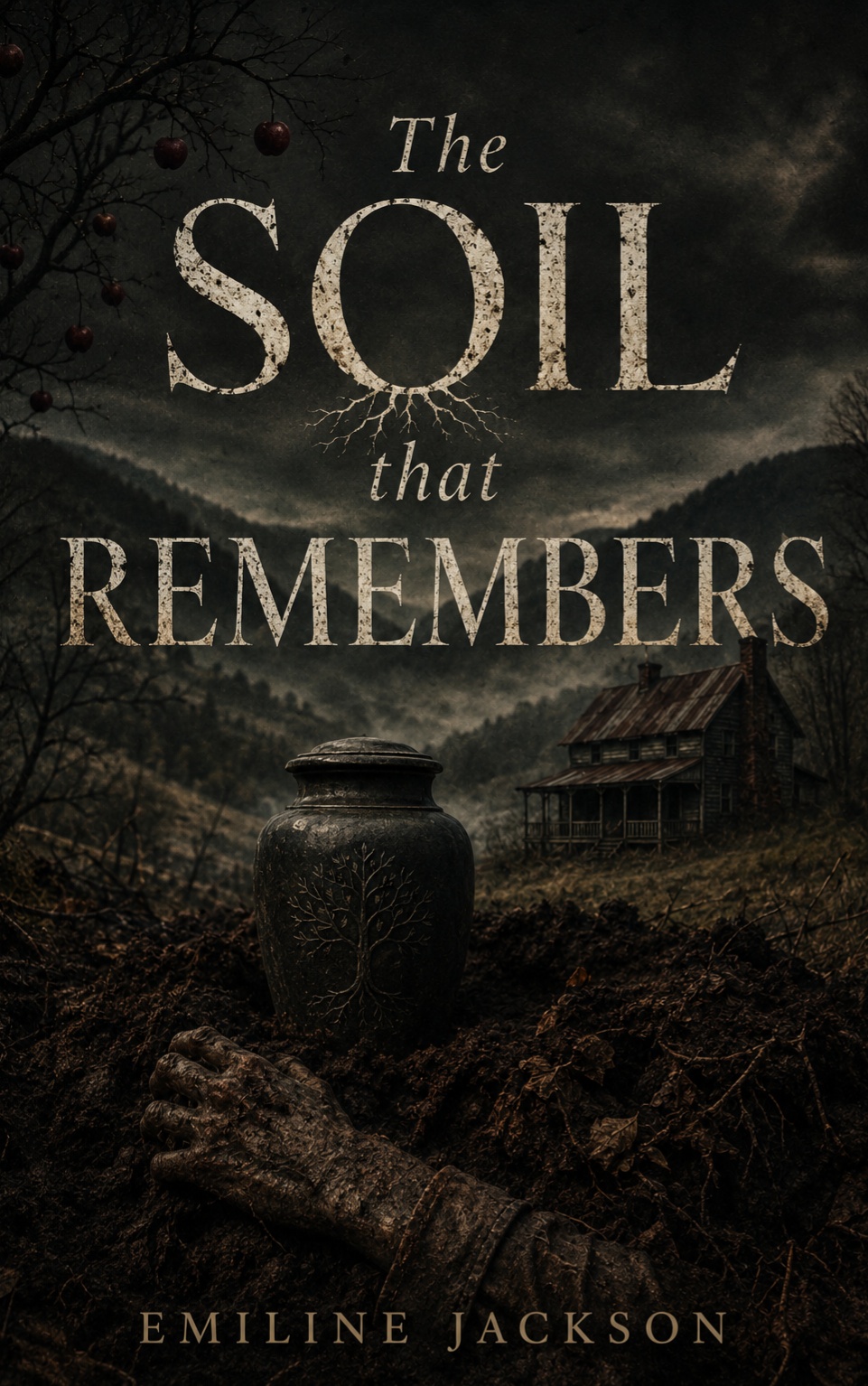
The Soil That Remembers
In the Appalachian shadows, the earth preserves what the soul tries to forget
The mountains do not forgive, and the soil does not forget. Hollis Vane is a man who deals in the stillness of death. A reclusive taxidermist, he returns to his family’s derelict Appalachian farm with one final task: to bury his father’s ashes in the orchard. But the valley is governed by a terrifying alchemy. The soil here does not allow for decay; instead, it mummifies everything it touches, preserving secrets in a leathery, eternal grip. As Hollis breaks the ground, he unearths more than just stones. He finds the perfectly preserved body of an uncle who supposedly vanished decades ago. With every touch of the mummified remains, Hollis is plunged into visceral, tactile hallucinations—the land is forcing him to relive the violent crimes of his ancestors. Now, his father’s voice rumbles through the dirt, demanding a legacy of blood. Trapped between a complicit sheriff and a landscape that breathes with the memories of the dead, Hollis must find a way to break the cycle. In a place where the earth remembers every sin, the only way out may be to become part of the orchard forever. Masterfully atmospheric and chillingly original, The Soil That Remembers is a haunting exploration of grief, heritage, and the heavy price of the past.
- Horror
- Literary Fiction
- Folk Horror
- Grief & Loss
- Psychological Horror
- Character Study
The Jar on the Seat
The heater in the truck had died somewhere outside of turnoff forty-two, leaving only a thin, whistling draft that smelled of burnt oil and old horsehair. Hollis Vane kept his right hand on the steering wheel, his knuckles yellowed and dry, while his left rested on the passenger seat. Beneath his palm, the ceramic urn was cold. It was a cheap thing, grey-glazed and heavy, bought from a catalogue in the back room of a county crematorium. It did not rattle. The ashes of Silas Vane had been ground fine, reduced to a heavy, grey grit that shifted with the lean of the truck as it climbed the gravel road.
The road was narrower than Hollis remembered. The weeds had eaten the shoulders, and the pine branches hung low, scraping against the rusted cab with the dry, rhythmic sound of fingernails on cardboard. He had spent ten years in the lowlands, working in a room that smelled of borax, arsenic, and damp feathers. In that room, he had learned how to make things look like they were still looking back at you. He knew the exact weight of a glass eye for a red fox, and he knew how to stitch a hide so the seam remained hidden beneath the grain of the fur. He had built a life out of stillness, believing that if he kept his hands busy with the clean, dead shapes of animals, he would never have to think about the heavy, breathing shape of his father.
Yet here he was, climbing back into the shadow of the ridge.
The air outside grew thick as the elevation rose. It was not the light, sharp cold of the high peaks, but a damp, heavy chill that seemed to pool in the hollows, carrying the scent of hemlock and wet charcoal. Hollis looked at the dashboard. The clock had stopped three years ago at twelve minutes past four, its little black hands frozen like the legs of a dead beetle. He did not need a clock to know he was late. Silas had been dead for six days, but the man had always possessed a way of making time stretch out, of making a single minute of silence feel like an afternoon under a heavy hand.
The truck cleared the final rise, and the valley opened up below him like an unstitched seam. The Vane family farm lay in the bottom of the bowl, where the light did not quite reach even at noon. From this height, the house was a small, grey notch against the dark wood. It looked less like a building and more like a pile of old timber that had fallen from the ridge and settled in the mud, its chimney leaning toward the creek like a broken collarbone.
Hollis let the truck coast down the final switchback, his boot hovering over the soft brake pedal. The tires sank into the gravel, the noise changing from a sharp crunch to a wet, sucking thud. He pulled up near the well-house and killed the engine. The silence that followed was immediate and absolute. There were no birds. In the lowlands, the woods were always busy with the small, nervous movements of thrushes and wrens, but here, the air was as still as the water in an abandoned cistern.
He sat for a moment, his hand returning to the cold ceramic of the urn. Just one day, he told himself. He would find a spade in the barn, dig a hole three feet deep beneath the trees, and tip the grey dust into the earth. He did not need to go inside the house. He did not need to look at the kitchen table where the grease from twenty years of salt pork had yellowed the oilcloth. He only had to finish the chore and turn the truck around before the dark came down over the ridge.
When he opened the cab door, the air hit him. It was heavy, wet, and carried a faint, metallic sweetness that made the back of his throat itch. It was a smell he knew from his own workshop, the scent of things that had been stopped from turning back into dirt, but here it was wild, mixed with the damp rot of leaf-mold and the cold grease of the creek.
He stepped down, and his boot went deep. The ground did not yield with the clean, dry snap of frozen grass or the resistance of clay. It was spongy. It felt like walking on a thick wool blanket that had been left in a tub of water, giving way beneath his weight with a soft, quiet sigh. He looked down. The grass was green, a dull, oily shade that looked wrong for the season, and when he lifted his heel, the blades did not spring back. They stayed flattened, holding the shape of his sole like lead.
He carried the urn under his left arm, his fingers hooked through the small wire handle. The weight of it was awkward, pressing against his ribs as he walked toward the porch. The steps were grey, the grain of the oak raised and sharp from years of mountain rain. As his boot touched the bottom step, the wood groaned, a low, hollow sound that seemed to travel up through his shins and settle in the small of his back.
To his left, the orchard stretched away toward the creek. It was then that he saw them. The apple trees were old, their trunks twisted into black, muscular shapes that looked like they were trying to pull themselves out of the spongy soil. They should have been bare, their branches grey and sharp against the mountain sky. Instead, they were heavy. Great, thick clusters of leaves hung from the limbs, and among them sat the fruit. The apples were large, the size of a man’s fist, their skin a deep, bruised purple that looked almost black in the failing light. A few had fallen into the tall grass below, but they had not split or gone soft. They lay there, whole and dark, like stones dropped into a pond.
Hollis stared at them, his throat dry. It was late November. By now, the frost should have taken the last of the windfalls, turning them into brown slime for the yellowjackets. But there were no insects here. There was only the heavy, purple fruit, hanging so low the branches creaked under the weight.
He turned back to the house, his breath coming in thin, white plumes. The front door was ahead of him. It was a thick slab of pine, greyed by the weather and marked by the deep, vertical scars where Silas had once used his pocketknife to scrape the mud from his boots. The brass latch was green with verdigris. There was no lock. Silas had always said that a lock was a sign of fear, and that no man in the county had enough sand in him to walk into a Vane’s house without an invitation.
Hollis reached out, his hand stained with the yellow shadow of walnut juice and tanning acid, and pressed the latch. It gave way with a sharp, dry click. The door swung inward into the dark, and the smell of the house came out to meet him.
The Preserving Dirt
The darkness inside the house was thick, smelling of cold tallow, woodsmoke, and the sour grease of old meals. Hollis Vane stepped across the threshold, his boots making no sound on the floorboards. The pine planks did not creak under his weight here as they had on the porch. They felt dead, stiffened by some internal density that resisted the natu…