

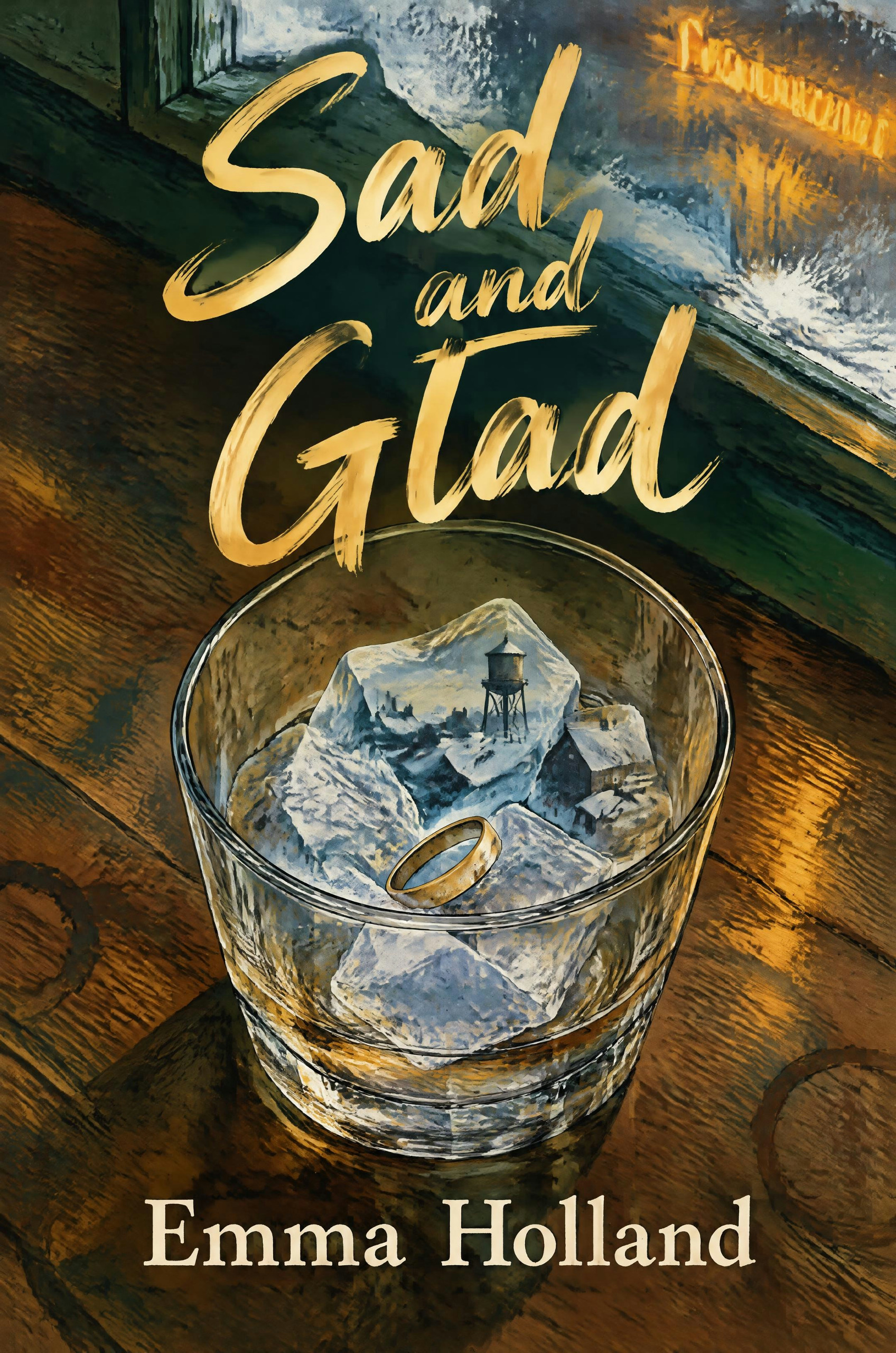
Sad and Glad
In a frozen town, leftover love and grief share the same chest
by Emma Holland
Jimmy Schutze still walks the winter streets of Almost, Maine, years after Sandrine St. Pierre left without a last word. He works odd hours, keeps a ring he never offered, and wears a tattoo meant to honor a name he misspelled. Sandrine has built a chosen life with Martin Lafariere. The whole town already treats the wedding as fact. On a frozen night her friends drag her into the old bar for a send-off, and Jimmy is already there with a beer he has not finished. Public talk of vows lands in the same room where he once practiced a speech in his truck. A waitress named Villian walks in with the unlikely spelling on his skin. Brief warmth starts. Then tragedy cuts it down. Months into marriage, Martin dies. Sandrine comes home a widow. Gossip, grief, and two people who are both newly unattached force a second meeting that is not a rerun of the proposal Jimmy never gave. Sadness and gladness share the same chest as they decide whether Almost can hold a new beginning that does not erase the dead.
- Romance
- Literary Fiction
- Small Town Romance
- Relationship Drama
- Small Town Drama
- Grief & Loss
The Night He Kept Open
Jimmy Schutze took the loop the way other people took a prayer, slow and unnecessary, beanie pulled down so the wind could not get at his ears. Last call had already happened. The old bar's windows were still yellow, then they weren't. He drove past the post office, past the lake road that never quite stayed plowed, past the dark general store, and back again. His flannel collar was up. The heater in the truck ticked like it wanted credit for trying.
He parked where he always parked, across from the bar, and told himself he was only checking the lights. One still burned over the side door. That was all. He sat with his hands on the wheel until they cooled. Then he opened the glove box because he always did, and because not looking felt like lying.
The velvet box was small enough to hide under a stack of napkins and a spare pair of gloves. He did not take it out. He looked at it the way a person looks at a letter they already know by heart. The speech had gone stale months ago. He practiced nothing out loud. The words had lived in this cab so long they had lost their shape. He shut the glove box with two fingers, careful, as if the ring could hear him.
He started the truck again and rolled past the general store. In the window, under a taped flyer for ice fishing, someone had put up a handwritten notice. Community hall rental. Wedding party. Dates in block print that did not belong to him. He looked away before he finished the second line. The street was empty. His breath fogged the glass and he wiped it with his sleeve.
The plow barn sat on the edge of town like a shed that had gotten ideas. He clocked in late. The dispatcher, a woman named Carol who had known him since he was a kid with too-long hair, did not make a speech about it.
"You're late, Schutze."
"Winter's the only thing that still shows up on time," he said. "Figured I'd let it have the first turn."
Carol snorted into the radio. "Route's the same. Watch the ice by the church. Don't invent extra streets."
"Wouldn't dare."
"You would. That's the problem."
He took the keys. He ran the blade until the sky paled at the edges and the town looked like it had been scraped clean of everybody's business. The work was simple. The questions were not. He kept seeing the notice in the store window whenever he blinked. A wedding party at the hall. The town already treating it as fact, names not even needed yet. He swallowed that the way he swallowed most things: without comment, with a little extra salt.
When the shift ended he drove home to the rented kitchen that still smelled like someone else's onions. He left one light on over the sink because a dark house felt like giving up. He poured coffee he did not drink. It sat and went the color of old tea. He sat with it anyway, boots still on, and rolled his sleeve.
The tattoo sat on his forearm in letters that had seemed like honor when he was twenty-three and sure. He had meant a name. He had gotten the spelling wrong. He traced it with his thumb now, slow, as if the skin might correct itself if he asked nicely.
"Villian," he said, wrong on purpose, the extra letter sitting there like a joke he had paid for.
Then he said it right, the way it should have been, and the right version sounded like a stranger. Then he did not say it at all. The kitchen clock ticked. Somewhere a dog barked twice and quit. He thought about the ring in the glove box, about the speech that had gone stale, about a woman who had left without a last word and a town that kept the streets open anyway. He was not good at pretending he had moved on. Hope still startled him. He treated it like a leak he could tape.
He thought, too, of the bar night that had not happened yet and already felt old: him with a beer he would not finish, public talk of vows landing in a room where he had once practiced a future in a parked truck. He told himself that was later. Tonight was only the loop and the notice and the coffee going cold.
Depression, if that was the word, did not arrive as a storm. It arrived as this: sitting dressed at a table, tracing ink, leaving a light on for nobody. He was bewildered more than bitter. He looped the same questions. Why no last word. Why he stayed. Why winter still felt like a person who might come back through a door.
He went to bed still dressed. The flannel itched. The beanie stayed on the hook. He lay on top of the quilt because getting under it felt like a decision. Sleep came in pieces. He dreamed of the hall rental notice blowing down Main Street, catching on a plow blade, getting shredded into white scraps that looked like snow and then like nothing.
The horn woke him. A plow, not his, two streets over, a long blast that sounded like a question he did not have an answer for. He sat up. His mouth tasted like unswallowed coffee. The kitchen light was still on. He walked out in his socks and looked at the mug, then at his arm, then at the window where the freeze had drawn ferns on the glass.
Almost was quiet in the way small towns are quiet when they already know the story and are waiting for you to catch up. Jimmy put on his boots. He did not look at the tattoo again. He did not open the glove box from here; the truck was outside, the ring was still in it, unused, a future he had never offered. He stood in the doorway with his coffee mug in one hand and the cold coming in around his ankles, and he told himself he would drive the loop later, after last call, only to check the lights.
He already knew he would. He already knew he would park across from the old bar. He already knew he would look away from the next notice, and the next, until a name appeared or did not, until the town made the wedding real enough to sit in the same room with him. Gladness and sadness occupied the same chest. He set the mug in the sink without washing it. The horn sounded again, farther off, like someone asking if anyone was still awake.
"Yeah," Jimmy said to the empty kitchen, low, almost tender. "I'm here."
He was. He had been. He would be, until the door opened or it didn't, until the speech stayed stale or found a new sentence, until the misspelled mark on his skin meant something or meant only that he had been young and sure and wrong, and was still, in the freeze, waiting like it was a skill.
Dresses on Ordinary Days
Sandrine St. Pierre ironed a floral dress in the drafty house off the main road while the kitchen did what it always did in Almost: leaked cold around the window frames and pretended it was only weather. The board sat on the dining table because the laundry room was a closet with a bulb that flickered. Steam rose off the cotton in little sighs. She…