

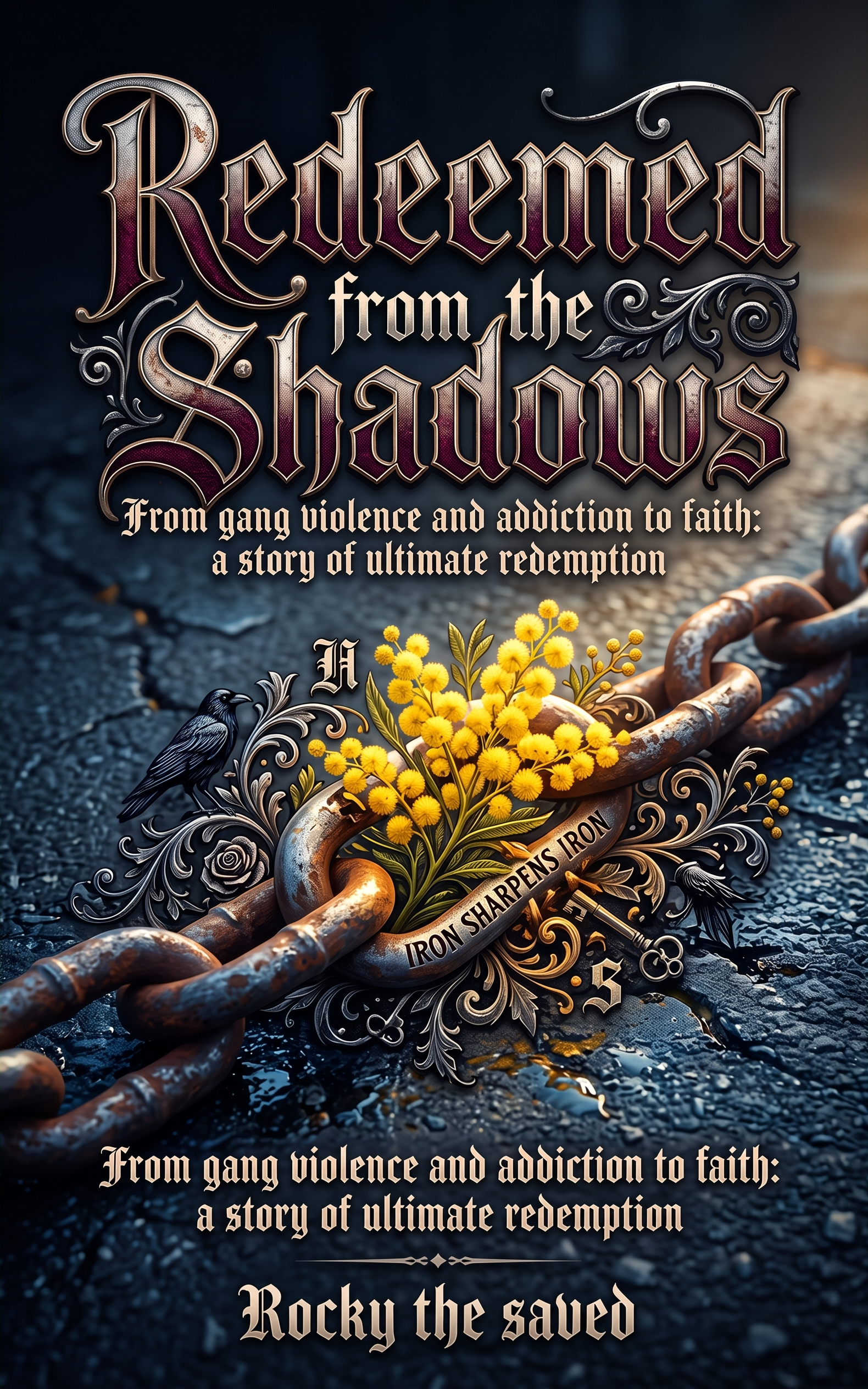
Redeemed from the Shadows
From gang violence and addiction to faith: a story of ultimate redemption
by Erik Gray
Surviving his mother's attempt on his life as an infant was only the beginning for Cain. Raised without a family outside of coastal gang crews, he spent a decade immersed in heavy crime, severe addiction, and unrelenting violence. He buried over twenty mates to suicide and watched others die in cold blood on Australian streets. By twenty-seven, broken by survivor's guilt and trauma, Cain parked his car, ready to end it all via suicide by police. Instead, in a moment of pure desperation, he cried out to a God he barely knew. What followed was a miracle. Achieving sobriety on 6 January 2020, Cain began the grueling work of rebuilding his life. A chance meeting at a local café led him to a supportive spiritual community and a profound baptism on his birthday—turning a date plagued by painful memories into a celebration of rebirth. Raw, honest, and deeply moving, Redeemed from the Shadows is Erik Gray's powerful memoir of breaking free from the darkness, confronting lifelong trauma, and discovering a divine calling to mentor the next generation of lost youth.
- Non-Fiction
- Literary Fiction
- Memoir
- Biography
- Identity Journey
- Coming of Age
Born into the Dark
It all began on the second of May 1992 in a coastal town in Victoria. I came into this world in a hospital that smelled of bleach and salt air drifting through the windows. Little did anyone know that my own mother was about to try and kill me. That was the start of a very long and dark road of hate for people, crime, drugs, and trying to find myself.
I do not remember the moment with clear pictures. Newborns do not keep proper memories. What stays is a cold knowledge in the body, a tightness that never fully left. She tried it not long after they put me in her arms. The details came later from scraps of talk I overheard as a kid, half-heard arguments in kitchens that stank of cigarettes and cheap wine. She was in a bad way, desperate and angry at the world and at me for existing. There was pressure around my throat, a sudden cut of air, and then someone pulled her off. Nurses or a doctor, I suppose. I survived. That fact alone settled into my bones like a verdict. I was never meant to make it, and yet I did.
They sent us home to a run-down rental house a few streets back from the water. The place leaned with the wind. Paint peeled off the weatherboards in long strips. The roof leaked whenever the southerly blew hard off Bass Strait. Inside it was cold most nights. My mother came and went. Sometimes she was there for days, staring at the wall or sleeping through the afternoon. Other times she vanished and left me with whoever happened to be around. Neighbours. Temporary carers who lasted a week or a month. None of them stayed. None of them looked at me like I belonged.
I learned early that adults could not be relied upon. One carer would feed me and then pack her bag the next morning without a word. Another would shout if I cried too loud. The house filled with different voices and then emptied again. I stopped expecting anyone to come when I called. That hollow feeling started then, the sense that I belonged nowhere and to no one. The coastal streets became the only constant. I can still name them. The long road that ran parallel to the beach, the side street with the cracked footpath where the milk bar used to sit, the laneway behind the shops that smelled of rotting seaweed and old oil.
By the time I reached primary school age the isolation had hardened. Other kids had parents waiting at the gate. I walked home alone past the same peeling fences and the same cold wind coming off the water. Teachers asked questions I could not answer. Where is your mum today? Who looks after you at night? I shrugged and kept my mouth shut. Inside, rage started to spark. Small at first. A shove in the playground when someone laughed at my torn jumper. A stolen pencil case because I needed something that was mine. Theft began as survival and quickly turned into identity. If no one would give me a place, I would take what I could.
The violence stayed small in those early years but it felt big inside me. I smashed a window once just to hear the glass break. I punched a kid who called me a stray. My knuckles split and the sting felt honest. Better than the empty quiet of the house. Temporary carers came and went while I watched from doorways. They smiled at first and then grew tired of the mess and the silence. When they left I stood in the hallway and felt nothing new. Just the same confirmation. Adults leave. You cannot need them.
I remember standing outside after one of those rejections. It was late afternoon. The wind cut across the street and carried the smell of the sea. Someone had just told me I was too much trouble and walked away with their bag. I was still a boy, primary school age, skinny and already carrying a jagged sense that I should not have survived that first night. I watched the figure disappear down the road toward the shops. No tears came. Only a hard vow that settled deep. I would never need anyone again. Not a mother. Not a carer. Not a family. If I stood alone then nothing could be taken from me.
That vow sealed me into isolation. The streets of the town became my map. I knew which corners the wind hit hardest. I knew the hollow feeling that came when the sun dropped and the lights came on in other people’s windows. Hate for people started there, quiet and steady. They had failed me from the first breath. Crime was still years away in its full form, but the first sparks lived in those small thefts and the sudden punches. Drugs would come later. The long dark road stretched ahead and I had already started walking it with my fists clenched and my heart closed.
I carried the knowledge of that infant betrayal like a scar under the skin. My mother had tried to end me before I could even speak. Everything after felt like proof of the same truth. Neighbours glanced and then looked away. Carers filled forms and moved on. At school I sat at the edge of the group and learned to watch without joining. Belonging nowhere became the only belonging I trusted. The cold wind off the water matched the cold inside. I named the streets under my breath as I walked them alone: the beach road, the cracked lane, the short cut behind the old timber yard. They did not reject me. They simply existed, same as the rage.
By then the foundation was set for everything that followed. A boy standing alone after another rejection, promising himself he would never open the door again. The decade of gangs and worse still waited, but the shape of it was already there in the empty house and the stolen things and the vow spoken into the wind. I was born into the dark on the second of May 1992. I survived the first attempt to put me back into it. From that day forward I decided I would survive on my own terms, needing no one, trusting nothing but the hard edge of my own will.
The coastal town kept turning. Waves hit the shore. Cars drove past the rental house without stopping. Inside, a child learned that love was a story other people told. Hate and distrust filled the space instead. Small acts of violence became practice. Theft became habit. Isolation became armour. I did not know then how far the road would run or how many mates I would lose along it. I only knew the promise I made to myself on that windy street. Never need anyone again. That promise held for years. It shaped every choice that came after. It kept me alive and it kept me empty at the same time.
Looking back now I can still feel the weight of that early decision. It was not wisdom. It was survival dressed up as strength. A boy who had already been betrayed by the one person meant to protect him chose the only shield he could find. He stood alone and called it freedom. The dark had claimed him at birth. He simply decided to walk through it without holding anyone’s hand.
The Only Family I Knew
I was fourteen the first time the crew really took me in. It happened behind the old milk bar that had shut years earlier, in the alley where the bins stank of sour milk and cigarette butts. An older bloke called Daz looked me up and down, saw the anger sitting plain on my face, and nodded like he already knew the story. He did not ask about home. …