

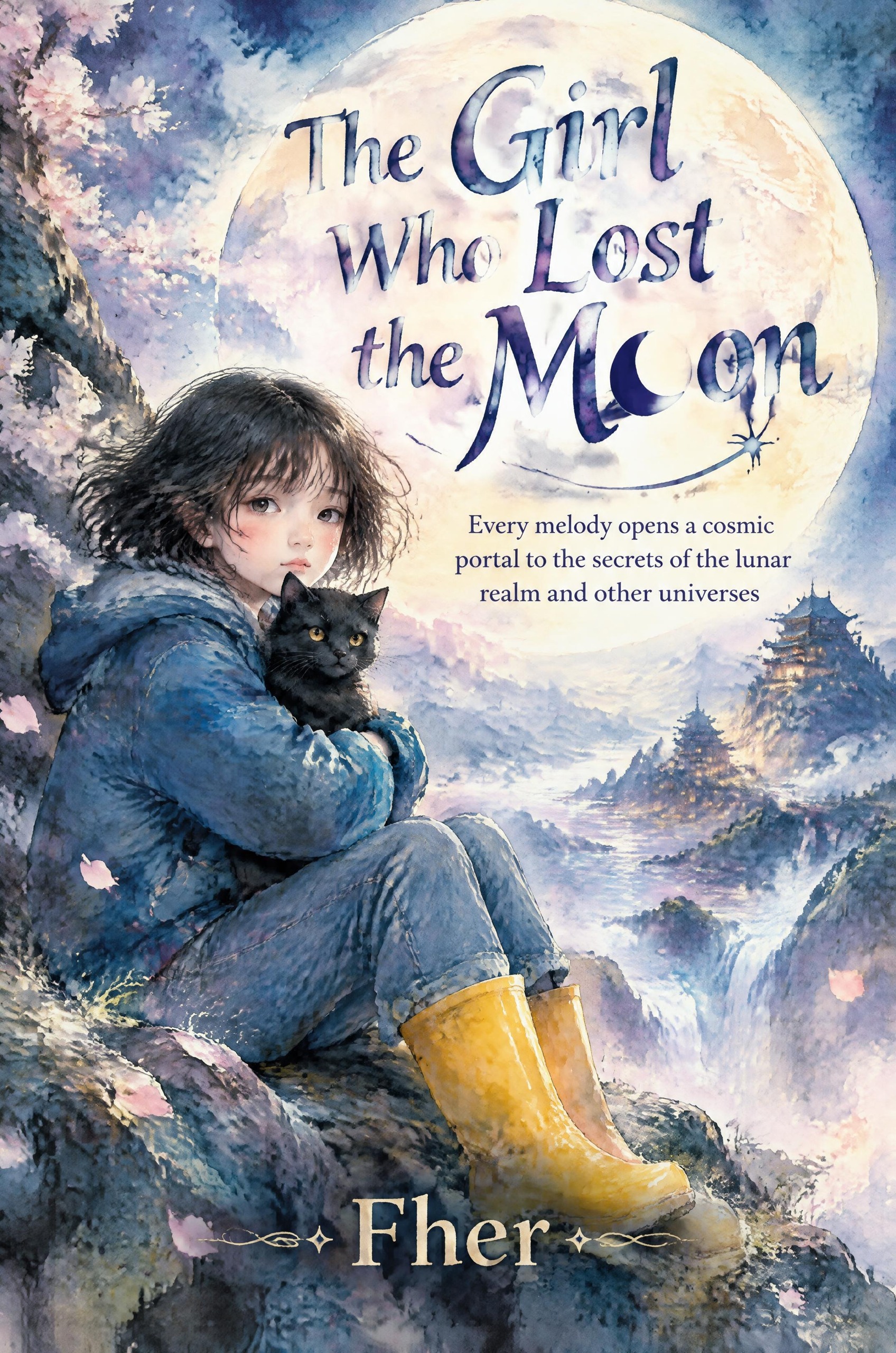
The Girl Who Lost the Moon
Every melody opens a cosmic portal to the secrets of the lunar realm and other universes
by Fernando Hernandez
Mei is ten years old and has a piano that no longer sounds like comfort. Since her mum vanished without a trace and her dad shut himself away in silent sadness, music has become her only refuge. Everything changes the afternoon she rescues Eodum in the rain. The little black cat turns out to be an ancient being: a spirit guide who guards the borders of the dream plane. When her new companion guides her fingers across the keyboard, Mei's notes tear the veil of reality and open portals to a dazzling lunar realm inspired by ancient Korean myths. There, among libraries suspended in the void and silver maps, Mei discovers that her family holds a thousand-year-old secret. But the shadows that devour the light are growing fast, fed by the dark melody her father rehearses in secret. To save her mother and mend the fabric of the worlds, Mei won't need to erase her sorrow, but to learn to walk with it. An unforgettable adventure about memory, grief, and the infinite power of music.
- Fantasy
- Adventure
- Child Books
- Portal Fantasy
- Mythological
- Middle Grade Fantasy
The Watch in the Pocket
Mei’s alarm clock had been ringing for three minutes by the time she finally opened her eyes. She didn’t get up straight away. She looked at the sand-coloured canvas roof of her tent, which smelt of old damp and candle wax, and listened to the sounds of the house waking up without her: water running through a pipe somewhere, a door being closed with care, the usual silence where there ought to have been voices.
She got dressed inside the tent, in the dark, feeling around for the uniform she had left folded the night before. Tights first, then the skirt, then the black blazer with the embroidered crest that was already beginning to fray at one corner. Her skin looked pale against the dark cloth; her short, brown hair clung to the nape of her neck, and her fringe slightly covered her large, light brown eyes, which in the half-light seemed rounder still. She blew her fringe to one side, a mechanical gesture, and reached under the pillow for her grandfather’s watch, where she kept it each night as if someone might take it from her while she slept.
It was a chain watch, heavy, made of silver tarnished with age, with engravings so fine they looked like script in a foreign tongue. It was far too big for her wrist, so she never wore it there. She kept it in the blazer’s inside pocket, pressed against her chest, where she could feel its weight every time she took a deep breath. It had belonged to her paternal grandfather. Every sixty minutes, if one pressed an ear against the cold metal, one would discover that the hand slipped behind by an entire heartbeat, as though the time within that watch refused to move at the same pace as the hours in the rest of the house.
Around the house, she always went barefoot or in thick socks across the polished floorboards. Even though the special slippers that everyone wore indoors were waiting in the entranceway, as in any Korean home, she preferred the cold touch of the floor directly against her skin, with nothing between her feet and the boards. Her school shoes were downstairs, waiting in the hall.
She crawled out of the tent on all fours, as always, and was greeted by the cold, white light of her bedroom. Everything in that room seemed arranged for someone who no longer lived there: the unruffled bed because Mei never slept in it, the desk with books stacked in neat columns, an empty music stand beside the window. The practice piano, a small upright with keys worn smooth in the middle, had remained closed for weeks.
She crept down the stairs without a sound. In the kitchen, Ji-young Lee already had a flask of hot water ready, along with a piece of bread wrapped in a cloth napkin.
“You’ll be late again,” the woman said, without looking up from the pot she was stirring. “Your father has already left for the campus.”
“Yes, Ji-young.”
“Tie your shoes.”
“Yes, Ji-young.”
She did not tie them properly. She sat down on the step in the hallway, slipped her bare feet into her school shoes, and left the laces loose, dragging on either side. She took the bread, slipped it into the pocket opposite the watch so as not to crush it against the metal, and took out her old, first-generation iPod. She put in the white earphones before stepping through the front door into the street. She tugged her jumper sleeves down until they covered her hands, a habit as old as the uniform itself, and let the murmur of a prelude shut out the morning air that still smelt of damp earth.
She walked the six blocks to school with her head down and the volume up, looking at her own feet and the sway of her loose laces. The iPod was her infallible shield: as long as music filled her ears, her mind would not wander into impossible worlds or painful memories, nor did she have to say hello to the neighbours. She slid her thumb across the click wheel, scrolling through the dozens of saved playlists, and selected the solo piano one. Instantly, the pieces she had listened to so many times paraded past: Claude Debussy’s Clair de lune unspooling in delicate arpeggios, Frédéric Chopin’s Nocturne in E-flat major, Op. 9, No. 2 with its measured melancholy, and the crystalline bars of Franz Schubert’s Moments musicaux No. 3 in F minor. She counted the cracks in the pavement in time with the piano to keep from thinking about anything else.
She arrived in the classroom just as the teacher had begun calling the register. She went in without asking permission, because asking meant everyone turning to look at her, and sat in her usual place, the second desk in the row by the window, her gaze fixed on the scratched wood of the desktop.
“Mei,” said the teacher, without reproach, merely stating a fact. “You’re here.”
“Yes,” Mei answered softly, with a quick blink, as though her eyelashes served as a curtain.
She said nothing more. She took out her exercise book and her pencil, aligning them parallel to the edge of the desk. She pressed her lips together without realising, brought a hand to her chin, and remained like that, attentive, until the lesson began. When she glanced up for an instant towards the blackboard, her eyes grew still, fixed, and the entire classroom could have vanished without her noticing.
Around her, the classroom hummed with whispers and laughter. Nearly a year ago, everything had been different: Mei would share the sweets her mother packed for her in small tins, she would laugh out loud at break time and pick up stray words—a bit of Japanese with her friend Aiko, phrases in Chinese with Lian, and Spanish idioms with Fernando. But when she withdrew and turned inwards after her mother’s departure, the others stopped coming over and drifted away in silence. Only Fer had remained, stubborn and patient, offering her warm smiles, sweets, and little notes whenever he passed by, never demanding explanations.
Between lessons, Mei would immediately put an earphone in, hidden beneath her hair, so that no one would try to speak to her. Maths passed without her saying a word, not even when the teacher asked if anyone wanted to come up to the blackboard. Mei knew all the answers, but raising her hand meant exposing herself to everyone’s gaze and shattering that wall of sound protecting her from the world.
It was during the changeover to the history lesson, in that minute of disorder when children stand up, stretch their legs, and swap books, that she felt someone approaching her desk from behind. She didn’t need to turn round. She recognised the footsteps, the slight dragging of his left foot, the way he hummed under his breath without realising he was doing it.
Fernando Hernández set something down on her desk and hurried almost at a run back to his own seat two rows away, in silence.
Mei waited for the room to settle before looking at what Fernando had left.
It was a drawing. He had made it with crayons, the thick kind children their age hardly ever used anymore, on a sheet of paper folded in half like a card. On the front was a table laden with items: round-shaped bread, fruit, a clumsily drawn portrait of a smiling gentleman, and candles with sharp orange flames. All around it was a border of tangerine-coloured flowers, petals clustered tightly together, forming a path that led out of the drawing and seemed to head somewhere beyond the paper.
Inside, in large, crooked handwriting, Fernando had written: This is an ofrenda. It’s so that those who are gone can find their way back home. The flowers are called cempasúchil. They have a strong scent so the souls can follow them. I made it for you. — F.
Mei stared at the drawing for much longer than she should have. Something tightened in her chest, a knot similar to what she felt whenever her father played certain pieces on the piano—the ones that began gently and ended in something she could not name.
She didn’t turn to look at Fernando. She didn’t smile at him. She gave no sign of thanks, even though a part of her, a tiny part hidden deep within, wanted to walk across the whole classroom and tell him that yes, she liked it, that the orange flowers were pretty, that she wanted to know more about that petal path that guided those who were gone.
Instead, she folded the drawing carefully along the crease it already had and tucked it between the pages of her maths exercise book, where no one could see it or crumple it.
It wasn’t that she didn’t care about Fernando. It was quite the opposite. She cared so much that she didn’t know what to do with it. Talking to him meant opening a door, and Mei had already learned, at ten years old, that open doors were dangerous. Through an open door, her mother had gone. Behind a closed door, her father was turning into someone else.
Better not to open any.
The rest of the day went by like any other: lessons, bells, the din of the dining hall which she avoided by sitting at the far table, alone, with an open book she wasn’t actually reading. Now and then she felt Fernando’s gaze from the other side of the room, but each time she looked up, he had already returned to chatting with the other children, laughing at something, with that effortless ease of existing in the world that Mei had completely forgotten how to manage.
When the final bell rang, Mei packed her things away slowly, on purpose, so that she would leave only when the corridor was empty. Fernando’s drawing remained between the pages of her exercise book. She didn’t take it out. But she didn’t throw it away, either.
The walk home was identical to the morning’s, only in reverse: the sun already lower, the shadows longer across the pavement, the same cracks she counted without thinking. She reached her front door just as the sky began taking on that shade between grey and purple that reminded Mei of the afternoons when her mother mixed too much water into her watercolours, the colours bleeding into one another, refusing to stay put.
Inside, the house held that particular afternoon silence—a silence that was not peace, but absence. Ji-young came out of the kitchen drying her hands on her apron the moment she heard the door.
“You’re home,” she said, as if it were important news. “Come along, I’ve made piping hot kalguksu. Just the way you like it, with anchovy broth and fresh vegetables.”
Mei took off her blazer and hung it on the coat rack by the entrance, taking care to remove the watch first and slip it into her skirt pocket. She followed Ji-young into the kitchen and sat on the high stool beside the counter, the very spot she had sat in for as long as she could remember.
“How was school?” Ji-young asked, ladling the broth into a deep bowl.
“Fine.”
“Did you eat the bread I gave you?”
“Yes.”
Ji-young placed the steaming bowl on the counter and set the traditional utensils beside it: a long-handled spoon and polished metal chopsticks, accompanied by a small dish of pickled radish slices. She stood on the other side, watching her with that boundless patience that never asked for anything in return.
“Eat slowly,” she said. “It’s hot.”
Mei picked up the chopsticks to lift the thick, handmade noodles and used the spoon to sip the clear broth. The steam rose to her eyes, and for a second she had to blink several times. It wasn’t because of the heat.
“Ji-young?”
“Yes?”
“Is Dad home yet?”
The woman took a second too long to answer, just long enough for Mei to understand that she wouldn’t like the response.
“He got in an hour ago. He’s in his study.”
Mei asked nothing more. There was no need. She went on eating in silence, alternating between spoon and chopsticks with mechanical precision, while Ji-young bustled about the kitchen putting dishes away and filling the hollows of the afternoon with small household noises that made the house feel a little less cold.
When Mei finished, Ji-young placed a hand on her forehead, a quick, almost unthinking gesture, like someone checking whether a person has a fever even though they know they don’t.
“Go up and rest,” she told her. “I’ll bring you some fruit later.”
“Thank you, Ji-young.”
“Mei.”
The girl paused on the first step.
“Yes?”
Ji-young looked at her for a long moment, as if wanting to say something more and unable to find the words, or as if the words existed but she knew it wasn’t the right time.
“Nothing,” she said at last. “Get some rest.”
Mei went up the stairs slowly, feeling the weight of the watch bumping against her hip with every step. Halfway down the first-floor landing, opposite the closed door of her father’s study, she paused involuntarily.
From inside came the sound of the piano. It wasn’t a complete piece, only fragments, phrases that began and cut off, as if the person playing could not decide what he wanted to say. Mei recognised a few bars of Chopin, others of Schubert, notes repeating over and over in search of something that refused to emerge.
She stood very still, her hand hovering millimetres from the wood.
She remembered the sound of that same door when it used to stay open. How her father would call her from inside, come, sit here, listen to this, and pull her onto his lap before the keyboard so she could feel the vibrations of the bass notes travelling up the bones of her legs. How he would explain to her that each composer had a colour, even if they never agreed on what those colours were exactly, because to her father Mozart was yellow, whereas to her he was more like white—white like the light of a Sunday morning.
He didn’t call for her anymore. The door had been shut for a long time, shut in a way that wasn’t merely about wood, but about something else—something Mei could not name, yet felt every time she passed by, like an invisible wall stretching beyond the frame.
The notes stopped abruptly. Mei held her breath.
Nothing. Silence. Then, a single low chord, sustained by the pedal, which faded slowly until it died away.
Mei stepped away from the door and walked the rest of the corridor to her bedroom.
Inside, the light was already beginning to fade, that bluish light of autumn afternoons slanting through the window, tinting everything in a shade her mother would have loved to paint. Mei locked her bedroom door, something she had done every afternoon for the past year, and dropped to her knees before the opening of her tent.
In the middle of the tent, resting upon the worn cushions, her stuffed rabbit awaited her. It was white, or had been many years ago, before the edges turned grey from the constant rubbing of her fingers, and it bore a small crescent moon embroidered on its chest in deep blue.
Inside the tent, the world grew smaller and safer. Mei switched on the battery-powered lamp hanging from one of the poles, a warm, yellow light that cast gentle shadows upon the canvas. She pulled the iPod from beneath the pillow, the first-generation device, with its scratched screen and the click wheel worn smooth in the centre from so much use. It had belonged to her father. It held more than a hundred playlists he had put together himself, with names that no longer meant anything—Playlist 14, For Mum, Sundays—yet which Mei knew by heart, every song in its exact order, the way one knows the chapters of a book read too many times.
She put on her earphones and switched on the player. She slid her thumb across the wheel, searching through the folders until she came across a playlist titled Strings and Shadow, devoted entirely to solo violin. She selected it and let the tracks play: Johann Sebastian Bach’s harrowing Chaconne in D minor, with its solemn lament; Jules Massenet’s Méditation from Thaïs, laden with a suspended, ethereal sorrow; and Christoph Willibald Gluck’s elegiac Melody in D minor. The sharp, melancholy sound of the bow drawing across the strings filled her ears as she reached out to settle the rabbit into her lap, stroking the faded thread of its seams with the pad of her thumb.
She lay back among the cushions, clutching the toy to her chest. Her mother had given it to her on the very day she was born, sewn entirely by hand. On the sole of its left paw, embroidered in blue silk thread that had barely lost its lustre, a name was written: Dal-tokki.
Her mother used to sit on the edge of the bed and tell her stories about him before everything shattered. In the tales of the Korean peninsula, he was no ordinary hare: Dal-tokki was the mythical rabbit who lived on the white moon, beneath an ancient tree, grinding the elixir of immortality in a stone mortar and guarding the nocturnal realm against the darkness. To Mei, back then, it had merely been a lovely bedtime tale; now it was the only tangible trace of her mother’s hands that still carried her gentle scent of linen and lavender.
She didn’t fall asleep. She hardly ever fell asleep early. She would lie there, earphones wedged in to keep from drifting into strange daydreams, clutching Dal-tokki to her chest as if the soft toy could hear the racing pulse of her breath.
She took out one earphone and let the music play softly, barely a thread of sound, as she stared up at the canvas roof above her head. The shadows cast by the lamp shifted slowly with each flicker of the nearly spent battery.
“Dad doesn’t look at me,” she said, in a very low voice, as if speaking it aloud made it more real than it already was. “Mum doesn’t call.”
“But you listen to me,” she whispered to the cloth rabbit, stroking the embroidery on its chest. “Don’t you, Dal-tokki?”
She ran her fingers over the crescent moon on the rabbit’s chest, feeling the soft, aged fabric, imagining for an instant that the moon rabbit’s heart was beating silently in time with her own.
She hugged Dal-tokki against her neck and lay still, seeking in that cotton body an anchor that wouldn’t dissolve into the gloom.
Outside the tent, the room remained dark. Through the small gap in the entrance, Mei could make out the rectangle of blue light coming through the window, growing darker and darker, until the afternoon finally turned to night without her ever noticing the exact moment it happened.
She thought of Fernando’s drawing, still tucked inside her maths exercise book, inside the schoolbag she had left by the door. She thought of the orange flowers, of that path of petals that, according to him, guided those who were gone back home. She wondered, involuntarily, if there might be a similar path for those who were still here but no longer knew how to feel at home either.
She found no answer. She didn’t look very hard for one. It was one of those questions Mei had learned to leave hanging, unresolved, like so many others, because answering them hurt more than letting them be.
She changed the track on the iPod, skipping past several playlists until she found one she didn’t quite recognise—something slow, for solo piano, which she couldn’t identify. She let it play.
Sleep crept in slowly, as it always did, in that twilight state where thoughts grew blurrier and images began to mingle without order: Fernando’s smiling face, the tangerine flowers, the low chord of her father’s piano fading away slowly, and the white silhouette of Dal-tokki outlined against a dark sky that didn’t seem to belong to this world.
It was right on that threshold, between waking and sleeping, that the sound drifted up from the depths of the house.
At first she thought it was part of the nascent dream. But the feeling in her chest—that chill running up her arms, making the skin prickle beneath the sleeves of her pyjamas—was no dream. It was real.
The notes seeped under her closed bedroom door, travelling down the corridor, descending from her father’s study as though the entire house had been built so that this sound would reach wherever she was, no matter how many doors stood in the way.
Mei recognised it at once. There was no need to hear more than four bars. That funeral waltz, that tempo starting out soft like an invitation and gradually twisting into something darker, something that seemed to mock her from the bass keys of the piano. First came the twelve dry chimes, a D struck in an unforgiving metre marking midnight, and then the dissonant tritone: death’s diminished fifth tearing through the calm. Each hammer blow against the strings sounded hollow, metallic, and grim, like bones knocking together in the dark. The staccato chords leapt across the lowest octaves with theatrical, tragic harshness, dragging behind them a dull rattle of resonances that set the floorboards vibrating. The melody soared in a dizzying whirlwind, dense and frantic, transforming the air into a spectral march where every pressed key seemed to rip away an invisible piece of the house.
Danse macabre.
Mei clutched Dal-tokki desperately to her chest, holding her breath while her heart hammered against her ribs in time with the frantic pace of the keyboard.
“Again,” Mei whispered, her voice coming out thinner than she would have liked.
The notes kept coming down the corridor, slipping under the doors, filling every corner of the house with that waltz her father played with veiled desperation. Her father was not mad, nor was he blind to what was happening: he knew with terrifying certainty which threshold had swallowed his wife, and he had scoured archives and legends searching for a weaver, a spinster who could mend the rift, yet he had found no one. Without the latent gift that flowed only through maternal blood and now lay dormant inside Mei, the only recourse left to him was to punish the keyboard until he tore through his own dimension, battering the keys with contained violence to force a fracture between worlds and bring his wife back, terrified by the thought that the very same shadow might end up stealing his daughter away too.
She did not stir from the tent, nor did she dare go out to investigate that night, when her body urged her to stay still, huddled deep within the canvas with Dal-tokki in her arms and her earphones turned up to the maximum volume the dying battery would allow.
She turned the volume up. The notes of Debussy playing in her ear briefly mingled with those of the real piano drifting up from the depths of the house, two entirely distinct melodies fighting for the very same space, until Mei squeezed her eyes shut and forced herself to hold on to just one of them.
She buried her face in Dal-tokki’s faded fur, breathing deeply, trying not to hear the violence with which the hammers struck the strings on the floor below.
Outside, somewhere down the hall, the waltz played on, bar after bar, rising and falling like a tide that never quite finished breaking.
Mei never knew at what point sleep finally came. She only knew that when the piano notes at last died away, long afterwards, she was still awake, her eyes open in the darkness of the tent, listening to the new silence left in the wake of the music—unlike any other in that house, one that seemed to be waiting for something that had not yet come to pass.
The rain began to beat against the windowpanes shortly before midnight. At first there were heavy, isolated drops striking the metal frame, and then a steady drumming that drowned out the creaks of the old timber. Mei lay motionless, her back pressed against the canvas, her breathing keeping time with the patter. Whenever she closed her eyes she instantly felt the fall: a vast vertigo, a sea of grey mist, and celestial chimes shattering against the water. But every time she tried to seize the image, the memory dissolved between her fingers, leaving only a hollow ache in her chest, as though she had crossed an entire bridge in her dreams only to wake without knowing which shore she belonged to.
In the Rain
Dal-tokki rested in Mei's arms, pressed against her chest with a gentleness that seemed to hold the weight of the entire world. Every time her fingers brushed the worn ears of the stuffed rabbit, a faint, deep peace washed over her body, easing the loneliness that inhabited the empty house. Dal-tokki was her only faithful companion in the nightly d…