

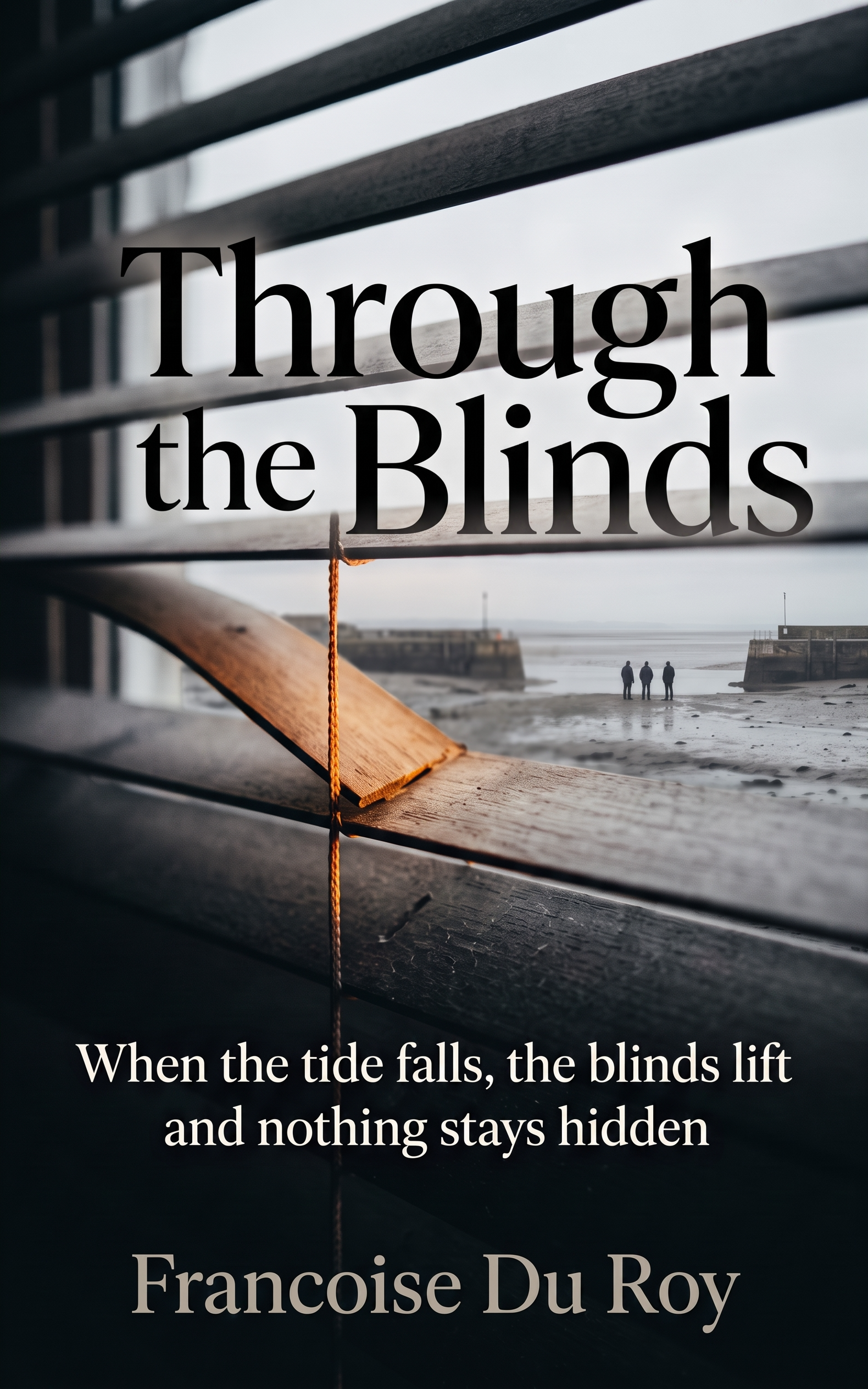
Through the Blinds at Low Tide
When the tide falls, the blinds lift and nothing stays hidden
by Francoise Du Roy
She came to the salt marshes to bury a failing marriage in paperwork. The estuary had other plans. Forty-two-year-old solicitor Janine Jackson has spent a decade locking away a canal-side secret. With her husband away in America and a major case drowning her in files, she retreats to an isolated Suffolk cottage. Anonymity is supposed to be a refuge. Instead it is a match to dry tinder. Across the mudflats at low tide, a man in tweeds watches the cottage with unnerving stillness. Venetian blinds become a stage. Lingerie becomes bare skin. What begins as a private ritual for one observer soon draws others—and the village pub, the barmaid, and Janine’s carefully constructed respectability—into a current she can no longer control. Then a late-night call from America ends the marriage for good. Through the Blinds at Low Tide is a taut, explicit descent into voyeurism, exhibitionism and the dangerous thrill of being truly seen—when the water recedes and there is nowhere left to hide.
- Erotica
- Thriller
- Contemporary Erotica
- Psychological Thriller
- Taboo
- Exhibitionism
A Month of Salt and Paper
Cardboard groaned against polished oak as I dropped the final heavy crate of files onto the dining table, the dull, gritty tang of salt air and sun-warmed wax immediately biting the back of my throat as I rolled the tight knot of tension out of my shoulders. Creek Cottage smelled of old timber and salt, the sort of place estate agents called characterful when they meant draughty. Outside the gravel drive still held the heat of the afternoon, but the estuary was already sliding towards low tide, mudflats gleaming like wet pewter.
France had been the plan. A month of decent coffee and contracts finished by the pool. Then I opened the passport and saw the expiry date staring back like a clerk who had already decided against me. A few weeks left. Not enough for passport control to play nicely. So Suffolk it was: isolated, anonymous, and cheap enough that I could tell chambers I was working remotely without anyone asking awkward questions.
Clive was in America, supposedly hammering out some acquisition that needed his personal charm. I was fairly certain the charm was being applied elsewhere. We had not slept in the same bed for eight months. The conversations had become invoices and builder updates. I had already written the marriage off in my head; the paperwork would follow when he came home, or didn’t.
The table disappeared under lever-arch files and plastic wallets. A merger that refused to lie down. Pre-existing agreements that would or would not survive the new structure, depending on how clever I could be before the next conference call. I had brought enough work to bury myself for four weeks if I chose. Part of me hoped I would.
The phone on the kitchen counter rang at six, transatlantic delay making Clive sound as if he were speaking from the bottom of a well.
“They’ve found more issues with the sales specifications,” he said, no greeting. “Don’t worry about it. Enjoy the sea air. I’ll be back in a few weeks.”
“I’m not worrying,” I said. “I’m working.”
“Good. That’s my girl.” A woman’s laugh somewhere behind him, quickly muffled. “Must go. Dinner thing.”
The line went dead. I set the phone down carefully, as if it might bruise. Practised coolness. Inside I was already drafting the settlement letter I would send when the time came. Amicable. Fair. No drama. We both knew it had been dying for years.
I poured a large gin and tonic, two cubes, no fruit, and carried it to the bay window. The living room faced the water. Venetian blinds half drawn, the way I had found them. I left them exactly like that. The tide was falling fast now, exposing the creek bed, the black ribs of an old boat, the harbour wall on the far side.
A man sat perched on the harbour wall, an unmoving silhouette draped in a weathered tweed jacket and jeans, legs casually crossed against the stones. A paperback was cupped in one hand while his other arm hung loose, fingers cradling a cigarette whose thin ribbon of blue smoke drifted lazily into the briny air before vanishing into the twilight. He looked entirely settled, as though he had grown there alongside the salt-crusted timber and the lichen.
My lawyer’s brain immediately started cataloguing the facts. Isolated village. Not a soul knowing who I was. My passport sitting useless in the bedside drawer, and my husband three thousand miles away playing happy families with whoever had giggled in the background. And right across the water, this quiet figure sat on the harbour wall, mirroring almost identically the librarian who had once occupied the bench opposite my old canal apartment a decade ago.
God, had it really been ten whole years? I thought, staring out across the mudflats. Back then, I’d been a fresh, ambitious young solicitor who had somehow found herself stripped down to matching lingerie in front of an open window, night after night, desperately teasing a stranger buried in his book. I remembered the sheer terror of it, the absolute panic of unbuttoning my blouse, wondering if he’d glance up, terrified that he would and utterly crushed when he didn’t.
It had started as a spontaneous thrill—a tiny crack in a changing-room curtain—and escalated until I was standing naked in the bedroom glow, soaking wet between my thighs, my fingers sliding over my clit while he sat completely unbothered across the water. That illicit rush had awakened an exhibitionist craving I’d never known was inside me, one that made my pussy ache with a deep, pulsing heat just from the sheer gamble of being caught.
I had sealed that scandalous fortnight away the moment I climbed the partnership ladder and settled into married life. But looking at the man on the harbour wall now—tweed jacket, book, cigarette, motionless—it was like looking at a ghost. The resemblance was uncanny, and instantly I felt that same old current flare back to life, nine parts sharp anxiety and one part raw, electric desire that made my heart hammer against my ribs.
I sipped the gin and stayed at the glass. He turned a page. That was all. The light was going, the mudflats turning the colour of wet slate. I could have closed the blinds. I could have sat down with the files and forgotten the whole ridiculous echo.
Instead I stayed. The cottage was too quiet. The village too empty. Anonymity was already doing its work, loosening the neat tailoring I still wore, the respectable solicitor who billed by the six minutes and never left a paperclip out of place. I felt the first illicit jolt, the same one that had once made me unbutton a blouse I had no intention of removing.
I shifted my weight against the windowsill, catching my faint reflection in the darkened pane as I reached up to pull the band from my dark-blonde hair, letting it tumble loose over my shoulders. At forty-two, I still held onto the firm, gym-toned frame beneath my tailored clothes—long legs, curves that hadn't given up, and full breasts I'd taken to hiding under sensible linen now that no one at home bothered looking. In the glass, my face still photographed as someone you'd trust with your deeds, but my eyes gave away the reckless heat simmering just beneath the surface.
He did not look up. Not yet. I told myself it proved nothing. He was simply a local with a book and a habit of sitting still. The hunger that stirred was mine alone, a leftover from a life I had sworn was finished.
I finished the gin and poured another. The files waited. The merger would not draft itself. Yet I remained at the window, watching the tide expose more of the flats, watching the man who did not move. The gravel drive behind me was empty. No one would come. No one knew I was here except Alison, who would ring later for the usual catch-up, and Clive, who was busy elsewhere.
The old ritual wanted to start. Check the window. Inventory the risk. Decide how much skin was an accident and how much was an invitation. I had committed no offence then and I would commit none now. I was a woman standing in her own rented sitting room with a drink. The offence, if there was one, lived entirely in what I hoped he might do with the information.
He turned another page. The cigarette glowed. I felt my pulse in my throat, that familiar cocktail of nerves and something warmer, lower. I had not planned this. It was happening the way the changing-room curtain had happened: spontaneously, before the sensible part of me could vote it down.
I set the glass on the sill and let my jacket slide off one shoulder, then the other, feeling the cool evening air graze the silk of my blouse. Just the jacket. Nothing more. A woman arriving, unpacking, getting comfortable. He did not look, but the scrape of wool slipping down my bare arms sent a sharp, electric thrum straight down between my thighs, quickening my breath in the dim room.
The light died properly. He produced a small torch and kept reading. I stood there until the second gin was gone and the files on the table began to look like an accusation. Then I drew the blinds the rest of the way, not because I wanted privacy but because I needed to prove I still could.
The cottage settled around me, timber ticking as the temperature dropped. I opened the first wallet of contracts and tried to read. The words slid. All I could see was the harbour wall and the motionless figure who had already become the librarian, ten years later and a coastline away.
The hunger could stay buried. It had stayed buried this long, and a month of salt air and contracts ought to have been enough to keep it that way.
Yet when I finally went upstairs I left the bedroom blind an inch open, the same way I had left the canal window, just in case the tide and the man on the wall decided to look after all.
Sleep did not come quickly. I lay listening to the creek suck at the mud, feeling the way my body had answered a stranger’s stillness as if it had been waiting a decade for the cue. The respectable facade was already thinner than I liked. Anonymity had that effect. It always had.
Tomorrow I would work. I would ring Alison and talk about anything except this. I would not stand at the window again. That was the plan. I almost believed it, the way I had once believed the canal episode was a one-off aberration I could file and forget.
Outside, the tide would turn. The man in tweeds would be there or he would not. Either way, I already knew I would check.
Half-Drawn Slats
I spent the day drowning in leases I could not hold in my head. Clause after clause slid off the page as if the salt in the air had loosened the ink. Recitals, indemnities, change-of-control provisions that ought to have been second nature after twenty years at this game simply refused to stay put. I made coffee at half past eight, then again at el…