

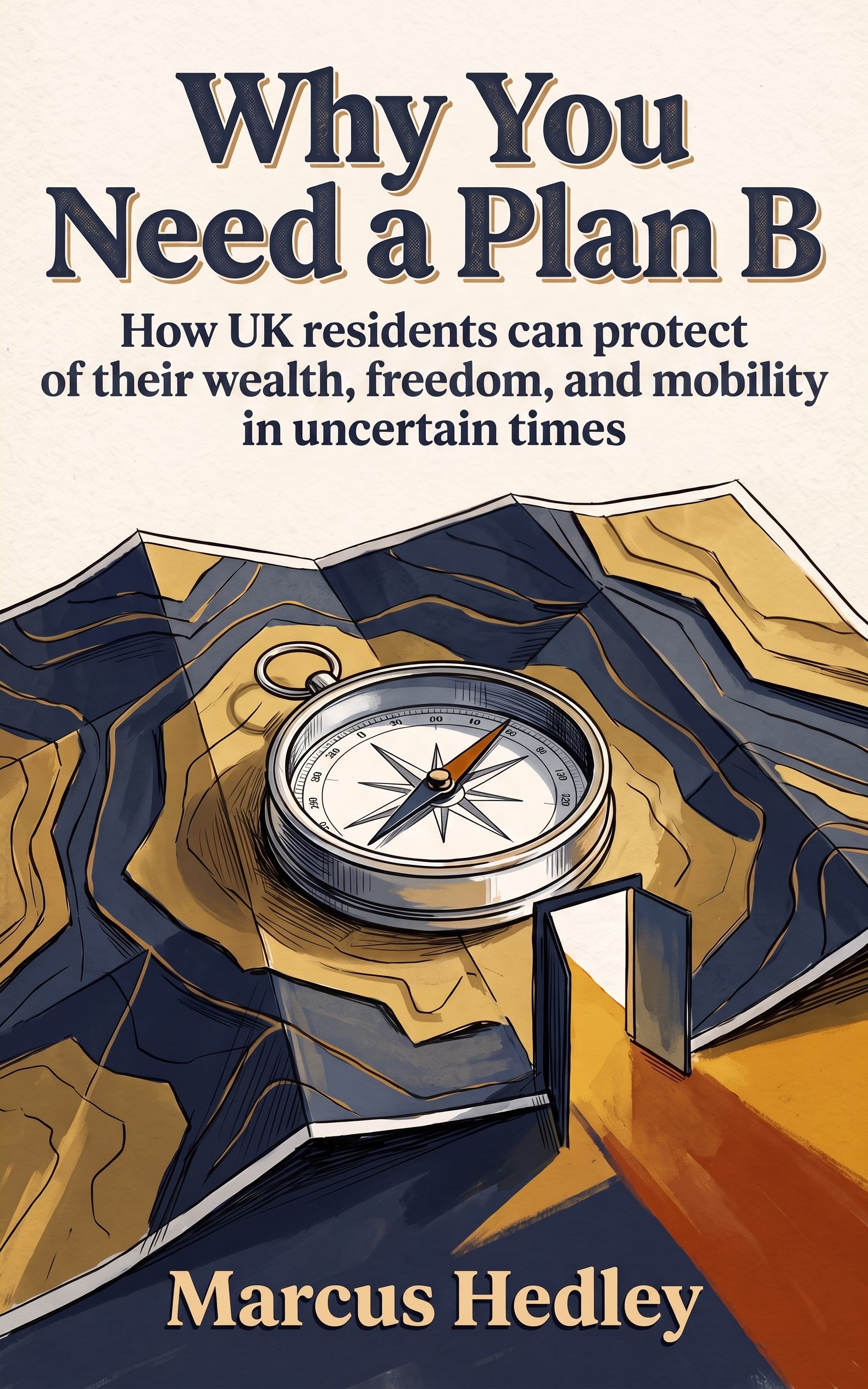
The Plan B Guide: Why You Need a Plan B
How UK residents can protect their wealth, freedom, and mobility in uncertain times
by Francoise Du Roy
Are your assets, freedom, and lifestyle fully protected against systemic risk? In an era of rising national debt, shifting regulations, and global volatility, relying on a single country for your financial security and personal freedom is no longer a safe strategy. While Britain remains a vibrant home, the margin for error has narrowed—leaving unprepared citizens vulnerable to sudden economic and institutional shifts. In The Plan B Guide: Why You Need a Plan B, risk analyst Marcus Hedley delivers a clear, non-ideological blueprint for personal resilience. Moving past fear and politics, this book provides a pragmatic framework to evaluate your personal exposure and take concrete action. Inside, you will learn how to: - Audit your financial and legal vulnerabilities in the UK. - Safeguard your capital through cross-border diversification. - Protect your digital privacy, autonomy, and personal security. - Build international networks and secure flexible global residency options. Drawing on historical lessons from nations that experienced rapid structural change, Hedley transforms complex global trends into a step-by-step strategy for independence. Don't wait for a crisis to force your hand. Discover how to build a robust contingency plan today and take control of your family's future.
- Self-Help
- Finance
- Travel Guide
- Financial Independence
- Wealth Building Strategies
- Expat Living
Why people wait too long
Consider two neighbours on the same ordinary street in England. Both are in their early fifties, both own their homes outright, and both have modest savings alongside workplace pensions.
One of them has spent a little time each year preparing for uncertainty. She renews travel documents well before they expire, keeps secure copies of important records, maintains an emergency fund, and has taken the trouble to understand whether a realistic residence option abroad might ever be available to her family. She has also made sure that she is not entirely dependent on a single bank, a single source of income, or information stored only in one place.
The other has done none of this. Not because he thinks preparation is foolish, but because it has never quite risen to the top of his list. There is always a school run, a work deadline, an ageing parent, a household repair, or a Saturday better spent doing something more enjoyable.
For years, the difference between the two is invisible. Nothing happens to test it. Then life changes: a serious illness, a job loss, a major change in tax rules, a period of financial strain, an urgent family need, or a moment when a move abroad would suddenly be useful rather than merely interesting. At that point, the neighbour who prepared is not guaranteed an easy answer, but she has choices. The one who did not prepare discovers that his options are limited to whatever remains available, and whatever remains is often slower, more expensive, and less attractive than it would have been several years earlier.
This is the central pattern on which this book is built: people who prepare early usually retain more choice; people who wait often find that events have made choices for them.
That is not a dramatic claim. It is simply how options behave over time. A residency route that is available today may be changed, restricted, or closed to new applicants later. A country that looks appealing for a future move may become less affordable. A period of calm may be the easiest time to organise documents, learn a little of another language, take a reconnaissance trip, or obtain independent professional advice. The lesson is not that disaster is coming. The lesson is that, whatever comes, early preparation normally leaves more room to manoeuvre than late preparation.
The Comfort of Yesterday
There is a well-known tendency in human psychology to assume that because conditions have been stable for a long time, they will remain stable. This is often called normalcy bias. It is not stupidity, cowardice, or a personal failing. It is a useful shortcut for ordinary life.
You do not inspect every familiar street as if it were dangerous. You do not expect every journey to end in an accident. You do not wake each morning assuming that the systems around you will fail. Most of the time, that instinct is sensible. Most days do resemble the day before, and most people would struggle to function if they treated every possible setback as imminent.
The problem begins when this sensible habit becomes the only guide to planning. Some environments change slowly; others appear stable for long stretches and then change much faster than people expect. Financial conditions can tighten. A family member’s health can alter the practical choices available. Employment can become less secure. A new policy can change the economics of saving, owning property, running a business, or spending time abroad. Administrative systems that work tolerably well in normal conditions can become slow and difficult when demand rises or capacity is reduced.
In such moments, the person who has done nothing is not necessarily irresponsible. They have simply discovered that their comfortable assumption—that tomorrow would look broadly like yesterday—was not enough of a plan.
Normalcy bias is comforting because it is usually correct. Most years do genuinely resemble the year before. But the value of preparation is concentrated in the years that do not. Nobody needs a contingency plan for a year that goes smoothly. The point of a Plan B is to reduce the cost of being wrong when life, policy, markets, or family circumstances take an unexpected turn.
Why Familiar Institutions Feel Permanent
A related habit is to place complete confidence in institutions simply because they are familiar. The NHS, the courts, the civil service, the banking system, pensions, local authorities, and the wider legal system have formed the background to British life for decades. For many people, they have functioned reliably enough that it feels unnecessary, even disloyal, to ask whether their capacity could ever be strained.
This book is not arguing that these institutions are about to fail. Britain retains important strengths, including long-established legal traditions, deep professional expertise, substantial private wealth, international connections, and institutions that continue to perform vital work every day. Those strengths matter.
But capability is not a permanent condition. It depends on funding, staffing, competent management, public confidence, clear rules, and the ability to adapt when circumstances change. Each can be weakened gradually. A service may remain recognisable while becoming slower, more expensive, less accessible, or less consistent than it was before. Public perception often lags behind this kind of change because trust has been built over decades of experience.
A prudent person does not need to become cynical about institutions in order to prepare independently. Respecting an institution is not the same as assuming it will always operate exactly as it did thirty years ago. It is sensible to value public systems while also keeping important documents accessible, maintaining some financial resilience, understanding your legal position, and ensuring that your family is not completely dependent on one point of failure.
The Insurance We Already Buy
There is a simple inconsistency in the way many people think about risk. Most of us already practice preparedness in other parts of life, often without calling it that.
A typical financially responsible household may have:
- Home insurance, in case of fire, flood, theft, or other damage.
- Car insurance, because even careful drivers can be involved in accidents.
- Life insurance or income protection, because dependants may need support if work or health changes unexpectedly.
- A pension, because people understand that life after employment requires long-term preparation.
- Investments spread across more than one company, sector, or asset type, because placing everything on one outcome is widely understood to be risky.
Nobody calls this paranoid. Buying home insurance is not a prediction that a house will burn down. Holding some savings for emergencies is not an admission that a crisis is expected. Diversifying investments is not a claim that the economy is about to collapse.
These are ordinary habits of a sensible adult managing uncertainty. They are based on probability rather than certainty. The question is not whether an unwelcome event is guaranteed to happen. The question is whether the cost of a modest preparation is reasonable when compared with the cost of being unprepared.
Yet many people who insure their homes, protect their income, and diversify their investments have done little to diversify other parts of their lives. Their essential documents may be scattered in drawers. Their financial access may depend on a single institution. Their income may depend on one employer or one local market. Their knowledge of residence options, travel rights, healthcare arrangements, or practical relocation may be almost non-existent. They may have no current passport, no emergency contact plan, no secure record of key information, and no idea what they would do if circumstances changed quickly.
A Plan B is simply the extension of ordinary insurance logic into these neglected areas of life. It is not a declaration that Britain has failed. It is a decision not to leave every aspect of personal security dependent on a single set of circumstances.
What This Is Not
It is worth being direct about what a Plan B is not, because the idea can attract more heat than it deserves.
A Plan B is not a prediction that Britain is about to experience a currency crisis, widespread disorder, or state failure. Nothing in this book asks the reader to assume that. Britain has faced serious pressures before and has often adapted, sometimes slowly and imperfectly, without suffering the kind of abrupt discontinuities seen elsewhere.
A Plan B is also not the same as permanent emigration. Some readers may eventually decide to spend part of the year abroad, obtain a lawful residence right elsewhere, or relocate entirely. Others may decide that their best Plan B is to remain in Britain while strengthening their finances, skills, documents, professional flexibility, and family preparedness. Both can be successful outcomes.
The goal is not to leave. The goal is to have the ability to make an informed choice—whether that means adapting in place, spending time elsewhere, or moving if circumstances make that sensible.
Nor is a Plan B the same thing as obsessive fear. There is a meaningful difference between a household that reviews its financial resilience once a year, keeps important records up to date, and takes modest steps to widen its options, and a household that spends every evening consuming catastrophic predictions. The first is preparedness. The second can carry a real personal cost.
Sensible risk management should reduce anxiety, not manufacture it. A person with a clear plan generally worries less about difficult news because they know they are not starting from zero. They know where their documents are, whom they would contact, what financial resources are available, and what practical steps could be taken if a significant change occurred.
It is also fair to acknowledge the strongest counterargument. Many concerns about Britain’s future will not turn into a dramatic crisis. Warnings about social, financial, and political decline have circulated for generations. Britain has often muddled through, sometimes at genuine cost, but without the sharp breaks seen in less resilient countries.
A sceptical reader is entitled to say that most gloomy forecasts do not come true, and that preparing for every imaginable danger can waste time, money, and peace of mind. That is correct. A Plan B should not require someone to make reckless financial decisions, hold their life in suspension, or pursue an overseas move that does not suit their family, finances, or health.
But this objection misses the purpose of preparation. The purpose is not to bet everything on one prediction. It is to be reasonably well positioned across a range of plausible futures. Most of those futures may be mild. Some may be more difficult. The point is not to predict precisely which one will happen.
Insurance works in exactly this way. A driver who buys insurance is not predicting a crash. They are recognising that crashes happen, that the cost of being wrong can be high, and that a manageable ongoing cost is preferable to a large, sudden loss. A personal Plan B applies that same reasoning to financial access, skills, documentation, income flexibility, and the ability to live or spend time in more than one place.
Uncertainty about the future is the reason to prepare. It is not proof that catastrophe is coming.
The Cost of Waiting
The difference between the two neighbours at the start of this chapter was not intelligence, wealth, or political outlook. It was timing. Timing matters because the value of most options declines as the need for them becomes more obvious.
A person who looks into residence possibilities abroad while life is calm can compare countries, learn the requirements, travel slowly, and decide that none of the options is right for them. That is still a useful outcome. They have exchanged uncertainty for knowledge.
A person who begins the same process only when it has become urgent is more vulnerable to poor information, pressure, expensive intermediaries, unsuitable property decisions, and schemes that promise far more than they deliver. They may also discover that overseas property ownership does not automatically create a right to live in a country, that tax residence is more complicated than expected, or that health, family responsibilities, and language create constraints they had not considered.
The same principle applies to other parts of a Plan B. It is easier to renew a passport before it is needed, sort out a will before a medical emergency, learn how to access records before a lost device, build an emergency fund before a job loss, or develop portable skills before a career becomes uncertain. Preparation is generally cheaper when it is gradual and voluntary than when it is rushed and imposed by events.
Consider a couple in their late fifties with a paid-off home, adult children, and a comfortable but not extravagant pension. Their lives are entirely rooted in Britain: their savings, pension arrangements, healthcare expectations, professional contacts, and family support. For decades this may have been entirely sensible. There may have been no reason to complicate a life that was working well.
Then a change arrives. It may be personal rather than national: one partner develops a health issue, a parent needs care, an adult child moves abroad, or the couple begin to think seriously about their later years. It may be financial: costs rise, an income changes, or the value of their savings feels less secure than it once did. It may be political or administrative: a rule changes, a residence pathway becomes harder, or a long-postponed question suddenly becomes urgent.
They begin researching options for the first time and discover how much they do not know. They may find that the best routes require planning, evidence, legal advice, time in the country, language ability, or a financial commitment. None of this makes action impossible. It simply means that the process is more difficult when the decision is rushed.
Doing nothing is also a decision. It is the decision to allow future circumstances, rather than deliberate judgment, to determine what options remain. Sometimes that costs nothing because nothing significant changes. At other times it costs a great deal because the decision was never recognised as a decision in the first place.
Prudence, Not Panic
The right way to think about a Plan B is not as an emergency response to an imagined crisis. It is a form of ordinary personal housekeeping. It should be practical, proportionate, and reviewed occasionally rather than allowed to dominate daily life.
For one person, a Plan B may begin with a current passport, secure document copies, a clearer household budget, better digital security, and a modest emergency fund. For another, it may mean investigating whether they could work remotely, spend part of the year abroad, or obtain residence rights in another country through a lawful route. For a retiree, it may mean understanding pension, healthcare, tax, and inheritance implications before making a commitment. For a family with limited savings, it may mean improving skills, reducing avoidable debt, building trusted networks, and knowing where to find reliable information.
The question is not whether every reader should do the same thing. The question is whether you have enough understanding and enough flexibility to act deliberately if circumstances change.
Ask yourself honestly: if life in Britain changed materially over the next one to five years—through further fiscal pressure, a policy change, a shock to household finances, a health issue, or a family need—would you have genuine choices? Or would you be starting from scratch at the moment when you had the least time and least leverage to act?
For many people, the honest answer may be uncomfortable. That discomfort is not a reason to panic. It is simply a signal that it may be time to begin.
Britain remains home to millions of people for good reasons, and it may remain the right place for you. But a fair-minded look at public finances, demographic change, institutional capacity, political uncertainty, and a less predictable international environment suggests that the margin for assuming tomorrow will always resemble yesterday has narrowed.
The next chapter takes that proposition seriously. It examines why Britain may be at an inflection point, what that means in practical terms, and why the case for personal optionality deserves closer attention.
Britain at an Inflection Point
Countries rarely put up a sign to mark the moment their trajectory changes. There is no single headline, vote, or official announcement that tells a population: this is the year in which the assumptions that guided the last generation will no longer guide the next one.Britain is not a failed state, and nobody writing honestly about its future can t…