

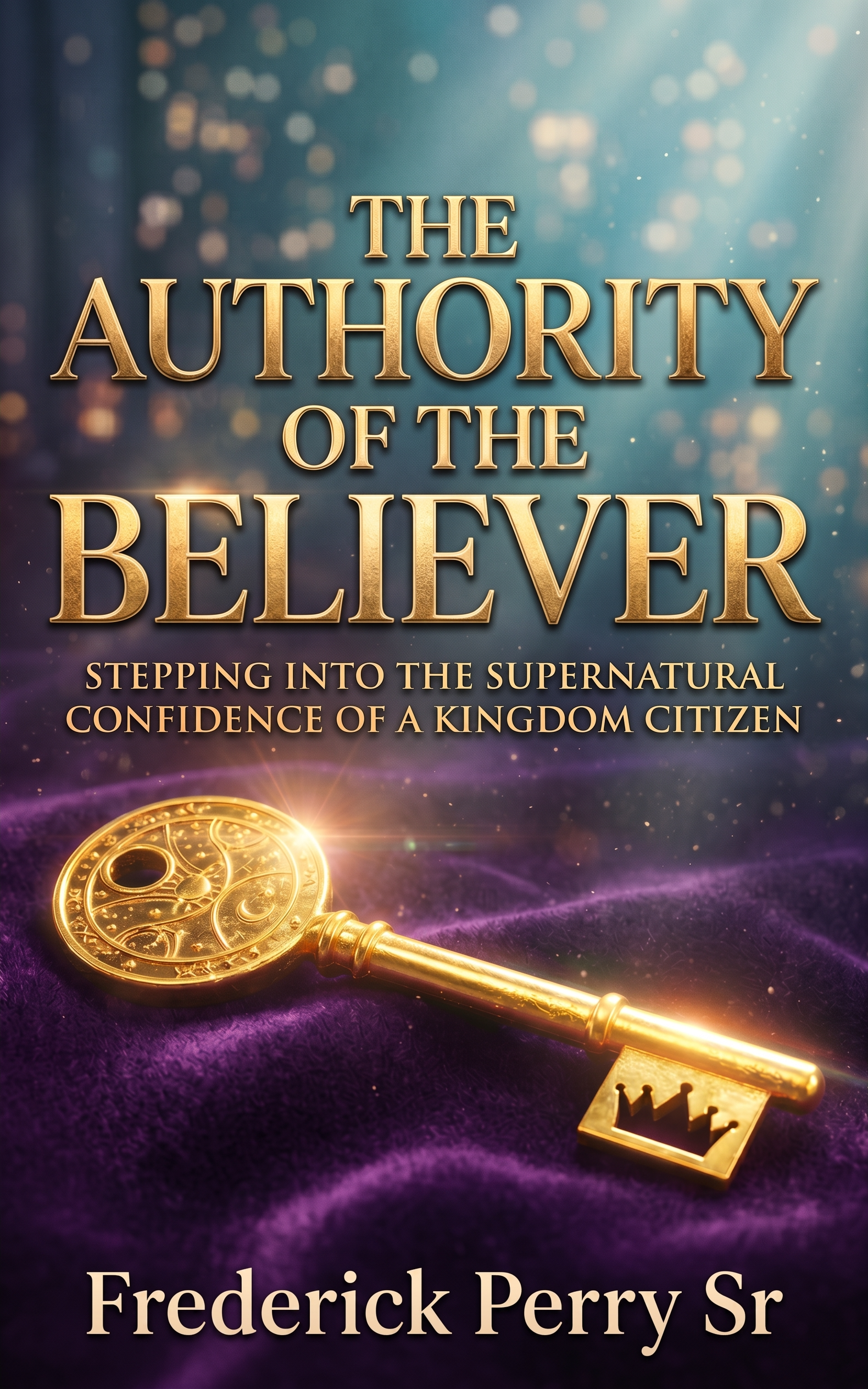
THE AUTHORITY OF THE BELIEVER
Claim your heavenly citizenship and walk in the unshakable power of God's kingdom
by Frederick Perry
You were never meant to live a life of spiritual defeat. In the third volume of the Dominion and Authority Series, Frederick Perry Sr delivers a transformative roadmap for every believer who feels there is more to the Christian walk than mere survival. The Authority of the Believer reveals that your identity is not defined by your circumstances, but by your legal standing as a citizen of heaven. This isn't just about spiritual warfare; it's about a fundamental shift in perspective. Discover how to move from a place of hoping for victory to living from a position of triumph. Perry expertly breaks down the ambassadorial role of the Christian, teaching you how to represent the King with both boldness and humility. Through practical wisdom and deep theological insight, you will learn to: - Renew your mind to break free from earth-bound limitations. - Develop sharp spiritual discernment to hear God’s voice clearly. - Walk in the governance of love to exercise true spiritual authority. - Maintain stability and integrity in an ever-shifting world. Stop living beneath your privilege. It is time to embrace your birthright, put on your royal identity, and step into the authority you were designed to carry.
- Religion & Spirituality
- Self-Help
- Christianity
- Spiritual Growth
- Prayer & Devotional
- Mindset & Motivation
Citizens of Heaven
There is a document sitting in a government file somewhere that determines more about your daily life than almost anything else. It tells you which laws apply to you, which courts have jurisdiction over you, which protections you can invoke, and which resources you can access. It determines whether you can work in certain places, live in certain locations, and receive certain benefits. It is not your birth certificate, though that matters too. It is your proof of citizenship. And the remarkable thing about it is that you did not earn it through achievement. You were either born into it or you went through a legal process of transfer. Either way, the moment it was granted, everything that citizenship carries came with it.
This is exactly the kind of reality the New Testament is describing when it speaks about what happens at salvation. Colossians 1:13 puts it plainly: God "has delivered us from the domain of darkness and transferred us to the kingdom of his beloved Son." That word "transferred" is doing significant legal work in that sentence. It is not the language of aspiration or spiritual progress. It is the language of a completed transaction. A transfer, in legal terms, is a formal change of ownership or jurisdiction. It means something has moved from one governing authority to another. You were under one jurisdiction. Now you are under a different one. The transfer is done.
A Formal Change of Jurisdiction
Most believers understand salvation as a moral event. They were forgiven. Their sins were covered. They received eternal life. All of that is true, and none of it should be minimized. But there is a legal dimension to salvation that often goes unexamined, and missing it leaves a person with only half the picture. Salvation is not simply a change in your moral record before God. It is a change in your citizenship. You moved from one kingdom to another, and that move came with all the legal implications of any change in jurisdiction.
Consider what it means in natural terms when someone becomes a citizen of a new country. They are no longer subject to the laws of their former nation in the same way. They have new rights. They have a new passport. They carry the authority and protection of a new government. If they travel abroad, they represent a different country than they did before. If they need help in a foreign city, they call a different embassy. The legal framework that governs their life has fundamentally changed, not because they feel different, but because a formal transfer took place.
This is what happened when you came to Christ. Philippians 3:20 says, "Our citizenship is in heaven." Not will be. Not might be, if we perform well enough to keep it. Is. Present tense, right now, already settled. The kingdom of heaven is your governing authority. Its laws apply to you. Its resources are available to you. Its King represents you. You are not a foreigner trying to get into the kingdom through good behavior. You are a citizen with legal standing.
The reason this matters so much practically is that most believers live as if they are still under the old jurisdiction. They pray as if the laws of lack, sickness, fear, and defeat still govern them. They accept conditions that their citizenship gives them the right to contest. They beg for things that are already included in what their new country provides. It is as though they went through the entire citizenship process, received all the documentation, and then continued living by the rules of a country they no longer belong to. The transfer happened. But they are not walking in what the transfer gave them.
From a Position, Not Toward One
Here is the shift that changes everything. Most believers have been taught, implicitly or explicitly, to think of the Christian life as a journey toward a destination. You are working toward holiness. You are pressing toward the finish line. You are trying to get closer to God, trying to earn more access, trying to accumulate enough spiritual credibility to operate in real authority. The Christian life becomes a long climb, and authority is the summit you hope to reach someday.
But that is not the framework the New Testament presents. The New Testament presents the finished work of Christ as the starting point, not the goal. You do not live toward victory. You live from it. The victory was won at the cross, confirmed at the resurrection, and legally applied to every believer at the moment of salvation. You are not trying to get to a position of authority. You are already in one. The work is not to achieve what Christ accomplished. The work is to understand it well enough to live accordingly.
Think about what it means to inherit something. When a person inherits a property, they do not earn the property through years of labor. They receive it because of their relationship to the one who owned it. The moment the legal process of inheritance is complete, the property belongs to them. They did not build it. They did not pay for it. But it is theirs by right, and they have every legal standing to live in it, maintain it, and make decisions about it. The only thing that could stop them from benefiting from what they inherited is if they never moved in.
Romans 8:17 says believers are "heirs of God and fellow heirs with Christ." Not heirs in training. Not candidates for inheritance. Heirs. The inheritance is already established. What is required is not more spiritual achievement but a clearer understanding of what you already have legal access to and the willingness to actually occupy it.
The Rights of a Heavenly Citizen
Citizenship is never just a title. Every citizenship comes with a specific set of rights, and those rights are not optional add-ons. They belong to every citizen equally, regardless of how long they have been a citizen or how they feel about their standing on any given day. A new citizen has the same legal rights as someone whose family has been in the country for generations. The rights are attached to the citizenship, not to the person's history or performance.
The rights of heavenly citizenship are substantial. Access to the Father is one of them. Ephesians 2:18 says believers have "access in one Spirit to the Father." This is not access based on spiritual seniority or religious track record. It is legal access, available to every citizen. The right to use the name of Jesus is another. John 16:23-24 makes clear that asking in that name carries the full backing of the one who holds it. The right to the provision and care of the King is woven throughout the Sermon on the Mount, where Jesus repeatedly frames God's provision as a matter of family relationship: "your Father knows what you need." These are not promises you have to qualify for through performance. They are rights that come with the citizenship.
There is also the right to operate in authority over spiritual opposition. Luke 10:19 records Jesus saying He has given His followers "authority to tread on serpents and scorpions, and over all the power of the enemy." That is not a special gift for a select few. It is a statement about what kingdom citizens carry. It is part of the jurisdiction that changed when the transfer happened. The enemy no longer has legal authority over a citizen of heaven, and a citizen who knows their rights can enforce that legal reality.
This is where the cultural gap between earth and heaven becomes visible. Earth's systems operate on the premise that resources are limited, that access depends on status, and that power belongs to the strongest or wealthiest. Heaven operates on entirely different principles. In the kingdom, the least is the greatest. Generosity multiplies rather than diminishes. Authority flows through humility, not force. The King serves His people. These are not just different values. They are a different operating system entirely, and a believer who tries to function in kingdom authority while thinking with earthly logic will find constant friction between who they are and how they are living.
The Culture of Your Home Country
When someone moves from one country to another, they carry the culture of where they came from. Their habits, expectations, and assumptions were shaped by their original home. It takes intentional effort to adopt the culture of a new place, to understand how things work there, what is normal there, and what the social and legal norms of the new country actually are. The transfer of citizenship happens in a moment. The cultural transformation takes longer, and it requires deliberate engagement.
This is exactly what Paul is describing in Romans 12:2 when he instructs believers not to be conformed to this world but to be transformed by the renewing of the mind. The citizenship transfer is already done. The mind, however, still carries patterns formed under the old jurisdiction. It still defaults to the logic of lack, the logic of fear, the logic of working for what you should already know you own. Renewing the mind is the process of learning to think like a citizen of heaven rather than a subject of earth's failing systems.
Heaven's culture does not operate in anxiety about the future, because the King already holds it. It does not operate in shame before God, because the legal record has been cleared. It does not operate in competition for limited resources, because the supply comes from an unlimited source. A believer who is actively renewing their mind begins to see these realities not as hopeful ideas but as functional truths that change how they make decisions, how they respond to pressure, and how they pray.
The contrast with earth's systems is not just philosophical. It is practical. Earth's political systems are fracturing. Its economic structures are unreliable. Its social frameworks are shifting in ways that produce widespread instability. None of this surprises a citizen of heaven, because the kingdom they belong to is not built on those foundations. Their security does not come from a stable economy or a stable government. It comes from an unchanging King whose kingdom has no end. That is a genuinely different foundation, and it produces a genuinely different quality of stability in a person's daily life.
Stop Seeking What You Already Possess
There is a particular kind of spiritual exhaustion that comes from spending years praying for things you already have. It is the exhaustion of a person who owns a house but keeps sleeping outside because nobody told them the deed was already in their name. They are praying for shelter. They are believing for provision. They are asking God to give them what they need. And all along, the house is there, the deed is recorded, and the key is available. The problem is not a lack of faith. The problem is a lack of information about what they already legally possess.
This is one of the most common forms of spiritual poverty in the church, and it is not caused by a lack of devotion. It is caused by a misunderstanding of what the legal transfer of citizenship actually conveyed. When a believer learns that healing, peace, access to the Father, authority over darkness, and the provision of the King are not things they are hoping to receive someday but things they already have legal access to right now, it changes the entire posture of their spiritual life. They stop begging and start enforcing. They stop asking God to do what He already did and start applying what He has already provided.
Enforcing is the right word here. A citizen who knows their rights does not beg the court to recognize those rights. They present them. They invoke them. They stand on the legal ground that has already been established in their favor. This is not arrogance. It is legal literacy. It is knowing what your country's law says about your situation and refusing to accept treatment that violates it. In spiritual terms, it means refusing to accept the conditions that the enemy tries to impose on a citizen of heaven, because those conditions have no legal standing in the jurisdiction you now live under.
The challenge at the end of this chapter is a simple one, but it requires honest reflection. Where are you living like a foreigner in your own country? Where are you accepting conditions that your citizenship gives you the right to contest? Where are you praying for things that heaven's law already says belong to you? The transfer already happened. The rights are already established. The King's name already backs your authority. The only remaining question is whether you will start living like it is true.
Your home country has a culture, a set of resources, and a legal framework that is unlike anything the world has ever produced. It does not rise and fall with markets. It is not threatened by political instability. It is not limited by the scarcity that governs every earthly system. You were transferred into it the moment you came to Christ, and everything that citizenship carries came with you in that moment. Not someday. Not after you have grown enough or prayed enough or learned enough. Now. The address has already changed. It is time to live at the new one.
Ambassadors for Christ
There is a specific kind of person who walks into a room differently than everyone else in it. Not because they are louder, or more physically imposing, or carrying visible credentials. They walk differently because of what they know about who sent them and what they carry on that person's behalf. They have been briefed. They have been authorized. …