

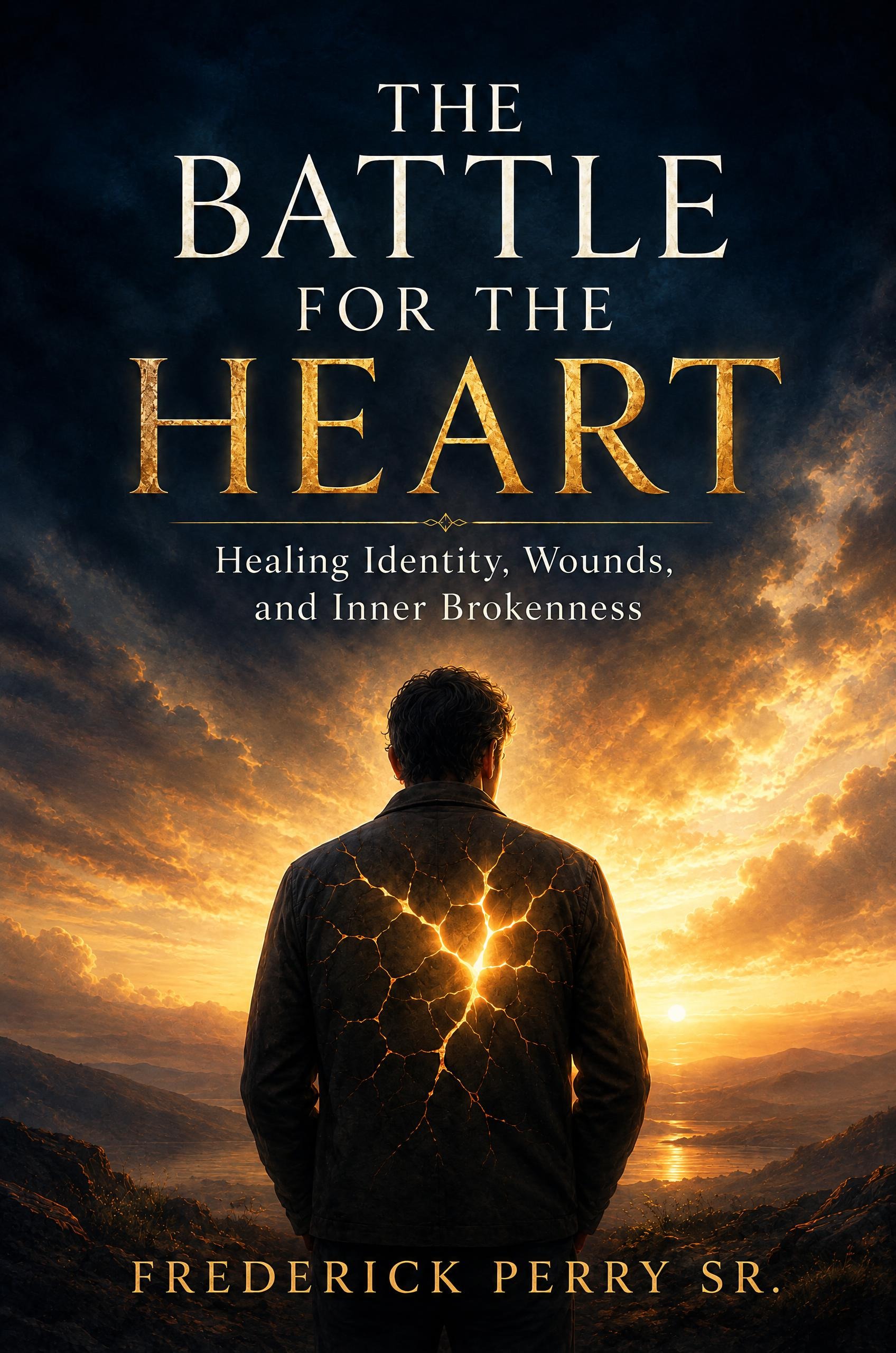
THE BATTLE FOR THE HEART
A pastoral guide drawing on Scripture and biblical narratives to address emotional pain, spiritual wounds, and distorted identity. The book navigates four movements: identifying hidden wounds, uncovering the lies pain teaches about self-worth, applying biblical truth and healthy boundaries, and learning to live from a restored identity in Christ.
- Religion & Spirituality
- Self-Help
- Christianity
- Spiritual Growth
- Healing & Trauma
- Boundaries & Self-Care
The Battle No One Sees
“But the LORD said unto Samuel, Look not on his countenance, or on the height of his stature, because I have refused him: for the LORD seeth not as man seeth; for man looketh on the outward appearance, but the LORD looketh on the heart.”
—1 Samuel 16:7
There is a woman standing at the door of the tabernacle at Shiloh, and she is falling apart.
Her name is Hannah. She has come to worship in a season when worship costs her everything she has. She is barren in a culture that measured a woman’s worth by her children. She shares a household with another woman who has children and who uses them as a weapon. Scripture says plainly that her rival “provoked her sore, for to make her fret” (1 Samuel 1:6). Year after year. Not once—year after year.
So she is standing there praying, and her praying does not look like praying. Her lips are moving but no sound is coming out. She is weeping. She is in a condition that most churches would not know what to do with.
And Eli the priest looks at her and concludes she is drunk.
I want you to sit with that for a moment. The spiritual leader—the man positioned at the very door of the house of God—looked directly at a woman in the deepest anguish of her life and misread her completely. He saw the behavior. He did not see the battle.
Then Hannah says one of the most honest sentences in all of Scripture:
“No, my lord, I am a woman of a sorrowful spirit… but have poured out my soul before the LORD.”
—1 Samuel 1:15
I am a woman of a sorrowful spirit.
She does not perform. She does not explain herself away. She does not pretend to be further along than she is. She names her condition out loud in the presence of God, and God is not offended by it. In fact, the chapter ends with God remembering her.
But notice what had to happen first. Someone had to see her wrongly before she could be seen rightly.
The Wound Nobody Diagnoses
Most of the people reading this book have never had anyone look at them and see it.
If you break your arm, the world responds immediately. There is a cast. There are questions. People carry things for you. Nobody says, “That’s been six weeks now—shouldn’t you be over that?” There is a visible marker that says: this person is injured, adjust accordingly.
There is no cast for a heart.
So the person whose father left when they were nine goes to work. The person who was betrayed by their closest friend leads the meeting. The person who was told they were worthless by the one voice that should have told them otherwise raises their children and coaches the team and teaches the class, and everyone around them thinks they are fine, because fine is the only category available.
And here is what that does over time: it teaches you that your pain is not real, because if it were real, surely somebody would have noticed by now.
That is a lie, and it is one of the earliest ones we learn. Pain that goes unwitnessed does not stop being pain. It just stops being spoken.
The Skill of Looking Fine
Let me say something that may sting a little, in love.
Many of us have not been healed; we have simply gotten good.
Good at redirecting the conversation. Good at answering “How are you?” without ever answering. Good at staying busy enough that the quiet never arrives. Good at spiritual language that sounds like faith but functions as avoidance—“I don’t dwell on the past,” “I gave that to God years ago,” “I don’t have time to be in my feelings.” Sometimes those statements are true and glorious. Sometimes they are a very well-built wall.
Competence is a wonderful gift and a magnificent hiding place.
We even have a religious version of it. There are believers who can teach a class on the healing power of God and have never once let Him near the room where their own hurt lives. I say that without a word of condemnation, because for a long stretch of my own life I could have been described exactly that way. It is possible to be genuinely saved, genuinely faithful, genuinely useful—and genuinely unhealed in a specific place.
That is not hypocrisy. That is being human in a world that gave us wounds and never gave us a place to bring them.
The Battle Is Real Even When It Is Invisible
Consider Elijah.
In 1 Kings 18, this man stands alone against four hundred and fifty prophets of Baal and calls fire down from heaven. It is one of the great public victories in all of Scripture. Everyone saw it.
In 1 Kings 19—the very next chapter—he is sitting under a juniper tree in the wilderness asking God to take his life. “It is enough; now, O LORD, take away my life” (1 Kings 19:4). Nobody saw that. There was no crowd on that mountain. The same man, days apart.
And watch how God handles him, because it will tell you something about how God intends to handle you.
God does not rebuke him. God does not deliver a lecture about how a man who just called down fire has no business being discouraged. God lets him sleep. God feeds him—twice. God asks him a question and lets him answer it, and lets him answer it a second time when the first answer was not the whole truth. And when God finally speaks, He does not come in the wind or the earthquake or the fire. He comes in “a still small voice” (1 Kings 19:12).
The God who thundered on Carmel whispered under the juniper tree. He knows the difference between a man who needs a display of power and a man who needs to be treated tenderly.
If you have been afraid that God is impatient with the condition you are in, look again at how He treated His prophet on his worst day.
Even the Son of God Fought a Battle No One Saw
We should not move past this chapter without going into the garden.
On the last night, Jesus takes Peter, James, and John into Gethsemane, and Scripture pulls back the curtain on His interior life in a way that ought to stop us cold:
“Then saith he unto them, My soul is exceeding sorrowful, even unto death: tarry ye here, and watch with me.”
—Matthew 26:38
He told them. He said it plainly. He asked them to stay awake with Him.
And they slept.
Three times He came back, and three times He found them sleeping. The deepest agony ever experienced by a human soul was taking place a stone’s throw away from three men who loved Him, and they did not see it.
Do you understand what that means for you? The Savior you are bringing your wound to is not a stranger to being unwitnessed. Isaiah called Him “a man of sorrows, and acquainted with grief” (Isaiah 53:3). He knows what it is to hurt in a room where nobody is watching. He knows what it is to ask for company and be met with silence.
“For we have not an high priest which cannot be touched with the feeling of our infirmities; but was in all points tempted like as we are, yet without sin.”
—Hebrews 4:15
That is not a doctrine to admire from a distance. That is a Person who understands your Tuesday.
The First Honest Step
So where do we begin?
Not with a formula. Not with a demand that you produce a breakthrough by the end of this chapter. We begin where Hannah began: by saying the true thing out loud in the presence of God.
David did it constantly. Read the Psalms with fresh eyes and you will find a man who tells God exactly where he is before he ever tells God what he believes. “My heart is sore pained within me” (Psalm 55:4). “I am poured out like water” (Psalm 22:14). “Why art thou cast down, O my soul?” (Psalm 42:11). These are not the words of a weak believer. These are the words of the man God called a man after His own heart.
Honesty is not the opposite of faith. Honesty is where faith starts working with something real.
So I am going to ask you to do one thing before you turn to chapter two, and only one:
Admit that there is a battle.
Not the whole story. Not the analysis. Not the resolution. Just the acknowledgment—between you and God—that something in you has been hurting and you have been carrying it by yourself for a long time.
He already knows. This is not new information for Him. But something changes in us when we stop pretending in the presence of the One who has been watching the whole time with love.
“Thou tellest my wanderings: put thou my tears into thy bottle: are they not in thy book?”
—Psalm 56:8
Your tears have been collected. Not ignored. Not counted against you. Collected—the way a person keeps something precious.
Hagar, running through the wilderness, hurt and used and cast out, gave God a name that no one had given Him before:
“…Thou God seest me.”
—Genesis 16:13
That is where this book begins. Not with a fix. With a witness.
You have been fighting a battle no one sees.
He sees.
For Reflection
Take these slowly. There is no need to answer all of them today.
- Is there a battle you are currently fighting that the people closest to you know nothing about? What has kept it unspoken?
- Hannah said, “I am a woman of a sorrowful spirit.” If you were to name your condition as plainly as she named hers, what would you say?
- Has someone ever misread you the way Eli misread Hannah—seeing your behavior but missing your battle? How did that shape what you were willing to share afterward?
- Where has competence become a hiding place for you? What are you very good at that keeps you from having to sit still?
- Read 1 Kings 19:1–13 slowly. What do you notice about the order in which God cared for Elijah—what came first, and what came last?
- What would it look like, this week, to say one true sentence to God about where you actually are?
A Closing Word
I am not asking you to be brave in this chapter. I am asking you to be honest, which is often the harder of the two.
If nothing moved in you as you read this, that is all right. If something moved and you would rather it had not, that is all right too. You are not behind. There is no schedule you are failing to meet.
The Lord who healeth the broken in heart is unhurried, and He is already in the room.
“The LORD is nigh unto them that are of a broken heart; and saveth such as be of a contrite spirit.”
—Psalm 34:18
Next: Chapter Two — When the Heart Has Been Wounded
When the Heart Has Been Wounded
“For I am poor and needy, and my heart is wounded within me.”—Psalm 109:22There is a man in the Old Testament whose whole life was shaped by an accident that happened when he was five years old.His name was Mephibosheth. He was the son of Jonathan and the grandson of King Saul, which means he was born into royalty. But when word came that Saul and …