

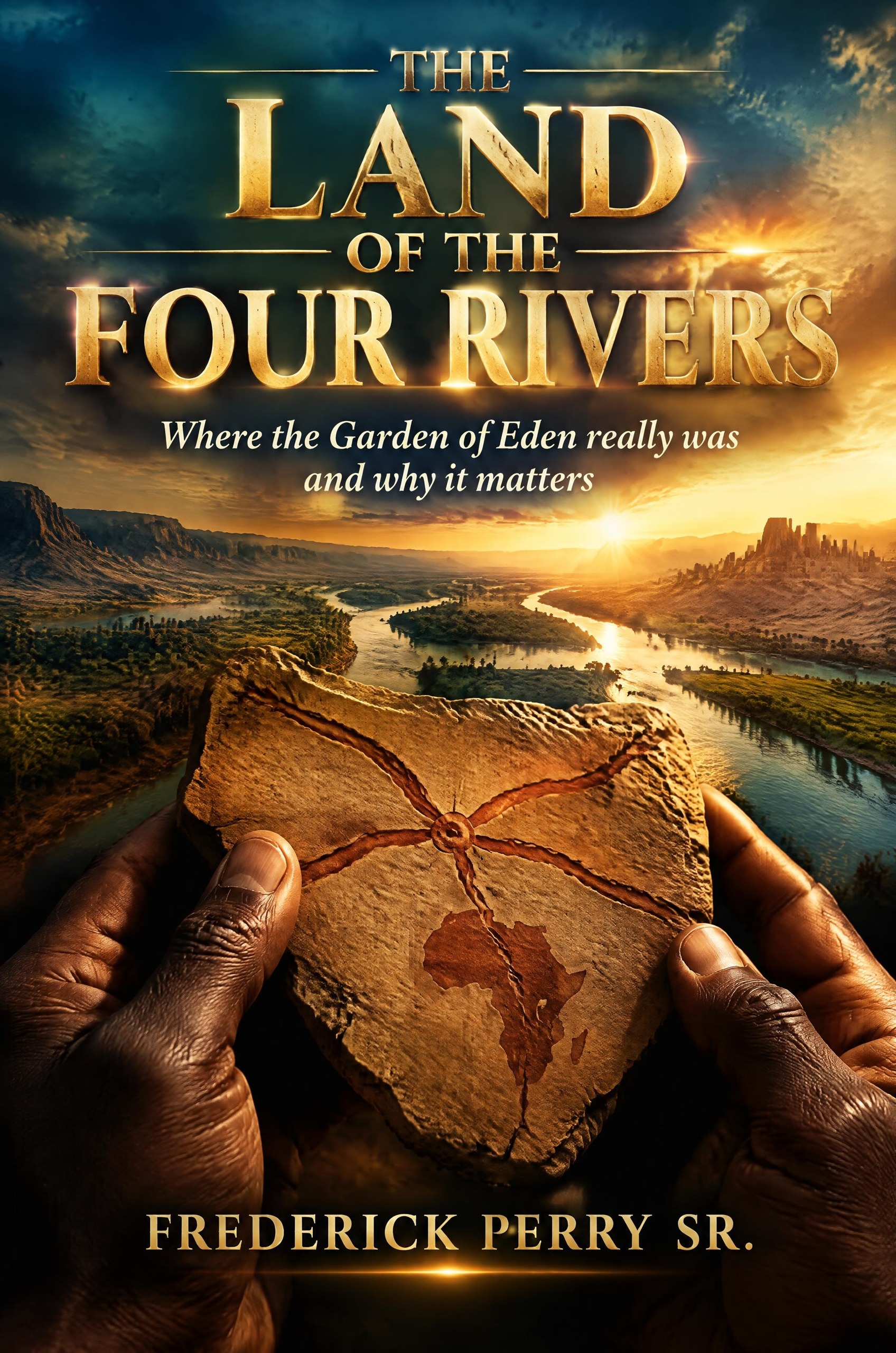
THE LAND OF THE FOUR RIVERS
Where the Garden of Eden really was and why it matters
The Garden of Eden has been painted, preached, and imagined for two thousand years—almost always in the wrong place. Western art localized it to Europe. Church tradition recast its inhabitants with pale skin. And in 1807, a Bible stripped of liberating passages was shipped to enslaved people in the Caribbean to keep them docile. This book goes back to the text itself. The Land of the Four Rivers investigates the geography of Genesis 2, tracing the Euphrates, Tigris, Pishon, and Gihon to their real-world sources in Arabia and the African land of Cush. It examines the Hebrew roots of Adam and adamah, revealing a name tied to red earth and vital soil, not European features. It documents the presence of Cushites and African figures throughout Scripture, the suppression of that record by colonial powers, and the profound legacy of early African church leaders in Carthage and Alexandria. Finally, it asks what science says about human origins and how young-earth and old-earth Christians can both affirm that all nations are made of one blood, reconciled in Jesus Christ, the Last Adam. This is a book about history, language, theology, and the truth that sets people free.
- Religion & Spirituality
- Historical Non-Fiction
- Christianity
- Sacred Texts & Scripture
- Religious History Studies
- Ancient History
Why “Where” Matters
— ❦ —
“So God created man in his own image, in the image of God created he him; male and female created he them.” — Genesis 1:27
Every person carries a picture of the beginning. Few of us remember when we first received it. It may have come from a framed print on a Sunday school wall, a children’s Bible with bright illustrations, a film shown at Easter, or a stained-glass window catching the morning light. However it arrived, it settled in quietly and stayed. Ask almost anyone to describe Adam, and an image rises before they have time to think about it.
That image deserves examination. Not because pictures are sinful, and not because imagination has no place in faith, but because the pictures we carry shape the conclusions we draw. What we assume about the first man influences what we assume about every man and woman who came after him. A question that sounds like a matter of geography turns out to be a matter of identity.
This book asks a simple question: where did Adam live? The answer reaches further than a location on a map.
The Picture We Were Given
For generations, much of the Western church learned the story of creation through European eyes. The garden looked like an English estate or a Tuscan hillside. Adam and Eve appeared with pale skin, light hair, and features drawn from the artist’s own neighbors. Noah, Abraham, Moses, David, the prophets, the apostles, and Jesus Himself were painted the same way.
Artists have always painted the familiar. A painter in Florence used faces from Florence. A painter in Amsterdam used faces from Amsterdam. That tendency is understandable, and in its original setting it was often innocent. The trouble came later, when those paintings traveled far beyond their studios and were received not as one culture’s imagination but as the way things actually were.
Once an image is treated as fact, it begins to do work that no one assigned to it. It tells children who belongs at the center of the Bible’s story and who stands at the edges. It suggests that the people of Scripture looked like one part of the human family and not the others. It quietly teaches that the land of the Bible was nearer to Europe than it truly was. None of this is written in Genesis, yet millions absorbed it as though it were.
The Bible never describes Adam’s hair, eyes, or complexion. It does something more important. It tells us where he was placed, what he was made from, and whose image he bore. Those details are the proper starting place. Everything else must be tested against them.
Image Bearers, Every One
The first chapter of Genesis makes a declaration that has no equal in the ancient world. Other nations told stories in which human beings were servants created to relieve the gods of their labor, or accidents born from divine conflict. Genesis says something far higher.
“And God said, Let us make man in our image, after our likeness: and let them have dominion over the fish of the sea, and over the fowl of the air, and over the cattle, and over all the earth, and over every creeping thing that creepeth upon the earth.” — Genesis 1:26
Man is not an afterthought. He is the product of divine counsel. “Let us make” is the language of intention and deliberation. God did not stumble into humanity; He purposed it.
Notice also what the verse does not do. It does not assign the image of God to one nation, one tribe, or one color. The image is given to “man” — to humanity as a whole, male and female together. Whatever the image of God includes, it belongs to every descendant of Adam without exception.
The apostle Paul carried this truth into the heart of Athens. Standing before philosophers who prided themselves on their ancestry, he declared:
“And hath made of one blood all nations of men for to dwell on all the face of the earth, and hath determined the times before appointed, and the bounds of their habitation.” — Acts 17:26
One blood. All nations. One Creator who set the times and boundaries of every people. Paul’s audience considered themselves superior to the rest of the world, and he dismantled that notion with a single sentence rooted in Genesis.
This is why the location of Eden matters. If all nations came from one man, then the story of that man belongs to all nations. When his story is claimed by one group and presented in one group’s likeness, something precious is taken from everyone else. And when the truth is restored, something precious is returned.
A Question Worth Asking
Some readers may wonder whether this question is worth the effort. Does it truly matter where the garden stood? Isn’t the spiritual lesson of Eden more important than its coordinates?
The spiritual lesson is indeed central. Eden teaches us about fellowship with God, the goodness of creation, the dignity of work, the gift of marriage, the reality of temptation, and the tragedy of sin. None of that depends on a map.
Yet Scripture itself chose to include the map. Genesis 2 pauses in the middle of the creation account to name four rivers, identify the lands they flowed through, and even describe the quality of the gold found in one region. Moses did not have to write those verses. The Holy Spirit did not have to inspire them. They are there because God wanted His people to know that Eden was a real place in a real world.
When God gives details, His people should pay attention to them. Paul wrote that “all scripture is given by inspiration of God, and is profitable” (2 Timothy 3:16). That includes the geography. The rivers of Genesis 2 are as inspired as the promise of Genesis 3:15. To ignore them is to neglect part of what God said.
There is a second reason the question matters. When the truth about a subject has been obscured, recovering it becomes an act of faithfulness. Scripture repeatedly calls God’s people to remember, to search, and to test what they have been told. The Bereans were commended because they “searched the scriptures daily, whether those things were so” (Acts 17:11). They did not simply accept what they heard, even from an apostle. They checked it against the Word.
This book invites the same kind of searching. Some of what follows will confirm what you already believed. Some of it may unsettle a picture you have carried since childhood. Either way, the goal is not to replace one set of assumptions with another. The goal is to see what the evidence actually shows.
When Truth Meets Resistance
It would be dishonest to pretend this subject is neutral. Questions about human origins touch deep places. For some readers, discovering that the Bible’s world was centered far from Europe will feel like a long-overdue correction. For others, it may feel like an attack on something familiar.
Neither reaction should decide the matter. Feelings are real, but they are not evidence. The question is not whether a conclusion is comfortable but whether it is true.
Jesus said, “And ye shall know the truth, and the truth shall make you free” (John 8:32). Truth frees because it removes what binds us to error. Sometimes the removal is painful. A splint must come off before a limb can move freely again. But the freedom is worth the discomfort.
At the same time, truth must be handled with care. A person who uses facts as weapons to wound others has missed the point of truth altogether. The purpose of recovering what was lost is not to exalt one group over another. It is to restore to every group what belongs to all of them. That is the spirit in which this book is written.
How This Book Weighs the Evidence
Because this subject stirs strong feelings, the method matters as much as the conclusions. Every claim in these pages is tested against four standards.
First, Scripture. The King James Version is quoted throughout, with each reference given so readers can open their own Bibles and check. Where Scripture speaks plainly, its word is final.
Second, the original languages. Genesis was written in Hebrew, and some of its meaning is only visible in that language. When a Hebrew word matters to the argument, its meaning is drawn from standard reference works such as Strong’s Concordance and the Brown-Driver-Briggs Hebrew lexicon.
Third, the documented record. Ancient historians, archaeological discoveries, museum collections, and published scholarship all contribute. When a fact comes from one of these sources, the source is named so readers can verify it.
Fourth, honest labeling. Some questions can be answered with certainty. Others cannot. Where the evidence is strong, this book says so. Where scholars disagree, both sides are presented. Where a conclusion is an interpretation rather than an established fact, it is identified as interpretation.
This last standard is the most important safeguard. It would be easy to write a book that overstates its case, claiming certainty where there is only probability. Such books often sell well for a season, but they collapse when a careful reader checks the sources. The truth does not need exaggeration. It needs only to be told accurately.
Why Origins Shape Identity
Every people on earth tells a story about where it came from. Nations celebrate founders, families preserve genealogies, and individuals search records to discover who their ancestors were. The instinct runs deep because origins answer a question every human heart asks: Who am I, and where do I belong?
Scripture answers that question at the level of the whole race before it answers it for any single person. David marveled at how intimately God had shaped him:
“For thou hast possessed my reins: thou hast covered me in my mother’s womb. I will praise thee; for I am fearfully and wonderfully made: marvellous are thy works; and that my soul knoweth right well.” — Psalm 139:13–14
In another psalm, he looked up at the night sky and asked what place man could possibly have in so vast a creation:
“What is man, that thou art mindful of him? and the son of man, that thou visitest him? For thou hast made him a little lower than the angels, and hast crowned him with glory and honour.” — Psalm 8:4–5
That crown of glory and honour was not placed on one nation’s head. It rests on humanity as God created it. When any group is taught, openly or quietly, that the Bible’s story belongs to someone else, that crown is dimmed in their eyes. They may still believe the gospel, yet carry a lingering sense of standing at the edge of a story that was never really theirs.
The reverse is also true. When a people is taught that the Bible’s story belongs chiefly to them, pride can grow where gratitude should. The history examined in later chapters shows how that pride was used to justify cruelty on a massive scale.
An accurate account of human origins guards against both errors. It tells every reader the same thing: you descend from the man God formed with His own hands, you bear the image He placed on the whole race, and the land where it all began is the common inheritance of every nation.
The Danger of Borrowed Assumptions
Most errors about Scripture do not begin with deliberate deception. They begin with assumptions borrowed from someone we trust. A teacher repeats what his teacher said. A textbook repeats what an earlier textbook claimed. An artist paints what earlier artists painted. Over generations, an assumption hardens into what “everyone knows.”
Solomon recognized this pattern long ago:
“He that is first in his own cause seemeth just; but his neighbour cometh and searcheth him.” — Proverbs 18:17
The first version of a story always sounds convincing — until someone examines it. The Bible does not ask believers to reject everything they were taught. It asks them to test it. Paul wrote, “Prove all things; hold fast that which is good” (1 Thessalonians 5:21). Proving comes first; holding fast follows.
That pattern will guide the chapters ahead. Some traditions will pass the test and deserve to be held firmly. Others will fail it and must be released, however familiar they feel.
Two or Three Witnesses
The law of Moses established a principle for settling disputed matters: “at the mouth of two witnesses, or at the mouth of three witnesses, shall the matter be established” (Deuteronomy 19:15). Jesus repeated it (Matthew 18:16), and Paul applied it in the church (2 Corinthians 13:1).
The principle is wise far beyond the courtroom. A single source can be mistaken. When several independent witnesses agree, confidence grows.
This book calls several witnesses to the question of Adam’s origin. Scripture is the first and final authority. Alongside it stand the witness of the Hebrew language, the witness of geography, the witness of ancient historians, the witness of archaeology, and the witness of documented history. None of these secondary witnesses carries the authority of Scripture. But when they agree with one another and with the plain meaning of the text, their testimony strengthens the case.
Where the witnesses disagree, that disagreement will be reported honestly. A verdict built on selected testimony is no verdict at all.
The Road Ahead
The chapters ahead follow a deliberate path.
Part One stays close to the biblical text. It reads Genesis 2 slowly and examines the Hebrew words behind the man God formed.
Part Two follows the rivers. It traces the four streams named in Scripture, explores the land of Cush, and surveys the places where serious students have located the garden.
Part Three asks what was left out. It examines Africans named in the Bible whose stories are rarely preached, an edition of Scripture that deliberately removed passages about freedom, the process by which the Bible’s people were repainted, and the African roots of early Christian thought.
Part Four turns to science. It presents what scientists teach about human origins, then examines that teaching through two Christian lenses: the young-earth reading and the old-earth reading.
Part Five draws everything together. It returns to the truth that all nations share one blood and closes where every biblical story ultimately leads — to Jesus Christ, the last Adam.
The First Witness
Every investigation begins by calling its first witness. In a question about Eden, that witness can only be the text that first described it. Before consulting historians, archaeologists, or scientists, we must hear what Genesis itself says — and hear it without adding what we expect to find.
That is where the journey begins: in the second chapter of the Bible, with a garden planted toward the east.
“Eastward in Eden”: Reading Genesis 2 Plainly
— ❦ —“And the LORD God planted a garden eastward in Eden; and there he put the man whom he had formed.” — Genesis 2:8Most people read Genesis 2 quickly. They know the story well enough — the dust, the breath, the garden, the rib — and their eyes move past the geography to reach the drama of the serpent in chapter 3. Yet the second chapter of the Bi…