

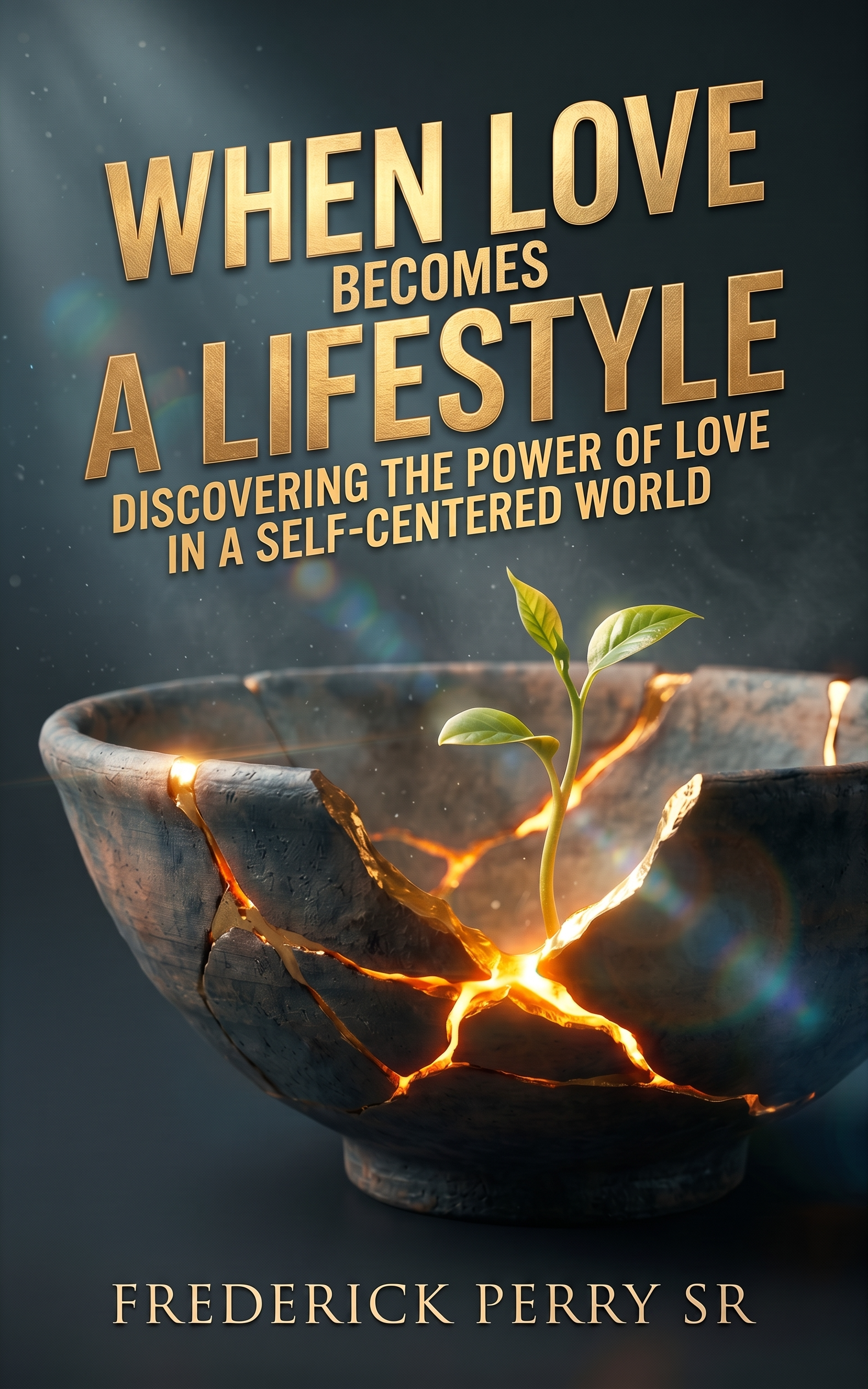
When Love Becomes a Lifestyle
Discovering the Power of Love in a Self-Centered World
by Frederick Perry
In a world that equates love with fleeting feelings and self-gratification, the ancient words of the Apostle Paul offer a radical alternative. Biblical love is not a passive emotion; it is a disciplined posture and a transformative way of life. In 'When Love Becomes a Lifestyle,' Frederick Perry Sr. takes readers on an immersive journey through 1 Corinthians 13, deconstructing the gap between spiritual performance and spiritual maturity. He reveals that without love, even the most impressive spiritual gifts are nothing more than empty noise. This is a call to move beyond the spiritual childhood of the Corinthian church and into a robust, adult faith characterized by patience, humility, and honor. Through insightful analysis and practical application, Perry demonstrates how to cultivate a heart that keeps no record of wrongs and finds joy in the truth. Whether you are seeking to heal broken relationships or deepen your walk with God, this book provides the spiritual roadmap needed to turn the highest virtue into your daily reality. Complete with a 30-day lifestyle guide, this book will challenge you to stop merely speaking of love and start living it.
- Religion & Spirituality
- Christianity
- Spiritual Growth
- Prayer & Devotional
- Personal Growth
The More Excellent Way
There is a moment in every believer's life when the question shifts. It stops being what can I do for God? and becomes something much harder to sit with: who am I becoming? That shift is uncomfortable, because most of us have built our spiritual confidence on activity. We measure our walk by what we produce, what we know, and what gifts we display. Paul had something to say about that. What he wrote in 1 Corinthians 13 was not a poetic interlude tucked between chapters about spiritual gifts. It was a correction. A pastoral interruption. A father pulling his children aside to tell them they had missed the point entirely.
Why Paul Wrote 1 Corinthians 13
Paul did not write this passage because the Corinthian church lacked spiritual power. He wrote it because they had spiritual power and were misusing it. This distinction is vital for us today, because it warns that we can easily mistake our spiritual activity and influence for spiritual maturity. The letter to the Corinthians was written to a church that was causing Paul tremendous heartache. They were dividing over teachers, tolerating immorality, taking each other to court, and turning the Lord's Supper into a social occasion for the wealthy. And yet, in the middle of all of it, they were also speaking in tongues, prophesying, and boasting about their spiritual gifts as though those gifts were proof of their maturity.
Paul's response was not to invalidate the gifts. He spent all of chapter 12 affirming that the gifts are real, that they come from the Holy Spirit, and that every member of the body has a role to play. But then he paused and told them there was a way that surpassed all of it. He called it a more excellent way. That phrase is not a suggestion. It is a signpost, pointing them away from spiritual performance and toward something the gifts alone could never produce.
The Context of a Gifted but Immature Church
Corinth was one of the most cosmopolitan cities of the ancient world. It was wealthy, culturally diverse, and filled with competing philosophies and religious practices. The church that formed there reflected its surroundings in many ways. Status mattered in Corinth. Public display mattered. Being seen, heard, and admired was woven into the social fabric of the city. When the Corinthian believers came to faith in Christ, many of them brought those same values with them into the church. The result was a congregation that treated spiritual gifts the way the broader culture treated social currency.
Speaking in tongues became a status symbol. Prophecy became a stage. The church gathered not to serve one another but, in many cases, to outperform one another. Their gatherings were, as Paul would later describe them, more harm than good. This is not a story about a church that had gone cold. It is a story about a church that had gone loud. Gifted, busy, expressive, and deeply divided. And underneath all the spiritual activity, the character of Christ was largely absent.
That is a sobering picture. But if we are honest, it is not entirely unfamiliar.
Why Love Is the Highest Expression of Spiritual Maturity
Paul's argument through chapters 12 and 13 builds toward a single conclusion: love is not one gift among many. It is not even the greatest of the gifts. Love sits in a different category altogether. The gifts are given by the Spirit for a season and for a purpose. Love is the character of God himself expressed through a yielded life. When Paul says that tongues without love is just noise, that prophecy without love is empty, and that even martyrdom without love profits nothing, he is making a statement about the nature of spiritual maturity. Maturity is measured not by the reach of our public performance, but by the depth of our private character when loving others costs us everything.
This is what makes love the more excellent way. It cannot be faked for long. Gifts can be displayed without character behind them. Love cannot. It shows up in patience during inconvenience, in kindness when criticism would be easier, in humility when pride is screaming for recognition. These are not flashy qualities. They do not draw crowds or generate applause. But they are the clearest evidence that the Holy Spirit is doing something real in a person's life.
The Difference Between Spiritual Activity and Spiritual Character
Here is the question Paul was really asking the Corinthians, and the one this entire book will ask you: Is your spiritual life producing a changed heart, or just an impressive record of spiritual activities? Those are not the same thing, and they do not lead to the same place.
Spiritual activity is what you do. Spiritual character is what you are. Activity can be motivated by a desire for approval, a need to belong, a fear of falling short, or even a genuine love for God. Character, on the other hand, is formed slowly, often painfully, in the ordinary and unglamorous spaces of daily life. It grows in the long wait for an answered prayer. It is shaped in the relationship that keeps asking more of you than you feel you have to give. It deepens every time you choose to respond with grace when your flesh wants to react with something else entirely.
Paul was not telling the Corinthians to stop using their gifts. He was telling them to grow up. There is a spiritual childhood in which gifts are exciting and performance feels like progress. Then there is a spiritual adulthood in which love becomes the measure of everything. The more excellent way is not easier. It is deeper. It is slower. And it is the only path that leads to the kind of life that actually looks like Jesus.
As you read through these pages, resist the temptation to evaluate your spiritual life by its outputs. Sit with the harder question. Let love be the lens. That is exactly where Paul wanted the Corinthians to start, and it is exactly where we need to start too.
When Gifts Become Noise
There is something deeply uncomfortable about the image Paul chose—not a gentle whisper or a fading echo, but a clanging cymbal that is loud, hollow, attention-grabbing, and ultimately meaningless. He did not pick that image by accident. When Paul wrote to the Corinthians that speaking in the tongues of men and angels without love makes a person no…