

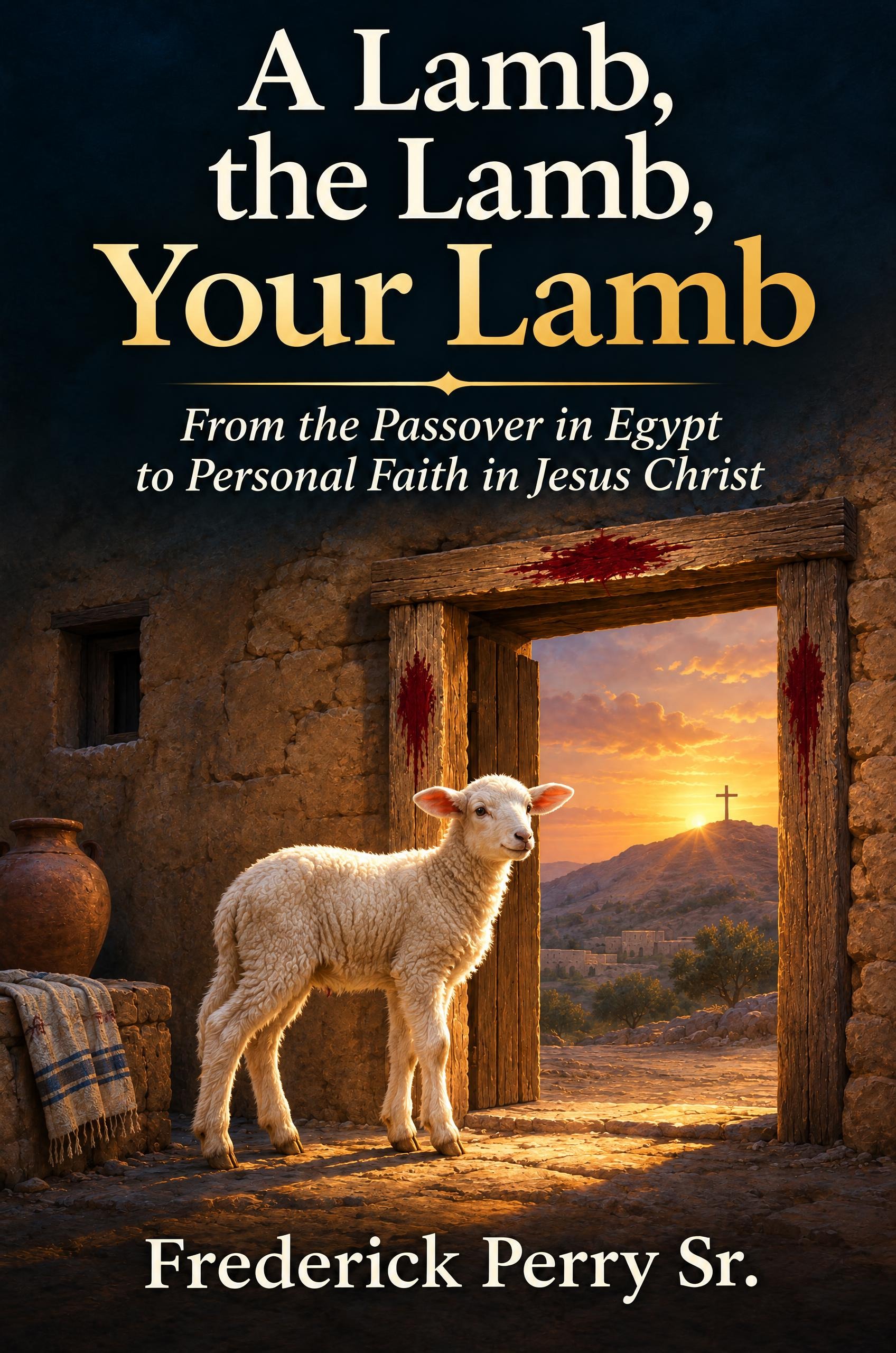
A Lamb, the Lamb, Your Lamb
From the Passover in Egypt to Personal Faith in Jesus Christ
Throughout Scripture, salvation unfolds through three transformative phrases: a lamb, the lamb, and your lamb. In ancient Egypt, deliverance required shelter under the blood of an unblemished substitute. Centuries later, John the Baptist pointed toward the Jordan and declared Jesus to be the Lamb of God who takes away the sin of the world. Yet biblical faith never stops at distant historical facts or formal religious doctrines. The ultimate question echoing through eternity remains: Is He your Lamb? Frederick Perry Sr. traces this profound journey from the Exodus to the cross, the empty tomb, and the throne of Revelation. By examining the spotless sacrifice, the reality of Christ's resurrection, and the daily walk of the redeemed, this book challenges believers to move beyond inherited tradition into vital personal surrender. A Lamb, the Lamb, Your Lamb invites you to witness God's timeless covenant of grace, embrace the Savior who died in your place, and join in the eternal worship of the Lamb upon the throne.
- Religion & Spirituality
- Christianity
- Spiritual Growth
- Prayer & Devotional
- Sacred Texts & Scripture
A People in Bondage
Scriptures: Exodus 1:8–14; Exodus 2:23–25
— ✦ —
The Passage in Context
The book of Exodus opens with good news that quickly turns bitter. Jacob’s family had come down to Egypt during a famine, welcomed because of Joseph, the son God had raised up to save many lives. For a time they lived in peace, and they grew. Then the story changes with one sentence:
“Now there arose up a new king over Egypt, which knew not Joseph.” (Exodus 1:8)
The new king did not remember what Joseph had done, and he did not care. He saw only a large foreign people living inside his borders, and he was afraid of them. So he decided to “deal wisely with them” (Exodus 1:10). His wisdom was cruelty. He set taskmasters over Israel “to afflict them with their burdens” (Exodus 1:11), and the Hebrew people built storage cities for Pharaoh.
Yet the plan did not work as Pharaoh intended. “But the more they afflicted them, the more they multiplied and grew” (Exodus 1:12). The harder Egypt pressed, the heavier the yoke became:
“And they made their lives bitter with hard bondage, in morter, and in brick, and in all manner of service in the field: all their service, wherein they made them serve, was with rigour.” (Exodus 1:14)
Years passed. A king died, but the bondage did not. Then the writer tells us what happened in heaven while Israel suffered on earth:
“And the children of Israel sighed by reason of the bondage, and they cried, and their cry came up unto God by reason of the bondage. And God heard their groaning, and God remembered his covenant with Abraham, with Isaac, and with Jacob. And God looked upon the children of Israel, and God had respect unto them.” (Exodus 2:23–25)
The verbs in those verses are worth reading slowly. God heard. God remembered. God looked. God had respect unto them. Long before a single plague fell or a single lamb was chosen, the Lord had turned His attention to His suffering people.
Looking to Christ
The Covenant Behind the Rescue
Israel’s deliverance did not begin because the people had earned it. It began because God had made promises to Abraham, Isaac, and Jacob, and He keeps His word. When the Lord later spoke to Moses, He described what He was about to do:
“I will bring you out from under the burdens of the Egyptians, and I will rid you out of their bondage, and I will redeem you with a stretched out arm, and with great judgments: And I will take you to me for a people, and I will be to you a God.” (Exodus 6:6–7)
The word redeem appears right there in Exodus. God would buy His people back from slavery and claim them as His own. That word will follow us all through this book.
A Greater Bondage
The New Testament does not say that every detail of Israel’s slavery is a picture of our spiritual condition. But it does speak clearly about another kind of bondage, one that reaches every human being. Jesus said:
“Verily, verily, I say unto you, Whosoever committeth sin is the servant of sin.” (John 8:34)
Sin does not stay a choice. It becomes a master. Like the taskmasters in Egypt, it demands more and gives back less. And behind sin stands the fear of death. Hebrews says Christ came to “deliver them who through fear of death were all their lifetime subject to bondage” (Hebrews 2:15).
So when Jesus stood up in the synagogue at Nazareth, He announced a mission of rescue. He had been sent “to preach deliverance to the captives… to set at liberty them that are bruised” (Luke 4:18). And He promised, “If the Son therefore shall make you free, ye shall be free indeed” (John 8:36).
The God Who Sees
The God who heard Israel’s groaning is the same God who sent His Son. Stephen, retelling Israel’s story before the council, quoted the Lord’s words at the burning bush: “I have seen, I have seen the affliction of my people which is in Egypt, and I have heard their groaning, and am come down to deliver them” (Acts 7:34).
Am come down to deliver them. In Egypt, God came down in power through His servant Moses. In Bethlehem, God came down in the person of His Son.
A Deliverer Prepared in Advance
Even before Israel cried out, God was already at work. Exodus 2 tells how Moses was born in the days when Pharaoh ordered the Hebrew baby boys killed, how he was hidden, drawn out of the river, and raised in Pharaoh’s own household. As a grown man he tried to help his people in his own strength and failed. He killed an Egyptian, was rejected by his own people, and fled to Midian (Exodus 2:11–15). Forty years later, God met him at the burning bush and said, “Come now therefore, and I will send thee unto Pharaoh, that thou mayest bring forth my people the children of Israel out of Egypt” (Exodus 3:10).
Moses was not the Saviour of the world, and we should not make every detail of his life a symbol. But his story reminds us of something the New Testament says plainly about Jesus: He came to His own, and many did not receive Him. Yet the rejected One became the means of rescue. God’s deliverance is often prepared long before we see it.
What This Means for Us
The Passover story does not begin with a lamb. It begins with a need. Before Israel could appreciate God’s provision, they had to feel the weight of their chains.
Many people never come to Christ because they never admit they need Him. They may feel tired, restless, or burdened, but they explain it away. They tell themselves they are doing as well as anyone else. Yet Scripture says, “There is none righteous, no, not one” (Romans 3:10). The first step toward deliverance is acknowledging that we cannot free ourselves.
For those who already belong to Christ, this chapter brings comfort. Israel’s cry “came up unto God.” Your cry does too. You may be in a season where the work is hard and the relief seems slow. Israel waited years. But God was not absent during those years. He was hearing, remembering, and looking. When the time came, He acted.
There is one more lesson here. The new king “knew not Joseph.” Forgetfulness of God’s past goodness led to cruelty and bondage. We, too, can drift into spiritual slavery when we forget what the Lord has done. Remembering His faithfulness keeps our hearts soft and our eyes open.
When the people first heard that God had seen their affliction, Exodus says, “the people believed… then they bowed their heads and worshipped” (Exodus 4:31). Hope began not when the chains came off, but when they heard that God had taken notice. That can be your starting place too.
Something to Ponder
1. Israel’s suffering made them cry out to God. What burdens in your own life have driven you to prayer?
2. Jesus said that whoever commits sin is the servant of sin. In what ways have you seen sin act more like a master than a choice?
3. Exodus 2:24–25 says God heard, remembered, looked, and had respect. Which of those truths do you most need to believe today?
A Personal Response
Name your need before God. Set aside a few quiet minutes this week and tell the Lord where you feel bound: a habit you cannot break, guilt you cannot shake, a fear that rules your choices. Do not dress it up. Israel simply “sighed” and “cried,” and their cry reached heaven.
If you have never trusted Christ, this is where the road begins: admitting that you need a Saviour. If you are already His, bring Him the burden you have been carrying alone, and thank Him that He is the God who hears.
Prayer
God of Abraham, Isaac, and Jacob, You heard the groaning of Your people in Egypt, and You hear me. I confess that I cannot free myself from sin or from the burdens I carry. Thank You for remembering Your promises and for coming down to deliver. Thank You for sending Your Son to set captives free. Help me to admit my need and to trust the deliverance You provide. In Jesus’ name, Amen.
Judgment and the Need for Deliverance
Scriptures: Exodus 11:1–10; Exodus 12:12–13; Romans 3:23— ✦ —The Passage in ContextBy the time we reach Exodus 11, Egypt has endured nine plagues. Water turned to blood. Frogs, lice, and flies filled the land. Livestock died. Boils broke out. Hail destroyed the crops, locusts devoured what remained, and thick darkness covered the country for three …