

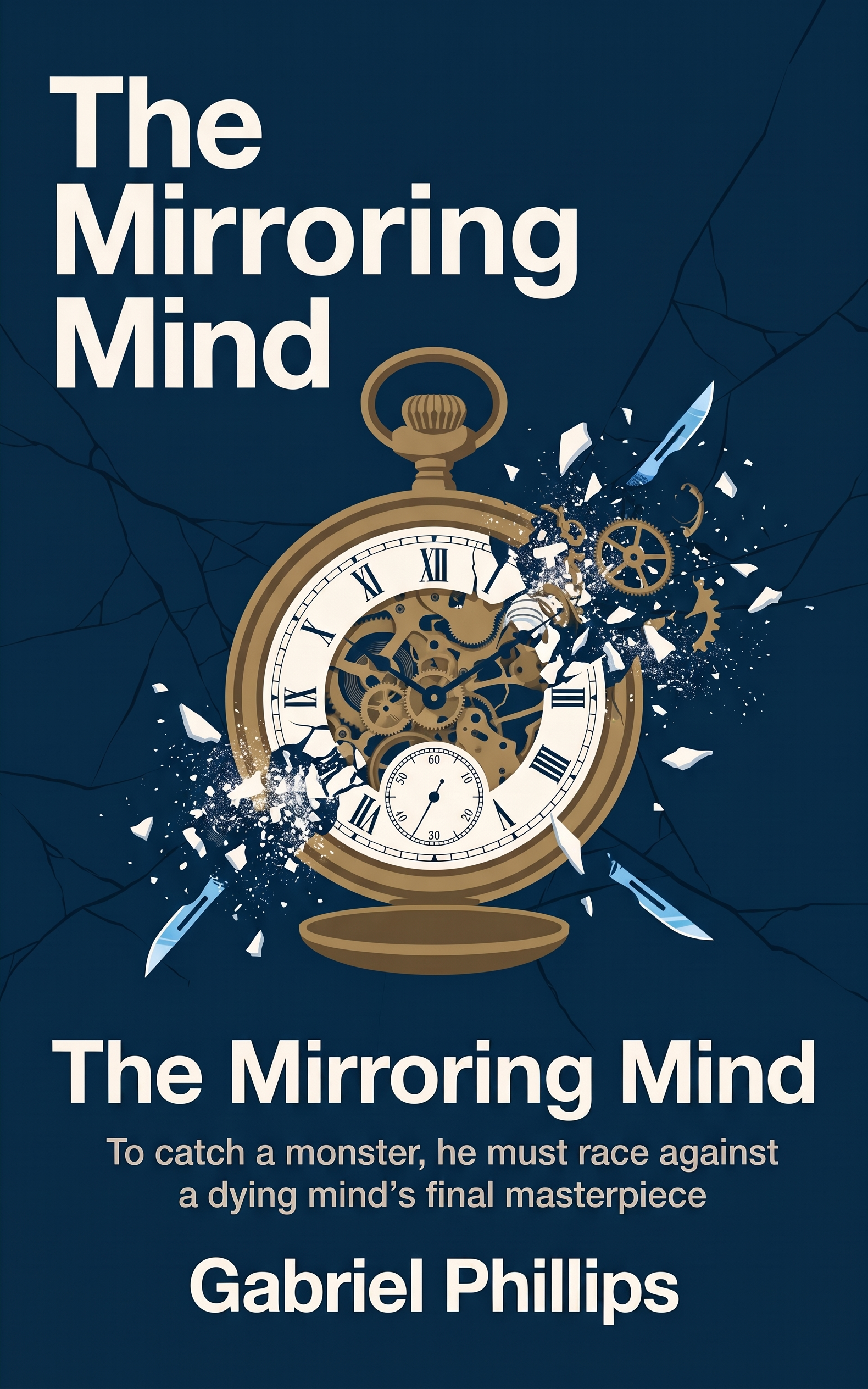
The Mirroring Mind
To catch a monster, he must race against a dying mind's final masterpiece
by Gabriel Phillips
Arthur Pendergast was once a ghost: a master clockmaker who concealed his chilling crimes with mechanical precision. Now, confined to an assisted living facility and fading into the haze of dementia, his identity is slipping away. But during sudden, terrifying flickers of clarity, his procedural instinct for violence awakens. Desperate to prove his legacy before his memory dissolves completely, Arthur begins recreating his most notorious cold cases. The resulting crime scenes confound the police—oscillating wildly between surgical mastery and senile chaos. Only veteran detective Silas Vance recognizes the gruesome signatures from twenty years ago. Haunted by the unsolved murders that defined his career, Vance realizes he is locked in a bizarre, frantic race against time. As a vengeful daughter circles and corrupt figures scheme to keep past secrets buried, Vance must hunt down a predator who is rapidly forgetting his own horrific acts. Can Vance extract the truth before Arthur’s mind erases every trace of evidence forever? A brilliant and harrowing psychological cat-and-mouse thriller, The Mirroring Mind explores the terrifying fracture between memory, identity, and cold-blooded evil.
- Mystery
- Thriller
- Crime Fiction
- Serial Killer
- Psychological Thriller
- Police Procedural
The Mainspring Breaks
The world is made of white noise and lavender-scented wax.
Arthur is sitting in the wingback chair again. He knows it is his chair because the left armrest has a small, cigarette-burn hole that he picks at when the voices in the hallway get too sharp. The woman in the blue scrubs, the one with the nametag that says Bree, is humming somewhere down the corridor. She thinks she is being soothing. To Arthur, she sounds like a faulty hydraulic press.
He looks at his hands. The fingers are long and steady, which is wrong, because everything else about him trembles now. His thoughts tremble. The wall across from him trembles, its color shifting between the cream he remembers and a grey he cannot name. But his hands are still. They have always been still. He used to say that a clockmaker's hands are the last things God takes back.
Outside the window, the afternoon light is the color of old brass. A delivery truck is idling at the curb below, and the driver is climbing out, unhurried, checking something on a clipboard. The man has a thick neck. He moves the way people move when they believe they are completely alone in the world.
Something shifts inside Arthur's chest. Not a feeling, exactly. More like the first tooth of a gear catching on the next. A small, precise engagement. A mechanism waking up.
The mainspring winds, some deeper part of him notes. Good. Good. We have been stopped for too long.
He does not remember standing. He is simply standing, which is how it always works during these moments. The fog does not lift so much as it steps aside, parting like curtains drawn by an unseen hand, and behind the curtains is not light but a different kind of darkness, sharper and more purposeful than the blurring grey that fills his ordinary hours.
The security panel at the side exit is a model he recognizes. He recognizes it the way a pianist recognizes a chord, not through thought but through the geometry of his fingers. He watched the maintenance man reset it three weeks ago, or perhaps three months ago. Time is a slippery thing. But the sequence is still there in his hands, and his hands press the correct combination without consulting the rest of him.
The door opens. The evening air smells of diesel and wet concrete and something faintly floral from the garden along the fence. Arthur straightens his cardigan and walks toward the curb with the unhurried gait of a man who has simply stepped out for some air.
The driver looks up from his clipboard. He is younger than Arthur first judged from the window, perhaps thirty-five, with a sunburned face and a friendly, incurious expression.
"You all right there, sir?" the man asks.
"I wonder," Arthur says, and his voice is calm and formal, the voice of a man who spent forty years discussing the tension of hairspring coils with collectors and gallery owners, "if you might help me. I've dropped something in the alley just there. My back, you understand." He gestures vaguely toward the narrow gap between the facility fence and the neighboring building. "These old bones."
The driver smiles. He has a good smile, open and without suspicion. He sets his clipboard on the passenger seat. "Sure thing," he says.
Arthur knows the rest of it without knowing it. His right hand is already inside the deep pocket of his cardigan, and his fingers have already found the thin silver wire coiled there, which he cannot explain owning and does not try to explain. The wire is smooth and cold, wound tightly around two small wooden handles he turned himself on a lathe somewhere in a workshop that exists now only as a sensation in his palms.
The alley is very quiet.
It takes thirty-eight seconds. Arthur counts them without deciding to count, the way a clock counts without caring. The driver struggles for perhaps fifteen of those seconds, then less, then not at all. There is no noise worth mentioning. There is only the precise, practiced geometry of it, the angle of the arms, the distribution of weight, the specific tension required so that the wire does not slip. A clockmaker understands tolerances. A clockmaker understands that too much force is as ruinous as too little.
When it is finished, the man is on the ground between a dumpster and the fence, and the alley looks like an alley. Arthur straightens up. He unwinds the wire from the wooden handles and places it back in his pocket. His hands are still steady.
Then the adrenaline fades. And the fog comes back.
It comes back the way water fills a hole in the sand, rushing in from all sides at once, smooth and total and indifferent. Arthur blinks. He is standing in an alley. The concrete is cold through the thin soles of his slippers, which he now notices he is wearing, which means he forgot his shoes, which means something went wrong with the morning routine again. Bree will be disappointed.
He looks down at his hands. They are red. Not entirely red, but there is a darkness in the creases of his palms and under two fingernails, and he stares at it with the patient confusion of a man trying to remember a word that has simply left the language.
Paint, some part of him offers helpfully. You were helping with the garden project. The red pot by the east window.
Arthur accepts this. He accepts it because the alternative is a door he cannot see the other side of, and he has learned that some doors are better left closed.
He finds his way back to the side exit. The panel accepts the same sequence his fingers remember. He moves through the corridor without being seen, which seems fortunate, and reaches his room, which smells of the lavender spray Bree uses on his pillow.
He takes off the cardigan. There is more darkness on the left cuff. He folds it carefully, the way he folds everything, with the stained side facing inward, and he kneels beside the bed and slides it beneath the mattress, behind the box spring, where the shadows are deepest.
He is still kneeling when the door opens behind him.
"Arthur, there you are." Bree's voice is warm and slightly exasperated, the voice of someone who has been looking but refuses to be angry about it. He hears the small plastic cup rattling in her hand. "Up we get. It's vitamin time, and you've been out of your chair for almost an hour."
He rises slowly and turns to face her. She is smiling at him with her whole face, the way she always does, her curly hair catching the light from the hallway. She holds out the cup. Three pills: white, yellow, blue.
"There we go," she says, when he takes them. "Feeling okay? You look a little pale."
"The gears are just settling," Arthur tells her, and he means it to sound like something from the garden project, something ordinary and harmless, but she just nods and pats his arm and turns to adjust his blanket.
He swallows the blue pill last. He knows it is supposed to keep the lights on in his head. He has never told anyone what he suspects: that some evenings, the lights go off precisely so that something older can see in the dark.
He sits back in the wingback chair. He finds the cigarette-burn hole with his thumb and picks at it gently, methodically. Outside, the delivery truck is still idling at the curb.
By the time Bree closes the door behind her, Arthur cannot remember why he thought that was strange.
The Hitch Knot
The alley smells like wet cardboard and copper, and my knees know before my eyes do that this is going to be a bad morning. I've had this limp since a stairwell in 2003 took a chunk out of my meniscus, and the damp always finds it first, a low ache that starts behind the kneecap and works its way up like a rumor. I duck under the tape. Somewhere be…