

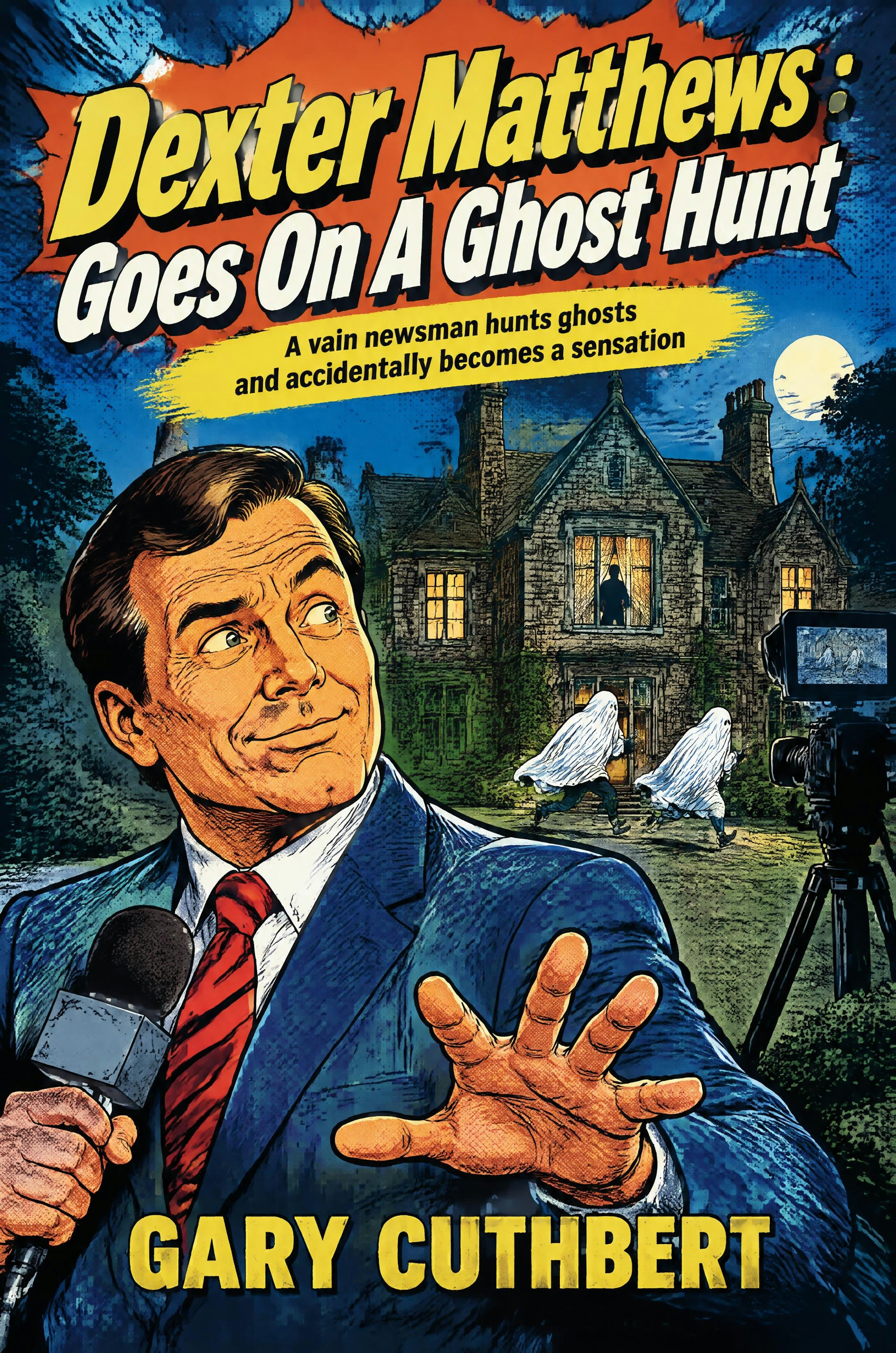
Dexter Matthews : Goes On A Ghost Hunt
A vain newsman hunts ghosts and accidentally becomes a sensation
by GARY CUTHBERT
Dexter Matthews still haunts The News Channel after an accidental Nobel Peace Prize, much to the despair of Lord Homes and Tania Blackwood. They nudge him towards a paranormal investigation, hoping he will look a fool and finally leave. He takes the bait with relish, dragging reluctant former assistant Olivia Dowding back from Toronto, cynical cameraman Dick Davies, and gadget man Danny Carter. In latex disguises they sit through church-hall lectures, tour a derelict music hall, and stage a sting in a brand-new house built to look ancient. Two mediums invent the spirits of a history that never happened, while hidden cameras roll. Lord Homes airs the special, certain it will end Matthews for good. Then a mysterious bedroom anomaly in the final seconds turns the programme into a national phenomenon. Dexter Matthews: Goes On A Ghost Hunt is a comic mystery of vanity, faked séances and one unexplained flicker that no one can quite explain away.
- Paranormal
- Mystery
- Ghost
- Psychic
- Medium
- Amateur Sleuth
We Need A Plan
Lord Barrett Homes had watched the footage eleven times that morning, and it did not improve with repetition. On the laptop screen, balanced awkwardly on a stack of ratings reports because the desk itself was far too grand and far too old to accommodate anything so vulgar as modern technology, Dexter Matthews stood on a sun-bleached stage in Mangier, accepting a medal from an official in robes while a brass band played something that was not quite the right anthem. Dexter's chin was tilted at the angle he always used for grave national news, the one he had perfected over four decades of informing Britain about flooding and by-elections, and his artificial blue eyes shone with the sincere conviction of a man who had absolutely no idea what he had done to deserve any of it.
"Look at him," Homes said, not for the first time. "Look at his face. He thinks he's earned it."
Tania Blackwood, standing by the window with her arms folded and her watch already checked twice since she had come in, did not look. She had seen the footage enough times to recite it from memory, including the bit where Dexter had mispronounced the name of the country he had supposedly just saved from civil war.
"He has earned it, in the sense that it has, in fact, been given to him," she said. "That's rather how prizes work, Barrett. Somebody hands you one, and after that, legally, it's yours."
"It's an outrage. Forty years that man read the news without once understanding a word of it, and now he's got a medal from a committee in Norway sitting on a shelf somewhere, probably next to his hair gel."
"Actually I believe he keeps it in the downstairs loo. Visible from the sink. He showed me."
Homes closed the laptop with more force than was strictly necessary and sat back in his chair, which creaked the way it had creaked for thirty years, a sound he found strangely comforting given how little else in his life these days was reliable. Behind him, out of the grimy window that nobody had cleaned since the building had somehow failed to get the memo about modernisation, London carried on exactly as it always had, indifferent to the crisis unfolding on the top floor of The News Channel.
"We stripped his desk," Homes said. "We stripped his office. Security changed the codes on four different doors. And he is still, this very morning, somewhere in this building, isn't he."
"He's in the canteen. He's telling the new runners about Mangier."
"For God's sake."
"They love it. One of them asked for a selfie."
Homes pressed two fingers to the bridge of his nose and held them there, a gesture that had become so habitual in recent months that Tania suspected he no longer noticed himself doing it. He was an old man who had built this network from nothing, who had discovered Dexter Matthews as a hungry young presenter and had spent a small fortune over the decades on the teeth and the hair and the contact lenses that kept him looking permanently thirty-eight on camera, and his reward for all that investment was a Nobel laureate who would not go away and could not, under any circumstances a lawyer would sign off on, be thrown out of his own television station.
"We cannot ban a Nobel Peace Prize winner from the building, Tania. Can you imagine the headlines. 'Network Bars War Hero.' The Americans would never buy us after that, not at any price."
"You're still thinking about selling, then."
"I am thinking," Homes said, with the slow, dreamy emphasis of a man picturing something very far from London, "about a beach. White sand. A rum drink with a little umbrella in it. Nobody in a corset reading an autocue anywhere within four thousand miles."
"The Americans are still interested?"
"They were interested until our flagship asset became an international celebrity who refuses to retire. Now they're interested and nervous, which is worse. They keep asking whether he comes with the deal."
Tania pulled out the chair opposite him, the one reserved for visitors who were not important enough to merit the good leather sofa by the window, and sat down heavily. "We sent him to a war zone once already. Look how that turned out."
"Don't remind me."
"I'm only saying, the obvious options are closed to us. We can't send him somewhere dangerous, because apparently danger simply surrenders to him. We can't fire him, because the lawyers have made that abundantly clear. We can't ignore him, because he won't be ignored, he materialises in meeting rooms like damp." She paused, watching Homes's face for the flicker of an idea, and found instead only tiredness. "What we need," she said slowly, "is something so stupid, so far beneath him, so obviously beneath the dignity of a Nobel Peace Prize winner, that the mockery alone does the work for us. Something he volunteers for. Something where nobody made him look a fool, he simply walked into it himself."
Homes raised his head. "Go on."
"UFOs. Crystals. That sort of thing. Ghosts, perhaps. Give the man a torch and a tape recorder and send him off chasing spooks in some draughty old house, and let the broadsheets write it up. Let every rival channel run the clip on a loop. The man who won the Nobel Peace Prize, out at midnight asking a wardrobe if it's got anything it wants to say."
For the first time in several days, something like hope crossed Lord Homes's face, though it was quickly followed by suspicion, because hope in his experience rarely survived contact with Dexter Matthews. "And how precisely do we get him to agree to make an utter fool of himself on purpose?"
"We don't make him do anything," Tania said. "We let him think it's his idea. You know how he is. Suggest something gently enough, and in a week he'll be telling the tea lady he thought of it in the bath."
"It would have to be entirely his own project. Nobody can be seen to have put him up to it. If it comes out that we engineered his humiliation, we'll be the villains, and he'll somehow come out of it smelling of roses, the way he always does."
"Leave that to me," Tania said, and stood up, because the clock on Homes's wall, which was at least forty years out of date and kept slightly the wrong time on principle, told her she was already late for the nine o'clock bulletin review. "I'll find a way to drop it in his lap so gently he won't feel it land."
She left Homes in his office, still turning the idea over, already half lost in a vision of turquoise water and a telephone that nobody from TNC could reach, and took the lift down to the newsroom floor, running through in her head the list of things that could possibly go wrong before ten o'clock, a list which, in this building, was never short.
What she had not accounted for was Dexter Matthews standing directly behind the main anchor desk, in full view of the live camera, with his hand resting proprietorially on the shoulder of Marcus Lane, TNC's newest and most nervous anchor, who had been reading the nine o'clock headlines for exactly eleven days and had clearly never been warned that a national treasure might wander into shot mid-sentence.
The doors of the lift opened directly onto the newsroom floor, and Tania arrived in time to see, on the bank of monitors above the sound desk, her own channel broadcasting live to the nation the sight of Dexter leaning into frame and saying, with the warm, unhurried confidence of a man who believed himself still very much in charge: "Of course, when I covered this sort of story back in the nineties, we didn't have half this fuss over a simple interest rate rise."
Marcus Lane's eyes, visible even from this distance, had the glazed look of a rabbit that has just understood, too late, what the headlights are for.
"Get me security," Tania said, to nobody in particular and everybody at once, and three people in the gallery scattered towards three different phones.
By the time a security guard named Terry had gently steered Dexter away from camera range, murmuring something about an urgent call waiting for him upstairs that did not exist, the damage, such as it was, had already gone out live to several hundred thousand breakfast tables across the country, and would no doubt be clipped, captioned, and circulating online before the lunchtime bulletin even began. Tania did not wait to watch the clip travel. She turned on her heel, strode past the gallery, and told the first assistant she passed that she wanted every single department head in the main conference room in ten minutes, no excuses, and anyone who thought they were too busy could explain that to Lord Homes personally.
The conference room, when it filled, smelled faintly of instant coffee and the particular anxiety of people who have been summoned without warning. Tania stood at the head of the table rather than sitting, which she had learned years ago gave her roughly forty per cent more authority in any given meeting, and looked around at the assembled heads of Sport, Features, Foreign, Digital, and a young man from Social Media who always looked as though he had personally been blamed for something before the meeting had even started.
"I want ideas," she said. "Big ones. Ridiculous ones. The kind of story that would make a serious journalist's blood run cold with embarrassment just reading the pitch out loud."
There was a silence of the sort that usually preceded somebody saying something they would regret.
"Care homes," offered the head of Features, a woman called Pauline who had survived four regime changes at TNC by always having a safe suggestion ready. "There's a scandal brewing in Kent, residents' savings, that sort of thing. Properly investigative. Could run for a fortnight."
"No," Tania said.
"It's a very strong story," Pauline said, slightly wounded.
"I don't want a strong story. I want the opposite of a strong story. I want a story so flimsy it would embarrass a man into retirement the moment he agreed to front it." Tania pressed her palms flat on the table. "Think smaller. Think sillier."
"Climate," said the head of Foreign, a thin man named Edwards who had clearly not been listening to a single word that had just been said. "Everybody's doing climate. Melting ice caps, that sort of—"
"Climate change is real, important, and entirely unsuitable," Tania said. "I am not asking for a story that matters, Edwards. I am asking for a story that doesn't."
"Sport, then," said the man from Sport, a round, cheerful fellow who contributed to every meeting regardless of its subject on the grounds that sport was, in his view, secretly relevant to everything. "There's talk of a new football regulator, could be—"
"Sport is a serious profession followed by millions of serious people, several of whom write to this network weekly to complain about the standard of our commentary. I would like to keep those people as viewers. No. Sport. Absolutely not."
The room settled into a thicker, more careful silence, the kind in which everybody present suddenly remembered urgent emails they had been meaning to send. Tania paced once around the table, heels clicking on the laminate floor, and stopped behind the empty chair at the far end, the one nobody ever used because of a long-standing superstition about a spilt coffee incident involving the previous head of Legal.
"Conspiracy theories," she said finally, half to herself, testing the shape of the words. "Big Pharma. Governments covering things up. The usual nonsense people believe on the internet at two in the morning. I want it researched by tomorrow at nine. Documents, claims, the lot, so that when I pitch this to somebody, I can sound like I know what I'm talking about."
"Pitch it to whom?" asked the young man from Social Media, who perhaps had not yet learned that some questions were better left unasked.
"Nobody you need to worry about," Tania said. "Nine o'clock tomorrow. Big Pharma, UFOs, the lot. I want a folder on my desk, and I want it to look serious, even though none of it is."
The meeting broke up with the particular relief of people who have survived something without being individually blamed for it, and Tania stepped out into the corridor already thinking about the clip of Dexter's unscheduled cameo, which by now would be on at least three news aggregator sites with headlines involving the word "chaos," when she found the man himself standing directly in her path, arms folded, wearing the expression of someone with a genuine grievance rather than a man who had just caused a national incident on live television.
"Ah, Tania. Just the woman."
"Dexter, we really don't have time—"
"It's my fountain pen," Dexter said, as though continuing a conversation they had already been having for some time. "And the little brass clock my producer gave me in nineteen eighty-six. And the award I won for Regional Newsreader of the Year, nineteen ninety-one, which I will remind you is a considerably rarer accolade than people give it credit for. All of it, gone."
Tania kept her face very still, which took effort, because every item he had just listed was at that moment sitting under a layer of shredded paper and stale sandwich crusts in a large industrial bin behind the building, having been cleared from his old desk the previous month on her direct instruction, in the hope that a man with no possessions in the building might eventually stop finding reasons to visit it.
"Have you checked with Facilities?" she said. "Things do get moved around during office reorganisations."
"I have checked with Facilities. I have checked with Security. I have checked, Tania, with the tea lady, who incidentally remembers my pen quite clearly, a lovely silver one, a gift from the Mangier ambassador." Dexter's voice dropped into the low, theatrical register he reserved for matters he considered worthy of a documentary crew. "I've been giving it some thought, and I don't believe this is simple carelessness. I think there's something in this building. Something that doesn't want to be found out."
"Something," Tania repeated carefully.
"A presence," Dexter said. "This building is, what, seventy years old? God knows how many people have worked and perhaps died within these walls over the decades. Stress, deadlines, the pressures of live broadcasting. It wouldn't surprise me in the least if somebody who once worked here, somebody perhaps overlooked, under-appreciated, never quite given the recognition they deserved, has decided to linger. And what do the overlooked and under-appreciated do, Tania, when nobody will listen to them in life? They start taking things. Small things. Fountain pens. Clocks. It's a classic sign, if you read the literature."
"I hadn't realised you'd been reading the literature."
"One does one's homework," Dexter said, with the modest dignity of a man who had, in fact, skimmed a single article that morning while waiting for his eggs to poach. "I merely raise the possibility. I wouldn't want to alarm anybody unnecessarily."
"No," Tania said, swallowing something that was half a laugh and half pure horror at how close he had wandered, entirely by accident, to the very idea she had been trying to engineer for him not twenty minutes earlier. "No, we wouldn't want that."
"I shall keep an eye on things," Dexter said, patting her once on the arm in the manner of a man concluding a successful business meeting, and strode off towards the lifts with the particular bounce of someone who felt his morning, on the whole, had gone rather well, television incident notwithstanding.
Tania stood in the corridor for a long moment after he had gone, staring at the spot where he had been, turning the conversation over in her mind, and told herself firmly that it meant nothing, that it was simply a coincidence, that a man like Dexter Matthews could no more stumble onto a genuinely useful idea than he could correctly pronounce the name of a European capital on the first attempt. She pushed the thought away and went to find out exactly how bad the online clip had become, which, as it turned out, was considerably worse than she had hoped, and spent the remainder of the day fielding calls from two different newspapers who wanted a quote on "the TNC ghost in the machine," a phrase one particularly inventive sub-editor had used to describe the unscheduled appearance, with no idea whatsoever how near the mark he had actually landed.
The nine o'clock meeting the following morning convened in the same conference room, with the same instant coffee smell, though this time there was a thin folder in front of every chair, each stamped with the word CONFIDENTIAL in a font that Tania suspected the young man from Social Media had chosen specifically because he found it exciting.
"Right," Tania said, flipping open her own copy. "Big Pharma. What have we got."
Edwards from Foreign cleared his throat and launched into a summary involving suppressed trial data, a vaccine conspiracy popular on three different forums, and a claim, which he delivered with total seriousness, that a well-known painkiller manufacturer had been covering up evidence of its own product's effectiveness in order to sell a more expensive version. Tania listened, turning pages, and felt her hopes sink with each paragraph. She had wanted something absurd enough to humiliate a Nobel laureate within a fortnight. What she had instead was three pages of reasonably competent, moderately interesting, entirely unglamorous research that read like something Panorama might run on a slow Tuesday.
"It's thin," she said, when Edwards finally stopped to breathe. "It's not stupid enough."
"It's a genuine, documented area of public concern," Edwards said, sounding wounded.
"I don't want public concern, Edwards, I want public ridicule." She turned to the next section. "What's this, geopolitical conspiracies?"
"Secret societies, mostly," said Pauline from Features, who had clearly drawn the short straw on this section and resented it. "A supposed shadow committee that decides interest rates behind closed doors. It's all a bit—"
"Dull," Tania finished for her. "It's dull, Pauline. You've managed to make a secret world government sound like a parish council meeting."
"There's only so much you can do with interest rates."
Tania closed the folder and pressed both hands flat against the table, the posture she adopted whenever she needed a moment to resist the urge to put her head straight through it. Around the table, the department heads exchanged the particular look of people who had done exactly what was asked of them and were now being punished for it regardless. "None of this works," she said. "None of this is going to make a Nobel Peace Prize winner look a fool. It's going to make him look like a serious investigative journalist taking on powerful institutions, which is the precise opposite of what I—" She stopped herself. "Of what this network needs," she corrected, a beat too late for anyone in the room not to notice. "What does the network need, exactly?" Pauline asked, with the mild insolence of someone who had already had quite enough of being wrong that morning.
Tania opened her mouth to answer, and it was at that exact moment that the conference room door, which nobody had heard open, swung inward with the particular confidence of a man who had never once in his career considered that a meeting might be happening without him.
"Ah, good, everybody's here," Dexter Matthews said, stepping into the doorway in a pale blue shirt that had clearly been chosen to flatter the contact lenses, his synthetic hair catching the overhead light with the sort of sheen that cost more per month than most people's rent. "I was hoping to catch you all together. Saves me repeating myself, which I always think is terribly inefficient."
"Dexter," Tania said, in the careful, level tone she reserved for moments when a great many things were happening inside her head at once. "This is a departmental meeting."
"Yes, splendid, I'll fold myself right in." He pulled out the chair at the far end of the table, the one nobody used, sat down without a flicker of superstition, and surveyed the room with the satisfied air of a man about to deliver very good news to people who did not yet know how badly they needed it. "I've had an idea. And I don't mind telling you, Tania, I think it's rather a good one."
Nobody in the room said anything. Pauline had gone very still. Edwards was staring at his folder as though it might offer some clue as to what was about to happen to him.
"After our little chat in the corridor yesterday," Dexter went on, entirely unaware of the effect his words were having on the woman at the head of the table, "about my missing fountain pen, and the clock, and the award, I got to thinking. Properly thinking, the way I used to before a big broadcast, when I'd sit in make-up and let the ideas come to me." He paused, allowing the room the full weight of the moment. "I want to conduct a scientific investigation. Into ghosts. Spirits. The paranormal, generally. Properly done, mind you, none of your crystal-ball nonsense. Cameras, equipment, a proper team. I want to get to the bottom of it once and for all, and I want to broadcast the whole thing on this network."
The silence that followed was of a different quality entirely to any that had come before it in that meeting, a silence in which Tania Blackwood discovered, with something close to horror, that the single most useful idea of her career had just been handed to her, unprompted, free of charge, by the one man in Britain least capable of understanding why anybody would want it.
"Ghosts," she repeated, very carefully.
"Ghosts," Dexter confirmed, beaming at her, entirely satisfied with himself. "I'll need resources, naturally. A proper team. And I rather thought, for sentimental reasons, I'd like Olivia back on board. She always had a good instinct for these things." He clasped his hands together on the table, looking from face to face with the expectant warmth of a man entirely confident that everyone in the room shared his enthusiasm. "So. Who do I speak to about a budget?"
Its Even In The Bible
Tania did not sit down. She remained standing at the head of the table, both palms still flat against the laminate, and watched the department heads absorb what Dexter had just said with the particular stillness of people who sense a trapdoor opening somewhere in the room and would rather not be the one standing over it. "Right," she said, before a…