

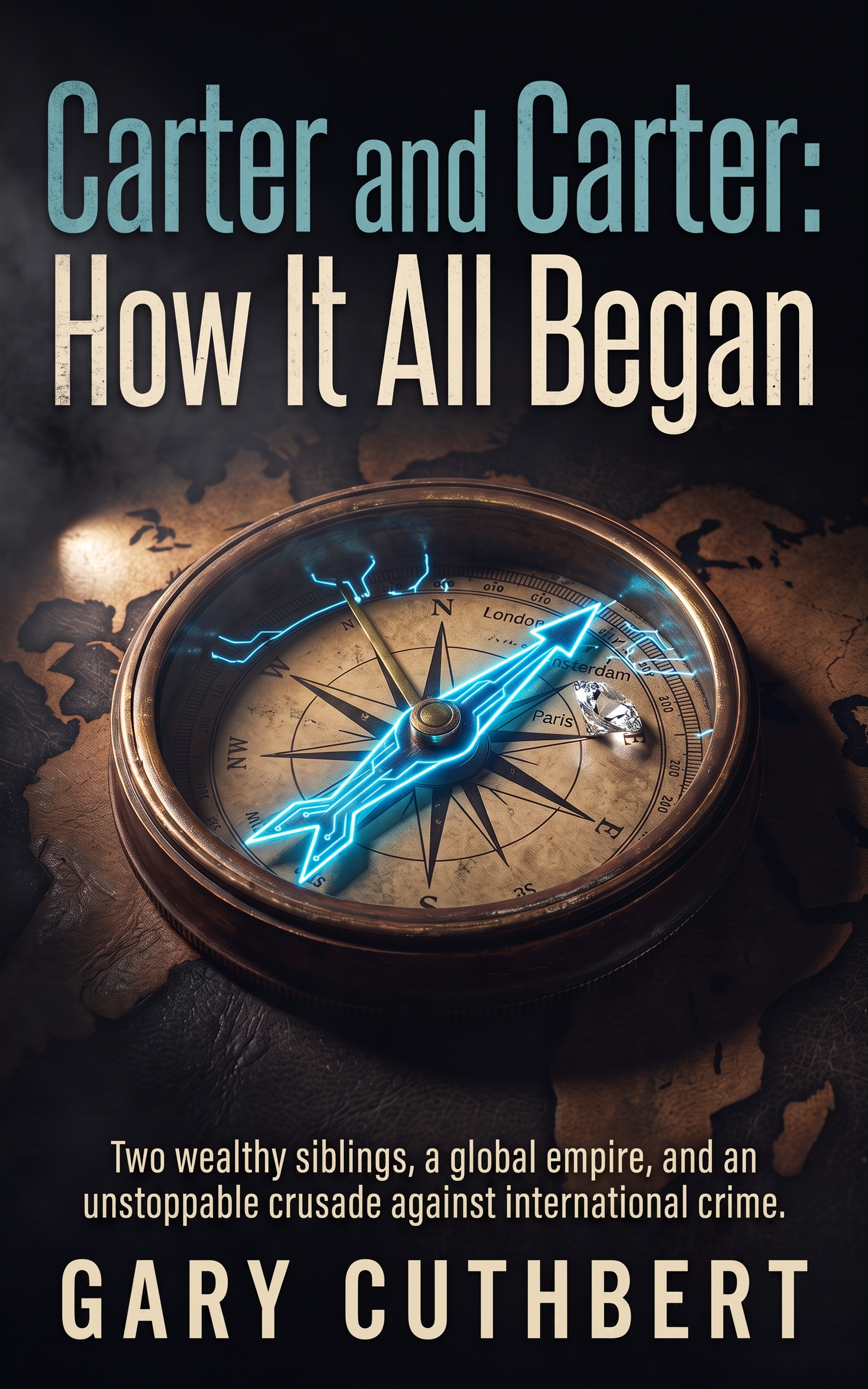
How It All Began
Two wealthy siblings, a global empire, and an unstoppable crusade against international crime.
by GARY CUTHBERT
Money can buy comfort—or it can buy justice. Nicky and Michael Carter are heirs to the vast Carter Global media empire, but they have no interest in living a life of quiet luxury. Driven by the tragic loss of a friend’s father to a ruthless online scam, the brilliant siblings pool their vast resources, investigative prowess, and tech wizardry to form a formidable crime-fighting partnership. From dismantling fraudulent cyber-dating rings to setting clever traps for high-stakes jewel thieves, Nicky and Michael quickly prove they are a force to be reckoned with. But their high-octane crusade soon pulls them into far deadlier waters. Tracking human trafficking cartels across Europe, exposing fake medical clinics in West Africa. The Carters repeatedly place themselves in the crosshairs of dangerous global syndicates. Packed with international intrigue, high-tech espionage, and relentless action, How It All Began is an explosive adventure that proves when evil spans the globe, two determined heroes can strike back anywhere.
- Mystery
- Thriller
- Adventure
- Crime Thriller
- Action Adventure
- Detective Story
The Amorous Man
Peter Sutch had been a careful man for most of his life. Careful with numbers, careful with clients' money, careful enough that thirty years in merchant banking had left him with a fine townhouse in central London, a pension that would have kept him comfortable into his nineties, and a wife named Jenna who had been the only reckless decision he had ever made. When Jenna died, the carefulness had nowhere left to go. It sat in him like a stone, and in the empty evenings that followed her funeral he discovered that a man can be careful with everything except loneliness.
It was a colleague at the bank, meaning well as colleagues often do, who first mentioned the Heavenly Marriage Bureau. A site for professional men, she'd said, discreet and classy, nothing like the meat markets of the ordinary apps. Peter had laughed it off at the time. Three months later, sitting alone at his kitchen table with a glass of wine he no longer tasted, he typed the address into his laptop anyway.
The women on the site were all absurdly young and beautiful, though Peter told himself he only wanted someone to chat with. The first translated letter cost him twelve pounds, but the warm reply made him feel remembered for the first time in two years. He paid for the next letter instantly, then swallowed a premium video chat fee, before parting with more than his monthly gym membership just to unlock her personal contact details.
Nobody forced Peter Sutch to keep paying. That was the cold cleverness of it, the mechanism ticking along beneath all that manufactured warmth. Each charge was small enough to seem reasonable on its own, and each one came wrapped in another paragraph of affection, another photograph, another promise that she felt something real for him, something she had never felt before. He began registering under the name James Butler, his late wife's maiden name, telling himself it gave him a little privacy, though in truth it let him pretend, just for an hour at a time, that he was someone other than a lonely widower typing into the dark.
He stopped going to the golf club. He stopped returning calls from old friends who wanted to take him to dinner and remind him that life continued. His secretary noticed him missing meetings, arriving late, leaving early to sit at home in front of a screen waiting for a message from a woman he had never once seen unfiltered, unposed, or in daylight. The bank noticed too, eventually, in the quiet way that banks notice things, with a review of his caseload and a suggestion that perhaps he take some leave.
By the time Peter finally understood what had been done to him, there was almost nothing left to lose. The remortgage on the townhouse had gone through to cover a wire transfer for a girl who claimed to be stranded in a hospital in Kiev. His pension had been raided for a girl who needed help getting her sick mother out of a war zone that, as it turned out, was nowhere near her supposed home town. When he finally stopped paying, cutting himself off cold, the tone of the messages changed entirely. There was no more warmth in them, no more affection, only a flat and businesslike insistence that certain photographs of him, certain conversations, could easily find their way to his employer and his daughter unless a final sum was transferred within forty-eight hours. It was not romance any longer, if it ever had been. It was simply an invoice, presented by people who had learned exactly how much a lonely man's dignity was worth and had priced it accordingly.
Peter Sutch did not pay the final invoice. Instead, on a wet Tuesday evening, he got into his car, drove it at considerable speed along a stretch of road he had travelled a thousand times before, and steered it directly into the concrete support of a railway bridge. Two pedestrians and the driver of an oncoming van died along with him. The newspapers, when they bothered with it at all, called it a tragic accident involving a well-respected banker. None of them asked why a careful man who had driven that road for twenty years without incident would suddenly lose control of his vehicle on a straight and dry section of tarmac.
The funeral was held eight days later under a sky that seemed to have taken the news personally, rain coming down in a steady grey sheet that soaked through umbrellas and left the crematorium's gravel path slick and treacherous. Of the men Peter Sutch had worked alongside for three decades, not one attended. Of his golfing friends, his neighbours, the acquaintances who had once filled his address book, none came either. Only two figures stood beneath the awning as the coffin was carried in, both women, both young, one of them supporting the other.
Nicky Carter held Vikki Butler's arm through the entire short service, feeling the tremors that ran through her friend's body each time the vicar mentioned Peter's name. Afterwards, outside in the rain, Vikki finally broke, her composure dissolving all at once as though it had been held together with nothing stronger than willpower and good manners. Nicky pulled her into an embrace and let her cry against her shoulder, not caring that the rain was soaking through both their coats.
"Nobody came," Vikki said into her shoulder, her voice thick and broken. "Thirty years at that bank and nobody came."
"I came," Nicky said, which wasn't remotely the same thing and they both knew it, but it was the only true thing she had to offer.
Vikki pulled back and wiped uselessly at her face with the back of a black glove. "Come back to the house. I need to show you something, and I can't do it alone."
The townhouse, when they reached it, still had the particular hush of a home where somebody used to live and now did not. Vikki led her through to the study, poured two large whiskys without asking whether Nicky wanted one, and handed over a plain silver disk in a paper sleeve before sitting down heavily in her father's old leather chair.
"I found it on his laptop three days ago," Vikki said. "He recorded it about a week before. I think he knew what he was going to do. I want you to watch it, because I've watched it about twenty times now and I can't watch it again, but somebody who isn't me needs to see what they did to him."
Nicky did not open the laptop with the disk until she was back home, alone, sitting in the living room of the Carter family house with nothing but the tick of the hallway clock and the whisky in her hand for company. She slid the disk in and watched Peter Sutch appear on the screen, seated at the same wooden desk she'd just left behind, his face grey and gaunt in a way that photographs from even two years earlier hadn't shown.
"If anyone ever sees this," Peter said, his voice steady in the deliberate way of a man rehearsing calm he did not feel, "I want it understood that I don't blame Jenna for dying, and I don't blame Vikki for anything at all. I blame myself, and I blame the people who made a business out of a lonely old fool. That's what I was. A lonely old fool with more money than sense and nobody left to spend it on."
He went on, methodical even now, laying out figures the way he must once have laid them out for clients across a boardroom table. The letters. The video calls. The girl in Kiev who did not exist, the mother in a war zone that was never named because it changed depending on which operator was manning the message queue that week. The remortgage. The pension. The final threatening emails demanding money for photographs that, he insisted, were entirely innocent but which he could not bear the thought of Vikki ever seeing attached to some invented scandal.
"I want whoever finds this to know the name of the site," he said, and gave it, slow and clear, twice, as though dictating for a stenographer. "Heavenly Marriage Bureau. There will be others like it, there always are, but that is the one that took everything from me, and if there is any justice left in this world somebody will make them pay it back."
The recording ended there, cutting off mid breath as though he'd meant to say more and thought better of it. Nicky sat in the dark for a long time after the screen went black, the whisky long since gone warm and forgotten in her hand.
She brought the story to work the following morning, though work was a generous word for the cramped, carpet-stained office of the free local paper that had employed her for the better part of a year without ever once printing anything she was genuinely proud of. Pat Symonds, her editor, listened to perhaps ninety seconds of it before waving a hand as though swatting a fly.
"A banker kills himself over an internet girlfriend," he said. "That's not news, Nicky, that's a Tuesday. We'd need names, we'd need the company on record, we'd need lawyers crawling all over it before I'd risk a paragraph, and even then it's a filler for page nine next to the bin collection schedule."
"Three other people died in that crash," Nicky said, keeping her voice level with an effort that cost her more than she wanted to admit. "A van driver. Two pedestrians. Doesn't that count for something?"
"It counts for a coroner's inquest, which is where it belongs." Symonds turned back to his monitor, already dismissing her. "Go cover the school fete like I asked you Tuesday."
Nicky looked at him for a long moment, weighing exactly how much of her opinion of him she wanted committed to the office's collective memory, then decided the honest answer was all of it.
"You know what, Pat? Cover it yourself." She was already reaching for her jacket. "I quit."
She didn't remember much of the drive home afterwards, only that by the time she pulled into the driveway of the empty Carter house she had gone from furious to something colder and far more useful. She went straight to her father's study, woke the desktop computer, and typed the address Peter Sutch had spoken twice into a camera he must have known would be the last thing he ever spoke into.
The Heavenly Marriage Bureau's registration page was slick, professionally built, full of soft-focus photographs of couples laughing on beaches that had almost certainly never existed in the company's actual portfolio of clients. Nicky filled it in without a second's hesitation, using details she pulled from an old company photograph on the Carter Global staff page: her brother's name, her brother's face, a fabricated age and profession that made him sound exactly like the sort of comfortably wealthy, faintly lonely man the site presumably fed on. She was midway through inventing a bio for Michael Carter, aged thirty-one, unmarried, a director of an unspecified investment concern, when the front door slammed and a familiar voice called out from the hallway.
"Anyone home? There's a distinct lack of anyone cooking anything, which frankly is un-British of this house."
Michael Carter appeared in the study doorway a moment later, travel bag still over one shoulder, and leaned against the frame to peer at his sister's screen with the mild suspicion of a man who has learned over many years that Nicky's projects rarely end quietly.
"That's my face," he said.
"Very observant."
"On a dating site."
"Marriage bureau, technically."
Michael dropped the bag, crossed the room, and leaned over her shoulder to read the profile properly, his expression sliding from confusion into something closer to alarm. "Nicky, tell me right now why my face and my actual name are attached to a bio claiming I run an investment firm and I'm looking for, and I quote, a meaningful connection with a woman who understands the value of a real gentleman."
"Because," Nicky said, and told him. All of it, from the funeral in the rain through to the disk still sitting in her bag, and by the time she reached the part where Peter named the site twice into a camera he'd never meant anyone else to see, Michael had gone quiet in the particular way he did when something had actually gotten under his skin.
"You want to go after a company like that," he said finally, "you don't do it by putting my photo up and waiting for a chat message. These operations are run out of some office with a couple of bored people typing on autopilot, and if there's real money moving through it, there's a real system behind it too."
"Which is where you come in."
"Which is where I come in," Michael agreed, and something in his face had shifted from reluctant to interested, the way it always did the moment a problem presented itself as something that could be taken apart and understood. "First thing tomorrow. Tonight I need my laptop, and you need to find me every decent photograph anyone's ever taken of you."
He worked through most of that night at the kitchen table, and Nicky watched with something between fascination and unease as her brother built, piece by piece, a small and entirely convincing lie. He mocked up a set of business cards identifying himself as a freelance photographer specialising in what the card discreetly called portrait and lifestyle work, complete with a logo he'd apparently designed in under twenty minutes. He threw together a website in an afternoon, deliberately amateurish, deliberately the sort of thing that would look exactly like a struggling photographer's online portfolio rather than anything a security-conscious man would look at twice.
Then he loaded a memory stick. Alongside a folder of photographs, some tasteful, a few considerably less so, taken from an old modelling shoot Nicky had done at university and never quite regretted, Michael buried a small piece of code he described only as "a very polite little program that lets itself in and doesn't bother knocking twice."
"It sits quiet the moment it's plugged in," he explained, not looking up from the screen. "No pop-ups, no warnings, nothing that would make a computer person nervous, assuming whoever's running this outfit even has one. Once it's in, it phones home, and from there I can walk around inside their system as freely as I like."
"And if they scan it for viruses first?"
"Then they'll find precisely nothing, because it isn't a virus. It's a guest that's very good at looking like it isn't there." He finally glanced up at her, and there was a familiar glint in his eye, the one she remembered from childhood right before he talked her into something spectacularly ill-advised. "The real trick, little sister, is getting them to plug it in at all. Which is where you come in."
Nicky spent an unreasonable amount of time the following morning deciding what to wear, eventually settling on a short red dress that left very little to anyone's imagination and considerably more to the memory afterwards. She smoothed the hem down over her thighs in front of the hallway mirror, hitched the shoulder straps into place, and grabbed her bag before Michael could finish his coffee.
"Subtlety was never really the plan," Michael observed, taking in the dress as she climbed into the passenger seat of his Alfa Romeo.
"Subtlety doesn't get memory sticks plugged into strange computers," Nicky said. "Confidence does. Now drive, we've got an appointment with a marriage bureau."
The Heavenly Marriage Bureau's London office turned out to occupy the upper floor of a squat, unremarkable building above a shuttered dry cleaner's in South Norwood, the kind of address that suggested rather more caution than the glossy website had implied. The reception area, when they climbed the narrow staircase and pushed through a door marked with a small brass plaque, consisted of a single desk, a water cooler that had seen better decades, and an elderly woman behind the desk who did not look up from her crossword when the bell above the door jingled.
"Mavis, I presume," Michael murmured, and got nothing back but the scratch of a pencil.
They waited a full two minutes before a door at the back opened and a man emerged, mid to late fifties by the look of him, with a tan that had clearly been purchased rather than earned and hair dyed a shade of black that didn't quite match the grey showing through at the roots. His hands, Nicky noticed, were rough in a way that didn't fit the cheap but tidy suit he wore, hands that belonged to someone who had done real physical work at some point in his life before discovering there was easier money elsewhere.
"Mr. Carter, is it?" the man said, extending one of those rough hands. "Ray. I run things this side of the pond. And this is?"
"My client," Michael said smoothly, gesturing at Nicky, who had positioned herself so that the red dress caught the light from the office's single grimy window to considerable effect. "She's after a portfolio for one of the dating profiles, and I understand your members respond rather well to a fresh face."
Ray's eyes lingered on the hem of her red dress before sweeping slowly up to her waist and mouth, his head tilting slightly as if calculating a price tag. Nicky gripped her handbag a little tighter behind her back, forcing her lips into a thin, pleasant smile while her jaw remained firmly set.
"She's a looker, I'll give you that," Ray said, still talking about her as though she weren't standing directly in front of him. "We could definitely work with this. Two hundred for a shoot, standard rate, more if she wants to do a proper series, and I take a cut on whatever she brings in once she's live on the profiles. Wouldn't be the first pretty face to make good money out of lonely gentlemen who just need someone to talk to."
"Someone to talk to," Nicky repeated, keeping her voice light. "That's a nice way of putting it."
"It's a service," Ray said, entirely without irony. "Some of these fellas, they've got nobody. We're giving them a bit of hope. Costs a bit, sure, but hope always does."
Michael's expression didn't so much as flicker, though Nicky could see the muscle working at the corner of his jaw. "Speaking of the photographs," he said, "I've got the shoot already loaded up here, saves you the trouble of scheduling anything. Full set, a few tasteful, a few not so much, whatever suits the different memberships you run."
He produced the memory stick and held it out. Ray took it, turned, and led them both through to the back office, a cramped room dominated by a desktop computer and a wall of filing cabinets that looked as though they hadn't been opened in years. He plugged the stick in without so much as a glance at it, clicked through the folder that opened automatically, and began scrolling through the images with the same unbothered efficiency of a man flipping through a catalogue of secondhand furniture.
"Very nice," he said, pausing on one of the less tasteful shots for rather longer than professional courtesy required. "Yeah, they'll do fine. They'll do very fine indeed. Get her set up under, what shall we call her, something that sounds a bit exotic, the gentlemen like exotic. I'll take the two hundred now if you've got it, and we'll have her live by tomorrow."
Michael counted out the cash from his wallet, thanked Ray for his time with a warmth Nicky knew he didn't feel in the slightest, and steered her back out through reception, past Mavis and her crossword, and down the narrow staircase into the grey daylight of the street.
"Well," Nicky said once they were back in the car, "that was easily the most disgusting two hundred pounds I've ever watched you spend."
"Money well spent, though," Michael said, and there was a note in his voice that hadn't been there before they'd walked in, something harder and more focused. "Home. Let's see what our new friend Ray just let into his system."
Back at the house, Michael didn't even bother with the pretence of a cup of tea first, dropping straight into the chair at his father's old desk and pulling his laptop toward him with the particular hunger he reserved for a genuinely interesting problem. Nicky watched over his shoulder as lines of text scrolled past, meaningless to her, apparently a small conversation to him.
"It's in," he said after a few minutes, something like satisfaction creeping into his voice. "Called home about four minutes after Ray plugged it in, which tells me either he left it running unattended or he's genuinely not curious about anything he touches. Give me a second."
The second turned into the better part of two hours. Nicky brought him coffee at intervals and watched the screen fill with folder structures, spreadsheets, and correspondence logs that Michael navigated with the ease of a man walking through his own house in the dark.
"This isn't just the South Norwood office," he said eventually, leaning back and rubbing at his eyes. "That's the front end. Ray's little shop is a franchise, effectively, feeding into a central server that runs the whole operation. There's branches logged here under half a dozen names across three continents, all running the same script. Fake profiles, automated replies dressed up to look personal, a whole library of stock photographs tagged by supposed nationality and age range."
"And the money?"
"That's the part that'll interest you." He pulled up another window, a spreadsheet dense with figures and account numbers. "There's a set of linked bank accounts here, offshore mostly, that every single payment routes through before it lands wherever it actually ends up. And this," he tapped another folder, "this is the clever bit. They've got what looks like an automated writing engine, something that generates the sob stories on the fly depending on what the target's already paid and how likely the system rates them to keep paying. Hospital in Kiev, mother in a war zone, whatever gets the best return. It's not a person writing those messages half the time. It's a machine deciding how much grief a man's worth."
Nicky thought of the disk still sitting in her bag, of Peter Sutch's grey face rehearsing his own eulogy into a camera, and felt something cold settle behind her ribs. "So it really was just a machine," she said quietly. "The whole time. Somebody built a machine to work out exactly how much a lonely man would pay before he broke."
"Looks that way." Michael's voice had lost its earlier satisfaction. "And it's good at its job. There's records here going back years. Names, dates, amounts paid. Some of these men lost considerably more than Peter Sutch did."
He kept working, quieter now, tracing the network outward the way he'd promised, following the links between the bureau's servers and the banks that processed its payments, then further still into a set of folders Nicky didn't understand the significance of until Michael sat up straight and let out a low whistle.
"There's the writing engine's source," he said. "The actual thing generating those messages. It's better built than half the customer service systems I've seen run by companies twenty times this size. Somebody spent real money making sure their lies sounded human."
"Can you shut it down?"
"I can do considerably better than shut it down." Michael cracked his knuckles, a habit Nicky had always found faintly irritating and was, for once, glad to see. "Give me another hour, and I'll have something worth showing you."
The hour stretched into two, the light outside fading toward evening while Michael built, tested, and rebuilt a piece of code he refused to fully explain, muttering occasionally about payment gateways and mirrored databases and something he called, with evident pride, a poisoned index. When he finally sat back, there was a single line of text on the screen, a command waiting to be run, and a cursor blinking beside it.
"What does it do?" Nicky asked.
"Everything at once," Michael said. "Every payment on record gets refunded automatically, straight back to the account it came from, whether that's some poor lonely banker or one of the girls they had typing replies for a fraction of what the marks actually paid. Every active member on the site gets an email explaining exactly what's been happening to them and where every penny they sent has actually gone. Every search engine that ever pointed a hopeful searcher toward Heavenly Marriage Bureau gets fed a very different set of results from now on, ones that lead straight to fraud warnings instead. And the men running it, wherever they happen to be sitting right now, get locked out of ever setting up anything like it again under any name I can find linked to them."
"You built all that in an afternoon."
"I built all that because I was angry," Michael said, and for a moment his usual playfulness dropped away entirely. "You should press it, though. It's your investigation."
Nicky hovered her index finger over the return key, feeling the hum of the cooling fan against her wrist. The desk smelled of old oak and cold whisky, and outside the window the autumn rain kept up a steady, rhythmic tapping against the glass while the green cursor blinked on the monitor screen.
She pressed enter.
Nothing dramatic happened on the screen itself, only a scroll of confirmations too fast to properly read, transaction after transaction reversing itself, email after email queuing and sending, until the scroll finally slowed and stopped and a small window declared, with no fanfare whatsoever, that the operation had completed.
"That's it?" Nicky said. "All that, and it just says done?"
"That's usually how the important things go," Michael said. "No fireworks. Just done."
They sat together for a while in the quiet of the study, and eventually Michael got up, put the kettle on in the kitchen, and came back with two mugs of tea, setting one down in front of his sister without a word.
"Thank you," Nicky said, wrapping both hands around the mug. "For helping. For Vikki, really, though I don't suppose she'll ever know exactly what we did."
"She doesn't need to know," Michael said, settling back into his chair. "She just needs to know somebody made them pay for it."
Nicky looked at her brother over the rim of her mug, at the tired satisfaction on his face, and felt something shift quietly into place between them, a kind of partnership neither of them had planned for but which, in the days and months that followed, would carry the Carter siblings a very long way from that quiet study, into places considerably more dangerous than a shabby office above a dry cleaner's in South Norwood.
Once a Thief Part 1
Michael Carter had never much cared for shopping centers. Too many people moving in too many directions, too much noise bouncing off polished tile, and not one of them with the faintest idea where they were actually going. He preferred the controlled hum of a server room, where everything behaved according to rules he had written himself. Crowds, h…