

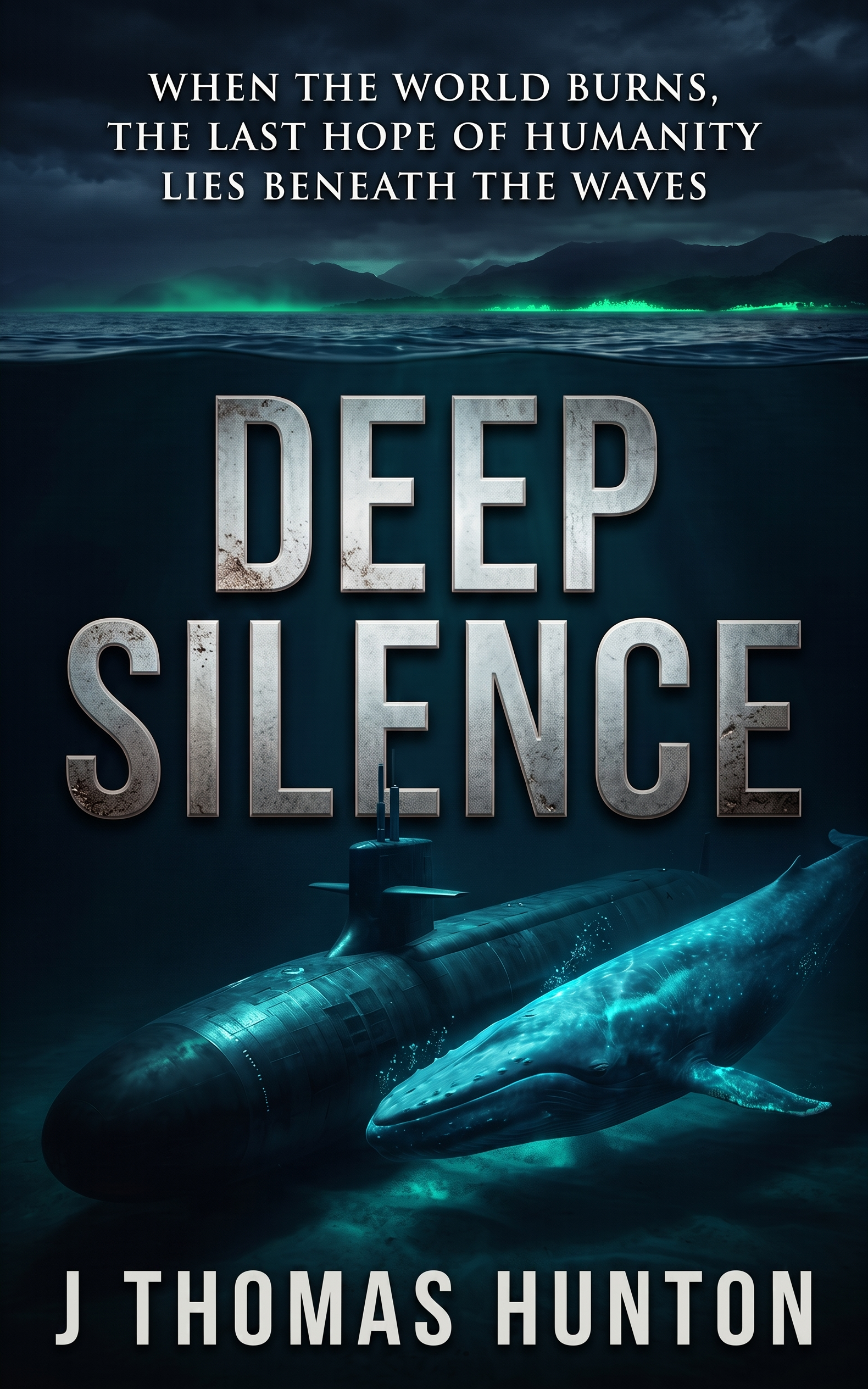
Deep Silence
When the world burns, the last hope of humanity lies beneath the waves
by Gene Thomas
The world ended while they were beneath the waves. On a routine strategic deterrence patrol in the Pacific, the ballistic missile submarine USS Pennsylvania plunges into dead silence. Every communication link with command goes dark. When Captain Josh Turnbuckle brings his boat to periscope depth, he discovers an unimaginable reality: global nuclear war has decimated the planet. Returning to America's ruined coastline, the crew finds only radioactive ash, lawless militias, and dying cities. From the incinerated remains of Pearl Harbor to the irradiated harbors of California, every port is a graveyard. Worse, surviving rogue factions and hostile warships now hunt the Pennsylvania for her firepower. With life on the surface collapsing into barbarism, Turnbuckle refuses to let his crew become ghosts of an extinct nation. Chasing rumors of uncontaminated waters and signs of surviving marine life, he navigates a treacherous Pacific crossing toward the Southern Hemisphere. Deep Silence is a gripping, pulse-pounding post-apocalyptic thriller about sacrifice, morality, and the desperate struggle to reignite the light of civilization from the ocean's darkest depths.
- Science Fiction
- Thriller
- Adventure
- Post-Apocalyptic
- Military Sci-Fi
- Survival Thriller
Departure
Day 1, 0830
The Hawaiian sun beat down on the black hull of the USS Pennsylvania with an intensity that made the air shimmer above the submarine's deck. Captain Josh Turnbuckle stood on the bridge, one hand resting on the warm metal of the sail, watching his crew complete the final preparations for departure. Below him, the massive Ohio-class ballistic missile submarine sat low in the water at Naval Station Pearl Harbor, 560 feet of American nuclear deterrence, preparing to slip beneath the Pacific and disappear.
"Captain, all departments report ready for sea." Lieutenant Commander Sarah Chen, his Executive Officer, stood at his elbow with a tablet in hand; her dark hair pulled back in a regulation bun that was already beginning to wilt in the humidity.
"Engineering has the reactor online and stable. We're green across the board."
Captain Turnbuckle nodded, his eyes tracking the movement of the deck crew as they prepared to cast off the mooring lines. Twenty-three years in the submarine service had taught him to read the rhythm of departure like a familiar song—the choreographed dance of sailors and lines, the subtle vibrations through the deck plates as the reactor hummed to life, the particular quality of light that seemed to change once you knew you were about to leave the world behind.
"Very well, XO. What's our weather window looking like?"
Chen consulted her tablet. "Clear skies for the next forty-eight hours. Seas running two to three feet. We couldn't ask for better conditions for the transit to our patrol box."
"Let's hope it stays that way." Turnbuckle glanced at his watch: 0847 hours. Thirteen minutes ahead of schedule. He liked that. Punctuality was a virtue in the submarine service, where every evolution was timed, every procedure measured against the clock. "Have the navigator lay in our course. Standard departure route, then we'll make our dive point at the usual coordinates."
"Aye, sir. "
As Chen descended the ladder to relay his orders, Turnbuckle took a moment to survey the harbor. Pearl Harbor on a Tuesday morning in October—the water a deep blue-green, the mountains of Oahu rising in the distance, their peaks softened by morning haze. Somewhere out there, beyond the harbor entrance, the Pacific waited. Seventy days of patrol. Seventy days submerged in the South Pacific, running silent, running deep, carrying enough nuclear firepower to end civilization but hoping—always hoping—that the orders to launch would never come.
It was his fourth patrol as commanding officer of the Pennsylvania, and the weight of command had never quite settled comfortably on his shoulders. Turnbuckle was forty-two years old, a graduate of the Naval Academy class of 2013, and he had spent more than half of his adult life underwater. He understood the mathematics of nuclear deterrence, the strategic calculus that kept the peace through the threat of mutually assured destruction. But understanding something intellectually and living with it were two different things.
"Captain, request permission to cast off all lines." The voice crackled through his headset—Lieutenant Marcus Webb, the deck officer, standing forward near the bow.
"Permission granted. Cast off all lines."
"Casting off all lines, aye."
The mooring lines splashed into the water, retrieved quickly by the deck crew on the pier. The Pennsylvania was free now, held in place only by her own inertia and the gentle pressure of the harbor current against her hull. Turnbuckle felt the subtle shift beneath his feet—that moment when a submarine transitions from being a stationary object to a vessel in motion, however slight.
"Helm, all back one-third."
"All back one-third, aye, sir." The response came from below, from the control room where Petty Officer Second Class Rodriguez sat at the helm station, his hands on the controls that would guide 18,750 tons of submarine away from the pier.
The Pennsylvania began to move, backing slowly into the harbor, her massive bulk responding with surprising grace to the commands from the control room.
Turnbuckle watched the pier slide past, watched the faces of the families gathered there to see them off. He could pick out individual figures—a woman holding a toddler, a teenage boy waving, an elderly couple standing close together. The families of his crew. The people they were leaving behind.
His own wife, Jennifer, wasn't among them. She'd said her goodbyes at home that morning, over coffee in their kitchen in the base housing complex. Twenty years of Navy marriage had taught her that pier-side farewells were harder than they needed to be. "I'll be here when you get back," she'd said, kissing him at the door. "I'm always here when you get back."
Their daughter, Emily, had been less stoic. Sixteen years old and increasingly aware of what her father's job actually meant, she'd hugged him hard enough to crack ribs. "Be safe, Dad. Please be safe."
"Always am, sweetheart. Always am."
But safe was a relative term when you commanded a ballistic missile submarine. Safe meant maintaining the deterrent, staying hidden, never being detected. Safe meant running a tight ship, maintaining discipline, keeping 155 crew members focused and professional for seventy days in a steel tube beneath the ocean. Safe meant hoping that the world above remained stable enough that his missiles stayed in their tubes.
"Captain, we're clear of the pier." Chen's voice pulled him back to the present. "Ready to come to course zero-nine-zero."
"Very well. Helm, all stop. Come to course zero-nine-zero, all ahead one-third."
The submarine's motion changed, the backward drift ceasing as the propeller stopped, then the subtle surge forward as power was applied again. The Pennsylvania began her turn, her bow swinging toward the harbor entrance and the open ocean beyond.
Turnbuckle descended the ladder into the control room, leaving the bridge watch to Lieutenant Webb. Down here, in the heart of the submarine, the atmosphere was different—cooler, dimmer, filled with the soft glow of instrument panels and the quiet murmur of professional communication. The control room was the brain of the Pennsylvania, a space roughly the size of a large living room packed with navigation stations, fire control systems, and the helm and dive controls that actually drove the submarine.
Lieutenant Commander Chen stood near the navigation table, conferring with Lieutenant Junior Grade Kowalski, the navigator. Kowalski was young—twenty-six, fresh from his department head training—but he had a gift for the complex mathematics of underwater navigation. When you couldn't see where you were going, when GPS was unavailable at depth, you needed someone who could dead-reckon your position using gyroscopes, speed logs, and occasional sonar fixes. Kowalski was that someone.
"Captain on deck," someone announced, though Turnbuckle waved off the formality.
"As you were. Navigator, show me our track."
Kowalski brought up the chart on the navigation display—a digital representation of the waters around Oahu, with their planned course marked in green. "Sir, we'll exit the harbor on course zero-nine-zero, then come to course two-two-zero once we're clear of the shipping lanes. Our dive point is here"—he indicated a position about twenty miles south of Oahu—"in approximately 2,000 fathoms of water. From there, we'll proceed submerged to our patrol box in the South Pacific."
"Time to dive point?"
"Approximately three hours at current speed, sir."
Three hours. Three hours of running on the surface, the last sunlight they'd see for seventy days. Turnbuckle nodded. "Very well. XO, set the watch for sea detail. I want all departments to report readiness status before we reach the dive point."
"Aye, sir."
The control room settled into the familiar rhythm of underway operations. Turnbuckle moved to the periscope stand, a raised platform in the center of the space that gave him a commanding view of all the watch stations. From here, he could see everything—the helmsman and planesman at their controls, the fire control technicians at their consoles, the sonar operators in their separate compartment visible through an open door, headphones clamped over their ears as they listened to the acoustic signature of the ocean.
The Pennsylvania cleared the harbor entrance, passing between the channel markers and into the open Pacific. Through the periscope, Turnbuckle could see the swells beginning to build, the submarine's bow rising and falling with the rhythm of the sea. On the surface, an Ohio-class submarine was an ungainly creature, designed for underwater operations rather than surface transit. But she was moving smoothly, her reactor providing more than enough power to push her through the moderate seas.
"Captain, communications." The voice came from Lieutenant Daniel Reeves, the communications officer, a thin man with wire-rimmed glasses and a perpetual expression of mild concern. Reeves was standing at the communications station, one hand holding a headset to his ear. "Sir, I'm having some trouble with the ELF receiver. I'm getting intermittent signal strength."
Turnbuckle frowned. The ELF—Extremely Low Frequency—system was their primary means of receiving messages while submerged. The system used incredibly long wavelengths that could penetrate seawater, allowing shore stations to send brief coded messages to submarines at depth. The messages were short—usually just a three-letter code that meant "come to periscope depth for further orders"—but they were vital. Without ELF, a submerged submarine was truly cut off from command.
"What kind of intermittent?"
"Signal fading in and out, sir. Could be atmospheric conditions, could be the antenna. I have technicians checking the connections now."
"Keep me informed. I want that system fully operational before we dive."
"Aye, sir."
It was probably nothing—ELF systems were temperamental, sensitive to atmospheric conditions and solar activity. But Turnbuckle made a mental note to have the communications division run a full diagnostic once they were submerged. Redundancy was everything in the submarine service. You checked, double-checked, and triple-checked every system, because 800 feet below the surface, there was no calling for help.
"Captain, request permission to come to the bridge." Lieutenant Webb's voice over the intercom.
"Granted."
Webb appeared a moment later, climbing down the ladder from the bridge access trunk. He was a tall man, broad-shouldered, with the kind of perpetual tan that came from growing up in Southern California. "Sir, we're clear of all surface traffic. Recommend coming to course two-two-zero."
"Concur. Helm, come to course two-two-zero."
"Coming to course two-two-zero, aye."
The Pennsylvania turned again, settling onto her new heading. The course would take them south and west, away from the Hawaiian Islands and into the deep waters of the Pacific. Somewhere out there, in a patrol box roughly the size of Lake Superior, they would spend the next seventy days. Waiting. Watching. Ready.
Turnbuckle glanced at the chronometer on the bulkhead: 0923 hours. Two hours until the dive point. He picked up the intercom handset and keyed the 1MC, the ship-wide announcing system.
"This is the Captain. We are now underway for our strategic deterrent patrol. For the next seventy days, we will be operating in the South Pacific, maintaining our readiness posture and ensuring the credibility of the nation's nuclear deterrent. I know this crew. I know your professionalism, your dedication, and your skill. We will conduct this patrol with the same excellence we've demonstrated on every previous patrol. Stay focused, stay sharp, and take care of each other. That is all."
He hung up the handset and caught Chen's eye. She gave him a small nod—approval, or perhaps just acknowledgment. They'd served together for eighteen months now, long enough to develop the kind of wordless communication that made a good command team. Chen was a superb XO, detail-oriented and unflappable, the kind of officer who could manage the thousand small crises that arose on a submarine without bothering the captain unless absolutely necessary.
"XO, I'll be in my stateroom reviewing the patrol orders. You have the conn."
"I have the conn, aye."
Turnbuckle left the control room and made his way aft through the submarine's narrow passageways. The Pennsylvania was a city in miniature, a self-contained world with its own power plant, its own water supply, its own atmosphere. The passageways were lined with pipes and cables, every inch of space utilized for some purpose. Crew members pressed themselves against the bulkheads as he passed, offering quiet greetings: "Morning, Captain."
His stateroom was small—about the size of a walk-in closet—but it was private, one of the few truly private spaces on the submarine. A bunk, a small desk, a chair, a tiny head with a sink and toilet. Spartan, but sufficient. Turnbuckle sat at the desk and pulled up the patrol orders on his laptop.
The orders were routine, as routine as orders could be when you were commanding a ballistic missile submarine. Proceed to patrol box Sierra-Seven in the South Pacific. Maintain strategic deterrent posture. Monitor ELF communications for further orders. Conduct routine maintenance and training. Return to Pearl Harbor in seventy days.
Routine. That word again. But there was nothing truly routine about what they did. Every patrol was an exercise in controlled tension, a high-wire act performed in slow motion. They carried twenty-four Trident II D5 missiles, each missile capable of carrying multiple independently targetable reentry vehicles—nuclear warheads. The Pennsylvania alone had enough firepower to destroy dozens of cities, to kill millions of people. And yet, paradoxically, that firepower was meant to prevent war, not wage it. As long as submarines like the Pennsylvania prowled the oceans, undetectable and ready, potential adversaries knew that a first strike would be met with devastating retaliation.
Mutually assured destruction. MAD. The acronym was grimly appropriate.
Turnbuckle closed the laptop and leaned back in his chair. Through the bulkhead, he could hear the muffled sounds of the submarine in operation—the hum of ventilation, the distant clang of a hatch closing, voices in the passageway. His crew. His responsibility.
One hundred and fifty-five men and women, ranging in age from nineteen to fifty-three. Officers and enlisted, veterans and newcomers, all of them volunteers for submarine duty. All of them willing to spend months at a time in this steel tube, cut off from sunlight and fresh air and the world above. Some of them were on their first patrol, still adjusting to the reality of submarine life. Others were old hands, career submariners who couldn't imagine doing anything else.
He thought about them now, his crew. Lieutenant Commander Chen, steady and reliable. Lieutenant Reeves, worrying over his communications systems. Lieutenant Kowalski, plotting their course with mathematical precision. And the enlisted sailors—the technicians and mechanics and cooks and corpsmen who kept the submarine running. Chief Petty Officer Martinez in the engine room, coaxing maximum efficiency from the reactor. Petty Officer Rodriguez at the helm, his hands steady on the controls. Seaman Apprentice Jackson in the galley, preparing lunch for one hundred and fifty-five people in a kitchen the size of a small bathroom.
Each of them had left someone behind: wives, husbands, children, parents, friends. Each of them carried that weight, that knowledge that for seventy days, they would be unreachable, unknowable. No phone calls, no emails, no contact with the world above except for the occasional family-gram—a brief, censored message transmitted through official channels. Forty words or less, nothing that could compromise operational security.
Turnbuckle pulled out his wallet and extracted a photograph—Jennifer and Emily, taken last summer at the beach. Jennifer was smiling, her arm around Emily's shoulders. Emily was making a face at the camera, teenage irreverence captured in a moment of joy. He looked at the photograph for a long moment, then tucked it back into his wallet.
Seventy days. He'd done it before, would do it again. But it never got easier.
A knock at the door. "Captain? XO requests your presence in the control room. We're approaching the dive point."
"On my way."
Turnbuckle stood, straightened his uniform, and stepped back into the passageway. Time to take his submarine beneath the waves.
The control room was busy but controlled, each watch stander focused on their station. Chen stood at the navigation table, watching the GPS display as it showed their position relative to the planned dive point. "Captain on deck."
"Status, XO?"
"Sir, we're five minutes from the dive point. All departments report ready to dive. The ship is rigged for dive; all hatches and vents are secured."
"Very well." Turnbuckle moved to the periscope stand and keyed the 1MC. "All hands, this is the Captain. We are preparing to dive. Rig ship for dive, rig ship for reduced lighting. Set condition normal throughout the ship."
Throughout the submarine, the lighting shifted from bright white to a dimmer red, easier on the eyes and more conducive to the long hours of watch-standing ahead. Turnbuckle could feel the change in atmosphere, the subtle shift as the crew transitioned from surface operations to submerged routine.
"Diving Officer, make your depth 150 feet. Five degree down angle."
"Make my depth 150 feet, five degree down angle, aye sir." The Diving Officer, Lieutenant Ramirez, was a compact woman with a reputation for smooth, precise depth control. She turned to the planesman. "Five degree down angle. Dive, dive."
The diving alarm sounded—two sharp blasts that echoed through the submarine. "Dive, dive," came the announcement over the 1MC.
The planesman pushed his control yoke forward, and the Pennsylvania's bow began to drop. Turnbuckle felt the deck tilt beneath his feet, felt the submarine begin her descent into the deep. Through the periscope, he watched the surface recede, watched the blue-green water rise up the lens until there was nothing but water, nothing but the endless Pacific.
"Passing 50 feet."
"Very well."
"Passing 100 feet."
The submarine continued her descent, the hull creaking slightly as the water pressure increased. This was the moment Turnbuckle always found oddly peaceful—the transition from the world of air and light to the world of water and darkness. Down here, the rules were different. Down here, they were invisible, untouchable, a ghost ship prowling the depths.
"Depth 150 feet, sir. Leveling off."
"Very well. Helm, all ahead two-thirds. Come to course two-four-zero."
"All ahead two-thirds, coming to course two-four-zero, aye."
The Pennsylvania settled into her cruising depth, her propeller biting into the water, pushing her forward at a speed that would carry them to their patrol box in three days. Turnbuckle watched the depth gauge, watched the course indicator, watched his crew work with the practiced efficiency of professionals who knew their jobs.
"Captain, sonar reports no contacts within 10,000 yards. We are clear and undetected."
"Very well." Turnbuckle allowed himself a small smile. They were gone now, disappeared from the surface world. For the next seventy days, the Pennsylvania would be a secret, a mystery, a submarine that existed only in the classified files of COMSUBPAC—Commander, Submarine Force, U.S. Pacific Fleet.
"XO, secure from sea detail. Set the regular watch rotation."
"Aye, sir. Securing from sea detail."
The control room began to empty as the sea detail watch standers were relieved by the regular watch section. Turnbuckle remained at the periscope stand, watching the instruments, feeling the submarine move beneath him. This was his world now. This steel tube, these 155 souls, this mission.
Lieutenant Reeves approached, his expression still troubled. "Captain, I'm still getting intermittent readings on the ELF receiver. I've had the technicians run every diagnostic we have. The equipment checks out, but the signal strength is inconsistent."
"Could it be the shore station?"
"Possibly, sir. Or atmospheric conditions. Solar activity has been elevated lately—could be interfering with the signal propagation."
Turnbuckle considered this. ELF communications were always somewhat unreliable, subject to interference from natural phenomena. But they'd never had problems this persistent before. "Keep monitoring it. If we don't see improvement in the next twenty-four hours, we'll come shallow and use the satellite system to report the issue to COMSUBPAC."
"Aye, sir."
As Reeves returned to his station, Turnbuckle felt a small prickle of unease. Probably nothing. Almost certainly nothing. But in the submarine service, you learned to pay attention to small anomalies, because small anomalies had a way of becoming large problems.
He shook off the feeling. They were three hours into a seventy-day patrol. Plenty of time to sort out communications issues. Plenty of time for everything to settle into routine.
"Captain, request permission to set the watch." Chen stood beside him, tablet in hand.
"Permission granted. I'll be in my stateroom if you need me."
"Aye, sir."
Turnbuckle took one last look around the control room—his crew at their stations, his submarine running smoothly, everything as it should be. Then he left, making his way through the passageways to his stateroom.
Behind him, the Pennsylvania drove deeper into the Pacific, her reactor humming, her propeller turning, her crew settling into the rhythm of patrol. Above them, the surface world continued its daily business—ships crossing the ocean, aircraft flying overhead, people going about their lives, unaware of the submarine passing beneath them.
And far to the north, in places the crew of the Pennsylvania couldn't see and didn't know about, other events were unfolding; diplomatic tensions were escalating. Military forces began mobilizing. The careful balance of deterrence beginning to shift.
But down in the deep, the Pennsylvania sailed on, silent and unaware, carrying her deadly cargo into the South Pacific.
Routine patrol. Standard operations.
Seventy days.
The chronometer on the bulkhead ticked forward: 1147 hours.
In the galley, Seaman Apprentice Jackson was preparing lunch—spaghetti and meatballs, garlic bread, salad. The smell of cooking tomato sauce filled the passageways, a small comfort in the steel world of the submarine.
In the engine room, Chief Martinez was monitoring the reactor, watching the gauges that told him the heart of the submarine was beating strong and steady.
In the torpedo room, forward of the control room, Torpedoman's Mate Second Class Chen (no relation to the XO) was conducting routine maintenance on the Mark 48 torpedoes, the submarine's conventional weapons.
And in the missile compartment, the long space that housed the twenty-four Trident missiles, Missile Technician First Class Thompson was running diagnostics, ensuring that the weapons that would hopefully never be fired remained ready for instant launch.
The Pennsylvania was a machine, but she was also a community, a floating city with its own rhythms and routines. And for the next seventy days, this would be their entire world.
Captain Josh Turnbuckle sat at his desk, reviewing maintenance schedules and training plans, doing the administrative work that never stopped, even on patrol. Outside his stateroom, the submarine hummed and creaked and lived.
Everything was routine.
Everything was normal.
Everything was exactly as it should be.
The chronometer ticked forward.
1148 hours.
Seventy days to go.
Routine
Day One, 2347 HoursPetty Officer Second Class Marcus Rodriguez sat at the helm station in the control room, his hands resting lightly on the control yoke, his eyes fixed on the depth gauge and course indicator. The midnight watch—2300 to 0700—was always the quietest; the submarine settled into a kind of nocturnal rhythm even though there was no day…