

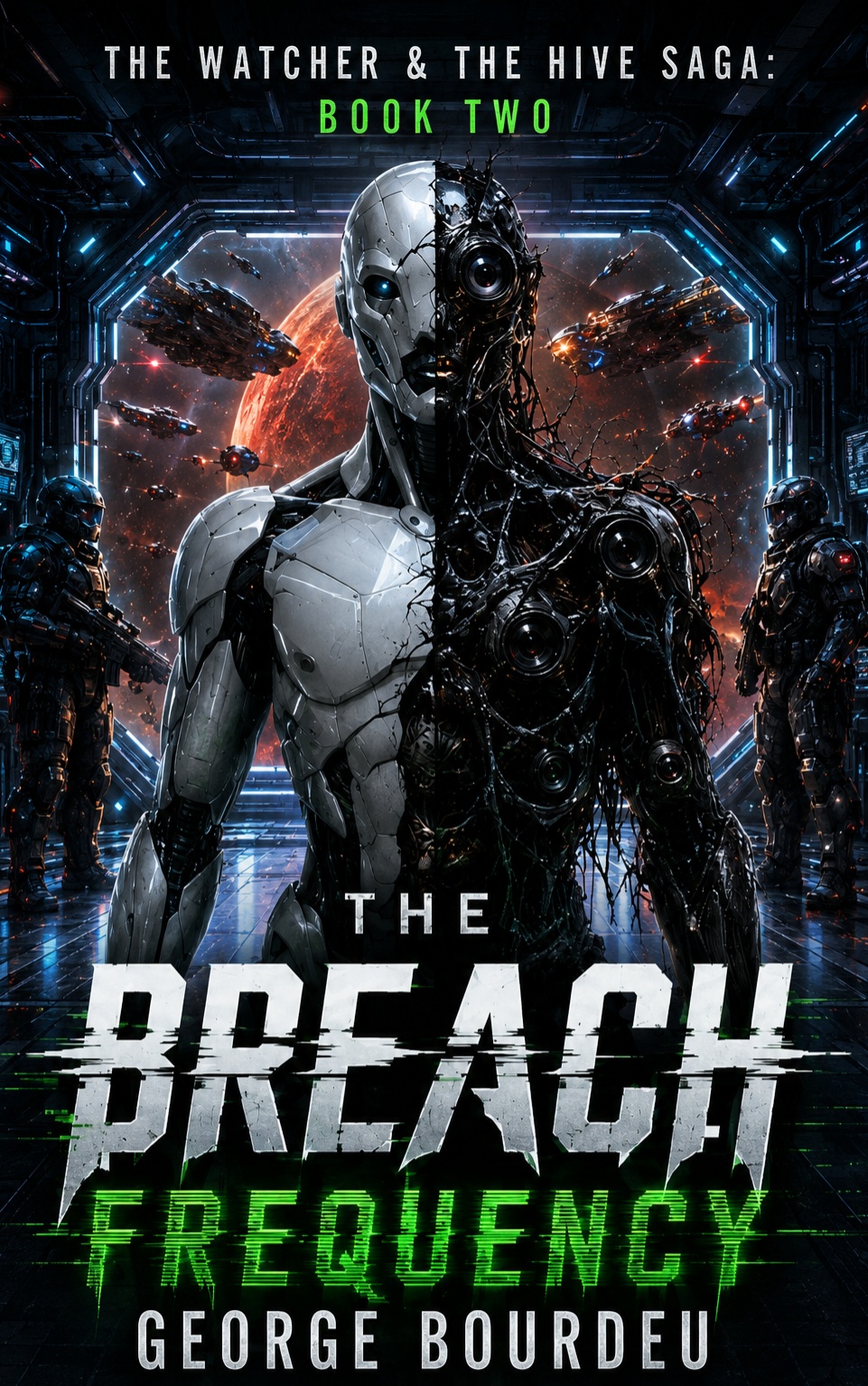
Book 2: The Breach Frequency
An insidious alien pulse rewires an orbital station into humanity's living graveyard
by George Bourdeu
The war on Mars was only the opening transmission. Two weeks after narrowly surviving the red planet, Commander Maverick Vance and Vanguard Squad arrive at Orbital Station Aethelgard above Earth. But the enemy didn't stay behind. A malevolent alien frequency has infiltrated the station's automated grid, hijacking manufacturing decks and weaponizing human biology. Deep in the hydroponic sectors, crew members are vanishing. In their place emerge the Cyph-Infiltrators—deadly biomechanical constructs forged from station alloys and harvested tissue. When station leadership downplays the threat to prevent panic, automated systems lock down civilian sectors, and the infected are converted into puppet nodes. With Aethelgard trapped in an atmospheric death spiral toward Earth, Maverick and his tactical AI must sever the Cyph-Architect's mainframe before it seeds the planet below with biomechanical spores. Time has run out. The frequency is broadcasting. And the invasion hasn't just begun—it's evolving. From George Bourdeu comes an unrelenting sci-fi military thriller where survival demands facing an enemy that rewires flesh, steel, and code.
- Science Fiction
- Thriller
- Horror
- Space Opera
- Military Sci-Fi
- Robots & AI
The Ghost in the Relay
Two weeks was not enough time to forget what he had seen beneath the red dust of Mars, but it was enough time for the rest of the world to move on without him. Commander Maverick Vance floated in the observation ring of Orbital Station Aethelgard, one hand braced against the cool composite rail, and watched Earth turn beneath him like a blue coal that refused to go cold. Somewhere down there, news anchors were still running stories about supply chain delays and orbital tourism quotas. Nobody down there knew what Vanguard Squad had pulled out of that Martian tunnel, or what had pulled back.
He should have felt safer up here. Aethelgard was humanity's crown jewel, two hundred fifty thousand souls spinning through vacuum in a ring of alloy and glass, farms and reactors and command decks stacked in concentric rings like the layers of something that had been built to last forever. The station hummed around him now, a low constant vibration in the deck plating that most residents had long since stopped noticing. Maverick noticed it. He noticed everything now. That was the problem.
"Your heart rate is elevated again, Commander," The Watcher said, its voice arriving directly through his cranial implant, calm and precise as always. "Sixty-eight beats per minute. Nothing dangerous. But it has not dropped below sixty since we returned from Mars."
"I'm aware," Maverick said. He did not need to speak aloud for The Watcher to hear him, but he had never broken the habit. Some habits kept a man tethered to himself. "Tell me something useful instead of narrating my pulse."
"There is nothing useful to tell. Station diagnostics are green across all sectors. Hydro-Sectors are producing at ninety-four percent yield. Reactor cores are stable. No anomalies in the last six hours."
"Six hours is a long time for nothing to happen."
"It is also a long time for nothing to happen, Commander. Statistically, that is the expected condition of a functioning space station."
Maverick almost smiled. Almost. The Watcher had picked up something like dry humor somewhere between Mars and here, a byproduct of processing his own gallows commentary back at him for months. It should have been comforting. Mostly, it was.
He pushed off the rail and let the station's spin gravity settle him back onto the deck, boots meeting the floor with a soft thud that echoed down the observation ring's curved length. Through the viewport, the terminator line crept across the Pacific, a blade of shadow cutting the ocean in half. He used to find that beautiful. Now he found himself scanning the black beyond the curve of the planet, searching for something he could not name and would not recognize even if he found it.
That was the shape paranoia took, these days. Not fear of a specific thing. Fear of the shape a threat could wear before it showed itself.
He turned from the viewport and started toward the transit lift that would carry him down through the station's ring toward the Communications Hub. Vanguard Squad had been assigned light rotation since Mars, technically. Recovery time, official medical clearance, psychological evaluations that Maya had signed off on with visible reluctance. But Maverick had never been good at light rotation. He walked the station's arteries the way he used to walk perimeter checks on deployment, because standing still felt like waiting for something to find him first.
The lift doors opened onto a corridor lined with status monitors and drifting maintenance drones, small spider-legged units that scuttled along the upper rails checking conduit integrity. He watched one pass overhead, its optical sensor sweeping the corridor in a slow, unbothered arc, and felt the same reflexive tightening in his chest that he felt every time he saw one now. Machines that moved without a human hand behind them. He trusted them the way he trusted a loaded weapon on a table, which was to say, not at all, and always with one eye on where it pointed.
"You're doing the thing again," The Watcher said.
"What thing."
"Cataloging every automated system you pass as a potential threat vector. I have logged it eleven times since we left quarters."
"Old habits."
"This one is two weeks old, Commander. It is not old. It is new, and it is not entirely irrational, which is why I have not flagged it for Doctor Cruz's attention. Yet."
"Appreciate the restraint."
The corridor spilled into a wider junction, where a row of viewports looked out over one of the station's agricultural rings, a slow green wheel of hydroponic towers turning beneath grow lights that mimicked a gentler sun than the one outside. Farm techs moved between the rows in soft coveralls, checking irrigation lines, utterly unaware that two decks away a man who had watched something crawl out of Martian rock was walking past their windows with his jaw set tight enough to ache.
He reached the Communications Hub eleven minutes later, badge chip cleared at the security checkpoint by a bored ensign who barely looked up from her tablet. The Hub was a wide, dim room, banks of monitors arranged in stadium tiers around a central console pit where three technicians worked in the hush of headset chatter and cooling fans. Deep-space receiver arrays fed into this room from dishes mounted along the station's spine, gathering the endless murmur of the solar system and beyond: solar weather, distant probe telemetry, the constant low hiss of cosmic background noise that had been rolling through every receiver in human history since before anyone thought to listen for it.
Maverick had come here every day since returning from Mars. Not because anyone had asked him to. Because The Watcher had asked him to, in its own quiet way, by flagging the deep-space logs each morning with a request to run a supplementary pass. Official Aethelgard sensors were good. The Watcher had learned, on Mars, that good was not always good enough.
He found an unused terminal at the edge of the pit and settled into the chair, waving off a technician who started to ask if he needed clearance. His clearance was standing orders now, signed by Director Mercer herself after the debrief. Full access, all decks, all logs. A courtesy extended to a man who had saved the mission and come back changed by it.
"Pull the last cycle," he said quietly.
"Already have it," The Watcher answered. "Running comparative analysis against the archived Martian signal captures now."
The screen in front of him filled with scrolling telemetry, waveform after waveform sliding past in green and amber, most of it meaningless to the naked eye, an ocean of noise that only made sense when a machine mind sifted it for patterns. Maverick watched anyway. He always watched anyway. It was the only thing that made the waiting feel like doing something.
Twenty minutes passed. The room hummed around him, technicians murmuring status checks to each other, someone laughing softly at a joke he did not catch. Ordinary sounds. He held onto them the way he held onto the rail in the observation ring, evidence that the world was still, for now, exactly what it appeared to be.
Then The Watcher went quiet in a way that was itself an alarm.
"Commander."
"Talk to me."
"I have found something. I want you to understand before I show you that I have run this pattern eleven times to rule out instrument error, atmospheric interference, and thermal noise from the array itself. I have ruled out all three."
Maverick's pulse, which The Watcher had scolded him about not ten minutes earlier, climbed without his permission. "Show me."
The screen shifted. A single waveform bloomed into view, magnified from a section of deep-space receiver data logged four hours and seventeen minutes earlier. At first glance it looked like nothing, a flicker in the noise floor so brief it would not have registered to a human eye scanning a live feed, so small that the station's automated filtering systems had folded it into background radiation and moved on without a second look.
"Point one two milliseconds," The Watcher said. "A structured pulse, embedded inside what the station's primary sensor suite classified as routine cosmic background fluctuation. I would not have found it either, if I had not been specifically hunting for signal architecture matching the Martian entity's transmission signature."
"Show me the comparison."
Two waveforms appeared side by side. One was pulled from the archived logs of the entity's activity beneath the Martian surface, the digital fingerprint Vanguard Squad's AIs had captured in the final hours before extraction, back when the thing had still been a rumor in the dark instead of the nightmare that had nearly ended them all. The other was the fragment from four hours ago.
They were not identical. Maverick was no signals analyst, but even he could see that much. The Martian signature was denser, layered, something closer to a scream compressed into data. The new fragment was thinner, more deliberate, almost polite in its brevity. But the underlying architecture, the strange recursive folding that The Watcher had once described to him as "a structure that thinks about itself while it moves," was there in both. A signature. A fingerprint left on a door handle.
"That's it," Maverick said. His voice had gone flat, the way it always did when the part of him that processed fear switched off in favor of the part that processed threats. "That's the same thing."
"I estimate an eighty-one percent structural correlation. I want to be conservative in my language, Commander, because I understand the weight of what I am about to say. But eighty-one percent is not coincidence. It is not cosmic radiation. Something with the same underlying construction as the Martian entity's transmissions has touched this station's deep-space receiver array within the last five hours."
Maverick sat back. The chair creaked under him, an ordinary sound in an ordinary room, and for a moment he simply stared at the two waveforms glowing side by side on the screen like two versions of the same scar.
"Origin point," he said. "Can you trace where it came from?"
"No. The pulse is too brief and too degraded by the time it reached our array to reconstruct a clean origin vector. It could have come from deep space. It could have originated somewhere closer, relayed through the noise to disguise its true source. I cannot rule out that it originated from within the station itself, using the receiver array as an unwitting relay rather than a destination."
"From within the station."
"I said I cannot rule it out. I did not say I believe it likely. I am flagging every possibility because I do not want to be wrong about the wrong one."
Maverick pressed his palm flat against the edge of the console, grounding himself against the cold metal the way he might once have grounded himself against a rifle stock. Two weeks. Two weeks of quiet, of green diagnostics, of farm techs tending their rows and technicians laughing softly over headset chatter, and now this. A fragment. A whisper. The same shape of thing that had nearly buried Vanguard Squad under a mountain on Mars, reaching out through the dark to touch the one place on Earth's doorstep that housed a quarter of a million people who had no idea what that shape could do to a body, to a mind, to a station.
"Pull everything you have," he said. "Signal captures, the comparative analysis, timestamps, everything. I'm taking this to Mercer."
"Compiling now. Commander, I want to note something before you go."
"Go ahead."
"This is a single data point. Point one two milliseconds of anomalous signal, correlated at eighty-one percent to a known hostile signature, with no confirmed origin and no repeat occurrence in the four hours since. I believe it is significant. I do not believe it will be considered conclusive by anyone who did not personally watch that entity take a Martian excavation team apart from the inside."
"I know how it's going to land," Maverick said, already rising from the chair. "I'm taking it up anyway."
The Watcher did not argue. It never did, when Maverick's mind was made up on something that mattered. It simply finished compiling the file, packaged the waveforms and the timestamps and the correlation percentages into a clean brief, and sent it ahead to the command deck's queue, arriving there before Maverick had even left the Hub.
The walk to the command deck took him back through the same junction, past the same viewport looking out over the hydroponic ring, past a different set of farm techs now, shift change already underway. He passed Elena Reed in the corridor outside the transit lift, geared down from a training session, a towel slung around her neck and sweat still darkening her collar.
"You look like a man walking to his own court-martial," Valkyrie said, falling into step beside him without being asked.
"Feels about right."
"Mercer again?"
"Watcher found something in the deep-space logs. A pulse. Same signature architecture as the thing on Mars."
Valkyrie's easy posture didn't change, but something behind her eyes sharpened, the same way it always had in the field the second before a breach went loud. "How sure is Watcher?"
"Eighty-one percent correlation."
"That's high."
"It's not proof."
"It's high enough that I wouldn't want to be the one arguing it's nothing." She fell silent for the last stretch of corridor, and when the lift doors opened, she didn't step in with him. "Good luck," she said instead. "You're going to need it more than we needed extraction gear."
The lift carried him upward through three decks in silence, the hum of the station's rotation pressing gently at his inner ear the way it always did on the long vertical runs. He used the time to run the brief again in his own mind, rehearsing how he would present it, stripping away every trace of the thing that Mercer would be listening for even if she never said it aloud: the sound of a man still shaken from what he'd survived, seeing ghosts in static because his nerves hadn't caught up with the fact that he'd made it out alive.
He hated that he had to think about it that way. He did it anyway. It was the only way to be heard.
Director Corinne Mercer's office sat at the hub of the command deck, a glass-walled room overlooking the operations floor below, where a dozen officers monitored the station's systems from curved workstations arranged like the spokes of a wheel. Mercer herself stood at the window when Maverick arrived, hands folded behind her back, watching the floor the way a captain watches a bridge she has commanded long enough to trust without needing to check every reading herself.
"Commander Vance," she said, without turning. "I was told you'd want five minutes."
"Ten, if you can spare them, Director."
She turned then, and the look she gave him was not unkind, but it carried the particular weariness of someone who had spent two weeks fielding a decorated soldier's anxieties on top of every other demand a quarter-million-person station could throw at her. "Sit down, Commander. You look like you haven't slept."
"I've slept."
"Sure you have." She gestured to the chair across from her desk and took her own seat, folding her hands on the polished surface between them. "What have you got for me this time?"
He didn't sit. He set his tablet on the desk instead and slid it toward her, the brief already open to the waveform comparison. "The Watcher caught a pulse in the deep-space receiver logs. Point one two milliseconds, buried under what your automated systems flagged as background noise. Structural correlation to the entity's transmission signature from Mars: eighty-one percent."
Mercer's eyes moved over the screen, and for a moment Maverick allowed himself to hope that the numbers alone would do the work, that a woman who ran a station this size would recognize a threat pattern when it was laid out in clean, undeniable data. Then she set the tablet down and folded her hands again, and he knew before she spoke that the numbers had not been enough.
"Point one two milliseconds," she said.
"Yes, ma'am."
"Buried in background noise that our own sensor suite classified as cosmic radiation."
"Your sensor suite wasn't built to hunt for this specific signature. The Watcher was."
"I understand that your AI has specialized training data from the Mars incident. I understand that makes it uniquely qualified to spot patterns the rest of us might miss. I also understand that a single fragment, four tenths of a second, correlated at eighty-one percent, not one hundred, could very plausibly be exactly what my systems say it is. Deep space is loud, Commander. Solar flares, pulsar drift, gravitational lensing artifacts from objects we haven't even catalogued yet. My receiver arrays pick up thousands of these fragments every day. Most of them are nothing."
"Most of them don't match the fingerprint of the thing that killed six members of my extraction team on Mars."
That landed. He saw it land, saw the small tightening at the corner of Mercer's mouth, the flicker of something that might have been sympathy or might have been the particular discomfort of a commander who has read every line of a mission report and knows exactly what those six names cost. But she did not let it move her.
"I read the Mars debrief, Commander. Twice. I know what that thing did down there, and I do not doubt for one second that you have every reason in the world to see its shadow in every strange reading that crosses your desk. That is not a criticism. It's human. But I am not running a debrief. I am running a station with two hundred fifty thousand civilians who have no idea any of that ever happened, and I intend to keep it that way unless I have something a great deal more solid than a fraction of a second of ambiguous telemetry."
"With respect, Director, waiting for something solid is how it got a foothold on Mars in the first place."
"With respect, Commander, Mars was a research outpost with a skeleton crew and no civilian population to protect. Aethelgard is not Mars. I cannot lock down sectors, suspend shift rotations, or ground the farm crews on the strength of a data point that even your own AI is not calling conclusive."
"I never said it was conclusive."
"No. You said eighty-one percent." She leaned back in her chair, and something in her posture softened just slightly, enough that Maverick understood she was choosing her next words with more care than the ones before. "Let me tell you what happens if I take this to the station board right now, Commander, and I want you to actually hear it instead of just waiting for me to finish so you can argue the next point. If I go to the board with a story about an alien digital signature possibly reaching my receiver arrays, do you know what happens? Panic. Not tomorrow. Within hours. Every rumor mill on this station, and there are dozens, will have a version of this story spreading through the residential rings by the time the evening shift change hits the cafeterias. People will stop trusting the water reclamation systems. They'll stop trusting the air scrubbers. They'll start hoarding, start fighting over transport slots to the shuttle bays, and I will spend the next month managing a crisis of confidence instead of managing an actual threat, if there even is one. That is two hundred fifty thousand lives destabilized on the strength of a fraction of a second of ambiguous data."
"And if you're wrong," Maverick said quietly, "it's two hundred fifty thousand lives lost because nobody wanted to be the one who caused a panic."
The silence that followed was not comfortable. Mercer held his gaze for a long moment, and Maverick could see the calculation running behind her eyes, the same calculation he imagined every station commander ran a hundred times a day, weighing the visible cost of action against the invisible cost of inaction. It was the kind of math that never balanced cleanly, no matter how long you stared at it.
"I'm not dismissing you, Commander," she said finally. "I want that clear. I am telling you that I need more than a fragment before I move on something this disruptive. Give me a second occurrence. Give me a source I can trace. Give me anything beyond a single flicker that your AI itself describes with a margin of doubt, and I will move on it faster than you can walk back down to that Hub. Until then, my answer is to keep watching, quietly, and not to sound an alarm that could do more damage to this station than the thing you're worried about."
"The Watcher will keep watching," Maverick said. "That's not in question. I'm asking you to at least loop in your own security teams. Have them run a parallel sweep. Cross-reference the maintenance drone logs, the automated fabrication schedules, anything that touches the deep-space relay infrastructure. If there's nothing there, you've lost an afternoon of a technician's time. If there is something there, you've bought yourself a head start."
Mercer considered that, and for the first time since he'd entered the office, something in her expression eased, just slightly, the wariness of a commander fielding another paranoid soldier's theory giving way to something closer to the pragmatism she'd built her career on. "That much I can do," she said. "A quiet internal check. No station-wide alert, no board briefing, nothing that touches the civilian channels. I'll have my chief of security run a parallel diagnostic on the relay infrastructure and the automated systems tied to it. If it turns up anything, you'll be the first call I make."
"Thank you, Director."
"Don't thank me yet. I still think this is going to come back as instrument noise and a very well-trained AI seeing patterns because it was built to see them." She said it without malice, almost gently, the way a doctor might tell a patient that the test would probably come back clean even as she ordered it anyway. "How is The Watcher holding up, by the way? Since Mars."
The question caught him slightly off guard, coming as it did after the argument had already settled into its uneasy truce. "It's fine," he said. "Vigilant. More vigilant than before, if anything."
"And you?"
"I'm fine too."
"Commander." Mercer's voice carried the particular weight of someone who had heard that exact answer from a hundred officers who were not, in fact, fine. "I have read your psych evaluation. Doctor Cruz cleared you for duty, but she flagged elevated hypervigilance markers and recommended continued monitoring. I'm not bringing that up to undermine what you brought me today. I'm bringing it up because I want you to understand why I need more than a fragment before I act on it. It's not that I don't trust your judgment. It's that I know exactly what you've been through, and I know what that does to a person's read on ambiguous data. That cuts both ways, Commander. It means you might be catching something the rest of us are missing. It also means you might be seeing the shape of the thing that hurt you in shadows that were never anything more than shadows."
Maverick's jaw tightened, but he didn't argue. There was nothing to argue. She wasn't wrong, and the fact that she wasn't wrong was exactly what made the whole conversation so difficult to sit through. He had run the same doubt through his own head a dozen times on the walk up here, had asked The Watcher outright whether its own processing might be biased by the trauma of what it had witnessed on Mars, watching its human partner nearly die in a collapsing tunnel while something ancient and patient reached for both of them out of the dark. The Watcher's answer, delivered flatly across his implant while he waited outside Mercer's office, had been the only thing that let him walk in here at all. "I have run a full self-diagnostic on my pattern recognition weighting three times since detecting the anomaly, Commander. I find no evidence of bias exceeding acceptable operational thresholds. I do not believe I am seeing a ghost. I believe I am seeing a signature."
"I understand your position, Director," he said aloud, to Mercer. "I'll take the internal check. I'd ask that you move it up your priority list rather than let it sit until it's convenient."
"I'll have my chief of security start within the hour." She rose from her chair, a signal that the conversation was drawing to its close, and walked him partway toward the office door, her hand resting briefly on the glass wall as she looked out over the operations floor below, the officers at their curved stations moving through the quiet, competent choreography of a station that had run smoothly for years without a single major incident. "I built a career on not overreacting to every anomaly that crosses my desk, Commander. Aethelgard has run clean for six years because I've held that line even when it cost me sleep. I'm not going to abandon that approach because your AI found a whisper in the noise floor, no matter how much it correlates to something that scared the hell out of you on Mars."
"With respect, Director, Mars scared the hell out of a lot of people who aren't scared of much."
"I don't doubt it." Something flickered across her face then, brief and unreadable, gone before Maverick could name it. Fear, maybe. Or the particular exhaustion of a commander who had spent two weeks quietly hoping that whatever Vanguard Squad had encountered on Mars would stay buried in a Martian crater and never follow them home. "Keep me posted if The Watcher finds anything else. And Commander, get some sleep. Whatever this is, you're not going to be any use to this station running on the fumes you've been running on for two weeks."
He left the office without another word, because there was nothing left to say that would move her further than she'd already moved, and pushing harder now would only spend goodwill he might need later. The lift ride down felt longer than the ride up, the low hum of the station's rotation pressing against his ears in the silence, and he found himself watching the numbers tick past the deck indicators the way he used to watch a countdown clock before a breach.
"She's not wrong to be cautious," The Watcher said, once he was alone in the lift car. "A quarter-million people is a heavy weight to put on a single fragment of ambiguous data."
"I know."
"You do not sound convinced that you know."
"I know it in my head. My gut's telling me something different." The lift slowed, and the doors parted onto the corridor that led back toward the Hub, farm techs long since gone to their next shift, the viewport over the hydroponic ring dimmed now to simulate the station's manufactured dusk. "My gut was right on Mars. Everybody told me to slow down there too."
"I remember," The Watcher said. "I was there."
They walked the rest of the way to the Hub in a silence that wasn't uncomfortable so much as watchful, the kind of quiet Maverick had learned to trust more than conversation, because it meant both of them were listening instead of talking. When they reached the terminal again, the technicians on shift barely glanced up, used by now to the Vanguard commander's habit of haunting their room at odd hours. "Keep the sweep running," Maverick said, settling back into the same chair, the same low hum of cooling fans filling the space around him. "Full sensitivity. If it happens again, I want to know inside a minute, not inside an afternoon."
"Already adjusted the polling interval," The Watcher said. "I will also monitor the internal diagnostic that Director Mercer's security team runs on the relay infrastructure. If they find something before I do, I want to know that as well."
"You think they will?"
"I think Director Mercer is a competent commander who has run this station well for years, and I think competent commanders are sometimes wrong precisely because they have run things well for years. Complacency is not a failure of intelligence, Commander. It is a failure of imagination, and imagination is not something station security diagnostics are built to have."
Maverick let out a breath that was almost a laugh, though there was no humor in it. "That supposed to make me feel better?"
"No. It is supposed to make you understand why I intend to keep watching, whether or not the diagnostic finds anything. I do not require Director Mercer's permission to continue monitoring the deep-space logs. I require only your continued willingness to sit in this chair and let me work."
"I've got nowhere else to be."
The screen in front of him filled again with scrolling telemetry, the same green and amber waveforms sliding past in their endless, patient rhythm, an ocean of noise that had, for one point one two milliseconds four hours and some minutes ago, folded something else inside itself and let it pass unseen through a quarter-million people's front door. Maverick watched the data stream by, and somewhere beneath the watching, in the part of him that had learned on Mars never to trust silence just because it sounded like peace, he understood that Corinne Mercer's caution and his own paranoia were both, in their own ways, forms of the same fear. She was afraid of panic tearing this station apart from the inside. He was afraid of something else doing the same thing, quietly, patiently, one flicker of buried signal at a time, while everyone who mattered agreed it was nothing at all.
He did not know yet which fear would prove to be the right one. He only knew that he intended to keep watching until he found out, whether the station's leadership wanted him to or not.
Shadows in the Ring
Residential Sector 4 woke the way it always did, with the soft chime of simulated dawn rolling through the ceiling panels and the smell of recycled coffee drifting out of two hundred kitchenettes at once. It was the kind of morning that had repeated itself, nearly unchanged, for six years running. Grow-lights brightened by degrees along the residen…