

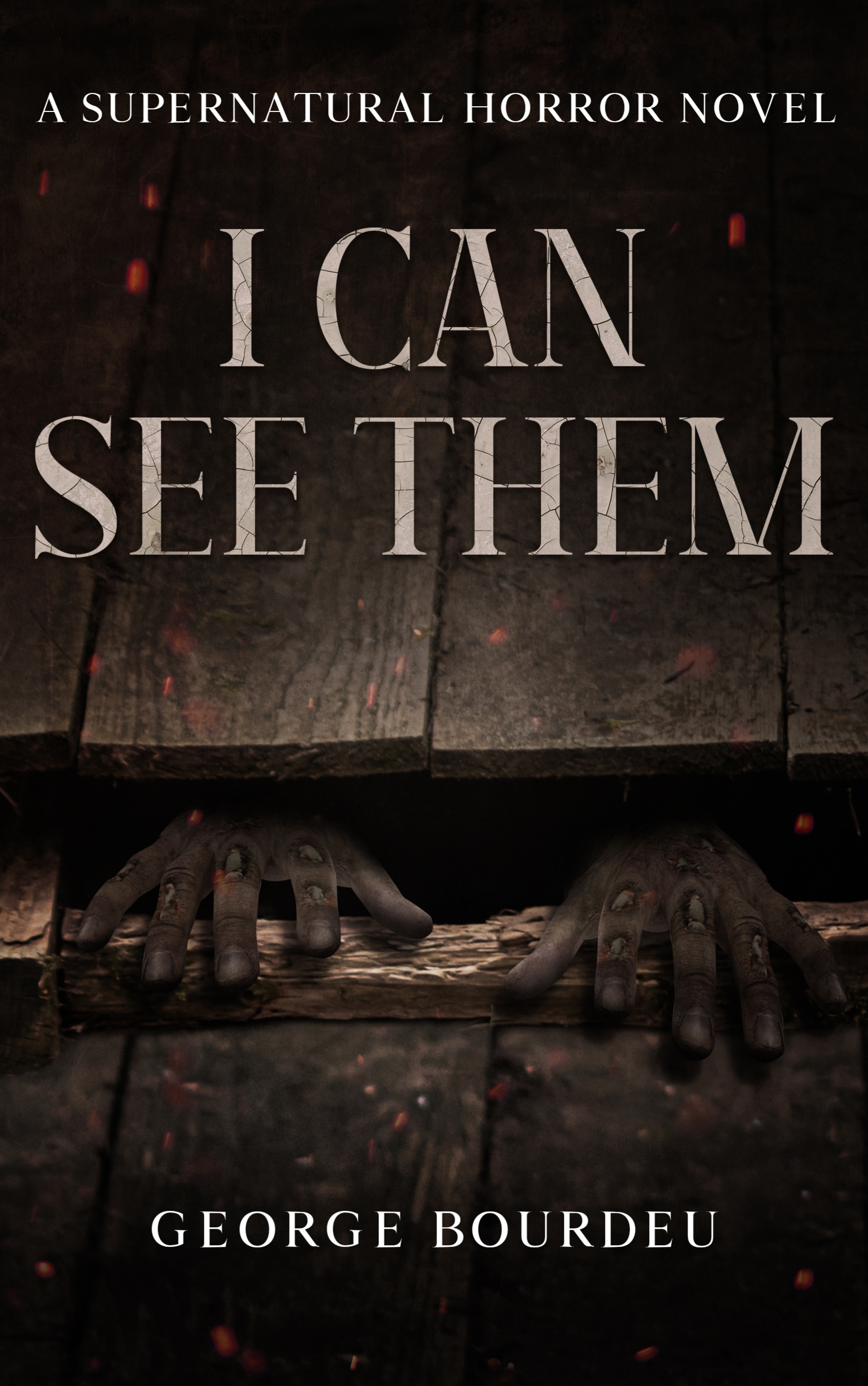
I Can See Them
The eyes are the windows to the soul, and they are coming to take yours
by George Bourdeu
In Millbrook Hollow, the past doesn't just haunt it; it hunts. Journalist Brian Whitmore thought he was investigating a simple local mystery, but the truth is buried deep beneath the floorboards of the Rialto Cinema. In 1784, thirteen children were burned alive in a cellar by those sworn to protect them. Now, on the 240th anniversary of their horrific deaths, the siblings have returned. They are blind, charred, and hungry for the sight they lost in the flames. As soot-cauterized corpses begin to pile up across town, Brian discovers a terrifying link: his own bloodline is tied to the tragedy. Alongside Detective Hannah Cross and a priest whose faith is no shield against the Church's own sins, Brian must uncover a centuries-old cover-up before the sun sets on Halloween. The entities are using voice mimicry to lure the living into the dark. They aren't just looking for revenge; they are harvesting eyes to replace what the fire stole. To stop the cycle, Brian must confront a legacy of evil that runs through his own veins. But when the light of the cellar goes out, who can you trust when you can no longer see? George Bourdeu delivers a visceral, bone-chilling descent into folk horror that will make you fear the sound of two knocks from below.
- Horror
- Supernatural Horror
- Ghost Story
- Demonic
- Slasher
- Folk Horror
The Ash on the Asphalt
The rain started sometime after eleven, thin and cold, the kind that soaked through wool before you noticed it happening. Brian Whitmore sat behind the wheel of his car in the empty lot outside the Rialto Cinema, engine off, camera resting on the passenger seat where he'd left it an hour ago. He had come to get exterior shots of the marquee before the demolition crews showed up in the spring, another dying piece of Millbrook Hollow for a story nobody outside the town would ever read. The theater had been closed for six years. Its letters were long gone from the sign, leaving only the ghost outline of words that used to advertise double features and matinee prices from another decade.
He checked the dashboard clock. Eleven forty-two. Late enough that he should have gone home an hour ago, early enough that some stubborn part of him still wanted one more shot, one more angle of the crumbling façade under bad light. That was the trouble with the job. You told yourself you'd leave after the next thing, and the next thing kept multiplying until the night swallowed you whole.
The rain thickened without warning. One moment it was a light patter against the windshield, the ordinary hush of an October storm, and the next it came down in sheets so heavy that the streetlamp at the corner of the lot dissolved into a smear of orange behind the water. Brian reached for the wipers out of habit, though the car wasn't running, and his hand hovered uselessly over the dash before he caught himself and let it drop.
He grabbed his notebook from the passenger seat, the leather-bound one he carried everywhere, and flipped it open across his knee to scribble a line about the light, about the way the rain made the old theater look like it was dissolving at the edges. It seemed like good color for the piece. He always caught himself doing this, turning fear or discomfort into material before he'd even finished feeling it. His pen moved fast across the page, the words slanted and hurried, and then he closed the notebook and set it on the seat beside him without giving it another thought.
That was when the smell reached him.
It came in through the vents before he understood what it was, acrid and sharp, like a chimney flue that hadn't been cleaned in years. He frowned and checked the vents, thinking maybe something had burned out in the engine, but the car was cold and silent, and the smell kept building anyway, filling the small space of the front seat until his eyes watered.
He looked up through the windshield and understood.
The rain had stopped being rain.
What fell now moved the same way water moved, streaking down in long silver lines caught in the streetlamp's glow, but where it struck the hood of his car it didn't splash. It hissed. Thin curls of steam rose off the metal, and when a drop landed on his side mirror he watched, frozen, as it left behind a small black smudge no bigger than a fingertip, the paint blistering around it like a burn.
Ash. It was raining ash, hot enough to scorch, falling in place of water from a sky gone the color of a dying coal.
Brian's first instinct was denial, the kind that comes automatically to a man who has spent fifteen years chasing down mundane explanations for everything strange. He told himself it was some kind of industrial accident, a fire somewhere upwind, embers carried on a freak gust and mixed in with the storm. He told himself this while his hands were already moving, one gripping the door handle, the other fumbling for his keys in the ignition where they weren't, because he'd pulled them out an hour ago to check the time on his phone.
He found the keys in his coat pocket. His fingers wouldn't cooperate. The ash kept falling, faster now, and where it struck the asphalt of the parking lot it didn't melt away like rain would. It gathered. Small drifts of gray-black soot built along the cracks in the pavement, along the painted lines of empty parking spaces, and steam rose off every surface it touched until the whole lot seemed to breathe.
That was when he saw them.
Two small shapes stood in the middle of the lot, maybe thirty feet from his car, positioned exactly where the burning rain fell heaviest. At first his mind tried to make them into something ordinary, kids out too late, a prank, a trick of the streetlamp's dying orange light. But the ash came down on their bare heads and bare arms and did not burn them. It settled onto their pale skin the way snow settles onto stone, and neither of them so much as flinched.
Brian's hand froze on the door handle.
They were dressed in what might have once been simple clothes, though the fabric had gone the color of old parchment, hanging loose and shapeless around thin frames. One was smaller, a girl maybe, with hair that hung in dark ropes past her shoulders, and the other stood slightly behind her, taller, its face angled down toward the ground in a way that made it impossible to tell if it was watching him or nothing at all.
He should have driven away. Every instinct he owned told him to turn the key, throw the car into reverse, and put the Rialto and its parking lot and its impossible ash storm in his rearview mirror as fast as the engine would carry him. Instead, he rolled the window down two inches, some reporter's reflex insisting he needed to hear this, needed to understand what he was looking at before he could believe it.
The smaller one turned her head toward him.
She did it slowly, the way a doll's head might turn on a stiff hinge, and when her face came around under the ash-choked light Brian felt his stomach drop somewhere below the car seat. Her eyes were flat. Not wide, not staring, simply flat, as if someone had smoothed the curve of the eyeball down into the socket and left two dark ovals where pupils should have been. From the corners, thin black tracks ran down her cheeks, oily and slow, like grease dripping from an old engine part left in the sun.
She did not blink. She never blinked, not once in all the time Brian watched her, and it was the absence of that small human motion that told him, more than anything else, that whatever stood in the lot was not a child in any way that mattered.
"Hey," Brian heard himself say through the gap in the window, his voice thin and stupid in his own ears. "Are you okay out there? It's not safe, you shouldn't be out in this."
Neither of them answered. The ash kept falling between them and his car, gathering in soft gray drifts against their bare feet, and somewhere above the clouds churned and boiled without a single flash of lightning, without a single roll of thunder, as if the storm had no interest in announcing itself.
The taller one lifted its head.
Its face was harder to make out, shadowed and turned at an angle, and Brian found himself leaning toward the window despite every nerve in his body screaming at him to do the opposite. The child's mouth opened. Not wide, not at first, just enough to let a sound out into the burning rain, and when it spoke, the voice that came out of that small, pale throat was not a child's voice at all.
It was his own.
"Brian."
His name in his exact voice, the same pitch, the same faint rasp he always heard when he listened to interview recordings played back, close enough that for one disorienting second he thought someone had hidden a speaker somewhere in the car and was playing a recording of him through it. He actually turned to check the back seat, some part of his brain still grasping for an explanation that didn't require him to accept what his own eyes were showing him.
There was nothing in the back seat. Only his jacket, folded where he'd left it, and the faint reflection of the streetlamp in the window glass.
"Brian," the child said again, and this time the voice carried a small, curious lilt to it, an inflection Brian recognized because it was the exact way he sounded when he was talking to a source he didn't quite trust yet, testing the waters before he asked the real question. "You shouldn't be out in this."
It was repeating his own words back to him. The same sentence, almost word for word, delivered in his own cadence, and hearing it come out of that small unmoving shape in the middle of a parking lot filling with hot ash did something to Brian's chest that he didn't have a name for. It wasn't quite fear. It was something closer to vertigo, the sensation of the ground tilting under a car that hadn't moved an inch.
The smaller child, the one with the flat unblinking eyes, tilted her head to one side. Then, slowly, deliberately, she tilted it the other way, the motion so smooth and unnatural that it reminded Brian of something mechanical winding through its limited range, a toy on a track rather than a body governed by muscle and bone. The black grease at the corners of her eyes ran a little farther down her cheeks and dripped, in slow separate beads, off her jaw and onto the ash-covered ground.
Brian's hand found the window switch and rolled the glass back up, though he wasn't sure what good half an inch of glass would do against whatever this was. His heart hammered against his ribs so hard he could feel it in his throat, in the base of his skull, in the tips of his fingers as they shook against the steering wheel.
"Who are you?" he asked, though the words barely made it past his lips, more breath than sound.
The taller child answered again, and this time the voice cracked slightly in the middle of the word, the way Brian's own voice sometimes did on cold mornings before his first coffee, an imperfection so specific and so personal that it made the hair along his arms stand straight up.
"Who are you," it repeated, mimicking not just his voice but the exact rhythm of his question, turning his own words back on him like a mirror held up at the wrong angle. Then it laughed, a small dry sound with no humor in it at all, and the laugh, too, was his.
Brian's hands moved on their own. The key found the ignition, turned, and the engine caught with a cough that sounded impossibly loud against the silence pressing down on the lot. He threw the car into reverse without looking, without checking his mirrors, some animal part of his brain taking over the controls while the rest of him stayed locked on the two shapes standing in the ash.
The car lurched backward. His tires spun for half a second on the slick, soot-covered asphalt before finding purchase, and in the rearview mirror he caught a last glimpse of the smaller child raising one thin arm toward him, fingers spread, not reaching exactly, more like she was showing him her hand, showing him something smeared black across her palm.
Then the mirror was empty. Just the parking lot, the dead marquee of the Rialto rising up behind it, and the ash still falling in slow curls through the orange light.
Brian didn't remember pulling out of the lot. He didn't remember the turn onto Route 9, or the four minutes it took to reach the edge of downtown, or the moment the rain outside his window turned back into ordinary rain, cold and clean and utterly unremarkable, hammering against his windshield the way October rain was supposed to. What he remembered, later, lying awake and replaying it over and over, was the sound of his own voice coming out of something that had never been alive in any way he understood, and the black grease running down a face that never blinked.
He pulled into the lot behind his apartment building on Cedar Street and sat there with the engine running for a long time, both hands still locked around the wheel, knuckles pale under the dashboard lights. The rain drummed steady and normal against the roof of the car. Somewhere down the block a dog barked twice and went quiet. A porch light flicked on in one of the houses across the street, then off again, some resident checking the weather before deciding it wasn't worth stepping outside for.
Brian made himself breathe. In through the nose, held for a four count the way some therapist had told him years ago during a rough patch after a story that had gone badly wrong, out slow through the mouth. He did it three times before his hands stopped shaking enough to let go of the wheel.
He told himself it was carbon monoxide. A leak somewhere in the old car's exhaust system, fumes seeping into the cabin and playing tricks on his brain, the classic explanation for every impossible thing a tired mind manufactures in the dark. He told himself the smell had probably never been ash at all, that his eyes had adjusted badly to the streetlamp glare and turned ordinary rain into something monstrous. He told himself the voice had been his own imagination, some acoustic trick of the storm bouncing his words back at him through the half-open window, an echo chamber effect he could probably find documented somewhere if he looked hard enough.
None of it worked. Every explanation slid off the memory the moment he tried to press it into place, because he had heard that laugh, and it hadn't been an echo. It had been an answer.
He killed the engine and sat in the dark of the parking lot a while longer, listening to the rain, letting the ordinary chill of the night settle back into his bones. When his heart finally slowed to something closer to normal, he reached over and grabbed his bag off the passenger seat, the notebook still tucked inside the outer pocket where he always kept it. He didn't open it. He didn't want to look at anything connected to that parking lot until he was inside, under real light, with a locked door between himself and whatever had been standing in that ash.
The walk from the lot to his building's side entrance took less than a minute, but it felt longer, every shadow along the brick wall seeming to shift at the edge of his vision, every parked car a shape that might unfold itself and take a step toward him. He fumbled the key into the lock twice before it caught, and once inside the stairwell, under the buzzing fluorescent light that had needed replacing for months, he let out a breath he didn't realize he'd been holding since the moment that child's mouth had opened in the rain.
His apartment on the second floor was exactly as he'd left it that afternoon, a stack of unread mail on the kitchen counter, a mug from that morning's coffee sitting in the sink, the low hum of the refrigerator the only sound in the whole place. He locked the door behind him, both locks, the deadbolt and the chain, and stood there a moment with his back against the wood, listening to his own breathing fill the small apartment.
Nothing followed him in. No cold spot, no smell of smoke, no sound of small feet in the hallway outside. Just the refrigerator, and the rain against the windows, ordinary now, indifferent, the way rain was supposed to be.
He set his bag down on the kitchen table and made himself a drink he didn't really want, whiskey neat in a glass that had been sitting in the cabinet since some holiday gift two Christmases back. He drank half of it standing at the counter, staring at nothing, replaying the two small shapes in the parking lot over and over until the image blurred at the edges from repetition, the way any memory does when you handle it too many times.
It was nearly half past midnight before he trusted his hands enough to reach for the notebook again.
He told himself he needed to write it down while it was fresh, while the details were still sharp enough to be useful, because that was the job, that was what fifteen years in the business had trained into him. You didn't let a story go cold. You got it on paper the moment it happened, before your own mind started smoothing the edges off, before doubt crept in and convinced you that you'd imagined half of what you'd seen. He pulled the notebook out of his bag, sat down at the kitchen table, and opened it to the next blank page.
Except the page wasn't blank.
Brian stared at it for a long moment, his mind refusing at first to process what his eyes were showing him. The handwriting wasn't his. His own writing slanted forward in quick, cramped strokes, the hand of a man who wrote fast and often illegibly, notes scrawled in the dark corners of press conferences and courtroom hallways for over a decade. What was written across the page in front of him now was different. The letters were uneven, some large and looping, others small and cramped together as if whoever wrote them had struggled to hold the pen steady, or had never held one before at all.
The message ran in a single crooked line across the middle of the page, the ink darker than his own, almost black, with small flecks of what looked like ash caught in the wet grooves of each letter.
we can see you
Four words. No period, no capital letter, nothing to soften the flatness of them. Brian's whiskey glass slipped an inch in his hand before he caught it, the ice inside rattling against the sides.
He flipped back through the notebook, fast, his fingers clumsy on the pages, checking every entry before this one, every scrawled note from earlier that night, from the week before, from months back. All of it was his own handwriting, unmistakably, the same familiar mess of half-formed letters and coffee-stained margins he'd been producing since journalism school. Only this one page was different. Only this one page held words he hadn't written, in ink he hadn't used, on paper that had been closed and zipped inside his bag the entire time he sat in that parking lot.
He remembered closing it. He remembered the small metallic click of the cover snapping shut before he'd tucked it into the outer pocket of his bag, well before the rain had turned to ash, well before he'd rolled down his window and asked two dead-eyed children if they were okay. The notebook had never left his bag. It had never been open. And yet here were four words waiting for him at his kitchen table, written in a hand that wasn't his, in ink still faintly damp at the edges as if it had been set down only moments ago.
Brian's mouth had gone dry. He set the glass down on the table without looking at it, his eyes fixed on the page, on the small dark flecks caught in the wet lines of the letters. He touched one with the tip of his finger, carefully, half expecting it to smear like fresh ink, and instead felt the faint grit of ash against his skin, gray dust that came away on his fingertip when he pulled his hand back.
He looked up at his own reflection in the dark window across the kitchen, half expecting to see something standing behind him in the glass, some small pale shape watching from the doorway. There was nothing. Only his own face, pale and unshaven, eyes wide in a way he barely recognized.
The refrigerator hummed on, indifferent. Somewhere down on the street a car passed, tires hissing against the wet asphalt, headlights sweeping briefly across the ceiling before fading again into the dark. Brian sat very still at his kitchen table, the notebook open in front of him, four words staring back up at him in handwriting that did not belong to him, and understood, in some deep and unwelcome part of himself, that whatever he had seen in that parking lot had not simply let him drive away.
It had followed him home in the only way it needed to.
By seven the next morning, gray light filtered through the blinds, casting thin stripes across the kitchen table. Brian had not slept. He sat in the same chair, his cold coffee untouched beside the open notebook. The quiet of the apartment felt heavy, almost brittle, as if the walls themselves were holding their breath. Then, from directly beneath his feet, two sharp, soft knocks sounded against the floorboards.
The Skinner’s Signature
The call came in at 8:02, and by 8:15 Detective Hannah Cross was standing on the sidewalk outside 114 Larkspur Lane, staring at a house that looked, from the street, like every other house on the block. White clapboard siding. A maple tree dropping its leaves onto a lawn someone had bothered to rake the week before. A wreath on the door, months ear…