

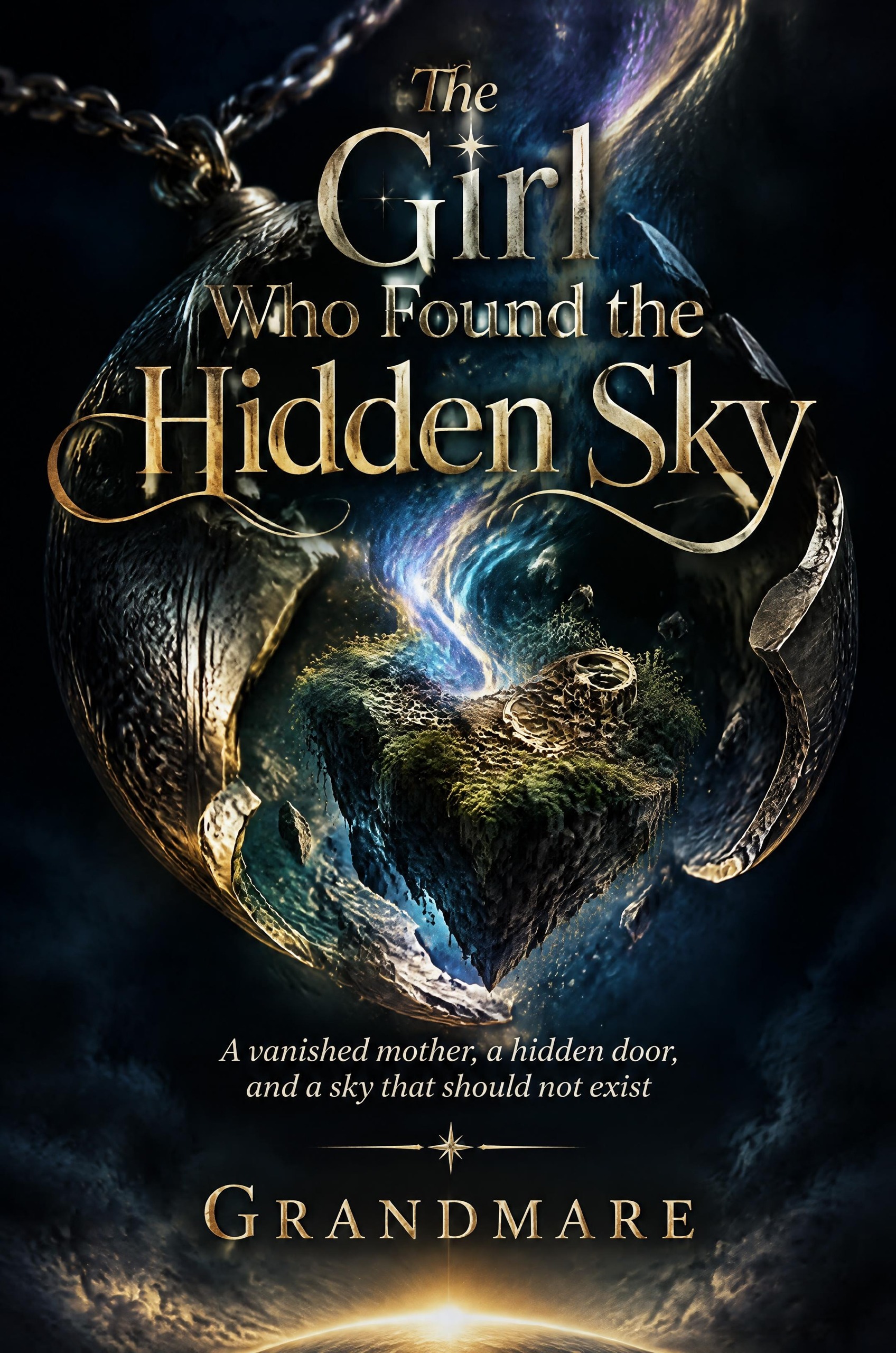
The Girl Who Found the Hidden Sky
A vanished mother, a hidden door, and a sky that should not exist
by Grammy Nana
Seventeen-year-old Mara Vale has spent eleven years mourning her mother Elara, who vanished without a trace, leaving only unanswered questions and a peculiar silver pendant. When a hidden door in the town's abandoned clocktower appears under a strange celestial alignment, Mara steps through an ethereal portal into Asterra, a shattered realm of floating islands. There she meets Elias, a sworn sky-scout hunting the legendary lost child of the realm's greatest guardian, and Silas Moorhouse, a grizzled sky-ferry pilot who knows how quickly the devouring Shadow can swallow a whole island. In the floating city of Lumen, archivist Rosalind Pike reveals a staggering truth: Elara is still alive, holding the cosmic Northern Gate shut against the void with her waning life force. As the islands crumble, Mara discovers she can weave starlight and heal fractured space. Their rescue mission shatters in the Obsidian Wastes. A monstrous manifestation of the void drags Elias into the abyss and traps Mara with her dying mother. Refusing the old cycle of tragic sacrifice, Mara rallies her companions, pulls Elias back from oblivion, and forges a brand-new celestial dawn—an eternal bridge between Earth and Asterra.
- Fantasy
- Young Adult
- Adventure
- Portal Fantasy
- YA Fantasy
- Quest Adventure
The Rooftop Observer
The high slate shingles of the Bellweather Public Library held the sun long after the streetlights flickered to life. Mara Vale sat with her back braced against the red brick chimney, her knees pulled tight to her chest, her pencil moving across the yellowed page of her notebook. Down below, the town square moved at its usual sluggish rhythm. Mr. Henderson was rolling the striped awning back over his hardware shop, swearing softly at the rusted crank. Two boys on bicycles raced across the cobblestones, their tires rattling over the uneven stone until they turned the corner past the post office. From this height, they looked small and easily understood.
Mara pulled her knitted cardigan tighter around her shoulders to keep out the October wind. The wool was frayed at the cuffs where she had picked at the threads during long lectures, but it was warm enough. She tucked a loose lock of dark brown hair behind her ear and checked the lead of her pencil. It was worn down to a blunt wedge. She liked this spot because nobody ever tilted their head up to look for someone on the roof. People in Bellweather kept their eyes level with the shop windows and the pavement, watching for puddles, dog mess, or acquaintances they wanted to avoid.
She had lived in Bellweather for seventeen years, and for eleven of those years, she had been an object of local sympathy that had gradually spoiled into mild annoyance. People did not know what to do with a girl whose mother had simply ceased to exist on a Tuesday morning. There had been no car accident, no muddy footprints trailing toward the river, and no farewell letter left beneath the ceramic salt cellar on the kitchen table. Elara Vale had walked out of their cottage to fetch a basket of plums from the orchard and had not come back. Her grandmother had stepped in with stiff iron rules, starched collars, and a quiet refusal to mention the name Elara under any roof she paid taxes on.
Mara sketched the arch of the bakery doorway, pressing hard into the paper. In the margins, she had written numbers: the bus schedule, the inventory of books due back in the return bin, and the dates of every unexplained light ever recorded in the county gazette. If anyone found the notebook, they would probably call it an obsession. Mara called it record-keeping. The world did not make sense unless you wrote down the parts that refused to fit.
A cloud passed over the square, throwing the brick storefronts into shadow. Mara looked up, expecting the usual slate-gray belly of an autumn squall coming off the hills. But the clouds were not behaving normally. Across the northern edge of the sky, above the squat silhouette of the abandoned bell tower, the overcast belly of the storm seemed to snag. It was not a break in the vapor, nor was it a beam of ordinary sunlight breaking through to touch the grass. It was a sharp, geometric line, perfectly straight and glowing with a dull, cold iridescence that looked like oil on water.
She stopped her pencil. The line remained. It hovered right against the dark belly of a thunderhead, cutting through the natural billows of gray with mechanical precision. She rubbed her thumb against her eye, thinking it was an afterimage from staring too long at the pale paper, but when she lowered her hand, the mark had sharpened. It was an angle now, a distinct corner turning at ninety degrees against the open sky, shimmering with the hard, metallic sheen of polished silver.
Down in the square, nobody stopped. Mrs. Gable kept sweeping dead maple leaves from the front steps of the dry cleaner. A stray hound trotted past the fountain without lifting its snout. Mara watched them with a sudden dryness in her throat. If a chimney had collapsed or a stray firework had burst, twenty people would have poked their heads out of windows. But this tear in the sky belonged only to her eyes.
The silver line pulsed once, a tiny shudder that rattled through her chest like a plucked bass string. The sensation made her stomach tighten. It was not a sound; it was a physical tug that pulled at the marrow of her bones, as familiar and unsettling as the scent of cedar shavings that still lingered in her mother’s old wooden jewelry box. Her heart knocked hard against her ribs. She closed the notebook, wedged the stubby pencil into the spiral binding, and slid both into the deep pocket of her coat.
The abandoned town bell tower stood three blocks away, jutting out of a patch of choked weeds behind the old municipal waterworks. It had been condemned before Mara was born, its timber landings rotting into mulch and its iron bell silenced after a lightning strike cracked the yoke in the seventies. The town council talked every spring about tearing it down, but the demolition bids were always too expensive, so it remained behind an eight-foot chain-link fence topped with barbed wire, sinking quietly into the damp soil.
Mara scrambled down the maintenance ladder on the library’s blind side, her boots finding the rusted rungs with practiced ease. She dropped the last four feet into the mud behind the recycling bins, her knees absorbing the shock. She straightened, brushing grit from her palms, and moved quickly down the alleyway, keeping her head low so the clerk through the apothecary window would not spot her.
The street was quiet. The wind picked up, carrying the smell of wet asphalt, dying weeds, and an odd, thin sharpness that felt like crushed mint leaves and dry ice. Mara crossed the street, slipped between two overgrown laurel bushes, and reached the chain-link perimeter of the waterworks yard. In the corner where the fence met the crumbling brick foundation of an old coal shed, the wire had been pried loose years ago. She pulled the chain-link back, wriggling through the narrow gap, the sharp zinc wire catching on her sleeve but not tearing the wool.
The yard was silent except for the hiss of the wind through the tall, dry grass. Before her, the bell tower loomed like a cracked tooth against the gray sky. Up near its open belfry, forty feet above the gravel, the air still looked strange, bent like light viewed through the bottom of a heavy glass bottle.
Mara approached the heavy oak door at the base. A rusted padlock hung open on a hasp, broken so long ago that orange flakes of iron fell away when she pushed against the timber. The wood groaned, giving way with a sullen scrape across the gravel. Inside, the air was cold, smelling of ancient pigeon droppings, moldering hemlock beams, and wet lime mortar.
She stepped into the gloom, letting her eyes adjust to the darkness. The circular chamber was choked with broken slates, rotten floorboards, and tangled coils of forgotten rope. In the center, a spiraling staircase of cast iron and timber curled upward into the dark throat of the tower. Many of the wooden treads had rotted through to empty air, leaving only the thin iron skeletons of the steps.
Mara tested the first step with her toe. It held. She climbed slowly, keeping her weight pressed close to the central iron pillar where the metal was thickest. Dust drifted down through the cracks above, settling in her hair. Her boots made small, hollow clicks on the iron plates, the sound swallowed immediately by the vast empty shaft. With every turn of the spiral, the air grew colder, but it was not the damp chill of the earth below. It was a dry, thin cold, the kind that belongs to high mountain passes or the edge of winter ponds before the first snow falls.
She passed the empty clock chamber where the four circular dials had long since lost their glass faces, leaving four round windows that framed the patchwork roofs of Bellweather. From here, she could see her grandmother’s house on Elm Street, a small white box with neat black shutters, solid and anchored to the grass. She looked away from it, turning back toward the stairs.
At the top of the tower, the staircase ended at a trapdoor that had fallen off its hinges, leaning drunkenly against the masonry. Mara hauled herself up onto the timber platform of the belfry. Here, the four open stone arches looked out toward the cardinal directions, letting the full force of the wind sweep through. In the center hung the bell itself, an immense green lump of tarnished bronze, its surface scarred by the lightning strike that had split its crown forty years ago.
Mara walked toward the northern arch, her boots crunching over bits of fallen mortar. There was no sky visible through that archway. Instead of the rolling gray hills and the slate roofs of the county hospital, the space between the two stone pillars was filled with an unbroken surface of dark, matte stone that looked like basalt. It had not been built there; it seemed to have grown between the brickwork, filling the arch completely.
Inscribed directly upon the dark surface was a fine, luminous outline. It traced the precise shape of a narrow door, arched at the top, glowing with the same cold, shimmering silver she had spotted from the library roof. It was faint, no thicker than a pencil line, but it held steady against the gloom of the storm. The silver shimmered, bright and clear, like the polish on an heirloom coin kept hidden in a drawer.
Mara stopped three paces away. Her mouth was dry. Her breath curled in front of her face in pale, wispy tails. In all the novels she had read while hiding on the library roof, doorways like this were described with flourish, surrounded by music or ancient runes carved by dead kings. But this was plain. It looked like an architectural diagram sketched in starlight onto a slab of frozen river stone.
She took a step closer. The line did not waver. The faint, rhythmic thrum she had felt down in the square was louder now, vibrating up through the soles of her boots. It was not a machine. It felt like a heartbeat, deep and regular, pulsing at a frequency that matched the blood rushing through her own ears.
With so much care and thoughtfulness, she kneeled. The rough timber floor bit into her knees through the denim of her jeans. Mara reached out with her right hand, her fingers trembling slightly. Her palm was pale against the dark face of the wall. She hovered her fingertips an inch above the shimmering line, feeling the air prickle against her skin with a dry, static sting.
"Don't," a voice said.
The sound was low, direct, and completely calm, emerging from the deep shadow cast by the massive bronze bell behind her. Mara jumped, her heels skidding against the grit, and she threw her shoulders around to face the dark.
A boy stood there, half-concealed by the iron framework of the bell. He wore a tailored coat of heavy charcoal cloth, its hem cut clean and practical above dark traveling trousers. His dark hair was whipped into tangled points by the wind, and his eyes, pale and remarkably clear, seemed to catch what little light remained in the belfry with an unnatural brightness. He had one hand resting on the hilt of a curved short blade sheathed at his hip, and around his neck hung a small, polished stone that gave off a faint, milky luminescence. He looked no older than eighteen, but he stood with the quiet, rigid balance of someone who expected the floor to give way beneath his boots at any second.
Mara scrambled backward on her hands and knees until her back hit the cold masonry beneath the arch. "Who are you? How did you get up here?"
"Step away from the threshold," he said, not raising his voice. He took one smooth, measured pace forward into the light of the arch. "Now is a bad time to discuss terminology. Move toward the stairs, slowly."
"I asked you a question," Mara said, her voice shaking despite her best attempt to keep it flat. Her fingers pressed back against the stone behind her, looking for purchase. "I know every kid in this town. You don't live here."
"I know I don't," the boy replied. His gaze flicked past her shoulder to the glowing silver line on the stone, his brow furrowing with genuine alarm. "And if you touch that, neither will you. Get away from it, Mara."
Hearing her name in his mouth hit her like a bucket of well water. She froze. "How do you know who I am?"
"Because you have your mother's stubborn tilt to your chin, and you've been sitting on that library roof for three hours drawing things you aren't supposed to see," he said. He reached toward her, not aggressively, but with an urgent, outstretched hand. "My name is Elias. I was sent to watch the gate, not to open it. It isn't stable. The wards are collapsing, and if you trigger the latch—"
"My mother?" Mara interrupted. Her heart hammered wildly against her ribs, deafening her to the wind. "What does she have to do with this? She's dead. She's been gone for eleven years."
"She isn't dead," Elias said. The words were flat, plain, and devastating in their simplicity. "She sealed the Northern Gate from the other side. But the seals are breaking. You can't be here. Stand up and take my hand."
The world seemed to tilt on its axis. For eleven years, every adult in Bellweather had used soft, evasive words: departed, moved on, lost to us. Nobody had ever looked her in the eye and said her mother had sealed a door from the other side. It was insane. It was the plot of the third-rate paperbacks she hid beneath her mattress. Yet her hand, resting against the stone behind her, could feel the deep, rhythmic pulse of the silver outline vibrating directly against the meat of her palm.
She did not take his hand. Instead, her instinct, sharpened by years of suspicion, pulled her backward. Her hand slipped along the masonry, and her bare fingertips brushed directly against the shimmering silver line.
The stone did not feel like stone at all. It was cold and shimmering, smooth as ice on a pond that had frozen overnight. The silver she remembered from the old ring her mother used to turn upon her finger flared instantly beneath Mara's touch. A sharp shock, like a needle of winter air, lanced up her arm and struck her directly behind the breastbone. Her stomach lurched violently.
As she stepped back to pull away, the stone didn't let go. It flared with a sudden, blinding white brilliance that burned away the shadows of the belfry. The geometric line didn't just glow; it tore open. A sound like tearing silk filled the small chamber, accompanied by a deafening, hollow groan as the ancient bricks of the bell tower began to shudder in their lime sockets.
"No!" Elias lunged forward, his coat flaring behind him, his boots skidding across the rotten timber.
The outline split down the middle. What lay beyond the basalt was not stone, nor was it the gray sky of Bellweather. It was an endless, impossible expanse of violet and gold, an open sky hanging upside down over islands of green moss and white marble that drifted like leaves across a pond. Mara saw them in a fractured, terrifying flash: landmasses suspended in absolute empty space, held aloft by nothing, while far beneath them rolled an undulating ocean of pitch-black smoke.
A gale of freezing, dry wind erupted through the gap, tearing the notebook from Mara's pocket. The pages fluttered wildly, ripping away from the spiral binding and scattering across the belfry like frantic moths. The force of the vortex pulled at her hair, her cardigan, her breath. She tried to scramble forward, away from the opening, but the floor beneath her gave a sick, splintering crack.
"Mara, grab the pillar!" Elias shouted over the roar of the wind, his hand reaching across the widening gap. His pale eyes were wide with a fierce, desperate focus.
She reached for his outstretched fingers, her hand inches from his charcoal sleeve. But the ancient masonry of the northern arch cracked with the sound of a gunshot. The entire stone lintel dissolved into a spray of fine, luminous dust. The floor beneath her dropped away entirely, timber giving up its long fight against time.
Her fingers brushed the cold wool of Elias’s sleeve, catching for a fraction of a second, before the sheer vacuum of the threshold tore her loose. Mara fell backward through the frame. The gray roofs of Bellweather, the green copper of the cracked bell, and the reaching silhouette of the boy in the charcoal coat vanished in an instantaneous burst of silver light. The air was ripped entirely from her lungs, replaced by the weightless, tumbling terror of a sky that had no floor.
The fall was not a clean drop. It was a chaotic skid across currents of air so thin and cold they scorched her throat like salt. Mara spun, her limbs flailing against the wind, her hazel eyes stinging as she tried to force them open. The world around her had shattered into light and vertigo. There was no ground below, no solid earth waiting to break her bones. There was only a terrifying, limitless blue that shaded into deep indigo at the zenith, freckled with stars that burned in broad daylight.
All around her, suspended in the vast gulf, floated the land. She tumbled past a mass of jagged gray rock the size of a church, its underside carpeted in thick, luminous moss that glowed with a faint cyan pulse. On its upper surface, a ruined colonnade of white limestone stood frozen against the sky, its broken pillars entwined with pale ivy. Further off, miles away in the shimmering haze, an entire mountain drifted slowly like an iceberg on an invisible tide, waterfalls spilling from its cliffs only to dissolve into mist before they reached the abyss below.
And below was the void. It was not simple empty space; it was an active, roiling belly of ink, a churning sea of shadow that swallowed all light that fell toward it. Mara could feel the pull of that darkness, an icy gravity that smelled of dust, stagnant water, and old iron. Her breath came in short, ragged gasps that produced no warmth. She was falling toward it, tumbling head over heels, the wind roaring in her ears until her skull felt like an empty bell.
A sharp crack echoed through the open air above her, like the snap of a canvas sail catching a gale. A hand seized the thick collar of her cardigan with enough force to choke her, wrenching her body out of its uncontrolled spin. Mara cried out, her hands flying up to grip the arm that held her.
It was Elias. He was falling with her, but he was not flailing. In his other hand he held a thick cord woven from braided, shimmering silver wire, the top end anchored to a broad, triangular kite-like glider of dark oiled silk that caught the updraft from the chasm. The sudden resistance of the silk jerked them both upward, the shock tearing through Mara’s shoulders with bruising intensity. For a second, the sickening plunge halted, and they hung suspended in the whistling wind, swaying beneath the small canopy of silk.
"Stop kicking," Elias ordered, his voice strained as he fought the crosscurrents with his right wrist. "If you kick, you throw the trim, and we both drop into the dark."
Mara pulled her legs together, her boots dangling over thousands of feet of empty air. Below them, the ink-colored sea rolled and churned, sending up long, wispy tendrils of black fog that seemed to reach for their dangling heels. She looked up at him, her chest heaving against the tight wool of her collar. "You jumped after me?"
"I didn't have much of a choice," he said between clenched teeth, his knuckles white around the control bar of the silk wing. "You're the only living person who can touch a threshold without turning to ash. I let you fall, the Northern Gate falls with you. Look ahead. Do you see the shelf?"
Mara forced her head around, her hair lashing across her eyes. A hundred yards downwind, a flat shelf of rust-colored stone drifted along a steady current. It was small, barely larger than the foundation of her grandmother's porch, covered in patches of dried, coarse scrub. A solitary, stunted tree with leaves the color of beaten copper clung to the edge of the rock, its roots gripping the stone like bird talons.
"I see it," she shouted over the rushing air.
"When I cut the tether, roll onto your left side," Elias said, his pale eyes tracking the drift of the stone. "Do not try to catch yourself with your wrists. Keep your head down."
"Wait, what do you mean, cut the tether?"
"We don't have enough lift for two," he said calmly. "Three, two, now."
There was a sharp click as he released the catch on the silver cord. The silk glider ripped away into the upper currents, instantly sucked upward by the wind, and gravity took them both again. For two terrifying heartbeats, Mara felt the bottom drop out of her stomach. Then came the violent impact of stone and gravel.
She hit the rust-colored shelf hard, rolling as Elias had commanded. The rough, jagged shale tore at the elbow of her cardigan and scraped the side of her hip, knocking the remaining breath from her lungs in a sharp grunt. She slid three feet across the gravel, her boots catching against the raised lip of the stone just inches from the sheer drop. She lay there, her cheek pressed against the cold, dry shale, her hands trembling as they gripped the jagged rock.
Beside her, Elias landed with far more grace, dropping to one knee and absorbing the momentum with his boots, though he slid a yard across the dust before coming to a halt. He immediately rose, releasing the strap of the harness from his chest, and turned his pale eyes out toward the open sky. His hand was already back on the hilt of his curved blade.
Mara pushed herself up onto her hands and knees. The shale dug into her palms, sharp and real. It was not a dream. The pain was too bright, the cold too thin, the smell of dust and ozone too sharp in her sinuses. She looked back over the edge. There was nothing below the shelf of stone. Just the open, hungry expanse of the dark mist, swirling miles beneath them like an oil slick on an infinite ocean.
"Where are we?" she whispered, her voice barely carrying through the thin air. "Where is Bellweather?"
"Behind you," Elias said without looking at her. He pointed his chin toward the empty blue above them. "About two miles up, through a rupture that is already sealing itself shut."
Mara looked up. There was no door. There was no bell tower, no brick chimney, no slate roof. There was only the vast, inverted bowl of the sky, shimmering with bands of gold and violet light that shifted like ribbon in a breeze. In the distance, floating like islands on a sea of air, hundreds of fractured landmasses drifted in silent, slow motion. Some had ruined towns perched upon their crags; others were nothing more than bare teeth of rock, floating alone in the quiet void.
"This is Asterra," Elias said. His tone was direct, drained of any wonder, the voice of a scout surveying a battlefield he had seen too many times. "Or what's left of it."
"This is impossible," Mara said. She sat back on her heels, her fingers digging through her cardigan pockets until she felt the hard outline of her pencil. But her notebook was gone, torn to pieces in the belfry. The loss hit her with a sudden, irrational spike of panic that tasted worse than the fall. "People don't fall through walls. Continents don't float. I was on the roof of the library ten minutes ago. I have to go back. My grandmother—"
"Your grandmother doesn't know what you are," Elias cut in. He stepped toward her, his dark traveler’s coat snapping around his shins in the wind. "She kept you in Bellweather because she thought the quiet would drown out the blood in your veins. But your mother was Elara Vale, the First Warden of the Northern Gate. And when she locked that gate eleven years ago, she didn't just lock away the void. She left the key inside you."
Mara stared up at him, her hazel eyes narrowed with a fierce, defensive skepticism. "You keep talking about her like she's some kind of soldier. My mother made jam. She read poetry to the cats. She left her wool socks on the radiator."
"She also held a three-hundred-mile line of light against an entity that devours stars," Elias replied, his face completely serious. "She had to make jam when she lived in your world, Mara. If she used her magic there, the threshold would have burned your town to cinder before you were old enough to speak."
He turned his back to her, his gaze scanning the horizon. Far off to the northeast, where the floating islands clustered into a jagged archipelago of white limestone, the sky had turned a bruised, sickly purple. Dark lightning, thick and silent, arced between the drifting crags. The sight was wrong, unnatural even in a world where rocks floated like corks. Wherever that purple lightning touched, the edges of the islands seemed to crumble, disintegrating into showers of black sand that drifted down into the devouring mist below.
"The Shadow is advancing faster than Rosalind predicted," Elias muttered, more to himself than to her. "The third sector is already collapsing. We have to reach the ferry line before Silas cuts the cables."
"Silas? Rosalind?" Mara stood up, her knees wobbling like birch saplings before she locked them. She wiped the dust from her jeans, refusing to let him see how badly her hands were shaking. "I'm not going anywhere with you until you explain what's happening. You pulled me out of my town. You told me my mother is alive."
"She is alive," Elias said, looking back at her. "For now. She is embedded in the stone of the Northern Gate, using the last of her celestial essence to keep the seal closed. But she can't hold it much longer. The wards are dying. And when they fail, the void doesn't just swallow Asterra. It spills through every open doorway left between our world and yours. Bellweather will be the first mouthful."
Mara looked at the pale stone around them, then out at the endless, terrifying beauty of the fractured realm. The air was thin and smelled of old memories, cold and clean, like the silver pendant she had found once in her mother's cedar chest, the one that had burned her fingers with frost when she touched it as a child. She remembered her mother’s hands, smelling of dry mint and clean river water, tucking her into bed with a look in her eyes that Mara had never understood until this second: the look of someone standing on a crumbling bridge, waiting for the timber to snap.
"What do you need me to do?" Mara asked, the words feeling heavy and strange on her tongue.
Elias looked at her for a long second, his pale eyes softening just a fraction, the rigid tension in his shoulders dropping an inch. "I need you to survive the crossing to Lumen. I need you to learn how to open what she closed. And I need you to stay behind me when the dark comes."
He unbuckled a spare leather strap from his pack and held it out to her. "Tie this around your waist and hook it to my belt. The air-bridges out here don't have railings, and gravity has a terrible habit of forgetting which way is down."
Mara took the leather strap. It was cool and smooth beneath her fingers, scarred with the marks of old buckles and long journeys. She tied it tight around her coat, securing the iron link with a firm twist. She was seventeen, her notebook was gone, her knees were bruised, and the sky beneath her feet went on forever. But for the first time in eleven years, the blank space where her mother had vanished wasn't an empty void in a town that refused to remember. It was a doorway, cold and shimmering, waiting to be unmade.
"Lead the way," Mara said.
Elias gave a short, curt nod, turned toward the edge of the floating shelf, and stepped out onto an invisible path of light that flared to life beneath his boots.
Shattered Horizons
The dark stone under Mara's ribs was completely flat, slick as wet glass, and freezing against her knuckles. She rolled onto her side and dug her fingers into the grit. The wind did not howl here so much as it whistled through thousands of tiny cracks in the stone, making a thin, piping note that vibrated right inside her teeth. Above her, the open…