

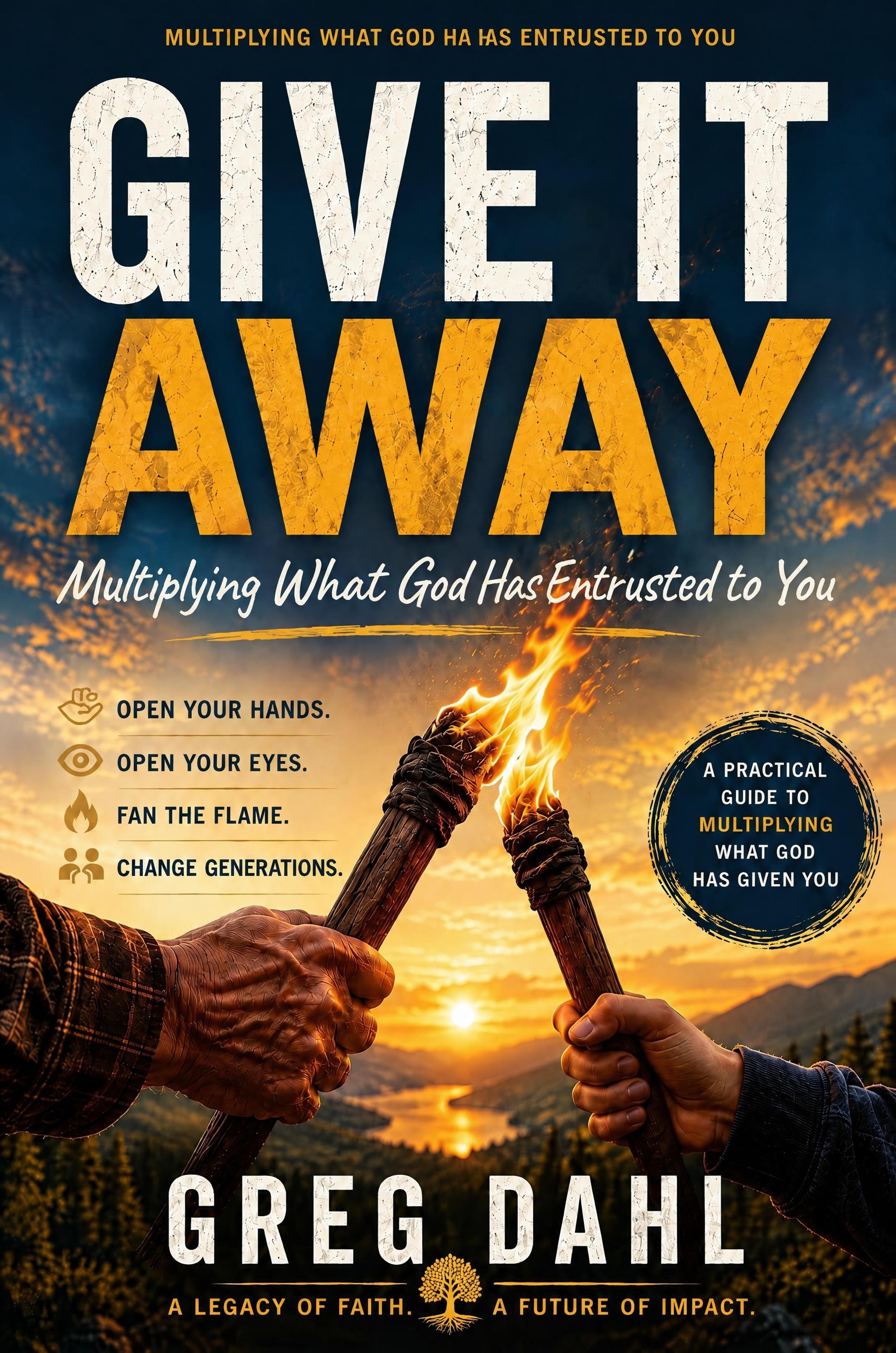
Give It Away
Multiplying What God Has Entrusted to You
by Greg & Theresa Dahl
# GIVE IT AWAY *What You Release, God Can Multiply* **You can hold onto something until it dies in your hands. Or you can give it away and watch it multiply.** For decades, Greg Dahl built heirloom furniture designed to outlast its owners. But somewhere between shaping wood and building a life, he discovered something far more valuable: **the greatest legacy isn't what we leave behind. It's what we pass on while we're still here.** What happens to everything you've learned when you're gone? Who will carry forward the wisdom, the vision, and the gifts God has entrusted to you? *Give It Away* challenges one of our deepest instincts: the desire to hold on. To protect what we've built. To remain indispensable. To believe that no one else can do it quite like we can. Drawing from the lives of Moses, Elijah, Jesus, and Paul, Greg reveals a powerful biblical principle: **the mission is always bigger than the messenger.** True leadership isn't measured by how many people depend on us, but by how many people we've equipped to carry the mission forward. With the practical wisdom of a craftsman and the heart of a pastor, Greg introduces a six-step pathway for mentoring the next generation. He addresses the fear of letting go, the challenges of developing others, and the courage it takes to step aside so someone else can step up. Whether you're a parent, pastor, business owner, mentor, or leader, this book will challenge you to rethink what it means to leave a lasting legacy. **Because the greatest things you build in life aren't meant to end with you.** *Stop protecting what you have. Start giving it away.*
- Religion & Spirituality
- Self-Help
- Christianity
- Spiritual Growth
- Personal Leadership
Old Money
"One generation shall commend your works to another, and shall declare your mighty acts."
— Psalm 145:4 (ESV)
I've spent most of my life building things.
Some people build careers.
Some build investments.
Some build reputations.
I've always been drawn to building things I could touch.
Businesses.
Furniture.
Ministries.
Projects.
Ideas.
If you handed me an empty piece of ground, I'd start imagining what could be built there.
If you handed me a problem, I'd start looking for a solution.
Building was never just something I did.
It was part of who I was.
For years I built custom furniture. Not the kind that comes out of a flat box with an instruction sheet. Not the kind designed to last until the next decorating trend.
I built heirloom furniture.
The kind a family could pass from one generation to the next.
The kind that could still be sitting in a home 100 or a hundreds of years from now.
People often asked why my furniture cost more than what they could buy somewhere else.
The answer was simple.
I wasn't building for today.
I was building for generations.
Anyone can build something that lasts a few years.
It takes a different mindset to build something that lasts beyond your lifetime.
Several years ago, I was delivering some of those heirloom pieces to the East Coast when I kept hearing a phrase that caught my attention.
"That's old money."
I heard it while visiting historic neighborhoods.
I heard it while talking with homeowners.
I heard it while admiring homes that had stood for generations.
At first, I assumed people were talking about wealth.
After all, the homes were beautiful.
The properties were impressive.
The families seemed established.
When people pointed to a neighborhood, a family, or a home and said, "That's old money," I assumed they were talking about large bank accounts and inherited wealth.
But the more I listened, the more I realized they weren't really talking about money.
They were talking about continuity.
One family had owned the same property for generations.
Another had built a business that children and grandchildren continued to operate.
Another family had established a reputation that still benefited descendants decades later.
The money was only the visible part.
The real story was transfer.
Someone had received something valuable and refused to let it die with them.
They passed it on.
Then the next generation did the same.
And the next.
And the next.
As I unloaded another piece of heirloom furniture into a home that would likely pass it down for generations, I couldn't shake the thought.
Maybe old money wasn't really about money.
Maybe it was about stewardship.
Maybe it was about transfer.
Maybe it was about refusing to let something valuable die with you.
That thought followed me home.
And the longer I thought about it, the more uncomfortable I became.
Because I began asking myself a question.
What has God placed in my hands that was never meant to stay there?
The older I get, the more that question matters.
Maybe that's because life has a way of reminding you that your time is limited.
I've survived cancer.
I've broken my neck.
I've burned my face.
I've had hundreds of stitches in my hands.
I've blown out both knees.
Today I take blood thinners because doctors believe they may help prevent a future stroke.
Looking back, I am amazed by God's faithfulness.
I shouldn't be here.
Yet here I am.
Every scar tells a story.
Every hardship taught a lesson.
Every season left something behind.
And somewhere along the way, I realized something.
One day I will leave this earth.
So will you.
That isn't negative.
It's reality.
The question isn't whether our lives will end.
The question is whether what God entrusted to us ends with us.
That realization changed the way I looked at everything.
It changed the way I looked at leadership.
It changed the way I looked at ministry.
It changed the way I looked at business.
It even changed the way I looked at success.
For years I measured success by what I could build.
Now I find myself measuring success by what will continue after I'm gone.
Over the years I have heard leaders say things like:
"This is my ministry."
"This is my calling."
"God gave me this."
And I understand exactly what they mean.
God does call people.
God does entrust vision.
God does assign responsibility.
But I sometimes wonder if we unintentionally use those statements to justify holding on too tightly.
Whenever I talk about finding someone to take my place someday, I often hear the same response.
"But God called you."
"God gave you this."
Exactly.
If God gave it to me, shouldn't I steward it the way He stewards everything He gives?
God is the greatest giver in the universe.
Nothing He creates is intended to stop with one person.
The Gospel was given away.
The Holy Spirit was given away.
Wisdom is given away.
Leadership is given away.
Discipleship is given away.
The Kingdom advances because what God gives is continually transferred from one person to another.
I do not believe God entrusts things to us so we can cling to them.
I believe He entrusts them to us so we can multiply them.
There is a difference between ownership and stewardship.
Owners protect.
Stewards prepare.
Owners ask, "How long can I keep this?"
Stewards ask, "Who should receive this next?"
That distinction changes everything.
One of the greatest obstacles to multiplication is that the people we are training are not yet where we are.
Of course they aren't.
Why would we expect them to be?
You may have spent twenty years learning what they are trying to learn in six months.
You have already made mistakes they haven't made.
You have already solved problems they are just beginning to face.
Naturally they will be slower.
Naturally they will make mistakes.
Naturally they will not perform at your level.
At first.
But that is not the measure of successful leadership.
The measure of successful leadership is not whether someone can do the job exactly like you today.
The measure is whether they can eventually do it better than you tomorrow.
If I spend years pouring wisdom, experience, knowledge, and encouragement into another person, I hope they surpass me.
I hope they learn from my victories.
I hope they learn from my failures.
I hope they avoid mistakes that cost me years to overcome.
I hope they start where I finished.
A father wants his children to go farther than he did.
A teacher wants his students to know more than he knew.
A coach wants his athletes to perform beyond his own abilities.
A mentor should desire the same thing.
The goal is not to create copies of ourselves.
The goal is to create people who stand on our shoulders and see farther than we ever could.
The greatest compliment to a teacher is not being needed forever.
The greatest compliment is seeing those they taught thrive without them.
That is why the pattern of Scripture is always multiplication.
Abraham invested in Isaac.
Moses invested in Joshua.
Elijah invested in Elisha.
Jesus invested in His disciples.
Paul invested in Timothy.
Again and again, God reveals the same principle.
What He gives to one generation is meant to flow into the next.
One day, while reflecting on all of this, a simple thought settled deeply into my spirit.
A gift that is not multiplied is eventually lost.
The more I thought about it, the more I realized how true it is.
Wisdom withheld eventually dies.
Leadership unshared eventually fades.
Knowledge untaught eventually vanishes.
Vision that is never transferred ends with the visionary.
Most people think old money is about wealth.
I have come to believe it is about transfer.
Someone received something valuable and refused to let it die with them.
The question is no longer whether God has given you something valuable.
The question is what you will do with it.
Will it die with you?
Or will it live on through the lives of others?
Because what we keep eventually fades.
But what we give away multiplies.
And perhaps that was God's plan all along.
What has God placed in your hands that was never meant to stay there?
A Gift That Is Not Multiplied Is Eventually Lost
"And what you have heard from me in the presence of many witnesses entrust to faithful men, who will be able to teach others also."— 2 Timothy 2:2 (ESV)I have always been fascinated by old craftsmen.The kind of men who could look at a rough piece of wood and see something beautiful hidden inside.The kind who knew things that weren't found in books.…
Want to read the rest?
Get the full book here: