

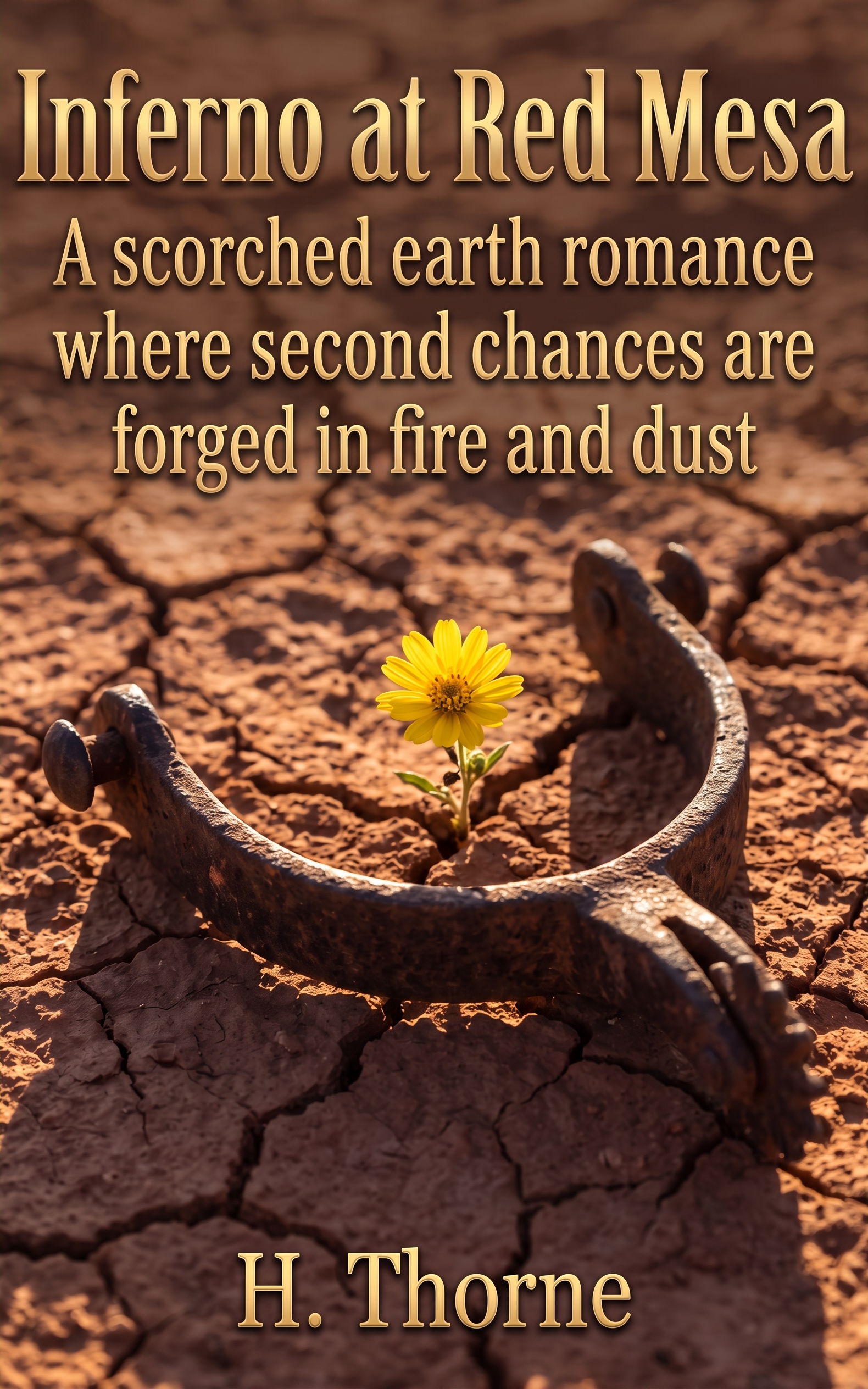
Inferno at Red Mesa
A scorched earth romance where second chances are forged in fire and dust
by H. Thorne
The valley is drying up, and Eden Mercer is holding on by a thread. As the owner of the Red Mesa ranch, she's fighting a brutal drought and the predatory reach of land speculators. But the greatest threat to her composure isn't the heat—it's the return of Wade Ashby. Four years ago, Wade walked away from Red Mesa and Eden's heart without a word. Now he's back, tasked with inspecting the very creek that keeps her legacy alive. As they clash over water rights and old wounds, the friction between them sparks a fire more dangerous than the one threatening the horizon. When a devastating wildfire rushes toward their borders, Eden and Wade must choose between the pride that divided them and the partnership that could save them both. Amidst emergency foalings and town hall betrayals, they discover that some bonds, like the red earth of the mesa, only harden under pressure. H. Thorne delivers a sweeping Western saga of grit and desire, proving that even the most parched ground can bloom when the right heart returns home. Can Eden trust the man who left her, or will the secrets he brought back burn everything to the ground?
- Romance
- Western
- Historical Fiction
- Second Chance Romance
- Western Romance
- Slow Burn Romance
Chapter 1: Dust Over the Creek
Eden Mercer reined in at the lip of the creek bed and looked down at what ought to have been running water.
Cottonwoods leaned over the narrow cut in the earth as if listening for a sound that did not come. Their leaves flashed pale and dark in the noon wind, silvering one moment, green the next. Beneath them, Red Mesa Creek dragged itself over stone in a ribbon so thin it scarcely deserved the name. Mud showed black at the edges. A month ago, the stream had sung loud enough to drown out a rider’s approach. Now it whispered and broke around exposed rock like a secret too weak to keep.
She sat very still in the saddle, one gloved hand closed on the reins, and let the sight settle into the hard, cold place inside her where figures were kept. Fewer head of cattle watered. Fewer kitchen gardens saved. Less hay come winter. Men hired and men let go. Promises made to families on her land and whether she could keep them.
Drought had a way of stripping life down to arithmetic.
Her mare sidestepped, uneasy in the shifting gravel. Eden soothed her with a stroke to the neck, though her own temper pricked sharper by the second. Someone had ridden down the bank before her. She could see the hoof marks pressed deep in the damp edge of the creek, fresh enough that the water had not yet clouded over them. There was another sign too, more offensive for being neat: a horse tied in the shade of the largest cottonwood, reins looped with the careless confidence of a man who believed he belonged wherever he chose to stand.
She knew that horse.
The bay lifted its head at the sound of hers and flicked an ear. Broad in the chest, black-maned, one white sock on the hind leg. Older than when she had last seen him, but unmistakable.
A pulse beat once, hard, at the base of her throat.
“No,” she said aloud to no one at all, as if a plain refusal might alter a fact already before her.
Then a man straightened from a crouch beside the creek, and refusal became useless.
He rose with a slowness that had nothing to do with uncertainty. He planted one hand on his thigh and came upright in a single easy line, water dripping from his fingers where he had tested the flow. His hat brim shadowed his face at first. Then he pushed it back.
Wade Ashby had been handsome at twenty-two with the kind of dangerous ease women mistook for kindness and men mistook for indifference. Time had not gentled him. It had cut him cleaner. The years had pared away what little softness he had ever worn in company and left a face all planes and weather, bronzed dark by sun, marked at the jaw by a pale seam of old scar she had never seen before. His mouth was the same, though: made for mockery and things she had spent years teaching herself not to remember. His eyes, under the brim, were a blue so clear they had always felt like an accusation.
He looked at her as if he had expected the creek to fail and the sky to stay empty, but not as if he had expected her.
“Miss Mercer,” he said.
The title was correct. The tone was not. It held too much history and not nearly enough distance.
Eden gathered the reins shorter and sat straighter, grateful for the structure of spine and saddle and skirt and gloves and every civilized thing between herself and surprise. “Mr. Ashby.”
Wind moved through the cottonwoods. Somewhere upstream a grasshopper clicked. It was an indecently private place for a meeting she had not agreed to have.
He glanced once at the creek, then back to her face. “You’re a long way from the main road.”
“So are you.”
“One might think there’s water here worth looking at.”
“One might also think the creek runs through Mercer land.”
The corner of his mouth shifted. It was not a smile. “Partly.”
She disliked that answer because it was true. The creek cut through disputed boundaries in three places before feeding lower pasture claimed by half the valley on paper and by whichever man had the stronger will in practice. In good years, men argued over fences and forgot the law. In lean years, they found religion in every line they had ever filed at the county office.
Eden let her gaze travel over him with a coolness she did not feel. Dust on his boots. A sweat-darkened line at his shirt collar. Coat slung over a low branch instead of worn despite the heat. No tie. He had never cared overmuch for neatness unless there was a funeral, a wedding, or a banker to impress. “I was under the impression Ashby stock watered farther west.”
“They do.”
“Then your concern here seems touching.”
“Water has a way of broadening a man’s concern.”
She should have expected he would come armed with civility sharpened to a point. Wade had always fenced best when he looked half amused. It made a person careless. It had made her careless once, and she had paid for it.
She dismounted without waiting for his assistance. The gravel slid under her boots as she stepped down the bank, and by the time she reached level ground she had arranged her face into the expression that had served her through three years of creditors, dry summers, and men who believed a woman running a spread must either be managed or outwaited.
“If you have business with this section of the creek, Mr. Ashby, I assume you mean to state it plainly.”
His gaze dropped, just once, to the place where her skirts brushed her boots. It was an instant only, but she felt it like touch. Then his eyes returned to hers and his expression gave nothing away. “Plainly, then. The flow’s down by nearly half from spring count. If it drops much more, the lower bend won’t fill the east channel at all.”
“I can see that.”
“You’ve had laborers clearing silt near the north cut.”
So that was it. She had wondered how long it would take for rumor to move. In this valley, news traveled quicker than rain and lasted longer. “I have.”
“Without speaking to the other holders.”
“The other holders did not consult me when they diverted runoff last season.”
“We rebuilt a broken bank after a storm.”
“You widened it.”
He looked at her for a beat, and there it was between them at last: not politeness, not memory, but the old and dangerous pleasure each took in meeting an equal force. “Still counting shovels, Eden?”
The use of her first name struck low and intimate as a hand set at her waist. Her own name on his mouth had once made the world feel close and bright and lawless. Here, in the washed-out bed of a dying creek with no witness but the trees, it made her pulse jump in a way she despised.
She said, “You will call me Miss Mercer.”
“Will I.”
“If you value harmony.”
“Do you.”
His voice had dropped. Not enough that another person might remark upon it. Only enough that she heard what sat underneath the words.
Eden kept her chin high. “Harmony is less costly than litigation.”
“Ah. There you are. I was wondering when the lawyer would arrive.”
“My lawyer is in Santa Fe. I am merely the owner of adjacent land with a proper regard for records.”
“Of course.”
The insult of being perfectly understood was almost worse than being challenged.
She moved closer to the creek and crouched, gathering her skirts in one hand. The water was cool when she touched it, colder than the heat aboveground suggested. Too little of it. She watched it slide around her fingers and vanish downstream, and she could feel him standing over her shoulder, not close enough to draw comment, close enough that her body noticed all the same.
It had been four years.
Four years since she had stood in church with every eye in town measuring the set of her mouth. Four years since Wade Ashby had left Red Mesa with dust on his boots and no word sent back except what business men traded over stock prices and grazing rights. Four years in which she had learned that humiliation, if properly tended, could harden into something serviceable.
She rose and turned to him before memory could get any further hold. “If you came to warn me off maintenance work, you’ve wasted your ride.”
“If I’d come to warn you off, you’d know it.”
“There’s a comforting sentiment.”
“I came to see whether what I heard was true.”
“And now that you have?”
“Now I know you’re cutting deeper at the north cut than your father ever did.”
At the mention of her father, every part of her cooled. “My father is dead, Mr. Ashby.”
His face changed, but only in the eyes. “I know.”
“Then don’t use him to make your point.”
A muscle moved once in his jaw. “Fair enough.”
The apology was real, which irritated her more than any smooth evasion could have. Wade had never been most dangerous when cruel. He was dangerous when honest.
She turned away from him under pretense of studying the bank. Above them, red earth lifted in shelves striped with stone, the mesa itself standing massive against the white-blown sky. The land gave beauty stingily here. What it offered, it made a person fight to keep.
“If the north cut is deeper,” she said, “it is because the bed has risen with silt and debris. If I do nothing, the channel chokes before August.”
“If you deepen it too much, you pull more flow west before the lower bend can take its share.”
“Your share.”
He laughed softly. “There she is.”
“What exactly did you expect, riding onto my land and questioning my management?”
He stepped nearer then, enough that she had to tilt her face to keep his. “I expected you to do precisely what you’re doing.”
“And what is that?”
“Stand as if you’re six inches taller than you are and dare me to call you on it.”
The remark was light. The look that accompanied it was not. It took in the line of her shoulders, her throat, the brim of her hat shading her eyes. For one foolish second she remembered him younger and less guarded, with his hand spread warm over the small of her back in the dark behind the assembly hall, saying her name as if it belonged to no one else.
Heat moved under her skin so quickly it felt like anger.
She drew a breath and gave him the smile she reserved for men who mistook familiarity for privilege. “I have found daring men to honesty is less effective than presenting them with facts. The fact here is simple. Mercer cattle have legal access to this creek.”
“Ashby cattle do too.”
“Then water them.”
“Hard to do if there’s none left by the time it reaches us.”
The words landed between them with the weight of all the weeks ahead. This was no idle sparring over fences. Men measured a summer by water. Women measured it by whether children grew thin before the first frost. A ranch did not fail all at once. It narrowed. It sold off teams. It planted less. It borrowed more. It made excuses until excuses became inventory.
Eden folded her gloves tighter in one hand. “What do you want from me?”
“There’s a phrase no man should answer too quickly.”
She looked at him with flat contempt. “Do not.”
His eyes flicked over her face. Something in his own shifted, darkened, acknowledged. “No,” he said quietly. “Best not.”
The air seemed to thicken. The creek whispered over stone. A bead of water slid from an overhanging root and struck the surface with a sound absurdly delicate in the heat.
That old knowledge of him was the worst of it. She knew the exact note in his voice when jest turned dangerous. Knew the stillness that came over him when he wanted something and had decided not to reach for it. Knew, by some treacherous memory in the body, what his restraint cost.
She stepped back, putting one clean pace between them. “State your business.”
He let the moment go, and she had the disorienting sense that he had done it for her rather than from obedience. “I want to inspect the north cut before anyone puts another shovel in the ground.”
“No.”
His brows rose. “That was swift.”
“I am not in the habit of turning my operations over to neighboring ranchers for approval.”
“You needn’t. But if your men alter the flow enough to hit our lower pasture—”
“Your lower pasture has drawn more than its due for two seasons.”
“Then bring the surveyor and prove it.”
She did not answer at once, because there was the difficulty. Surveyors cost money. Time too. And while lines could be argued on maps, water obeyed gravity and desperation in equal measure. By the time a survey was paid for, filed, contested, and perhaps respected, the creek could be a memory.
He saw the calculation in her silence. Of course he did. Wade had always read her too quickly. “That’s what I thought.”
“I do not require your pity.”
“Good. I wasn’t offering it.”
“Then what? A warning?”
“A chance to do this before the valley turns it into a spectacle.”
She almost laughed. “The valley turned us into a spectacle years ago. It scarcely needs encouragement.”
The words escaped before caution could stop them. For the first time since he stood, he looked as if she had struck him somewhere unguarded.
“Is that what you think this is?” he asked.
“I think,” she said, each word neat as stitching, “that Red Mesa has a powerful appetite for scandal and an even more powerful talent for pretending moral injury while consuming it. If you are seen riding in and out of Mercer property with any frequency, tongues will move. If we quarrel publicly over water, those same tongues will call it justice. I prefer not to feed either hunger.”
Color had risen under his sun-browned skin, not much, but enough. “You imagine I haven’t considered that?”
“I imagine very little about your considerations, Mr. Ashby. It saves time.”
A hawk wheeled high overhead, silent against the brutal blue. Wade looked away from her then, toward the line of cottonwoods upstream where the shade pooled thickest. “You always did know where to put the knife.”
She had not meant to hear the truth in that. It scraped at her all the same. “You taught me where to aim.”
He turned back slowly. Whatever she had reached in him, he had closed over it. “There’s the old score, then.”
“There is no old score.”
“Liar.”
The word was quiet. Not angry. Worse for being certain.
Her hand tightened around her gloves. A sensible woman would have mounted at once, returned to the house, sent a foreman tomorrow, and never again come to inspect the creek alone. A sensible woman would not stand in trees and heat with a man she had once nearly ruined herself over and feel alive in every nerve.
“I have no wish to discuss the past.”
“You brought it.”
“I named a fact.”
“So did I.”
His hat cast a bar of shadow over his eyes, but she could still see their color. Impossible that blue should look hard. Impossible too that she should remember them soft.
He said, “What happened between us may be dust by now where you’re concerned. It isn’t by me.”
The bluntness of it took the air from her. She had spent years prepared for rudeness, indifference, perhaps some superior masculine forgiveness she had no intention of accepting. Not this. Not a plain admission spoken into daylight as if he had a right.
She made her voice cold enough to survive on. “That is an unfortunate confession.”
One side of his mouth moved. “For both of us.”
She should have left then. Instead she said the one thing she had no business saying. “Why did you come back, Wade?”
His eyes narrowed slightly at his name on her lips. She had not meant to give it. The intimacy of it spread between them at once, undeniable and raw.
“For the same reason any man does,” he said after a moment. “Land. Work. Obligation.”
“That isn’t an answer.”
“It’s the one you get.”
“Because the true one would be inconvenient?”
His gaze dropped to her mouth, then lifted. “Wouldn’t it.”
Her breath caught, small and humiliating. The world around them seemed sharpened to impossible detail: the dry sweetness of cottonwood bark, the heat radiating off the red bank, the dark line of damp earth at the creek’s edge, the pulse in her own wrists. She became acutely aware that they were alone. More aware still that if anyone rode over the rise and found them standing this way, too still, too intent, there would be no version of it the valley did not improve.
“Step back,” she said.
He did not move. “I’m not touching you.”
“That is not the point.”
“Then tell me the point.”
The point was his nearness. The point was that she could smell leather and sun and clean male sweat beneath dust. The point was that four years had done nothing sensible at all to the traitorous, helpless recognition in her body. The point was that if he set one hand on her waist now, here with the creek dying and the whole valley balanced on scarcity, she did not trust herself to react with the outrage she had carefully earned.
“The point,” she said, and was grateful her voice did not shake, “is that I will not have my judgment compromised by old foolishness.”
At that, something fierce and humorless flashed in his face. “You think that was all it was.”
“I think naming it anything grander would be vanity.”
He stepped in close enough then that her back nearly brushed the bank behind her. Not touching. Not quite. The space between them was a breath’s width and hotter than contact. “You can call me vain if it helps,” he said. “But don’t stand there and tell me you’ve forgotten.”
She hated him for knowing she had not. Hated herself more for the answer her body gave before her mind could marshal denial. Her nipples tightened beneath lawn and corset. Heat pooled low and sudden, so vivid she almost reeled from the shame of it. This was madness. This was a creek bed in broad day and a man who could ruin her with one careless look if anyone saw.
She lifted her chin because it was the only movement she trusted. “Move.”
For one suspended instant she thought he would not. His eyes had gone dark as stormwater, fixed on her face with a hunger too disciplined to be called wild and too open to be mistaken for anything else. Then he exhaled, slow through his nose, and stepped back.
The absence of him was a shock.
He reached past her only for his coat from the branch, but his sleeve brushed the air near her shoulder, and she felt that too. Every nerve she possessed seemed to have turned opinionated.
“You should bring a hand with you next time,” he said, settling the coat over one shoulder.
The remark was proper. The meaning beneath it was not entirely. Protection, yes. Witness too.
“I did not ask for instruction.”
“No.” He put his hat lower over his brow. “You never did.”
She hated the ache his voice could still find in her. “Will you inspect the north cut by force, then?”
He gave a short laugh with no mirth in it. “Not today.”
“Tomorrow?”
“We’ll see.”
“There speaks the spirit of neighborly cooperation.”
“There speaks a woman who’d salt my well if I turned my back.”
“Only if the law favored me.”
His glance traveled over her once more, this time with a grudging heat that made her skin feel too thin. “God help the law.”
Against all reason, laughter rose in her. She swallowed it before it became visible. It would not do to laugh with him here, not after that near thing between them, not when the earth itself seemed to be withholding judgment.
He caught the almost-laugh anyway. He always had. The knowledge sat briefly between them like sunlight through leaves—unwanted, warm, painfully familiar.
Then the sound of another rider floated faintly from above, the clink of tack carrying down the bank.
Both of them changed at once.
By the time Eden turned her head toward the rise, her face had become composed, cool, entirely suitable for a woman alone on legitimate business. Wade had already stepped farther from her, every line of him settled back into easy reserve. It was astonishing, and infuriating, how swiftly they could perform innocence.
A young hand from the Mercer place appeared at the top of the bank, hat pushed back, freckled and anxious. “Miss Eden?”
“I am here, Toby.”
He looked down, saw Wade, and straightened so abruptly he nearly lost his seat. News would be half born in his eyes before he rode ten yards. “Beg pardon, miss. Mr. Taylor said you’d been gone a spell and wanted to know if you meant to head back for dinner.”
“I do,” she said. “Presently.”
Toby nodded too often. “Yes, miss.”
Wade touched two fingers to the brim of his hat in a gesture so proper it might have been carved on a church pew. “Afternoon.”
“Afternoon, sir,” Toby muttered, all but swallowing the word.
Eden knew exactly how this looked despite all efforts otherwise: the Mercer heiress and Wade Ashby alone at the creek where the boundary ran uncertain and old gossip bred like flies. Nothing had happened. Too much had happened. Reputation did not distinguish finely.
She climbed the bank with measured dignity, refusing Wade’s hand when he offered none. At the top she put one boot in the stirrup and mounted in a single practiced motion. From the saddle she looked down at him.
“Send word if you intend to come to the north cut.”
He rested one forearm on the pommel of his saddle where his bay stood tied, and the pose ought to have been careless. It was not. “Will you grant permission?”
“No.”
“Then I may save the messenger.”
“Trespass, and I’ll have you turned off.”
“I’d like to see who tries.”
She should not have answered. “You might.”
Toby sat very still several yards away, trying and failing to look deaf.
Wade’s gaze held hers another heartbeat too long. “Ride safe, Eden.”
There it was again, her name stripped of title and laid warm against old scars. In front of a witness this time. A small thing. A dangerous thing.
She gathered the reins. “Good day, Mr. Ashby.”
Then she turned her mare toward home and rode up through the red dust with her back straight and her pulse in disarray.
She did not look behind her. That was public performance, and she had perfected it. But all the way back across the dry pasture, with the mesa glaring red under the sun and the creek’s diminished whisper following her like a warning, she could feel him standing under the cottonwoods and watching her go. By the time the Mercer house came into view, white against the hard land, she knew two things with miserable certainty.
The water was running out.
And Wade Ashby was trouble of the oldest, hottest kind.
Chapter 2: Terms of Necessity
By dinner, the story had reached the Mercer table ahead of her.Not the truth, of course. Truth moved slowly and disliked company. What arrived first was the shape of a thing: Toby red-eared and earnest, Mr. Taylor grave, the cook pretending not to listen while listening harder than anyone, and the distinct sense in the room that Miss Eden had been …