

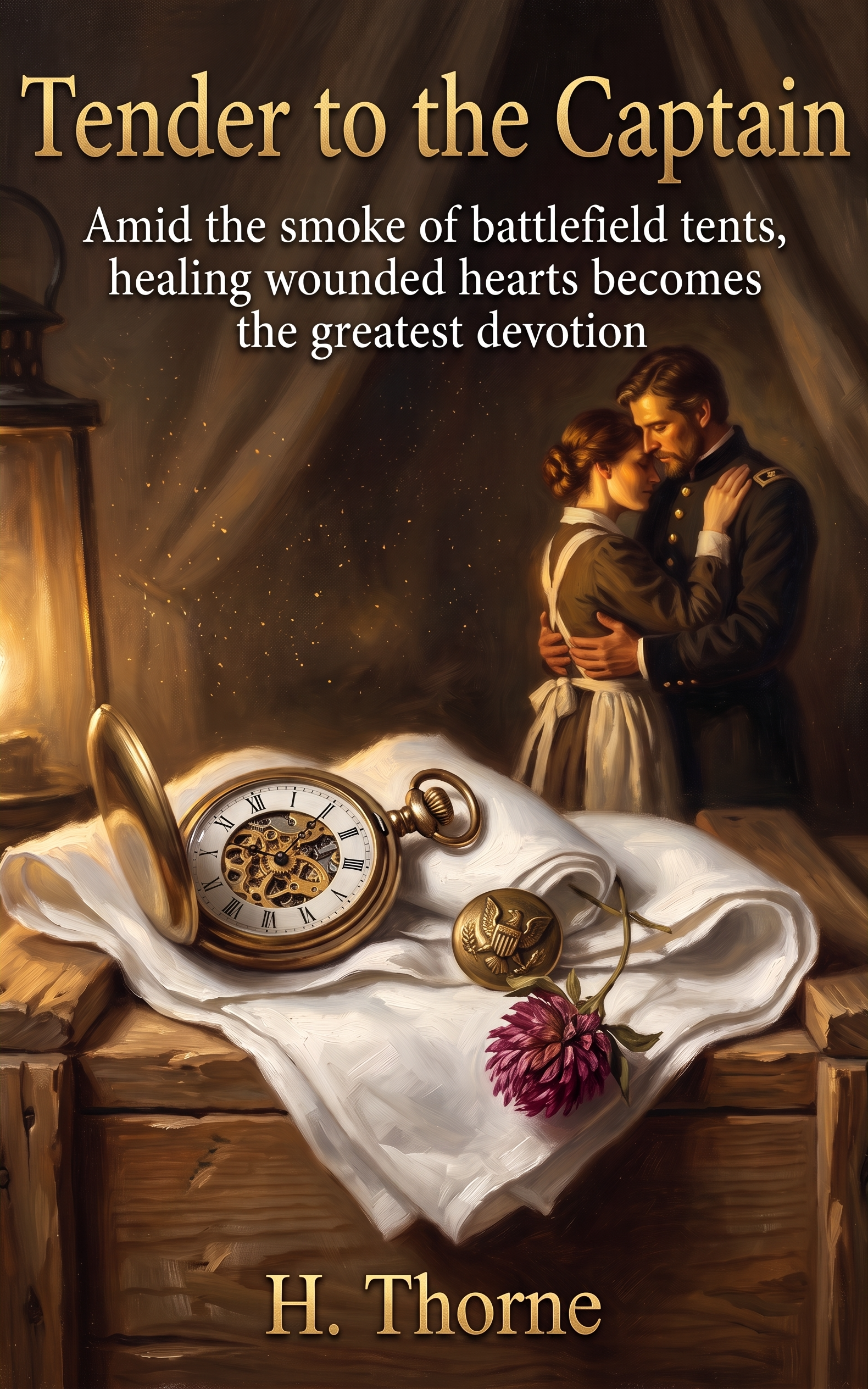
Tender to the Captain
Amid the smoke of battlefield tents, healing wounded hearts becomes the greatest devotion
by H. Thorne
In the shadow of the American Civil War, Clara Whitfield has guarded her heart behind bandages and battlefield medicine ever since Chickamauga claimed her husband. She lives only for duty, finding purpose within the blood-stained canvas of the field hospital. Then Captain Elias Macy is brought to her cot, shattered in body but armed with a sharp wit and deep vulnerability. As Clara tends his grievous shoulder wound through feverish midnight watches, a quiet intimacy sparks between them—one whispered word at a time. Behind canvas partitions and among supply crates, their unspoken longing turns into stolen, breathless moments. But their fragile bond draws the venomous gaze of Mrs. Lavinia Pike, chairwoman of the ladies' aid committee, who threatens Clara with scandal and immediate expulsion for impropriety. Faced with Clara's ruin, Elias makes an audacious stand. Refusing to let society destroy the woman who restored his will to live, he risks everything to claim her before the camp chaplain—proving that even amid the devastation of war, true devotion can conquer the darkest storm.
- Romance
- Historical Fiction
- Historical Romance
- Military Romance
- Slow Burn Romance
- American Civil War
Under Canvas
Rain drummed on the canvas hard enough to drown a prayer.
Inside the hospital tent, lamplight shivered over iron instruments, medicine chests, and rows of narrow cots crowded so close a man could reach from one fevered hand to another. The air smelled of wet wool, blood, old smoke, and vinegar, with the sharper bite of laudanum beneath it all.
“More bandages,” Dr. Pembroke called without turning. “And have Jenkins shift the lantern. I will not lose another man because I cannot see where the devil his artery has hidden itself.”
“Yes, Doctor.”
Clara crossed the packed earth between cots with the speed necessity taught and modesty denied. Her skirt hem was already soaked from the mud tracked in all evening, her apron marked, her back aching from too many hours bent over men who cried for mothers, wives, or God with equal desperation. She passed Private Harlan sleeping under a fever sweat, old Sergeant Reed gritting his teeth through a dressing change, and a boy from Ohio who could not be more than sixteen and had at last stopped asking whether his foot might be saved.
She moved the lantern nearer the surgeon’s elbow, set fresh strips of linen within reach, and took the soiled ones away. Her hands did not tremble. They had trembled once, in her first weeks among the wounded. They had not done so in a very long time.
A gust shoved at the tent wall. The canvas bellied inward, dark and wet, then snapped back. Men muttered. Somewhere outside, wheels ground through mud and a horse screamed as if the weather itself had laid hold of it.
“Miss Whitfield.”
Clara turned at the voice. It belonged to Mrs. Lavinia Pike, whose black silk cloak and spotless gloves looked indecently composed in such a place. She stood just within the entrance, a little retreat of dry propriety about her even with rain blowing in behind her. As chairman of one of the charitable committees from Washington, Mrs. Pike had managed to become indispensable to men who liked supplies and feared public opinion. She had also managed to make herself unwelcome to every woman who worked beneath canvas.
“The coffee urn from the ladies’ aid has arrived,” Mrs. Pike said. “I trust the officers will be seen to first.”
Clara kept her face smooth. “The men in greatest need will be served first.”
Mrs. Pike’s mouth refined itself into a smile too delicate to be mistaken for kindness. “Compassion is admirable, Miss Whitfield. Order is more so.”
Before Clara could reply, the tent flap flew wide and order vanished entirely.
“Captain coming in,” someone shouted. “Make room there. Make room.”
Four stretcher-bearers shouldered through mud and lamplight carrying a man in a soaked Union coat darkened nearly black with rain and blood. One arm hung loose from the edge of the canvas litter, the hand broad and slack, smeared red to the wrist. He was bareheaded. Wet dark hair clung to his temples and forehead. His face was bloodless beneath stubble and grime, the hard bones of it made harsher by pain.
“Gunshot to the shoulder,” one bearer said. “Threw him from the saddle when they brought him off the line. Took a knock to the ribs besides. He was still giving orders when we loaded him.”
“That fool habit afflicts the officer class,” Dr. Pembroke muttered. “Set him there.”
They lowered the patient onto an empty cot near the center aisle, where the light was strongest and privacy least possible. Clara was already moving toward him with scissors, bandages, and a clean basin. The captain’s eyes opened before she reached him.
Gray, she thought first. Not pale blue, not green. Storm-gray and sharp, with a soldier’s habit of measuring everything in a glance. They fastened on her face, then her hands.
“No.”
His voice came rough with pain and command alike.
Clara set the basin on the stool beside the cot. “You have been shot, Captain. You will permit me to see the wound.”
He made an attempt to rise on one elbow. A stripe of pain cut across his mouth. “I said no.”
One of the bearers gave a weary snort. “Begging your pardon, sir, but you’ve lost enough blood to float a skiff.”
“Out,” Captain Elias Macy said through his teeth. “All of you.”
Dr. Pembroke arrived at the cot and spared the captain one brisk glance. “You may dismiss your company when you are not in my hospital tent with a ball somewhere in your shoulder, Captain. Miss Whitfield, coat off. Shirt as well if you can save it. If not, cut it.”
At the doctor’s order, the captain’s gaze cut back to Clara with renewed disfavor. She had seen that look before from men of breeding who had never expected to place their bodies in a woman’s competent hands unless those hands belonged to a wife or a whore. Sometimes modesty drove it. Sometimes pride. Sometimes fear. This, she thought, was something sharper.
“Sir,” she said, because public softness often answered male obstinacy better than a challenge, “if you continue to argue, I shall only be obliged to cut more dearly woven cloth.”
“That is a low blow.”
The faintest edge of dry wit surprised her. So did the answer that leaped to her own tongue.
“Then let us be grateful the shot struck higher.”
One of the bearers barked a laugh before smothering it. Dr. Pembroke’s mustache twitched. The captain looked as though he did not know whether to be offended or impressed, which was better than resistance.
“Hold him steady,” the surgeon said.
“I do not require holding.”
“You require obedience.”
Clara set to work on the coat. The right shoulder was saturated through, the blue wool clinging stubbornly to the wound beneath. She slid her fingers under the collar to ease it back. At once every muscle in his body tightened.
There it was, that strange current she had not expected—a flare not of her own choosing, but of awareness. He was hurt, exhausted, and likely half delirious, yet the breadth of him on the cot seemed to crowd the little space around them. Wet wool. Clean male heat under rain and blood. The hard line of his throat working once as she touched him. It had been too long since she had let herself notice such things. Too long since noticing had brought anything but sorrow.
“Be still,” she said quietly.
“You speak to officers very boldly, Miss Whitfield.”
“I speak boldly to patients who make my work slower.”
That won her another look. Less hostile this time. More intent.
She peeled the coat away with help from a hospital steward and began cutting through shirt and undershirt where the fabric stuck. The ball had entered high in the right shoulder and buried itself in the outer muscle without, so far as she could judge, striking bone or a major vessel. The flesh around it was swollen and ragged. Not the worst she had seen that night. Bad enough.
Dr. Pembroke bent over the wound. “You are fortunate. Another inch and we should be discussing your funeral. This will hurt.”
“Your bedside manner is improving,” Captain Macy said.
“Miss Whitfield, sponge.”
She washed the blood away in steady strokes. The captain hissed as the cloth touched raw flesh, his jaw hardening until she thought his teeth might crack. She knew better than to offer apology. Men did not want pity while they fought to keep hold of themselves. They wanted witness without softness.
So she gave him that instead.
“Look at me,” she said.
His lashes lifted. For one second his eyes were unfocused, then fixed on hers.
“Not at the instruments,” she told him. “At me.”
Something altered in his expression then. Wariness remained, and pain, and masculine irritation at needing guidance from a woman half his size. Yet beneath it came compliance, unwilling but real. He looked at her while the surgeon probed.
Outside, rain hammered the camp to sludge. Inside, men groaned, lamps smoked, and time narrowed to the pressure of Clara’s hand braced against the captain’s uninjured shoulder and the burn of his gaze on her face.
“Ball’s deep,” Dr. Pembroke muttered. “Damnation. Forceps.”
Clara passed them over. Captain Macy’s breath came shallow and quick. Sweat beaded over his upper lip despite the chill. When the probe searched deeper he made one low sound, almost a growl, and his left hand shot out.
It closed over Clara’s wrist.
His grip was fierce, all reflex and raw strength. The basin rattled against the stool.
Every part of her went still.
The hand around her wrist was hot, callused, alive. Too alive. Too male. Too intimate. Men seized nurses in pain often enough, but something in the directness of his hold seemed different—not pawing, not confusion, not the grasping of a frightened boy. It was as if he had chosen the only solid thing available and found, to his own displeasure, that it was her.
His eyes sharpened at once as if he understood exactly what he had done.
“Release her, Captain,” Dr. Pembroke said, still intent on the wound.
Captain Macy did not release her. Not immediately. His thumb pressed once, involuntarily perhaps, against the inner pulse of her wrist.
Clara felt the answering leap all through her.
Then he let go so abruptly her hand almost fell.
“My apology,” he said, looking not at her now but at the tent roof. His voice was clipped, formal, and colder for the strain under it. “Pain lowers a man.”
Mrs. Pike, who had no reason to be near enough to observe and yet somehow always was, made the faintest disapproving sound from two cots away where she stood dispensing cups no one had asked her to pour.
Clara flexed her fingers once and set the basin straight. “You are not the first wounded man to forget his manners, Captain.”
“Am I to be comforted by belonging to a large club?”
“By surviving to complain of it, perhaps.”
Dr. Pembroke gave a sudden grunt of satisfaction. “There.” Metal clicked lightly. “I have it.”
Captain Macy went white to the lips and closed his eyes.
The surgeon lifted the flattened ball with the forceps before dropping it into a dish. “Buried in the muscle, no splintering that I can feel and no great vessel taken. You may keep the arm if you have the sense not to tear yourself apart before it mends.”
“I am attached to it,” the captain said faintly.
This time Clara did not hide the flicker of amusement that crossed her mouth. He saw it. Even in pain, he saw it.
She helped bind the wound while Dr. Pembroke examined his ribs and declared them badly bruised from the fall, painful enough to make deep breathing a misery but not, by his examination, broken. A dose of laudanum was measured. The captain refused it on the first offer.
“You will take it,” the doctor said.
“I need a clear head.”
“You need sleep.”
“I have men to account for.”
“And they will not improve because you stare nobly into the dark.”
Clara held out the spoon. “Take it, Captain. I promise your pride may recover alongside your shoulder.”
His gaze slid from the spoon to her face. “You promise a great deal to a stranger.”
“We have met under circumstances that excuse haste.”
A pause. His mouth shifted, almost a smile, though pained. Then he accepted the dose from her hand.
His lips brushed the spoon. Nothing in the world, she thought angrily, should make so small a contact feel so perilously noticeable.
Foolishness. Fatigue. Nothing more.
He swallowed and lay back against the rolled blanket serving as a pillow. The hard line between his brows eased by degrees, though suspicion had not left him.
Dr. Pembroke moved away to the next case. “Miss Whitfield, keep an eye on him through the night. If fever rises, wake me. And if he attempts heroics, bind him to the cot.”
“I heard that,” Captain Macy murmured.
“Then save us all the trouble.”
Clara began clearing the bloody instruments from the stool. Around them the tent resumed its relentless business. A man on the far side cried out for water. Another started muttering Scripture. The steward carried away a tray of stained dressings. Mrs. Pike drifted nearer at last, coffee service in hand, pious usefulness wrapped around her like a second cloak.
“Captain,” she said in a tone fit for a drawing room. “Mrs. Lavinia Pike, Sanitary Commission auxiliary. We are all anxiety for our brave men.”
Captain Macy looked at her once and then past her to Clara, as if judging whether he must perform courtesy for one woman while the other watched. “Madam.”
Mrs. Pike’s attention settled on the cut shoulder of his shirt, the loosened blankets, Clara standing beside the cot with blood on her apron. Her brows rose the merest fraction.
“Miss Whitfield is very… devoted in her duties.”
The implication was fine as needlework and just as sharp. Clara kept her spine straight.
“She is competent in them,” Captain Macy said.
The words were simple. The effect was not. Mrs. Pike’s smile thinned. Clara, absurdly, felt heat creep under her skin though she had spent the past hour elbow-deep in suffering.
“How fortunate for you,” Mrs. Pike said. “One hopes competence is always guided by propriety.”
Captain Macy’s eyes returned to hers then, and she saw that he understood perfectly what charge had been aired in so clean a tone. She hated the sudden awareness between them. Hated more that the defense he had given, curt though it was, had not been required by any duty of his and yet had been offered.
“The army is at war, madam,” he said. “If propriety objected to blood, I think it chose the wrong season.”
One of the nearby orderlies choked on what might have been laughter. Mrs. Pike drew herself up.
“I speak only from concern for the moral atmosphere, Captain.”
“Then I advise deeper breathing elsewhere,” Dr. Pembroke called from the next cot without looking up.
Mrs. Pike gathered her dignity and retreated to safer ground among the coffee cups.
Clara exhaled slowly through her nose. “You should not have spent your strength on that.”
“I have some prejudice against being used as a lesson in your conduct.”
She looked at him fully then. “My conduct requires no lesson.”
“No.” His gaze rested on her face with disconcerting steadiness. “I begin to suspect it does not.”
The laudanum was softening him around the edges but not enough to blunt intelligence. That made him more dangerous, not less. A stupid flirtation she would know how to avoid. A lucid man in pain, carrying bitterness under discipline, was another matter.
She adjusted the blanket over him, drawing it higher against the damp chill. “Try to sleep.”
“You order me often.”
“You disobey often.”
“Perhaps I object to the habit of being managed.”
“Then war has chosen an inconvenient profession for you.”
A breath of sound escaped him that might have been a laugh. His eyes closed. For a moment she thought he would drift off. Instead he said, without opening them, “Most women are gentler when they wish to be obeyed.”
The words might have been idle. They were not. There was an old wound in them that had nothing to do with Minie balls or broken ribs.
Clara’s hands stilled on the blanket.
She ought to have moved away. Ought to have treated the remark as no more than medicine-loosened speech. Yet some stubborn thing in her answered before caution could stop it.
“Most women,” she said quietly, “have not held men together while waiting to see which ones God means to keep.”
His lashes lifted.
The look he gave her then held no mockery at all. Only a long, searching gravity that made the busy tent around them seem for one impossible instant hushed.
“You have done that before,” he said.
She could have answered lightly. She could have said every nurse in Virginia and Washington had done the same. Instead truth crossed too near the surface.
“Yes.”
No more. She would give him no more than that.
He seemed to understand the boundary and, more surprisingly, to respect it. “Then I beg your pardon, Miss Whitfield.”
It was not a grand apology. It was, perhaps, better than one. Cleanly said. No excuses.
She inclined her head. “Accepted.”
He watched her another moment, as if some private reckoning in him had shifted half an inch and irritated him by doing so. “Elias Macy,” he said.
For a second she did not comprehend.
Then she did, and heat struck her far more sharply than any impertinence could have managed. He had given her his Christian name.
Not as flirtation. Not with a smile. As if naming himself were a kind of truce.
She ought not use it. She knew that at once. In any company but the most intimate, it would be impossible. Improper. Dangerous. Yet the offering itself changed the air between them.
“Captain Macy,” she said, because it was the only safe answer.
One corner of his mouth moved. “Wise.”
“You are under my care, sir. Wisdom is necessary.”
“Is it?” His voice had gone lower with weariness. “I had thought endurance the chief requirement.”
“For soldiers, perhaps. For nurses, both.”
He studied her as if he meant to fix her in memory and mistrusted himself for the effort. “And for women who have already buried someone?”
The question landed so directly she nearly stepped back.
The rain, the lamps, the groans of the wounded, Mrs. Pike’s censorious hovering—all of it rushed sharply back. Clara folded the bloodied cloth in her hands and set it aside with exaggerated neatness.
“You ask too much of a first meeting, Captain.”
“Do I?”
“Yes.”
He did not apologize this time, but his eyes closed again and the line of his face altered into something wearier than before. “Then consider the offense laudanum’s.”
Clara should have left him there. Instead she reached for the cup of water and held it while he drank, one careful swallow at a time. His fingers brushed hers around the tin edge. Whether by accident or because pain had made him slow, she could not tell. She wished, absurdly, that she could.
Enough, she told herself. Enough of this foolish noticing.
At the neighboring cot, a corporal began to retch. Clara turned at once, summoned by habit and necessity. “Rest,” she told Captain Macy.
“I suspect that was an order again.”
“It was.”
As she moved away, she felt his gaze following her across the narrow aisle. She did not look back until the corporal had been settled, the basin emptied, and another blanket fetched from the stack near the medicine chests.
When she finally glanced toward Captain Macy’s cot, he appeared half asleep, head turned slightly in her direction. His left hand lay open over the blanket, palm up, as if whatever fight had stiffened him at first admission had loosened under exhaustion. Without the hard edge of command, his face was younger than she had thought, though not soft. A man in the thick of his strength. A man accustomed, likely, to being obeyed by others and betrayed by no one but fate.
She had known one like that once.
Not a captain. Not this man. But brave, warm-handed, laughing, and gone before she had learned how to imagine a future that did not end at a telegram or a field grave. Since then she had made herself useful because usefulness did not ask for hope. It asked for clean linen, quick hands, and a heart capable of closing itself after each death. She had done tolerably well. Better than most would guess.
Then a wounded officer with bitter eyes and a dangerous mouth arrived under rain-dark canvas and gave her one look too many.
“Miss Whitfield.”
Mrs. Pike had returned, of course. Clara turned to find the older woman regarding her over a coffee cup.
“The chief surgeon relies on you very heavily,” Mrs. Pike said. “It invites comment when a young woman is so constantly among officers.”
Clara had learned long ago that bluntness unsettled women who traded in implication. “Then perhaps those inclined to comment should assist at amputations and discover whether rank remains alluring after an hour.”
Mrs. Pike’s nostrils flared. “I speak for your own good.”
“No, madam. You speak for your own comfort.”
A charged silence followed. Nearby, two convalescents pretended not to hear while hearing every word.
Mrs. Pike smiled with all her teeth. “Take care, Miss Whitfield. A woman without family protection ought not mistake indulgence for security.”
Clara felt the thrust exactly where intended. No father in camp. No husband. No respectable shield but usefulness, and usefulness could be withdrawn. She kept her face still because that, too, was armor.
“Thank you for the warning.”
Mrs. Pike glided away, satisfied perhaps that she had drawn blood.
Clara stood motionless for a moment, the basin cold against her fingers. Across the aisle Captain Macy’s eyes were open again.
He had heard. Of course he had heard.
Something in her recoiled from his witness almost as sharply as it had from Mrs. Pike’s threat. She did not want pity from him. Did not want understanding either, which might prove worse.
Yet when she approached to check his bandage, he said only, “You should sit, if there is a spare minute to do it. You are pale.”
The plainness of it disarmed her more than gallantry would have done. “And you are in no condition to diagnose anyone.”
“I know when a person has forgotten her own body in service to everyone else’s.”
“You know a great deal for a man newly shot.”
“I know command. It is the same weakness in another dress.”
She met his gaze despite herself. “You compare nursing to command?”
“I compare burden to burden.”
For one beat she simply looked at him.
Then she changed the subject because she must. “Can you move your fingers?”
He flexed them obediently on the wounded side, grimacing. “Yes.”
“Good. If numbness worsens, tell me at once.”
“Yes, Miss Whitfield.”
The formality ought to have cooled whatever had risen between them. Instead the title on his tongue sounded dangerously attentive. As if he meant it not for public hearing but for her.
She checked the dressing one last time. No fresh seepage yet. His skin was warm, but no hotter than a body shocked by blood loss should be. Satisfied for the moment, she drew the stool nearer his cot.
“You need not keep watch at my bedside like a relation.”
“Be grateful I do not sing hymns over you.”
A shadow of humor touched his face. “Would you?”
“Poorly.”
“Then yes. I am grateful.”
The lamps burned lower as midnight approached. Rain continued its assault on the canvas roof, making the whole tent seem an ark adrift in mud and darkness. Men slept, muttered, or moaned. The surgeon moved farther down the line. Somewhere a spoon clinked against a cup. Clara sat, at last, because her knees had begun to shake beneath her and because if Mrs. Pike objected to it she could object to the Almighty next.
Captain Macy watched her with half-lidded eyes.
“You ought to sleep,” she murmured.
“You first.”
“That is not how nursing works.”
“It should.”
She almost smiled. “You are very certain for a patient.”
“I am very tired for one.”
At that, some of the resistance went out of him at last. His breathing lengthened, though every third breath still caught at the ribs. Clara adjusted the folded blanket supporting his shoulder and this time he did not flinch from her touch. His eyes opened once more, slower now from the opiate.
“Miss Whitfield.”
“Yes?”
He looked at her as if the answer mattered more than it should, more than either of them could justify after one hour’s acquaintance and a surgeon’s forceps. “I did not resent your touch.”
The quiet statement struck straight through her.
Before she could shape any reply, his lashes lowered fully and did not rise again. Sleep, or something near enough, had finally claimed him.
Clara remained very still beside the cot, one hand resting lightly on the edge of the blanket she had just smoothed. Around them the hospital tent breathed and shuddered in rain and lamplight, full of pain, danger, scandal, and need. She ought to have heard only the storm, the groans, the clink of glass, Mrs. Pike’s inevitable whispering at the far end.
Instead, for one suspended moment, she heard only the echo of his voice and felt the warmth where his hand had closed around her wrist.
Then she withdrew her hand, folded it into the other in her lap, and kept watch until the night deepened around them all.
The Fever Watch
The warmth where his fingers had brushed hers should not have lingered.Clara set the cup aside with care, though there was no one near enough to notice whether her hand was steady. Captain Macy slept at last, his face slackened by exhaustion and laudanum, one dark lock fallen over his brow. The rain beat the canvas above them in long, merciless she…