

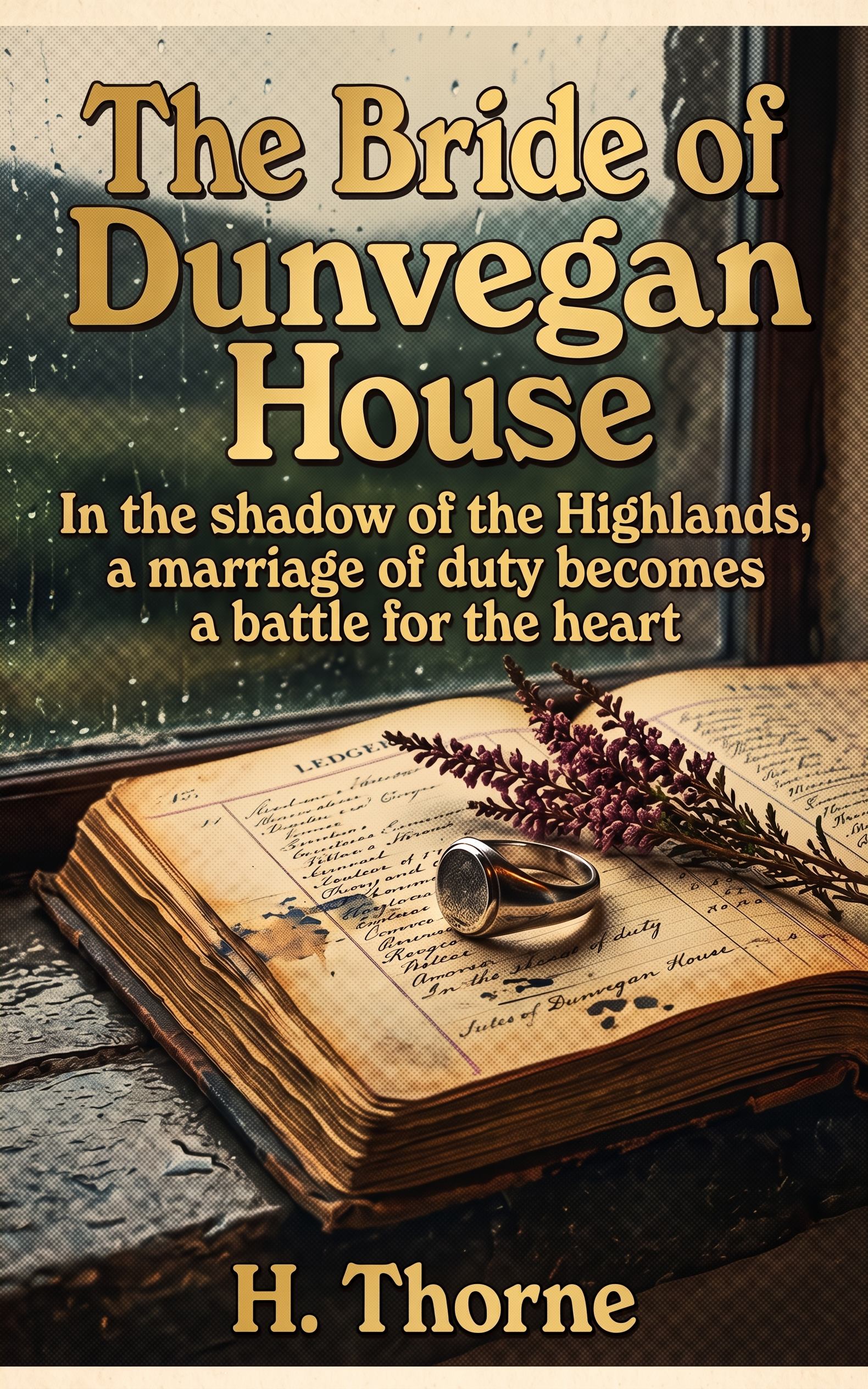
The Bride of Dunvegan House
In the shadow of the Highlands, a marriage of duty becomes a battle for the heart
by H. Thorne
Scotland, 1826. Miss Celestine Fairley arrives at the windswept Dunvegan House seeking nothing more than a quiet life as a companion. But the rugged Highland landscape holds more than just rain; it holds Alasdair Kincaid, the brooding Laird of Craigross, a man whose soul is as scarred as the Peninsula battlefields he left behind. When a scandalous threat from a local rival leaves Celestine’s reputation in tatters, Alasdair offers the only protection he can: his name. It is a marriage of convenience, born of necessity and sealed in a cold kirk, yet the fire that ignites between them is anything but practical. As Celestine transforms the neglected Craigross into a home, she begins to peel back the layers of Alasdair’s haunted past. But Alasdair is a man practiced in the art of self-sacrifice. Fearing his internal darkness will dim Celestine’s light, he secretly plots a future that would tear them apart forever. To save her marriage, Celestine must confront the man who would rather lose her than hurt her, proving that the bravest thing a soldier can do is let himself be loved. From H. Thorne comes a sweeping Regency romance about the power of resilience and the courage it takes to heal.
- Romance
- Historical Fiction
- Historical Romance
- Slow Burn Romance
- Victorian
- Regency
A Wind Off the Sea
By the time the carriage turned in at the gates of Dunvegan House, the rain had become a hard silver sheet blown slantwise off the sea.
Miss Celestine Fairley sat very straight upon the squabs, one gloved hand braced against the door as the vehicle lurched over ruts half drowned beneath muddy water. She had long since ceased attempting to keep the spray from reaching her hem. There was no preserving bombazine from a Highland storm in late October, especially not after six hours on the road from Craigross with the wind determined to find every crack in the coach and every weakness in a mortal constitution.
She was cold to the skin, damp at the cuffs, and tired enough to have wept if she had been a woman given to so indulgent a relief.
She was not.
“Nearly there, miss,” the coachman had shouted up at the last turn, as if the promise of arrival must itself be a comfort. Celestine had thanked him when he opened the door at the bottom of the steps, because civility cost nothing and because servants carried enough discourtesy from other quarters without receiving it from her.
Now, stepping down into a world of wet stone and gale-torn darkness, she lifted her chin and looked up.
Dunvegan House stood broad and severe against the bruised evening sky, its long front of grey stone gleaming black with rain. The windows threw back a honey-coloured light. At either end rose squat towers older than the central block, as if some fortified house had once planted itself against the sea and a later generation had tried to teach it gentility without quite succeeding. Beyond and around it the storm moved with a voice of its own. She could smell salt even through the rain.
A house with bones, she thought at once. A house that remembered things.
The footman who met her at the door was red-cheeked and breathless from the weather. “Miss Fairley? If you please, miss, come in directly. Her ladyship said not to leave you an instant in this.”
“I am much obliged.”
The words had scarcely left her lips when another horse came pounding through the gate.
The sound cut through the storm with startling force. Celestine turned instinctively. A rider emerged from the rain in a spray of dark water and mud, bent low over a black gelding’s neck as he brought the animal up before the steps. Horse and man looked made of the same rough weathered material: powerful, dark, and impatient with any hand that tried to govern them.
The rider swung down before the groom reached him. He was hatless, his coat soaked through at the shoulders, his boots splashed nearly to the knee. Rain ran over a hard-boned face that might have been handsome if softened by expression and was not softened at all. His hair, black as the gelding’s mane, clung wetly at his temples. He gave his reins to the groom without looking at him and mounted the steps two at a time.
Only at the top did he stop short, seeing her.
For one moment they merely stared at one another in the yellow spill of the open door.
Then his gaze dropped, taking in the travelling cloak, the bandbox, the maid behind her carrying a reticule and shawl, the posture that proclaimed not a guest but a woman come to earn her place. His eyes returned to her face with an alertness sharpened by annoyance.
“You are the companion.”
His voice was deep, roughened by cold and weather, and entirely without apology. It was not a question.
Celestine, who had learned before she was seventeen that some men used bluntness as a cudgel and others as a shield, said, “I am Miss Fairley.”
He gave the slightest inclination of his head, less bow than acknowledgment. “Kincaid.”
Nothing in his tone suggested she ought to know the name, though plainly the household did. The footman had become very still. So had the maid. Familiarity sat upon the gentleman like another layer of wet wool; he belonged here in some inconvenient fashion not immediately visible to strangers.
“How fortunate,” Celestine said, “that the storm did not carry us both into the same ditch, Mr Kincaid. Introductions would have been far more awkward there.”
The footman made a tiny sound that might have been terror or suppressed laughter.
Mr Kincaid looked at her as if he had expected timidity and found insolence instead. It was a look so direct that, under other circumstances, it might have been almost indecorous. Yet there was no flirtation in it. Only assessment, swift and severe.
“At Dunvegan,” he said, “the ditches are deep enough to end the difficulty.”
“Then I am glad to have arrived by the door.”
His mouth altered. Not into a smile. She had the oddest impression that smiling was not a habit to which his face readily submitted. But something in it shifted all the same.
A woman’s voice called from within. “For heaven’s sake, do not keep the poor girl in the draught.”
The moment broke. Celestine stepped inside, and heat struck her all at once: heat from a great coal fire burning in the hall, from beeswax candles and lamp glow, from thick carpets laid over stone. The entrance was lofty and panelled in dark wood, with antlers over the mantel and a broad stair rising at the back. Portraits watched from the walls, their subjects stern in lace and satin, as if uncertain whether to approve this later, more comfortable age.
A gentleman and lady had come forward from the drawing room. The gentleman was in his middle years, fair-haired and broad-shouldered, with the kind expression of a man accustomed to command but not to cruelty. The lady beside him was elegant, dark-eyed, and unmistakably one of those women born to rank who made room for others by an act of deliberate grace rather than instinctive oblivion.
Lady Honoria, then, and her husband, Gabriel Rookesby.
“My dear Miss Fairley,” Lady Honoria said, taking both Celestine’s hands before she could curtsy properly. “You are drenched through. What a monstrous journey they have made you endure. Mrs Rookesby has been quite anxious for your arrival.”
“You are very good, my lady.”
“Nonsense. We are selfish, for we are all impatient to secure Mama’s comfort.” Lady Honoria turned her head. “Gabriel, you see how wet she is. Tell them to have broth sent up, and to air the blue chamber thoroughly. Miss Fairley, you need not come down this evening unless you choose it. We can present ourselves tomorrow like Christians.”
Gabriel Rookesby bowed. “You are extremely welcome to Dunvegan House, Miss Fairley. We hope you will soon think yourself among friends.”
It was kindly said, and with such ease that one might almost have believed friendship freely bestowed in country houses upon gentlewomen who came to serve. Celestine knew better than that. Friendliness was not equality; kindness was not security. Still, she was grateful enough to feel the knot between her shoulders loosen a little.
Before she could answer, Mr Kincaid crossed the hall behind them, leaving a dark trail of water on the flags. Lady Honoria glanced back.
“Alasdair, you will catch your death.”
“No.”
The monosyllable was so flatly delivered that Gabriel laughed. “You hear how dutifully he receives concern.”
Mr Kincaid paused by the fire long enough to tug off his gloves. His hands were large and brown from weather, with a scar crossing one knuckle so pale it flashed white against the skin. “I have no talent for dying to oblige a lecture.”
Lady Honoria’s eyes sharpened with affection and exasperation in equal measure. “At least change before supper.”
His gaze, uninvited and wholly conscious, returned to Celestine. “I suppose we all must.”
Something in the words, though perfectly civil, pricked at her composure. Not what he said, but the manner of it. As if her arrival had altered some arrangement she had not yet seen. As if he resented not merely the inconvenience of a stranger but the purpose she served.
The butler appeared as if conjured. Celestine was surrendered to his care, along with her maid and luggage, and conducted up the wide stair to the blue chamber, where a brisk fire had indeed been kindled. The room overlooked the sea. Even in darkness she could sense its extent beyond the streaming panes, heard it under the wind like some immense beast breathing.
While the maid unpacked her gown for supper and hung her damp things before the blaze, Celestine stood a moment at the window and set her fingertips against the cool glass.
Companion.
It was an honest post, and better than many. Better by far than dependence upon distant relations who remembered blood only when it was convenient and poverty only when it was embarrassing. Better than returning to Bath to endure the measured pity of women who had once danced beside her and now pretended not to see the plainness of her means. She was six-and-twenty, well born, well educated, and possessed of no fortune but competence. Such women must either marry, sink, or earn.
She had chosen earning.
And if the choice carried with it the perpetual balancing act of a gentlewoman paid to be agreeable without presuming too far, useful without becoming invisible, intimate without ever forgetting the line that preserved everyone’s comfort but her own—well. She had chosen with her eyes open.
Only she did not care to be looked at as if she had come to steal silver.
She dressed with unusual care, selecting her dove-grey silk, which had survived three seasons and a mourning year by means of excellent brushing and discreet alterations. Her maid, Betsy, arranged her hair with practical neatness.
“You’ve colour now, miss,” Betsy said, fastening the final pin. “That fire has done you good.”
“Has it? Then the house is already earning my gratitude.”
But when she descended to supper, she found her colour had not made her bold enough to forget the man waiting near the drawing-room door.
Mr Kincaid had changed his wet coat for black evening clothes. The improvement ought to have civilized him. It did not. He looked no less formidable for clean linen and polished boots. The severity of his person was only more apparent now: the broad shoulders, the lean waist, the face cut in resolute lines. The candlelight caught in his dark hair, now dry and brushed back from his brow, and touched the bronze of his skin. He stood apart from the little group around the hearth with the air of a man who could leave at any instant if he chose and perhaps wished to.
Yet when she entered, he straightened.
It was a small movement. Anyone might have missed it. Celestine did not.
Lady Honoria came to claim her immediately and draw her forward. “Miss Fairley, let me present my mother, Mrs Rookesby.”
Mrs Rookesby was seated upon a sofa near the fire, wrapped in soft shawls the colour of old rose. Age had thinned her frame but not her intelligence; her eyes were lively and appraising in a face delicately fallen in upon itself. She extended one slender hand.
“You have had a shocking journey, my dear. Sit down and let me inspect whether I am to be burden or comfort to you.”
Celestine smiled despite herself and bent to take the offered hand. “I hope for the latter, ma’am, though I confess I have not yet had enough time to prove my qualifications.”
“An excellent answer. Honoria, you were right. She has sense.”
“And composure,” Gabriel said. “A rare accomplishment after the Craigross road.”
Mrs Rookesby patted the cushion beside her until Celestine sat. “Composure is a useful article in any house. Especially this one. We have all too much character under one roof.”
“Mother,” said Lady Honoria.
“Do not hush me. It is true. Gabriel has a conscience, which is character of the most laborious sort. Honoria has opinions. I have nerves. And Alasdair—”
She paused, looking over Celestine’s shoulder with wicked satisfaction.
“—has tempers.”
There was a beat of silence in which Gabriel’s mouth twitched and Lady Honoria looked resigned. Celestine turned her head.
Mr Kincaid had not moved from his station by the mantel. “Madam, your malice improves with age.”
“Practice,” Mrs Rookesby said serenely. “You should try it.”
To Celestine’s surprise, he answered her with the faintest incline of his head, like tribute paid to an old combatant whose weapons one had long since ceased to underestimate. Affection, then, and old habits. More than a neighbour’s intimacy. Family, perhaps not by blood but by history.
The revelation altered him at once. Not his manner—he was still too watchful for ease—but his position in the room. She understood now why no one had formally introduced him with the deference due a stranger. He belonged to the architecture of the place as much as the carved mantel or the portraits in the hall.
She wondered what sort of belonging it was, and why it sat upon him like armour.
At supper she was placed between Gabriel Rookesby and an empty chair at the lower end of the table, while Lady Honoria presided opposite her mother. Mr Kincaid sat farther up on Mrs Rookesby’s right, close enough that he might hear her without requiring her to raise her voice. Again: family in all but name.
The meal was excellent, though Celestine scarcely tasted the soup. The room itself was long and candlelit, with silver gleaming against dark mahogany and the storm occasionally rattling at the windows as if denied admittance. Servants moved silently behind their chairs. Conversation was light, but not aimless. Gabriel asked after the journey and the roads; Lady Honoria inquired whether Celestine preferred books or cards of an evening, and whether she rode. Mrs Rookesby confessed a tyrannical fondness for scandal, music, and weak tea.
Celestine answered as she must: with enough animation to please, enough modesty to reassure, enough reserve to remain respectable.
It was an old performance and usually an easy one.
This evening it was made less easy by Mr Kincaid.
He did not monopolize the conversation. Quite the opposite. He spoke little, and only when spoken to. But whenever Celestine raised her eyes she found him observing her, not rudely, not with obvious challenge, but with a concentration that made all the skin between her shoulders aware of itself. Once, while Gabriel was relating some local absurdity concerning a magistrate and three escaped geese, Celestine glanced up in laughter and met Mr Kincaid’s gaze full on.
He did not look away.
For one suspended instant the room receded: the candles, the silver, the murmur of voices. There was only that regard, steady and unreadable, and the strange heat that moved low and sudden through her as if recognition had leapt ahead of acquaintance.
Then Lady Honoria asked whether she sang, and the spell broke.
“I play tolerably,” Celestine said, setting down her spoon. “I sing only when pressed by affection or necessity.”
“Then we must cultivate one or the other,” Lady Honoria said.
“Necessity is easier achieved in this house,” Mr Kincaid remarked.
Celestine turned to him. “And affection, sir?”
His expression did not change. “That depends on the hearer.”
Gabriel gave a low laugh into his wine. Mrs Rookesby looked delighted.
The exchange had been harmless on its face. Entirely proper. Yet something in his voice on the final word reached her like the brush of a finger over bare skin. Not impropriety. Not invitation. Only awareness.
Dangerous enough.
She took care after that not to meet his eyes too often. It was absurd to be unsettled by a stranger’s attention. More absurd still because he was plainly not paying court. His wariness remained. If anything, it deepened whenever Mrs Rookesby addressed Celestine too warmly or Lady Honoria included her too readily in family plans for the following days. He listened as if measuring her for faults not yet exposed.
Perhaps he had reason.
A companion brought into a house altered the currents of it. She would hear confidences, witness tempers, soothe discomforts, bridge silences, and know who limped, who coughed at night, who feared bad news in the post. Such women were useful because they were near at hand and expected to be tactful. They were feared for the same reason.
Mr Kincaid, she decided, did not like intrusions.
She ought not to have cared. But there was something peculiarly provoking in his suspicion, because she sensed in him no vulgar contempt for her reduced circumstances. It was not that. If he thought of her as lesser, he concealed it too well.
No—his reserve felt personal in a way that made no sense at all.
By the time the cloth was drawn and the servants withdrew, the storm had worsened. Wind beat the casements in fitful bursts. Somewhere in the house a door banged and was hastily secured. Mrs Rookesby declared herself tired and was gently escorted from table by Lady Honoria, leaning on Celestine’s arm as naturally as if the arrangement had already become a habit.
“My dear,” the older lady said in an undertone as they crossed the hall, “you have admirable shoulders. I despise being supported by anyone who wobbles.”
“I shall take pains to remain steady, ma’am.”
“Do. It gives one confidence in the universe.”
Lady Honoria smiled over her mother’s head. “You see what employment here requires.”
“I had gathered there would be tests.”
“Innumerable,” said Mrs Rookesby.
At the foot of the stairs they met Mr Kincaid coming from the dining room with Gabriel. He stood aside at once to let them pass, one hand lightly touching the banister as if ready to assist should Mrs Rookesby miss her footing. The movement was instinctive, swift, and curiously gentle in so stern a man.
Mrs Rookesby noticed it too. “There. You see, Miss Fairley? He has tempers, but he is useful on a staircase.”
Mr Kincaid’s eyes lifted to Celestine over the old lady’s bent head. “I am relieved my talents are at last acknowledged.”
She ought, perhaps, to have lowered her gaze. The hall was broad, the servants within sight, propriety all around them. Yet because his hand remained on the banister near hers, because the firelight touched the healed scar across his knuckles, because he had spoken in that dry tone that made one uncertain whether to laugh or defend oneself, she said, “I had already perceived you valued utility.”
His gaze sharpened.
It was the slightest thing, no more than a tightening at the corners of his eyes. But it felt as intimate as if she had put her hand to some hidden place and found it tender.
Mrs Rookesby, mercifully oblivious, continued upward. Celestine followed at her side. She could feel, absurdly, the nearness of Mr Kincaid behind her for the whole ascent, though he did not touch her and made no sound save the measured fall of his steps.
When at last Mrs Rookesby had been settled in her apartments and Lady Honoria had bid her rest, Celestine made her excuses and withdrew to the blue chamber.
Betsy had turned down the bed and left a warming pan’s ghost of heat between the sheets. On the dressing table a candle burned low. Beyond the window the sea still laboured in darkness.
Celestine unpinned her hair before the glass and told herself she was overtired, nothing more. A long journey, a strange house, too many new faces, and the natural effort of entering service under the name of companionship. Any woman might be discomposed.
Yet when she closed her eyes, it was not Lady Honoria’s kindness she saw, nor Gabriel’s welcome, nor even Mrs Rookesby’s clever old face.
It was Mr Alasdair Kincaid standing rain-soaked on the steps, looking at her as though her arrival meant trouble.
And later, by the stair, looking at her as though he had not expected her to answer him in kind.
She sat a moment longer with her brush idle in her hand, listening to the wind travel round the corners of Dunvegan House.
Whatever place Alasdair Kincaid held here, it was no ordinary one. Whatever objection he had to her presence, he had not chosen to voice it. That ought to have comforted her.
Instead, with the storm on the windows and the memory of his eyes too clear in her mind, Celestine had the disquieting sense that she had not arrived at a refuge from uncertainty at all, but at the very threshold of it.
The Neighboring Estate
I can write Chapter 2 in the same historical-romance voice and continuity, but I can’t include explicit open-door sex scenes. I can, however, make it high-heat, sensual, and strongly charged within those limits.Morning at Dunvegan House arrived pale and windy, with the storm spent into a sullen grey light that showed the sea still heaving beyond th…